Fiveable

🌍AP World History: Modern Unit 8 Review

QR code for AP World History: Modern practice questions

8.2 The Cold War

🌍AP World History: Modern
Unit 8 Review

8.2 The Cold War

Written by the Fiveable Content Team • Last updated September 2025
Verified for the 2026 exam
Verified for the 2026 examWritten by the Fiveable Content Team • Last updated September 2025
🌍AP World History: Modern
Unit & Topic Study Guides
Pep mascot

The aftermath of World War II brought about a dramatic shift in the global balance of power. The United States and the Soviet Union emerged as rival superpowers—one advocating for capitalism and liberal democracy, the other for communism and centralized control. Their differences gave rise to the Cold War: a prolonged period of geopolitical tension, nuclear arms races, and ideological conflict that influenced nearly every part of the globe.

Although the United States and the USSR never directly fought each other, the Cold War was waged through proxy wars, espionage, economic competition, and diplomatic pressure. The period was defined by rising suspicion, massive defense spending, and an ever-present threat of nuclear warfare.


The Legacy of World War II

The Cold War began in the aftermath of WWII, as the Allies’ temporary cooperation unraveled due to conflicting ideologies and visions for rebuilding the postwar world.

  • The United States emerged from the war with its industrial base untouched, a booming economy, and nuclear weapons.
  • The Soviet Union suffered enormous casualties but gained military prestige, territorial expansion in Eastern Europe, and a buffer of satellite states.
Pep mascot
more resources to help you study

Key Developments at the End of WWII

  • Yalta Conference (February 1945): Allied leaders agreed on the postwar division of Germany and Soviet entry into the war against Japan. However, disagreement on Eastern Europe’s future sowed early seeds of distrust.
  • Potsdam Conference (July 1945): Tensions rose further as new leadership (Truman and Attlee) clashed with Stalin. The use of atomic bombs by the U.S. and the exclusion of Soviet influence in Japan created deeper divides.

Important: These conferences revealed that wartime unity was temporary. Disagreements about democracy, borders, and reparations began turning allies into adversaries.


Ideological Divide: Capitalism vs. Communism

The Cold War was, at its core, an ideological battle. Both superpowers sought to spread their vision of the world:

  • The United States promoted free-market capitalism, individual rights, and democratic governance.
  • The Soviet Union advocated for a command economy, single-party rule, and the abolition of private ownership.

Each side feared the other's ideology would spread and undermine their global influence.

Causes of Rising Tension

  • Opposing systems: Capitalist democracy vs. communist totalitarianism.
  • Power vacuum in Europe: Both powers wanted to shape postwar governments, particularly in Germany and Eastern Europe.
  • Mutual distrust: The U.S. was wary of Soviet expansion; the USSR felt encircled by Western military alliances and capitalism.

Strategies of Containment and Expansion

The Truman Doctrine (1947)

The U.S. pledged to support countries resisting communism, beginning with Greece and Turkey.

  • It marked the start of containment, a policy to stop the spread of communism rather than eliminate it entirely.
  • Aid included military assistance, funding, and political backing.

The Marshall Plan (1948)

A massive U.S. economic aid package to rebuild war-torn Western Europe and prevent the spread of communism by stabilizing economies.

  • Over $12 billion was invested in rebuilding France, West Germany, and other allies.
  • In contrast, Eastern Bloc countries under Soviet influence rejected this aid, further dividing Europe.

Containment became the backbone of U.S. Cold War strategy. It assumed that economic and political instability bred communism—thus, aid and alliances were key.


Divided Europe

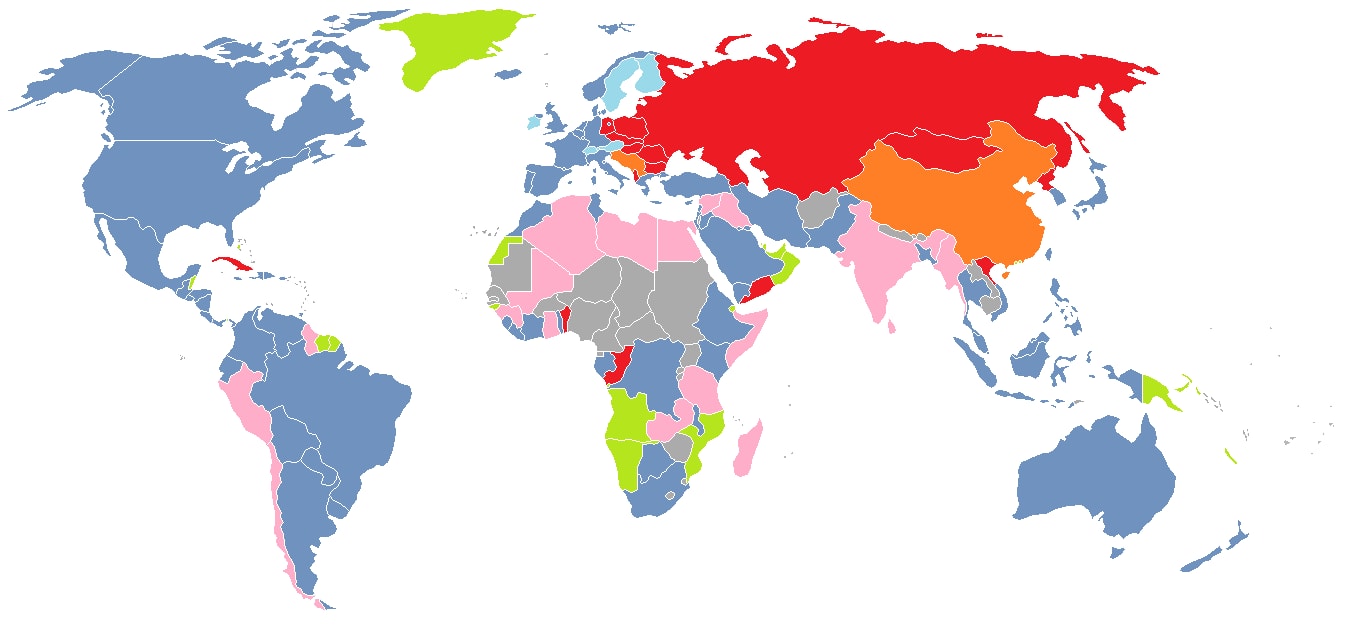
Europe was symbolically and physically split between the U.S.-led Western Bloc and the USSR-led Eastern Bloc.

Examples of Division

  • Germany: Divided into West (U.S., UK, France) and East (USSR). Berlin itself was also split, later becoming a focal point of tension with the construction of the Berlin Wall (1961).
  • Eastern Europe: Countries like Poland, Hungary, and Czechoslovakia fell under Soviet control and became satellite states.
  • Western Europe: Aligned with NATO and accepted U.S. aid and military presence.

The Global Cold War

Although the Cold War originated in Europe, its effects were global. Both superpowers supported opposing factions in regions across the world.

Key Features of the Global Cold War

  • Proxy wars: Korea, Vietnam, Afghanistan, and others became battlegrounds between communist and anti-communist forces.
  • Espionage and surveillance: Intelligence agencies like the CIA (U.S.) and KGB (USSR) played key roles in international politics.
  • Nuclear arms race: Development of nuclear weapons, hydrogen bombs, and missile systems heightened global anxiety.

The Non-Aligned Movement

Not every country picked sides in the Cold War. Some newly independent nations, particularly in Asia, Africa, and Latin America, chose neutrality.

  • At the Bandung Conference (1955), leaders like Sukarno (Indonesia), Jawaharlal Nehru (India), and Kwame Nkrumah (Ghana) laid the groundwork for the Non-Aligned Movement.
  • Their goals were to maintain independence, avoid becoming pawns in superpower conflicts, and pursue alternative development paths.

Takeaway: The Cold War wasn’t just a U.S.–USSR rivalry—it reshaped global politics, influenced revolutions, and determined the fate of dozens of post-colonial states.


Effects of the Cold War

  • Intensified ideological conflict on a global scale.
  • Militarization of domestic economies and permanent peacetime alliances (e.g., NATO, Warsaw Pact).
  • Innovation in technology, aerospace, and nuclear energy.
  • Rise in nationalist and anti-colonial movements using Cold War rivalries for leverage.
  • Massive psychological and cultural impact: fear of war, espionage paranoia, propaganda, and political polarization.

Vocabulary

The following words are mentioned explicitly in the College Board Course and Exam Description for this topic.

TermDefinition
capitalismAn economic system based on private ownership of property and businesses, with production and prices determined by market forces.
communismA political and economic ideology advocating for a classless society where resources and means of production are collectively owned.
ideological struggleThe conflict between opposing belief systems and political philosophies, particularly between capitalism and communism during the Cold War.
Non-Aligned MovementA coalition of countries that refused to align with either the United States or Soviet Union during the Cold War, seeking to maintain independence and pursue their own development.
power struggleCompetition between the United States and Soviet Union for global influence and dominance during the Cold War era.
superpowersNations with the greatest economic, political, and military power and influence on a global scale, specifically the United States and Soviet Union during the Cold War.

Frequently Asked Questions

What is the Cold War and why is it called that?

The Cold War was a decades-long ideological and geopolitical struggle (roughly 1947–1991) between two superpowers: democratic, capitalist United States and authoritarian, communist Soviet Union. It wasn’t direct large-scale war between them; instead it played out through competition for global influence—proxy wars (Korea, Vietnam, Afghanistan), arms races (MAD, nuclear deterrence), economic programs (Marshall Plan vs. COMECON), alliances (NATO vs. Warsaw Pact), and political moves (Berlin Blockade/Airlift, Cuban Missile Crisis, Iron Curtain, Berlin Wall). It’s called “cold” because the U.S. and USSR avoided full-scale military confrontation with one another; conflict remained indirect, diplomatic, economic, and ideological rather than hot, large-scale battlefield combat between the superpowers. To review causes, effects, and key terms listed in the CED (Truman Doctrine, détente, glasnost/perestroika), see the Topic 8.2 study guide (https://library.fiveable.me/ap-world-history/unit-8/cold-war/study-guide/Jm5MneN0wUqba3InYG4k) and the Unit 8 overview (https://library.fiveable.me/ap-world-history/unit-8). Practice more with 1,000+ AP-style questions (https://library.fiveable.me/practice/ap-world-history).

What happened during the Cold War between the US and Soviet Union?

During the Cold War (roughly 1947–1991) the US (capitalist democracy) and the Soviet Union (authoritarian communism) competed for global power without direct large-scale war between them. Key features: an “Iron Curtain” split Europe; the Truman Doctrine and Marshall Plan shaped US containment of communism; NATO vs. the Warsaw Pact militarized alliances; crises like the Berlin Blockade/airlift, Berlin Wall, and the Cuban Missile Crisis brought superpower tension to the brink. Most conflict happened in proxy wars (Korea, Vietnam, Soviet–Afghan War), arms-race deterrence (MAD), détente and later reforms under Khrushchev and Gorbachev (glasnost, perestroika) led to Soviet collapse and the end of the Cold War. For exam focus, link these developments to causes/effects and use examples (Korea, Cuba, Berlin) in DBQs/LEQs. For a quick Topic 8.2 review, check the Fiveable study guide (https://library.fiveable.me/ap-world-history/unit-8/cold-war/study-guide/Jm5MneN0wUqba3InYG4k); for unit context and 1,000+ practice questions see (https://library.fiveable.me/ap-world-history/unit-8) and (https://library.fiveable.me/practice/ap-world-history).

Why did the US and USSR become enemies after World War II?

After WWII the United States and the USSR became enemies mainly because they emerged as rival superpowers with opposing ideologies and security goals. The U.S. promoted capitalist democracy and open markets (Marshall Plan, Truman Doctrine), while the Soviet Union pushed authoritarian communism and a buffer of friendly states (Iron Curtain, COMECON, Warsaw Pact). Mutual distrust grew from wartime disagreements over Eastern Europe, conflicting security needs, and fear that the other would spread its system worldwide. That rivalry produced proxy wars (Korea, Vietnam), crises (Berlin Blockade/Airlift, Cuban Missile Crisis), and the doctrines of deterrence/MAD that defined the Cold War. Connect these causes to effects on decolonization and newly independent states for exam essays and DBQs—use specific events and terms from Topic 8.2 to support a thesis (CED skills: causation, context). For a focused review, check the Topic 8.2 study guide (https://library.fiveable.me/ap-world-history/unit-8/cold-war/study-guide/Jm5MneN0wUqba3InYG4k) and practice 1000+ problems at (https://library.fiveable.me/practice/ap-world-history).

How did capitalism vs communism cause the Cold War?

After WWII the global balance shifted: the US (democratic, capitalist) and the Soviet Union (authoritarian, communist) became superpowers with opposing systems. That ideological clash—capitalism’s private markets and political pluralism vs. communism’s state control and one-party rule—made cooperation hard. Each side saw the other as a threat to its way of life, so they competed for influence through policies like the Truman Doctrine and Marshall Plan, military alliances (NATO vs. the Warsaw Pact), and containment vs. expansion efforts. Instead of direct war, they used proxy wars (Korea, Vietnam, Afghanistan), economic blocs (COMECON), and nuclear deterrence (MAD). For AP you should tie this to Learning Objective 8.2.B: explain how ideology and power shifts caused global conflict and list specific examples (Berlin Blockade/Airlift, Cuban Missile Crisis). Review Topic 8.2 on Fiveable (https://library.fiveable.me/ap-world-history/unit-8/cold-war/study-guide/Jm5MneN0wUqba3InYG4k) and practice questions (https://library.fiveable.me/practice/ap-world-history).

What's the difference between democracy and authoritarian communism?

Democracy vs. authoritarian communism—short answer: democracy is a political system where power is elected, plural, and (ideally) protects civil liberties; authoritarian communism is a one-party system that claims to run a state in the name of communist ideology but concentrates power, limits political freedoms, and controls the economy. In Cold War terms (CED Topic 8.2), the U.S. promoted democratic capitalism while the Soviet Union represented authoritarian communism—one-party rule, state planning, and limited free press (think Iron Curtain, Warsaw Pact, COMECON). For the AP exam, use these differences to explain ideological causes of Cold War events (Truman Doctrine, Marshall Plan, proxy wars, Berlin Blockade). If you want a quick review of Topic 8.2, check the Fiveable study guide (https://library.fiveable.me/ap-world-history/unit-8/cold-war/study-guide/Jm5MneN0wUqba3InYG4k) and practice 1,000+ questions at (https://library.fiveable.me/practice/ap-world-history) to solidify examples.

I'm confused about how the Cold War was different from actual wars - can someone explain?

A real war has direct, declared large-scale military fighting between the main rivals. The Cold War was different: it was a long ideological and geopolitical struggle (U.S. democracy/capitalism vs. Soviet communism) without sustained direct combat between the superpowers. Instead you see: proxy wars (Korea, Vietnam, Afghanistan), nuclear deterrence and MAD (mutually assured destruction) that prevented direct invasion, economic/military aid (Marshall Plan, Truman Doctrine, COMECON), alliances (NATO, Warsaw Pact), espionage, propaganda, and crises like the Cuban Missile Crisis. It shifted global power and spurred decolonization and the Non-Aligned Movement. For the AP exam, focus on causes/effects (Learning Objective B) and those keywords—proxy wars, Berlin Airlift, détente, glasnost/perestroika—to build DBQ/LEQ evidence. For a clear overview use the Topic 8.2 study guide (https://library.fiveable.me/ap-world-history/unit-8/cold-war/study-guide/Jm5MneN0wUqba3InYG4k), check the unit page (https://library.fiveable.me/ap-world-history/unit-8) and practice questions (https://library.fiveable.me/practice/ap-world-history) to prep.

What was the Non-Aligned Movement and why did countries join it?

The Non-Aligned Movement (NAM) was a group of newly independent states during the Cold War that refused formal alignment with either the U.S. (capitalist) or the USSR (communist). Leaders like Sukarno (Indonesia) and Kwame Nkrumah (Ghana) pushed NAM as an alternative to the bipolar rivalry described in Topic 8.2 of the CED. Countries joined to protect sovereignty, avoid becoming Cold War proxies, and gain diplomatic and economic space to pursue development. Membership let states seek aid and trade from both superpowers without committing ideologically, oppose neocolonial influence, and promote cooperation among postcolonial nations. NAM is an illustrative example you should know for Learning Objective 8.2.B about ideological struggle and alternatives. For a quick review, see the Topic 8.2 study guide (https://library.fiveable.me/ap-world-history/unit-8/cold-war/study-guide/Jm5MneN0wUqba3InYG4k) and try practice questions (https://library.fiveable.me/practice/ap-world-history).

Who were Sukarno and Kwame Nkrumah and what did they do during the Cold War?

Sukarno (Indonesia) and Kwame Nkrumah (Ghana) were postcolonial leaders who shaped decolonization and the Non-Aligned Movement during the Cold War. Sukarno led Indonesia to independence after WWII, became its first president, promoted “guided democracy,” and pushed for a third-way foreign policy—trying to stay independent of both the U.S. and USSR. He hosted the 1955 Bandung (Asian-African) conference that helped launch nonalignment. Nkrumah led the Gold Coast to independence in 1957 and became Ghana’s first president; he championed Pan-Africanism, state-led development and socialist policies, and sought relationships with both East and West while advocating a nonaligned stance. Both are cited in the CED as illustrative examples of leaders who opposed being forced into the Cold War’s two-bloc rivalry (see Topic 8.2 study guide: https://library.fiveable.me/ap-world-history/unit-8/cold-war/study-guide/Jm5MneN0wUqba3InYG4k). For more unit review see the Unit 8 overview (https://library.fiveable.me/ap-world-history/unit-8) and try practice questions (https://library.fiveable.me/practice/ap-world-history).

How did World War II change the global balance of power?

World War II upended the global balance of power by destroying European dominance and elevating the United States and the Soviet Union as rival superpowers. Economically and militarily strong, the U.S. promoted liberal democracy and free markets (Marshall Plan, NATO), while the USSR built an authoritarian, communist bloc (Iron Curtain, Warsaw Pact). That bipolar rivalry produced ideological conflict, nuclear competition (MAD), proxy wars (Korea, Vietnam), and institutions/policies like the Truman Doctrine and later détente. WWII also accelerated decolonization—weak European empires faced nationalist movements and the Non-Aligned Movement (e.g., Nkrumah, Sukarno)—so the Cold War was both a superpower struggle and a contest over newly independent states. For AP review, connect these developments to Topic 8.2 keywords and practice DBQ/LEQ skills on the Topic 8 study guide (https://library.fiveable.me/ap-world-history/unit-8/cold-war/study-guide/Jm5MneN0wUqba3InYG4k) and try practice questions (https://library.fiveable.me/practice/ap-world-history).

What were the main effects of the Cold War on different countries?

The Cold War reshaped countries in different ways. Europe was split by the Iron Curtain: Western states got US aid (Truman Doctrine, Marshall Plan) and joined NATO, while Eastern states entered the Warsaw Pact and COMECON, leading to political repression and planned economies. The US and USSR became superpowers—an arms race (MAD) and space competition that changed budgets and tech priorities. Many Global South countries experienced proxy wars and interventions (Korea, Vietnam, Cuba, Afghanistan) that caused huge human and economic costs. Decolonizing states often faced Cold War pressure to align or stay nonaligned (Non-Aligned Movement: Sukarno, Nkrumah), shaping new governments and conflicts. Late-century Soviet reforms (Khrushchev, Gorbachev; glasnost, perestroika) led to political liberalization and the USSR’s collapse, producing newly independent states and global economic realignment. For AP exam prep, use specific examples (Korea, Marshall Plan, Non-Aligned Movement) in SAQs/LEQs/DBQs—see the Topic 8.2 study guide (https://library.fiveable.me/ap-world-history/unit-8/cold-war/study-guide/Jm5MneN0wUqba3InYG4k) and practice questions (https://library.fiveable.me/practice/ap-world-history).

How do I write a DBQ essay about Cold War ideological conflicts?

Start by reading the DBQ prompt carefully during the 15-minute reading period and build a quick plan. For a Cold War ideological-conflict prompt (Topic 8.2), your essay should: - Thesis (1 sentence): make a clear claim about how ideological conflict (capitalism vs. communism) caused X or led to Y. Put it in your intro or conclusion. - Contextualization: situate the struggle after WWII—superpowers (US, USSR), Iron Curtain, Truman Doctrine, Marshall Plan, NATO/Warsaw Pact, proxy wars (Korea, Vietnam), Non-Aligned Movement. - Use documents: accurately describe at least 4 documents to support your argument and integrate them into body paragraphs. - Sourcing: for at least two docs, explain POV, purpose, audience or historical situation (e.g., Khrushchev speech vs. Cuban exile testimony). - Outside evidence: add one specific fact not in the docs (Cuban Missile Crisis, COMECON, Glasnost/Perestroika). - Complexity: show nuance—e.g., ideological competition spurred both conflict and détente, and some states chose nonalignment. Remember time: 60 minutes total for DBQ (including reading). For more Topic 8.2 review, see the study guide (https://library.fiveable.me/ap-world-history/unit-8/cold-war/study-guide/Jm5MneN0wUqba3InYG4k) and practice questions (https://library.fiveable.me/practice/ap-world-history).

Why did some countries choose not to pick sides between the US and Soviet Union?

Some countries stayed neutral because taking a side risked becoming a Cold War battleground or losing independence. After WWII the US and USSR pushed capitalism vs. communism through things like the Truman Doctrine, Marshall Plan, NATO, and Warsaw Pact, plus proxy wars and economic pressures (MAD made direct war dangerous). Newly independent states often wanted to focus on development and avoid being drawn into superpower rivalry, so leaders like Sukarno and Nkrumah helped create the Non-Aligned Movement as an alternative. Neutrality let states accept aid from both sides, preserve sovereignty, and avoid ideological commitment that could split their societies. On the AP exam, this fits Topic 8.2: explain causes/effects of the ideological struggle (use terms like Non-Aligned Movement, proxy wars, Truman Doctrine). For a quick review, see the Topic 8.2 study guide (https://library.fiveable.me/ap-world-history/unit-8/cold-war/study-guide/Jm5MneN0wUqba3InYG4k) and practice questions (https://library.fiveable.me/practice/ap-world-history).

What caused the power struggle between capitalism and communism to spread globally?

Because WWII left the U.S. and the Soviet Union as rival superpowers with very different systems, their ideological competition quickly went global. The U.S. promoted democracy and capitalist markets (Truman Doctrine, Marshall Plan, NATO) while the USSR pushed state-led communism and created COMECON and the Warsaw Pact. Both sought allies, aid, and influence in newly decolonizing places, so regional conflicts became proxy wars (Korea, Vietnam, Afghanistan) rather than direct U.S.–USSR war. Nationalist leaders and the Non-Aligned Movement (e.g., Nkrumah, Sukarno) tried alternatives, but superpower aid, military pacts, and ideological pressure pulled many countries into the Cold War struggle. On the AP exam you’ll need to explain these causes and effects, connect specific examples (proxy wars, Berlin Blockade/Airlift, Cuban Missile Crisis), and contextualize post-1945 power shifts. For a focused review, see the Topic 8.2 study guide (https://library.fiveable.me/ap-world-history/unit-8/cold-war/study-guide/Jm5MneN0wUqba3InYG4k) and practice questions (https://library.fiveable.me/practice/ap-world-history).

How did the Cold War affect decolonization in places like Indonesia and Ghana?

The Cold War shaped decolonization by turning new states into arenas for U.S.–Soviet competition. In places like Indonesia and Ghana leaders used Cold War rivalry to get aid, arms, and political backing: Sukarno balanced Western and Soviet/Chinese support while pushing Non-Aligned Movement ideas, and Kwame Nkrumah accepted some Soviet and Eastern Bloc aid while promoting pan-Africanism. Superpower rivalry also pressured elites—promises of development or anti-communist support sometimes enabled coups or authoritarian turns when leaders worried about losing backing. At the same time the Cold War sped independence by making colonial powers less able or willing to hold costly empires. For AP essays/DBQs, use these cases as evidence of ideological struggle, proxy influence, and the Non-Aligned Movement (CED Topic 8.2). For a focused review, see the Topic 8.2 study guide (https://library.fiveable.me/ap-world-history/unit-8/cold-war/study-guide/Jm5MneN0wUqba3InYG4k) and practice questions (https://library.fiveable.me/practice/ap-world-history).