AMSCO 5.1 The Enlightment Notes

🌍AP World History: Modern Review
AMSCO 5.1 The Enlightment Notes
🌍 AP World History: Modern
AMSCO 1.1 Developments in East Asia Notes
AMSCO 1.2 Developments in Dar al-Islam Notes
AMSCO 1.3 Developments in South and Southeast Asia Notes
AMSCO 1.4 Developments in the Americas Notes
AMSCO 1.5 Developments in Africa Notes
AMSCO 1.6 Developments in Europe Notes
AMSCO 1.7 Comparison in the Period from c.1200 to c.1450 Notes
AMSCO 2.1 The Silk Roads Notes
AMSCO 2.2 The Mongol Empire and the Modern World Notes
AMSCO 2.3 Exchange in the Indian Ocean Notes
AMSCO 2.4 Trans-Saharan Trade Routes Notes
AMSCO 2.5 Cultural Consequences of Connectivity Notes
AMSCO 2.6 Environmental Consequences of Connectivity Notes
AMSCO 2.7 Comparison of Economic Exchange Notes
AMSCO 3.1 European, East Asian, and Gunpowder Empires Expand Notes
AMSCO 3.2 Empires: Administrations Notes
AMSCO 3.3 Empires: Belief Systems Notes
AMSCO 3.4 Comparison in Land-Based Empires Notes
AMSCO 4.1 Technological Innovations Notes
AMSCO 4.2 Exploration: Causes and Events Notes
AMSCO 4.3 Columbian Exchange Notes
AMSCO 4.4 Maritime Empires Link Regions Notes
AMSCO 4.5 Maritime Empires Develop Notes
AMSCO 4.6 Internal and External Challenges to State Power Notes
AMSCO 4.7 Changing Social Hierarchies Notes
AMSCO 4.8 Continuity and Change from c.1450 to c.1750 Notes
AMSCO 5.1 The Enlightment Notes
AMSCO 5.2 Nationalism and Revolutions Notes
AMSCO 5.3 Industrial Revolution Begins Notes
AMSCO 5.4 Industrialization Spreads Notes
AMSCO 5.5 Technology in the Industrial Age Notes
AMSCO 5.6 Industrialization: Government's Role Notes
AMSCO 5.7 Economic Developments and Innovations Notes
AMSCO 5.8 Reactions to the Industrial Economy Notes
AMSCO 5.9 Society and the Industrial Age Notes
AMSCO 5.10 Continuity and Change in the Industrial Age Notes
AMSCO 6.1 Rationales for Imperialism Notes
AMSCO 6.2 State Expansion Notes
AMSCO 6.3 Indigenous Responses to State Expansion Notes
AMSCO 6.4 Global Economic Development Notes
AMSCO 6.5 Economic Imperialism Notes
AMSCO 6.6 Causes of Migration in an Interconnected World Notes
AMSCO 6.7 Effects of Migration Notes
AMSCO 6.8 Causation in the Imperial Age Notes
AMSCO 7.1 Shifting Power Notes
AMSCO 7.2 Causes of World War I Notes
AMSCO 7.3 Conducting World War I Notes
AMSCO 7.4 Economy in the Interwar Period Notes
AMSCO 7.5 Unresolved Tensions After World War I Notes
AMSCO 7.6 Causes of World War II Notes
AMSCO 7.7 Conducting World War II Notes
AMSCO 7.8 Mass Atrocities Notes
AMSCO 7.9 Causation in Global Conflict Notes
AMSCO 8.1 Setting the Stage for the Cold War and Decolonization Notes
AMSCO 8.2 The Cold War Notes
AMSCO 8.3 Effects of the Cold War Notes
AMSCO 8.4 Spread of Communism Notes
AMSCO 8.5 Decolonization after 1900 Notes
AMSCO 8.6 Newly Independent States Notes
AMSCO 8.7 Global Resistance to Established Power Structure Notes
AMSCO 8.8 End of the Cold War Notes
AMSCO 8.9 Causation in the Age of the Cold Ward and Decolonization Notes
AMSCO 9.1 Advances in Technology and Exchange Notes
AMSCO 9.2 Technological Advancements and Limitations Notes
AMSCO 9.3 Technology and the Environment Notes
AMSCO 9.4 Economics in the Global Age Notes
AMSCO 9.5 Calls for Reforms and Responses Notes
AMSCO 9.6 Globalized Culture Notes
AMSCO 9.7 Resistance to Globalization Notes
AMSCO 9.8 Institutions Developing in a Globalized World Notes
AMSCO 9.9 Continuity and Change in a Globalized World Notes
Overview
AMSCO Topic 5.1, The Enlightenment, covers the intellectual revolution of the 17th and 18th centuries that set up every political revolution in AP World Unit 5 (1750-1900). These notes summarize AMSCO pages 275-284, which trace how thinkers like Locke, Montesquieu, Voltaire, Rousseau, and Adam Smith pushed reason over tradition and individualism over community values, and how those ideas later fueled reform movements like feminism, abolitionism, and Zionism. The big takeaway: Enlightenment ideas about natural rights and the social contract challenged monarchs and church authority, planting the seeds of revolution in America, France, and beyond.
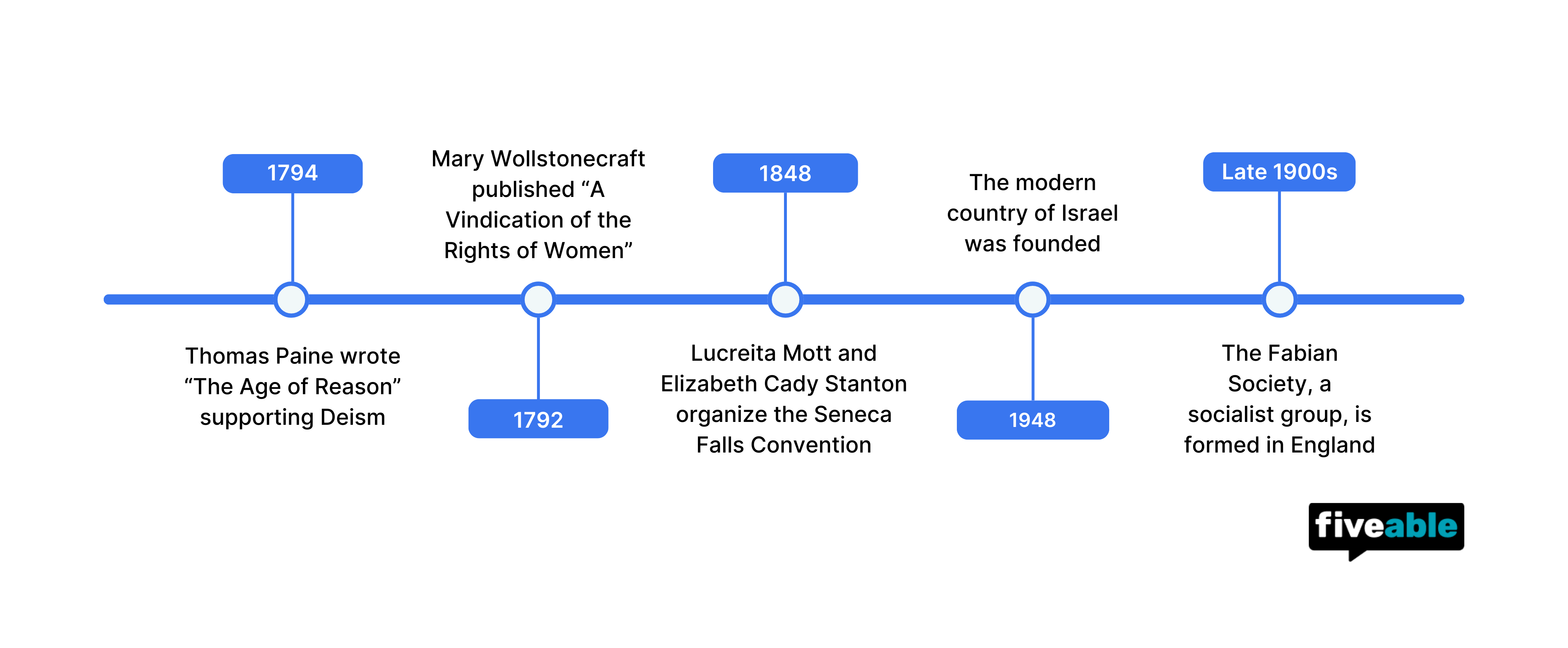
Timeline of key events in the Enlightenment Era. Image courtesy of Naomi Ling.
Key Takeaways
- The Enlightenment drew on the Scientific Revolution and Renaissance humanism, while nationalism challenged Europe's multiethnic empires.
- Bacon favored knowledge gained through observation; Hobbes argued for strong government to maintain order, while Locke defended the right to revolt against unjust government.
- Montesquieu influenced American separation of powers, Rousseau argued rulers must follow the General Will, and Adam Smith called for less government intervention in economic decisions.
- Utopian socialists proposed ideal communities, while classical liberals backed natural rights, constitutional government, and British reforms that expanded male suffrage.
- Feminists argued for women's education and political participation, while abolitionists sought to end the Atlantic slave trade and free enslaved people; trade bans came first.
- Serfdom declined as economies industrialized and peasant revolts pushed reform; anti-Semitism and the Dreyfus Affair helped build support for Herzl's movement for a Jewish homeland.
An Age of New Ideas
The Enlightenment grew out of the Scientific Revolution and Renaissance humanism, and its defining mood was optimism. If natural laws governed the physical world, thinkers reasoned, then natural laws must govern society and politics too. Apply reason to those laws, and you get progress.
- Enlightenment writers did not deny God's existence, but they emphasized human accomplishment in understanding nature. Traditional religion didn't vanish; it just became less pervasive.
- So many new schools of thought emerged (socialism, liberalism, conservatism) that the era earned the nickname "the Age of Isms."
- Conservatism, popular among Europe's ruling class, pushed back against socialism and liberalism by defending traditional institutions and practical experience over theories like human perfectability.
- The clash between new ideas and old political structures produced revolutions with two common aims: independence from imperial powers and constitutional representation.
- Nationalism, intense loyalty to people who share your language and culture, became a wrecking ball aimed at Europe's multiethnic empires. If every culture deserves its own nation-state, empires like Austria-Hungary and the Ottomans are in trouble. That thread continues in AMSCO 5.2 Nationalism and Revolutions.
New Ideas and Their Roots
The chapter's core argument is that Enlightenment political thought was built on empiricism, the idea that knowledge comes from observed experience rather than tradition or religious authority. Francis Bacon championed this approach in the 17th century, basing conclusions on observed natural data instead of inherited principles.
Hobbes and Locke on the social contract
Both philosophers saw political life as a social contract, but they drew opposite conclusions.
- Thomas Hobbes (Leviathan, 1651) argued life in the natural state was "nasty, brutish, and short," so people give up some rights to a strong central government in exchange for law and order.
- John Locke (Two Treatises of Government, 1690) flipped it: the social contract gives citizens the right, even the responsibility, to revolt against unjust government. People have natural rights to life, liberty, and property.
- Locke's An Essay Concerning Human Understanding (1690) proposed that a child is born a tabula rasa, a "blank slate" filled by experience. In a world that believed ancestry determined your intelligence and fate, saying environment and education shape people was radical.
The philosophes
In the 18th century, the philosophes (from the French for "philosopher") popularized and extended these ideas. The group included Thomas Jefferson and Benjamin Franklin in America, Adam Smith in Scotland, and several French thinkers.
- Baron Montesquieu's The Spirit of Laws (1748) praised Britain's checks on power through Parliament. His ideas directly shaped the American separation of powers into executive, legislative, and judicial branches.
- Voltaire (pen name of Francois-Marie Arouet) wrote the satire Candide (1759) and championed civil liberties. Exile in England gave him an appreciation for constitutional monarchy, and he returned to France campaigning for religious liberty and judicial reform. He corresponded with rulers like Catherine the Great and Frederick the Great, and his idea of religious liberty influenced the U.S. Constitution.
- Jean-Jacques Rousseau expanded the social contract in The Social Contract (1762), arguing a sovereign is obligated to carry out the General Will of the population. His Emile (1762) laid out ideas on education. His optimism inspired the revolutionaries of the late 18th century.
Adam Smith and laissez-faire
Adam Smith's The Wealth of Nations (1776) responded to mercantilism by calling for freer trade. He advocated laissez-faire ("leave alone"), meaning governments should reduce intervention in economic decisions. If businesses and consumers pursue their own interests, the "invisible hand" of the market guides them toward choices that benefit society. Smith's ideas became the foundation of capitalism, where the means of production are privately owned and run for profit. (He did support some regulations and saw benefits in taxes, so don't paint him as anti-government.)
Deism
Some Enlightenment thinkers adopted Deism, the belief that a divinity set natural laws in motion and then stepped back, like a watchmaker who builds a watch but doesn't fiddle with its daily workings. Deists thought scientific inquiry, not Bible study, revealed those laws. Many still attended church as a social obligation and source of moral guidance. Thomas Paine defended Deism militantly in The Age of Reason (1794); his earlier Common Sense (1776) had made him a hero of American independence, but his anti-church writing cost him much of that popularity.
The Age of New Ideas Continues: Reform Movements
Enlightenment ideas didn't stop at theory. As urbanization and industrialization created visible social ills (urban poverty, slums without sanitation, workers without political representation), reformers applied Enlightenment logic to fix them. Some wanted government programs, many Christians called for private charity, and conservatives often blamed the poor themselves.
Utopian socialism
Socialism means public or direct worker ownership of the means of production. Utopian socialists believed society could improve by building ideal communities.
- Henri de Saint-Simon (France) believed scientists and engineers working with businesses could create clean, efficient workplaces, and he pushed public works for employment. He proposed the Suez Canal, which the French government later built (opened 1869).
- Charles Fourier identified some 810 passions that, when encouraged, would make work enjoyable. He emphasized harmonious community living, not the class struggle central to Marx.
- Robert Owen (Britain) built intentional communities in New Lanark, Scotland, and New Harmony, Indiana, featuring education for child workers and communal property.
- Later, the Fabian Society in England pursued gradual socialism through parliamentary reform. H. G. Wells, Virginia Woolf, and George Bernard Shaw were prominent Fabians.
Classical liberalism
Classical liberals believed in natural rights, constitutional government, laissez-faire economics, and reduced spending on armies and established churches. Mostly professionals, writers, and academics, British liberals backed the Reform Bills of 1832, 1867, and 1884, which broadened male suffrage and gave industrial cities fairer parliamentary representation.
Feminism
The women's rights movement grew straight out of Enlightenment ideas. If all people have natural rights, why not women?
- Olympe de Gouges published the "Declaration of the Rights of Woman and of the (Female) Citizen" in 1791, calling out France's 1789 Declaration for ignoring women.
- Mary Wollstonecraft's A Vindication of the Rights of Women (1792) argued women should receive the same education as men so they could participate in political and professional life.
- The Seneca Falls Convention (1848), organized by Lucretia Mott and Elizabeth Cady Stanton, declared "all men and women are created equal" and demanded the vote, property rights, control of income, and legal guardianship of children.
Abolitionism and the end of serfdom
Abolitionism, the movement to end the Atlantic slave trade and free enslaved people, gained followers in the 18th century. Banning the trade came first: Denmark in 1803, Great Britain in 1807, the United States in 1808. Because most slave systems depended on a steady supply of newly enslaved people, slavery declined within about 30 years of the trade ending in most of the Americas. The United States was the rare exception where the enslaved population grew after importation stopped. Brazil was the last country in the Americas to abolish slavery, in 1888.
Serfdom declined as economies shifted from agrarian to industrial, with peasant revolts pushing reform. Elizabeth I abolished serfdom in 1574, France abolished feudal rights of the nobility in 1789, and Alexander II freed Russia's serfs in 1861. That Russian emancipation of 23 million serfs was the largest single emancipation of people in bondage in human history.
Zionism
Zionism was the movement, led by Theodor Herzl, for Jews to reestablish an independent homeland in the Middle East. After centuries of anti-Semitism and pogroms (violent attacks on Jewish communities), many European Jews concluded safety required controlling their own land. The Dreyfus Affair boosted the movement: in 1894, Alfred Dreyfus, a Jewish French officer, was convicted of treason on forged documents created by anti-Semites. His eventual pardon couldn't hide how widespread anti-Semitism was, even in France. Zionists faced major obstacles, since the Ottoman Empire controlled the land and Palestinian Arabs already lived there, but the movement grew until Israel was founded in 1948.
Key Terms to Know
| Term | Why it matters |
|---|---|
| Enlightenment | The 17th-18th century movement valuing reason over tradition and individualism over community, setting up the Atlantic revolutions. |
| Empiricism | Knowledge comes from observation and experiment, not tradition or religious authority. |
| Social contract | The agreement where people trade some freedom to a government for order; Hobbes and Locke read it very differently. |
| Tabula rasa | Locke's "blank slate" idea that education and environment, not ancestry, shape who you become. |
| Philosophes | 18th-century writers (Montesquieu, Voltaire, Rousseau, and others) who popularized Enlightenment political and economic ideas. |
| Baron Montesquieu | His Spirit of Laws (1748) inspired separation of powers in the American government. |
| Voltaire | Champion of civil liberties and religious freedom whose ideas influenced the U.S. Constitution. |
| Jean-Jacques Rousseau | Argued in The Social Contract (1762) that governments must follow the General Will of the people. |
| Laissez-faire | Adam Smith's call for governments to stay out of economic decisions; the foundation of capitalism. |
| Deism | Belief in a watchmaker God who set natural laws in motion but doesn't intervene. |
| Nationalism | Loyalty to a shared language and culture; threatened to break apart Europe's multiethnic empires. |
| Conservatism | Defense of traditional institutions and practical experience over new ideological theories. |
| Classical liberalism | Belief in natural rights, constitutional government, and laissez-faire economics; backed Britain's suffrage-expanding Reform Bills. |
| Utopian socialists | Saint-Simon, Fourier, and Owen, who tried to fix industrial society through ideal communities. |
| Feminism | The Enlightenment-driven movement for women's rights, from Wollstonecraft to Seneca Falls (1848). |
| Abolitionism | Movement to end the slave trade and slavery; the trade bans (1803-1808) came before abolition itself. |
| Zionism | Herzl's movement for an independent Jewish homeland, energized by the Dreyfus Affair. |
| Anti-Semitism | Hostility toward Jews, including pogroms, that drove support for Zionism. |
Practice and Next Steps
Pair these notes with the Topic 5.1 The Enlightenment study guide for the course-aligned version of this material, then continue with AMSCO 5.2 Nationalism and Revolutions to see these ideas turn into actual revolutions. You can browse every chapter on the AP World AMSCO notes page.
To check yourself, run through guided practice questions on Unit 5, drill definitions in the key terms glossary, and try writing about Enlightenment causation with FRQ practice and instant scoring.
Frequently Asked Questions
What is the Enlightenment in AP World History?
The Enlightenment was a 17th-18th century intellectual movement that emphasized reason over tradition and individualism over community values. Thinkers like Locke, Montesquieu, Voltaire, and Rousseau developed ideas about natural rights and the social contract that challenged monarchs and church authority. In AP World, it's the intellectual setup for the Atlantic revolutions covered in Unit 5.
What is the difference between Hobbes and Locke on the social contract?
Both saw government as a social contract, but they disagreed on what it implied. Hobbes argued people trade rights to a strong central government for law and order, since life in the natural state was 'nasty, brutish, and short.' Locke argued the contract gives citizens the right, even the responsibility, to revolt against unjust government, since people have natural rights to life, liberty, and property.
What reform movements came out of the Enlightenment?
Enlightenment ideas about natural rights fueled feminism (Wollstonecraft's Vindication, the 1848 Seneca Falls Convention), abolitionism (slave trade bans by Denmark in 1803, Britain in 1807, the U.S. in 1808), the end of serfdom (Russia freed 23 million serfs in 1861), and Zionism led by Theodor Herzl. The AP exam frames these as the Enlightenment's long-term effects on societies.
Was the Enlightenment anti-religious?
Not exactly. Most Enlightenment thinkers didn't deny God's existence; they just made religion less central to explaining the world. Deists believed God set natural laws in motion like a watchmaker, then stepped back, and many still attended church for moral guidance. The shift was from religious authority to reason and empiricism as the source of knowledge.
How does Topic 5.1 The Enlightenment show up on the AP World exam?
Topic 5.1 asks you to explain the intellectual context for the Atlantic revolutions of 1750-1900 and how Enlightenment ideas affected societies over time. Expect questions connecting thinkers like Locke and Rousseau to revolutions, and reform movements like feminism and abolitionism to expanded rights. Practice with guided MCQs to test those connections.
See Fiveable more often in Google
Mark Fiveable as a preferred source and Google is more likely to show you our guides in Top Stories, with a "preferred" badge in AI Mode and AI Overviews.