AMSCO 7.4 Economy in the Interwar Period Notes

🌍AP World History: Modern Review
AMSCO 7.4 Economy in the Interwar Period Notes
🌍 AP World History: Modern
AMSCO 1.1 Developments in East Asia Notes
AMSCO 1.2 Developments in Dar al-Islam Notes
AMSCO 1.3 Developments in South and Southeast Asia Notes
AMSCO 1.4 Developments in the Americas Notes
AMSCO 1.5 Developments in Africa Notes
AMSCO 1.6 Developments in Europe Notes
AMSCO 1.7 Comparison in the Period from c.1200 to c.1450 Notes
AMSCO 2.1 The Silk Roads Notes
AMSCO 2.2 The Mongol Empire and the Modern World Notes
AMSCO 2.3 Exchange in the Indian Ocean Notes
AMSCO 2.4 Trans-Saharan Trade Routes Notes
AMSCO 2.5 Cultural Consequences of Connectivity Notes
AMSCO 2.6 Environmental Consequences of Connectivity Notes
AMSCO 2.7 Comparison of Economic Exchange Notes
AMSCO 3.1 European, East Asian, and Gunpowder Empires Expand Notes
AMSCO 3.2 Empires: Administrations Notes
AMSCO 3.3 Empires: Belief Systems Notes
AMSCO 3.4 Comparison in Land-Based Empires Notes
AMSCO 4.1 Technological Innovations Notes
AMSCO 4.2 Exploration: Causes and Events Notes
AMSCO 4.3 Columbian Exchange Notes
AMSCO 4.4 Maritime Empires Link Regions Notes
AMSCO 4.5 Maritime Empires Develop Notes
AMSCO 4.6 Internal and External Challenges to State Power Notes
AMSCO 4.7 Changing Social Hierarchies Notes
AMSCO 4.8 Continuity and Change from c.1450 to c.1750 Notes
AMSCO 5.1 The Enlightment Notes
AMSCO 5.2 Nationalism and Revolutions Notes
AMSCO 5.3 Industrial Revolution Begins Notes
AMSCO 5.4 Industrialization Spreads Notes
AMSCO 5.5 Technology in the Industrial Age Notes
AMSCO 5.6 Industrialization: Government's Role Notes
AMSCO 5.7 Economic Developments and Innovations Notes
AMSCO 5.8 Reactions to the Industrial Economy Notes
AMSCO 5.9 Society and the Industrial Age Notes
AMSCO 5.10 Continuity and Change in the Industrial Age Notes
AMSCO 6.1 Rationales for Imperialism Notes
AMSCO 6.2 State Expansion Notes
AMSCO 6.3 Indigenous Responses to State Expansion Notes
AMSCO 6.4 Global Economic Development Notes
AMSCO 6.5 Economic Imperialism Notes
AMSCO 6.6 Causes of Migration in an Interconnected World Notes
AMSCO 6.7 Effects of Migration Notes
AMSCO 6.8 Causation in the Imperial Age Notes
AMSCO 7.1 Shifting Power Notes
AMSCO 7.2 Causes of World War I Notes
AMSCO 7.3 Conducting World War I Notes
AMSCO 7.4 Economy in the Interwar Period Notes
AMSCO 7.5 Unresolved Tensions After World War I Notes
AMSCO 7.6 Causes of World War II Notes
AMSCO 7.7 Conducting World War II Notes
AMSCO 7.8 Mass Atrocities Notes
AMSCO 7.9 Causation in Global Conflict Notes
AMSCO 8.1 Setting the Stage for the Cold War and Decolonization Notes
AMSCO 8.2 The Cold War Notes
AMSCO 8.3 Effects of the Cold War Notes
AMSCO 8.4 Spread of Communism Notes
AMSCO 8.5 Decolonization after 1900 Notes
AMSCO 8.6 Newly Independent States Notes
AMSCO 8.7 Global Resistance to Established Power Structure Notes
AMSCO 8.8 End of the Cold War Notes
AMSCO 8.9 Causation in the Age of the Cold Ward and Decolonization Notes
AMSCO 9.1 Advances in Technology and Exchange Notes
AMSCO 9.2 Technological Advancements and Limitations Notes
AMSCO 9.3 Technology and the Environment Notes
AMSCO 9.4 Economics in the Global Age Notes
AMSCO 9.5 Calls for Reforms and Responses Notes
AMSCO 9.6 Globalized Culture Notes
AMSCO 9.7 Resistance to Globalization Notes
AMSCO 9.8 Institutions Developing in a Globalized World Notes
AMSCO 9.9 Continuity and Change in a Globalized World Notes
Overview
AMSCO Topic 7.4, "Economy in the Interwar Period" (AMSCO p. 480-492), covers how governments around the world responded to economic crisis between World War I and World War II. The core story: the Great Depression broke people's faith in hands-off, market-based economics, and governments everywhere stepped in. The United States went more liberal with the New Deal, the Soviet Union ran the entire economy through repressive Five-Year Plans, and Italy, Germany, Japan, and Brazil swung hard to the right. This chapter sits in the middle of Unit 7's global conflict arc, connecting the fallout of WWI in AMSCO 7.3 to the causes of WWII.
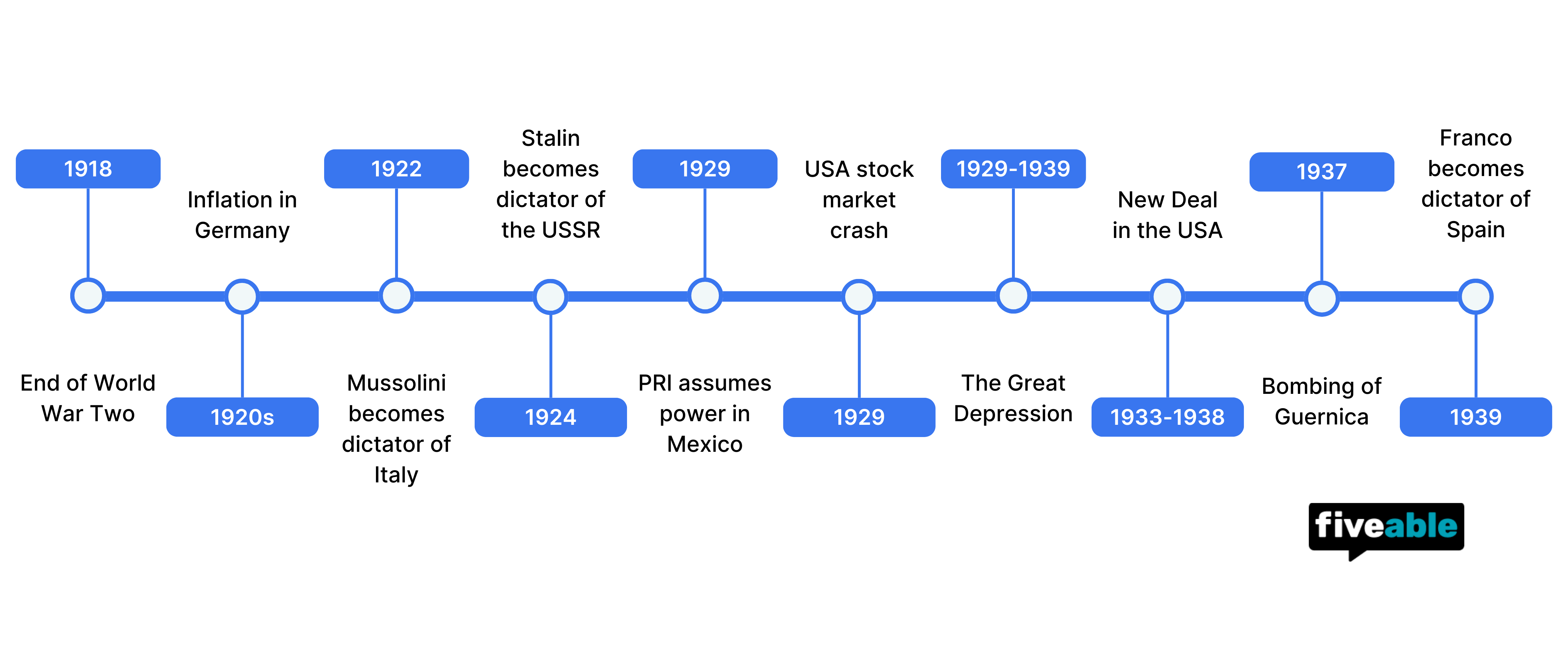
Timeline of events outlining the global economic crash and the struggle against fascism
Image Courtesy of Nirvana
Key Takeaways
- WWI debts and German reparations weakened the economy before agricultural overproduction and the 1929 U.S. stock market crash triggered the Depression; rising tariffs then drove global trade down further.
- Keynes urged deficit spending during downturns, and Roosevelt's New Deal sought relief, recovery, and reform; Japan made its goods cheaper by devaluing its currency.
- Lenin's NEP restored small-scale private trade after Russia's civil war; Stalin replaced it with Five-Year Plans that expanded heavy industry, while forced collectivization led to millions of peasants starving.
- Mexico's PRI dominated politics as the economy improved; under Lázaro Cárdenas, land reform succeeded and the government nationalized the mostly foreign-owned oil industry in 1938.
- Fascism combined extreme nationalism and militarism with suppression of dissent; Mussolini imposed state control on Italy's economy and invaded Abyssinia despite League of Nations sanctions.
- Germany and Italy armed Franco's Nationalists, who won the Spanish Civil War; Vargas's Estado Novo in Brazil resembled Mussolini's corporate state, with press censorship and imprisoned opponents.
The Great Depression and Its Causes
The Great Depression of the 1930s grew directly out of World War I's financial wreckage plus the 1929 U.S. stock market crash. The chain reaction worked like this:
- The Treaty of Versailles forced Germany to pay billions in reparations. Germany couldn't afford it, so its government printed more paper money in the 1920s.
- Printing money caused massive inflation, a general rise in prices. German currency became so worthless people used bills as wallpaper.
- France and Britain couldn't repay their wartime loans to the U.S., partly because Germany couldn't pay them. The Soviet government refused to pay Russia's prerevolutionary debts entirely.
- Two major triggers turned a fragile recovery into a global downturn: agricultural overproduction and the U.S. stock market crash of 1929.
When the American market crashed, U.S. investors pulled their money out of German banks. Germany, already battered by inflation, now faced bank failures too. It suffered more than any other Western nation during the Depression. Africa, Asia, and Latin America suffered because their economies depended on the imperial powers now in crisis. Japan's exports were cut in half between 1929 and 1931 because its economy relied on foreign trade.
By 1932, more than 30 million people worldwide were out of work. As unemployment rose, nations imposed strict tariffs (taxes on imports) to protect remaining jobs, which made international trade fall even further.
The Global Economy, 1929 to 1938 (1929 = 100):
| Year | Total Global Production | Total Global Trade |
|---|---|---|
| 1929 | 100 | 100 |
| 1930 | 86 | 89 |
| 1931 | 77 | 81 |
| 1932 | 70 | 74 |
| 1933 | 79 | 76 |
| 1934 | 95 | 79 |
| 1935 | 98 | 82 |
| 1936 | 110 | 86 |
| 1937 | 120 | 98 |
| 1938 | 111 | 89 |
Source: Adapted from data in Barry Eichengreen and Douglas Irwin, "The Protectionist Temptation: Lessons from the Great Depression for Today," March 17, 2009.
Notice the pattern: production recovered past 1929 levels by 1936, but trade never fully bounced back. Tariffs kept it down. That's a classic stimulus-table point on the exam.
Keynesian Economics and the New Deal
British economist John Maynard Keynes rejected the laissez-faire ideal and argued that intentional government action could fix a depression. His big idea: during a downturn, governments should use deficit spending (spending more than they take in) by cutting taxes and increasing spending to stimulate the economy and put people back to work.
President Franklin D. Roosevelt put Keynes's ideas to work in the New Deal, a group of policies aimed at three R's:
- Relief for the suffering: the poor, unemployed, farmers, minorities, and women
- Recovery to lift the nation out of the Depression, partly through government spending
- Reform of government policies to prevent future disasters
By 1937, unemployment was falling and production was rising, so Keynesian economics seemed to be working. But Roosevelt worried about deficits and reversed course, and unemployment grew again. The Depression only truly ended after the U.S. entered World War II in 1941 and military spending ran up deficits far bigger than anything in the New Deal.
One contrast worth knowing: Japan climbed out of the Depression relatively fast. It devalued its currency (lowered its money's value relative to foreign currencies), making Japanese goods cheaper than imports. Japan's overseas expansionism also boosted demand for military goods.
Russia and Mexico: Revolutionary Governments Manage Their Economies
Russia and Mexico both came out of early-20th-century revolutions, and each took a different approach to running its national economy in the interwar years.
Lenin's New Economic Plan
The Russian Civil War (1918-1921) left the economy near total collapse. Workers struck, peasants hoarded food, and industrial and agricultural production dropped sharply. In 1921, Lenin made a temporary retreat from communist economics with the New Economic Plan (NEP), reintroducing small-scale private trade so farmers could sell their products. The government allowed some economic liberty but kept strict political control. The NEP had modest success but ended when Lenin died in 1924.
Stalin's Five-Year Plans
Joseph Stalin took control of the Politburo (the Communist Party's central organization), made himself dictator, and held power for almost 30 years. He scrapped the NEP and launched the first Five-Year Plan to turn the largely agricultural USSR into an industrial power that could "catch up" to the West.
- Stalin collectivized agriculture: farmland was taken from private owners and given to collectives (each called a kolkhoz) to manage. In theory peasants joined freely; in practice the state forced them onto specific collectives with government-set quotas.
- Furious farmers retaliated by burning crops and killing livestock. The government seized food each year to feed the cities anyway.
- Collectivization was a huge failure. Millions of peasants starved to death, especially in Ukraine.
- Heavy industry, however, grew tremendously in the 1930s. Factory jobs were plentiful even though consumer goods were scarce.
Stalin executed political opponents or sent them to gulags (labor camps where many died), and his tight control of the press kept the atrocities largely unreported. A depressed capitalist world watched the rapidly industrializing USSR with a mix of horror and wonder.
Mexico Under the PRI
Mexico's revolution produced one dominant party, the Institutional Revolutionary Party (PRI), which controlled Mexican politics for most of the 20th century. The system is often called corporatist because the PRI claimed favors for its constituents, like access to primary education and infrastructure jobs. The economy improved substantially, especially from 1930 to the 1970s.
Under Lázaro Cárdenas, land reform succeeded in the 1930s, and in 1938 his government nationalized the mostly foreign-owned oil industry, angering foreign investors. The resulting company, Petróleos Mexicanos (PEMEX), became the second-largest state-owned company in the world. Despite these reforms, Mexico's social hierarchy didn't change dramatically in the interwar period.
The Rise of Right-Wing and Fascist Governments
Fascism appealed to extreme nationalism, glorified the military and armed struggle, and scapegoated ethnic minorities. Fascist regimes suppressed rival parties, protests, and independent trade unions, justified violence, and were fiercely anticommunist.
Mussolini's Italy
Benito Mussolini coined the term fascism from fasces, a bundle of sticks tied around an axe, an ancient Roman symbol of authority. Italy's fascist economy ran on corporatism: employers, trade unions, and state officials were treated as separate organs of one body, each supposedly free to organize itself as long as it supported the whole. In practice, the state imposed its will on every sector, creating a totalitarian state where the government controls all aspects of society.
Italy had been a victor in WWI but got very little territory from the Treaty of Versailles, fueling discontent. Mussolini and the Fascist Party took control of parliament, and he ruled as dictator ("Il Duce"), saturating schools and society with militaristic propaganda. In 1935, defying League of Nations sanctions, 100,000 Italian troops invaded Abyssinia (modern Ethiopia), avenging Italy's 1890s defeat there. The world did little to stop it, and many historians believe the Abyssinian crisis destroyed the League's credibility. In 1936, Mussolini and Hitler formed an alliance.
The Spanish Civil War
The Spanish Civil War (1936-1939) became a global struggle between democracy and fascism. In 1936 Spaniards elected the Popular Front, a left-wing coalition promising land reform. Conservative forces, including the Catholic Church and military leaders, violently opposed it. Spanish troops in Morocco rose up in July 1936, starting the war.
- General Francisco Franco led the insurgent Nationalists.
- The Republicans (also called Loyalists) defended the elected Spanish Republic.
- Despite a European nonintervention agreement, Hitler, Mussolini, and Portugal's Antonio Salazar armed the Nationalists. Civilian volunteers from the USSR, Britain, the U.S., and France aided the Loyalists. Many historians believe the Nationalists would not have won without German, Italian, and Portuguese help.
The German and Italian bombing of Guernica, a town in Spain's Basque region, was one of the first aerial bombings in history to target civilians, and many historians see it as a practice run for Germany's Luftwaffe. Pablo Picasso immortalized the massacre in his 1938 painting Guernica. Franco won in 1939 and ruled as dictator until his death in 1975. Spain stayed officially out of WWII but quietly helped Germany, Italy, and Japan.
Vargas's Brazil
Brazil, Latin America's "sleeping giant," was shifting slowly from agriculture to industry, and the urban middle class resented the large landowners who dominated the economy. A bloodless 1930 coup installed Getulio Vargas as president. His pro-industrial policies won middle-class support, but his Estado Novo ("New State") program looked a lot like Mussolini's corporate state: press censorship, abolition of political parties, imprisonment of opponents, and hypernationalism (belief in the superiority of one's nation above all others). Unlike European fascists, though, the Brazilian government did not rely on violence to maintain control, and Brazil ultimately sided with the Allies in WWII, which later pushed Brazilians to demand democracy at home.
Comparing the Three Systems
| Policy Area | Communism | Capitalism | Fascism |
|---|---|---|---|
| Economics | Businesses owned or managed by the government | Businesses privately owned and competing | Businesses privately owned, government restricts competition |
| Nationalism | Internationalist; opposed colonialism, called for global worker solidarity | Mix of nationalism and internationalism | Strongly nationalist; each nation pursues its unique interests |
| War and Peace | Peace would follow the defeat of capitalism | Mixed attitudes | Opposed peace, believing it weakened society |
| Equality | Supported political and economic equality | Political equality but not economic equality | Opposed both |
| Religion | Advocated atheism | Individual religious liberty | Used religion to build nationalism |
Key Terms to Know
| Term | Why it matters |
|---|---|
| Great Depression | The 1930s global economic collapse, triggered by agricultural overproduction and the 1929 U.S. stock market crash, that pushed governments worldwide to intervene in their economies. |
| Inflation | A general rise in prices; Germany's money-printing to pay reparations made its currency nearly worthless in the 1920s. |
| John Maynard Keynes | British economist who rejected laissez-faire and argued government action could end a depression. |
| Deficit spending | Spending more than the government takes in to stimulate the economy, the core of Keynesian policy. |
| New Deal | FDR's program of relief, recovery, and reform that applied Keynes's ideas in the United States. |
| New Economic Plan (NEP) | Lenin's 1921 temporary retreat from communism that allowed small-scale private trade while keeping strict political control. |
| Five-Year Plan | Stalin's quota-based program to industrialize the USSR rapidly; heavy industry boomed while consumer goods stayed scarce. |
| Collectivization / kolkhoz | The forced transfer of private farmland to state-controlled collectives; it failed catastrophically and millions starved, especially in Ukraine. |
| Politburo | The Communist Party's central organization, which Stalin took over after Lenin's death to make himself dictator. |
| Gulag | Soviet labor camps where Stalin sent political opponents, many of whom died. |
| Institutional Revolutionary Party (PRI) | The party that dominated corporatist Mexican politics for most of the 20th century. |
| PEMEX | The state oil company Cárdenas created by nationalizing Mexico's foreign-owned oil industry in 1938; it became the world's second-largest state-owned company. |
| Fascism | A right-wing system built on extreme nationalism, glorified militarism, scapegoating of minorities, and suppression of dissent. |
| Corporatism | The theory that employers, unions, and the state are organs of one body; in fascist Italy it meant total state control of the economy. |
| Totalitarian state | A state where the government controls all aspects of society, like Mussolini's Italy. |
| Spanish Civil War | The 1936-1939 conflict between Franco's Nationalists (backed by Germany, Italy, Portugal) and the Republican Loyalists; Franco won and ruled until 1975. |
| Guernica | The German-Italian aerial bombing of civilians in Spain's Basque region, immortalized in Picasso's painting. |
| Hypernationalism | Belief in one's nation's superiority over all others, central to Vargas's Estado Novo in Brazil. |
Practice and Next Steps
For the course-aligned version of this material, review the 7.4 Economy in the Interwar Period study guide, then continue the AMSCO sequence with 7.5 Unresolved Tensions After World War I, which picks up the political fallout that this chapter's economic crises made worse. All chapters in the series live on the AP World AMSCO notes page.
To check yourself, run targeted multiple-choice questions in guided practice and drill the vocabulary above with the AP World key terms glossary. Government responses to economic crisis (New Deal vs. Five-Year Plans vs. fascist corporatism) make a great comparison prompt, so try writing one in FRQ practice with instant scoring.
Frequently Asked Questions
What does AMSCO Topic 7.4 Economy in the Interwar Period cover?
AMSCO 7.4 (p. 480-492) covers how governments responded to economic crisis after World War I: the causes of the Great Depression, Keynesian economics and the New Deal in the U.S., Lenin's NEP and Stalin's Five-Year Plans in the USSR, the PRI and oil nationalization in Mexico, and the rise of fascism in Italy, Spain, and right-wing rule in Brazil.
What were the main causes of the Great Depression in AP World?
The two major triggers were agricultural overproduction and the 1929 U.S. stock market crash. Germany's reparations-driven inflation, unpaid Allied war debts, and American investors pulling money out of German banks spread the crisis globally, and tariffs then strangled international trade. By 1932, over 30 million people worldwide were unemployed.
What is the difference between Lenin's NEP and Stalin's Five-Year Plans?
Lenin's New Economic Plan (1921) was a temporary retreat from communism that allowed small-scale private trade to rescue a collapsing economy. Stalin scrapped the NEP and launched Five-Year Plans with state-set production quotas, forcing rapid industrialization and collectivizing agriculture. Heavy industry boomed, but collectivization failed and millions of peasants starved, especially in Ukraine.
Was Brazil under Vargas fascist?
Not quite, and that distinction matters. Vargas's Estado Novo copied fascist moves like press censorship, abolishing political parties, imprisoning opponents, and hypernationalism, but unlike European fascist regimes, Brazil did not praise or rely on violence to maintain control. Brazil also sided with the Allies in World War II.
How does Topic 7.4 show up on the AP World exam?
It's a classic comparison and causation topic: be ready to compare how different governments responded to economic crisis, like the New Deal, Soviet Five-Year Plans, fascist corporatism in Italy, and popular-support governments in Brazil and Mexico. The 1929-1938 production and trade data also makes good stimulus material. Practice with FRQ prompts with instant scoring to test the comparison skill.
See Fiveable more often in Google
Mark Fiveable as a preferred source and Google is more likely to show you our guides in Top Stories, with a "preferred" badge in AI Mode and AI Overviews.