AMSCO 4.2 Exploration: Causes and Events Notes

🌍AP World History: Modern Review
AMSCO 4.2 Exploration: Causes and Events Notes
🌍 AP World History: Modern
AMSCO 1.1 Developments in East Asia Notes
AMSCO 1.2 Developments in Dar al-Islam Notes
AMSCO 1.3 Developments in South and Southeast Asia Notes
AMSCO 1.4 Developments in the Americas Notes
AMSCO 1.5 Developments in Africa Notes
AMSCO 1.6 Developments in Europe Notes
AMSCO 1.7 Comparison in the Period from c.1200 to c.1450 Notes
AMSCO 2.1 The Silk Roads Notes
AMSCO 2.2 The Mongol Empire and the Modern World Notes
AMSCO 2.3 Exchange in the Indian Ocean Notes
AMSCO 2.4 Trans-Saharan Trade Routes Notes
AMSCO 2.5 Cultural Consequences of Connectivity Notes
AMSCO 2.6 Environmental Consequences of Connectivity Notes
AMSCO 2.7 Comparison of Economic Exchange Notes
AMSCO 3.1 European, East Asian, and Gunpowder Empires Expand Notes
AMSCO 3.2 Empires: Administrations Notes
AMSCO 3.3 Empires: Belief Systems Notes
AMSCO 3.4 Comparison in Land-Based Empires Notes
AMSCO 4.1 Technological Innovations Notes
AMSCO 4.2 Exploration: Causes and Events Notes
AMSCO 4.3 Columbian Exchange Notes
AMSCO 4.4 Maritime Empires Link Regions Notes
AMSCO 4.5 Maritime Empires Develop Notes
AMSCO 4.6 Internal and External Challenges to State Power Notes
AMSCO 4.7 Changing Social Hierarchies Notes
AMSCO 4.8 Continuity and Change from c.1450 to c.1750 Notes
AMSCO 5.1 The Enlightment Notes
AMSCO 5.2 Nationalism and Revolutions Notes
AMSCO 5.3 Industrial Revolution Begins Notes
AMSCO 5.4 Industrialization Spreads Notes
AMSCO 5.5 Technology in the Industrial Age Notes
AMSCO 5.6 Industrialization: Government's Role Notes
AMSCO 5.7 Economic Developments and Innovations Notes
AMSCO 5.8 Reactions to the Industrial Economy Notes
AMSCO 5.9 Society and the Industrial Age Notes
AMSCO 5.10 Continuity and Change in the Industrial Age Notes
AMSCO 6.1 Rationales for Imperialism Notes
AMSCO 6.2 State Expansion Notes
AMSCO 6.3 Indigenous Responses to State Expansion Notes
AMSCO 6.4 Global Economic Development Notes
AMSCO 6.5 Economic Imperialism Notes
AMSCO 6.6 Causes of Migration in an Interconnected World Notes
AMSCO 6.7 Effects of Migration Notes
AMSCO 6.8 Causation in the Imperial Age Notes
AMSCO 7.1 Shifting Power Notes
AMSCO 7.2 Causes of World War I Notes
AMSCO 7.3 Conducting World War I Notes
AMSCO 7.4 Economy in the Interwar Period Notes
AMSCO 7.5 Unresolved Tensions After World War I Notes
AMSCO 7.6 Causes of World War II Notes
AMSCO 7.7 Conducting World War II Notes
AMSCO 7.8 Mass Atrocities Notes
AMSCO 7.9 Causation in Global Conflict Notes
AMSCO 8.1 Setting the Stage for the Cold War and Decolonization Notes
AMSCO 8.2 The Cold War Notes
AMSCO 8.3 Effects of the Cold War Notes
AMSCO 8.4 Spread of Communism Notes
AMSCO 8.5 Decolonization after 1900 Notes
AMSCO 8.6 Newly Independent States Notes
AMSCO 8.7 Global Resistance to Established Power Structure Notes
AMSCO 8.8 End of the Cold War Notes
AMSCO 8.9 Causation in the Age of the Cold Ward and Decolonization Notes
AMSCO 9.1 Advances in Technology and Exchange Notes
AMSCO 9.2 Technological Advancements and Limitations Notes
AMSCO 9.3 Technology and the Environment Notes
AMSCO 9.4 Economics in the Global Age Notes
AMSCO 9.5 Calls for Reforms and Responses Notes
AMSCO 9.6 Globalized Culture Notes
AMSCO 9.7 Resistance to Globalization Notes
AMSCO 9.8 Institutions Developing in a Globalized World Notes
AMSCO 9.9 Continuity and Change in a Globalized World Notes
Overview
AMSCO Topic 4.2, "Exploration: Causes and Events" (AMSCO p. 199-208), explains why European states started paying for risky ocean voyages between 1450 and 1750 and what those voyages produced. The short version: Italian port cities held a monopoly on Mediterranean trade with Asia and controlled prices, so Spain and Portugal (and later France, England, and the Netherlands) went hunting for new routes. Add in gold fever, religious zeal to spread Christianity, and the new maritime technology from Topic 4.1, and you get the launch of state-sponsored transoceanic exploration that defines this unit.
Key Takeaways
- Governments paid for expensive voyages to gain wealth, compete for territory, spread Christianity, and control trade through mercantilist policies.
- Prince Henry sponsored Portuguese voyages, Diaz rounded Africa's southern tip, and da Gama reached India by sea.
- Portugal used fortified trading posts and permits to control Indian Ocean trade, but its small size and Dutch and English competition weakened its empire.
- A surviving ship from Magellan's Spanish-sponsored voyage circumnavigated the globe, and Manila became Spain's commercial center in the Philippines.
- Contact with the Aztecs and Incas made Spanish conquest profitable, and galleons carried silver from Mexico to Manila to trade for Asian goods.
- Northwest passage searches failed, but France built a fur trade around Quebec, England founded Jamestown, and the Dutch founded New Amsterdam.
Why States Sponsored Maritime Exploration
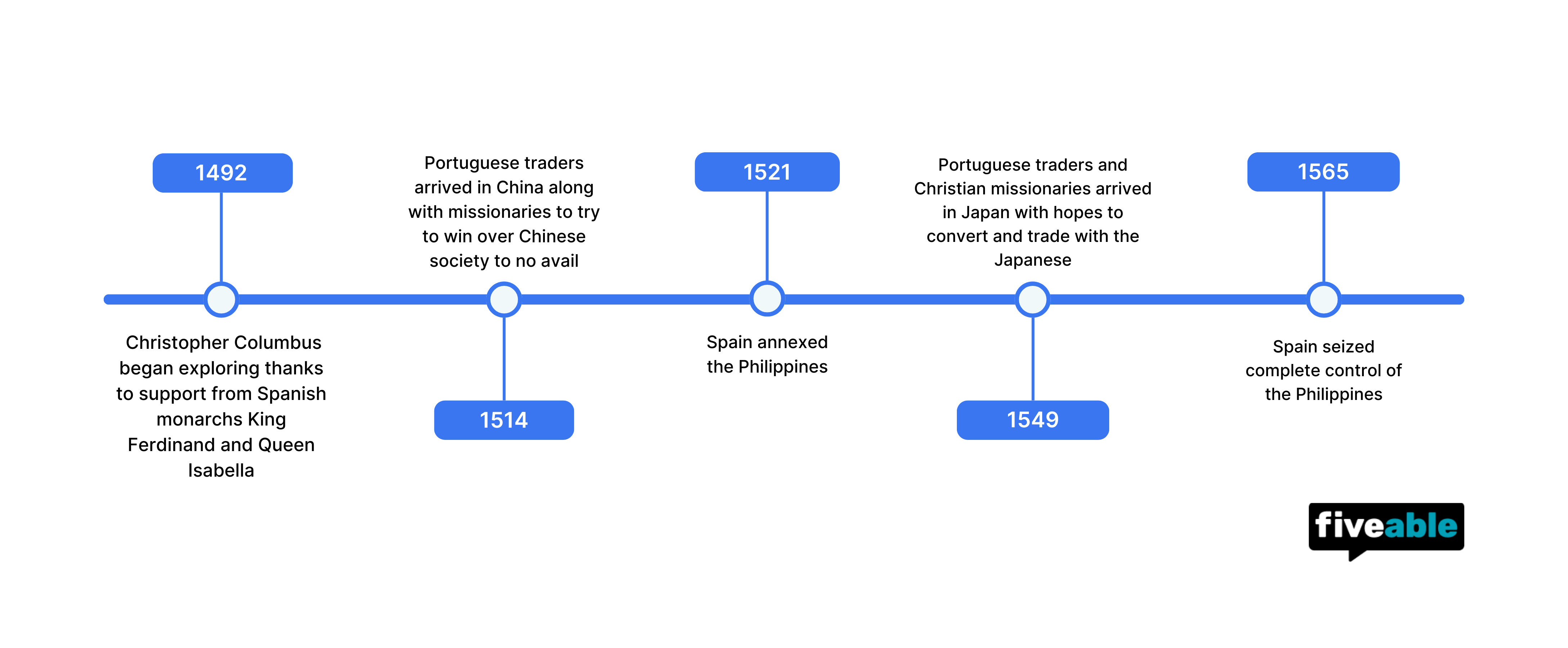
States, not lone adventurers, drove exploration because only governments could afford it. Voyages like Columbus's 1492 Atlantic crossing (backed by Queen Isabella and King Ferdinand of Spain) were too expensive for individual explorers or even most merchants.
States had four overlapping motives:
- Wealth and resources. Conquest brought new taxes, new trading opportunities, and eventually massive amounts of silver.
- Rivalry. European powers raced to claim territory before a competitor could grab it first.
- Religion. Many Europeans saw it as their Christian duty to find and convert people in other lands, and since religion was tightly woven into government, spreading the state's faith became state business.
- Mercantilism. By the 17th century, Europeans measured a country's wealth by its stockpile of gold and silver. So governments pushed policies to sell as much as possible to other countries (precious metals flow in) and buy as little as possible (precious metals stay put). That theory, mercantilism, required heavy government involvement in trade.
Columbus's voyages mattered beyond Spain. They sparked English, French, and Dutch interest in sponsoring exploration of their own.
Portugal Leads the Way
Portugal led European exploration just as it had led maritime innovation. The kingdom was small and boxed in by the Spanish kingdoms of Castile and Aragon, so the only direction it could expand was overseas. The interests of the state and the interests of explorers were tied together more closely here than anywhere else.
Three explorers to know
- Prince Henry the Navigator (1394-1460) became the first European monarch to sponsor seafaring expeditions, searching for an all-water route east and for African gold. Under Henry, Portugal began importing enslaved Africans by sea, replacing the overland slave trade.
- Bartholomew Diaz rounded the Cape of Good Hope at the southern tip of Africa in 1488, then turned back because he feared a mutiny.
- Vasco da Gama pushed farther, reaching India in 1498 and claiming territory for Portugal. Portuguese ports in India became the launching pad for trade across the Indian Ocean and beyond.
Into Southeast and East Asia
Early in the 16th century, the ruthless admiral Afonso de Albuquerque defeated Arab traders in a short, bloody battle and set up a factory at Malacca on the Malay Peninsula. He had previously governed Portuguese India (1509-1515) and was infamous for sending strings of Indians' ears back to Portugal as proof of his conquests.
China had ended its own exploration after Zheng He's final voyage in the 1430s. In 1514, the outside world showed up anyway: Portuguese traders, whose ships and weapons were unmatched in Europe. Portugal had already taken control of the African and Indian coasts and crushed a Turkish-Egyptian-Venetian fleet at Diu, India, in 1509.
Traders were followed by Catholic missionaries. Franciscans and Dominicans worked among ordinary Chinese, while Jesuits like Matteo Ricci (Italian, arrived 1582) and Adam Schall von Bell (German, arrived 1619) targeted the court elite from Macau, impressing them with scientific knowledge. It mostly didn't work. The hostile scholar-gentry considered the missionaries barbaric, and few converted.
The trading post empire
Instead of conquering large territories, Portugal built a chain of fortified outposts: Hormuz on the Persian Gulf (1507), Goa in western India (1510), and Malacca on the Malay Peninsula (1511). The goal was a monopoly on the spice trade. Portugal licensed all vessels trading between Malacca and Hormuz and restricted Indian Ocean trade to merchants who bought permits. This network of small forts, not big colonies, is what the AP exam means by a trading post empire.
Why Portugal couldn't hold on
Portugal succeeded for decades but was too small to enforce a global empire. It lacked the workers and ships, many Portuguese merchants ignored the government and traded independently, and official corruption ate away at the system. By the 17th century, Dutch and English rivals were moving in. The Dutch captured Malacca and built a fort at Batavia in Java in 1620, trying to monopolize the spice trade from there. The English focused on India and pushed the Portuguese out of South Asia. In Japan, Portuguese traders and missionaries (arriving 1549) built large Catholic settlements until the 1600s, when Japanese rulers outlawed Catholicism and expelled the missionaries.
Spain, Magellan, and the Pacific Silver Trade
Spanish ships were the first to circumnavigate the globe. The government sponsored Ferdinand Magellan's voyage; Magellan himself died in the Philippine Islands, but one ship from his fleet made it all the way around, proving the earth could be circumnavigated.
Spain annexed the Philippines in 1521 when Magellan's fleet arrived, returned in 1565, and fought a long campaign against fierce Filipino resistance. Manila became Spain's commercial center in the region, attracting Chinese merchants, and many Filipinos became Christians under Spanish and Portuguese occupation.
The lure of riches in the Americas
The Spanish found so little of value in their first two decades in the Americas that they considered quitting exploration entirely. What changed everything was contact with the Aztecs in Mesoamerica and the Incas in South America. These empires held the gold and silver that made conquest profitable. Europeans also realized they could grow rich raising sugar, tobacco, and other cash crops using enslaved Native Americans and, later, enslaved Africans.
Manila galleons and global silver
Silver from Mexico crossed the Pacific in heavily armed Spanish ships called galleons, stopping in the Philippines. At Manila, Europeans traded silver for silk, spices, and even gold bullion. China was an especially enthusiastic consumer; its government began using silver as its main currency. By the early 17th century, silver was a dominant force in the global economy. This trans-Pacific link is a favorite exam example of how exploration connected the whole world.
The Northern Europeans and the Northwest Passage
France, England, and the Netherlands all sponsored Atlantic crossings, often hunting for a northwest passage, a route through or around North America to Asia and its spice trade. Nobody found one, but the searching produced colonies.
French exploration
In 1535, Jacques Cartier sailed into the St. Lawrence River and claimed part of what is now Canada for France. Samuel de Champlain (explored 1609-1616) and others realized the Americas themselves held valuable resources, especially furs. The French founded Quebec as a town and trading post in 1608. In the 1680s, the trader La Salle explored the Great Lakes and followed the Mississippi River to the Gulf of Mexico, claiming the whole region for France.
The French rarely settled permanently. Instead of demanding land, they traded for furs trapped by Native Americans, which gave them better relations with indigenous peoples than the Spanish or English had. The tradeoff was slow growth: by 1754, New France had only 70,000 Europeans, while the English colonies had one million.
English exploration
In 1497, the English king sent John Cabot to look for a northwest passage; he claimed land from Newfoundland south to the Chesapeake Bay. England then sat out serious colonization for nearly a century because it couldn't match Spanish sea power (though English pirates called "sea dogs" raided Spanish ships). The turning point came in 1588, when England defeated the Spanish Armada, destroying all but one third of it. England then competed seriously for American land. In 1607, about one hundred colonists built Jamestown on the James River in Virginia, both named for King James I. It was England's first successful American colony, though the first colonies in the present-day United States were actually Spanish settlements in Florida and New Mexico.
Dutch exploration
In 1609, the Dutch sent Henry Hudson up the river now bearing his name, hoping it led to Asia. It didn't, but the voyage let the Dutch claim the Hudson River Valley and Manhattan, where they founded New Amsterdam (today's New York City). The port thrived as a node in Dutch transatlantic trade: furs from northern trappers and Virginia tobacco flowed to the Netherlands in exchange for manufactured goods sold throughout colonial North America.
Key Terms to Know
| Term | Why it matters |
|---|---|
| Mercantilism | Economic theory that national wealth equals gold and silver, so states maximized exports and minimized imports, requiring heavy government control of trade. |
| Trading post empire | Portugal's network of small fortified outposts (Hormuz, Goa, Malacca) built to control trade routes rather than rule large territories. |
| Prince Henry the Navigator | First European monarch to sponsor seafaring expeditions; under him Portugal began the sea-based slave trade from Africa. |
| Christopher Columbus | Sailed for Spain in 1492; his voyages sparked sustained European interest in transatlantic exploration. |
| Bartholomew Diaz | Rounded the Cape of Good Hope in 1488, opening the possibility of a sea route to Asia. |
| Vasco da Gama | Reached India by sea in 1498 and claimed territory there for Portugal's empire. |
| Ferdinand Magellan | Led the Spanish-sponsored voyage whose surviving ship was the first to circumnavigate the globe; he died in the Philippines. |
| Manila | Spanish commercial hub in the Philippines where American silver was exchanged for Asian luxury goods. |
| Galleons | Heavily armed Spanish ships that carried silver across the Pacific, making the global silver trade possible. |
| Northwest passage | The hoped-for route through or around North America to Asia that drove English, French, and Dutch exploration. |
| Jacques Cartier | French explorer who sailed the St. Lawrence River in 1535 and claimed part of Canada for France. |
| Samuel de Champlain | French explorer (1609-1616) who helped shift France's focus from finding Asia to exploiting American resources. |
| Quebec | French town and fur-trading post founded in 1608, the heart of New France. |
| New France | France's slow-growing North American colony (70,000 Europeans by 1754) built on fur trading, not land seizure. |
| John Cabot | English explorer sent in 1497 who claimed land from Newfoundland to the Chesapeake Bay. |
| Jamestown | England's first successful American colony, founded in 1607 on the James River in Virginia. |
| Henry Hudson | Dutch-sponsored explorer whose 1609 voyage justified Dutch claims to the Hudson Valley and Manhattan. |
| New Amsterdam | Dutch port on Manhattan (later New York City) that became a key node in transatlantic trade. |
Practice and Next Steps
Pair these notes with the Topic 4.2 course study guide for the College Board framing of the same material, then continue to AMSCO 4.3 on the Columbian Exchange to see the effects of all this contact. The full set of AMSCO Unit 4 notes covers the rest of the 1450-1750 period. To check yourself, drill exploration questions with AP World guided practice or look up any term in the key terms glossary.
Frequently Asked Questions
What is a trading post empire in AP World?
A trading post empire is an empire built on small fortified outposts that control trade routes instead of ruling large territories. Portugal built the classic example with forts at Hormuz (1507), Goa (1510), and Malacca (1511), aiming to monopolize the spice trade and license all ships trading between those points.
Why did European states sponsor maritime exploration from 1450 to 1750?
Four big reasons: wealth (Italian cities monopolized Asian trade, so other states wanted their own routes plus gold and silver), rivalry with other European powers, the religious goal of spreading Christianity, and mercantilist policies that tied national power to accumulating precious metals. States had to be involved because voyages like Columbus's were too expensive for individual explorers to fund.
Did Magellan actually sail around the world?
No, Magellan himself died in the Philippine Islands during the voyage. One ship from his Spanish-sponsored fleet completed the journey in 1522, making it the first circumnavigation of the globe and proving the earth could be sailed around. He's also Portuguese by birth even though Spain sponsored the expedition.
How were French colonies different from English colonies in North America?
The French rarely settled permanently. They traded with Native Americans for furs instead of demanding land, which gave them better indigenous relations but much slower growth. By 1754, New France had only 70,000 Europeans while the English colonies had one million. That contrast makes a great comparison example on the AP exam.
How does Topic 4.2 show up on the AP World exam?
Topic 4.2 feeds questions about the causes of state-sponsored exploration, Portugal's trading post empire, and the Spanish silver trade through Manila. It's strong evidence for essays on economic motives and global trade connections in the 1450-1750 period. You can practice these with AP World guided practice questions.
See Fiveable more often in Google
Mark Fiveable as a preferred source and Google is more likely to show you our guides in Top Stories, with a "preferred" badge in AI Mode and AI Overviews.