AMSCO 2.4 Trans-Saharan Trade Routes Notes

🌍AP World History: Modern Review
AMSCO 2.4 Trans-Saharan Trade Routes Notes
🌍 AP World History: Modern
AMSCO 1.1 Developments in East Asia Notes
AMSCO 1.2 Developments in Dar al-Islam Notes
AMSCO 1.3 Developments in South and Southeast Asia Notes
AMSCO 1.4 Developments in the Americas Notes
AMSCO 1.5 Developments in Africa Notes
AMSCO 1.6 Developments in Europe Notes
AMSCO 1.7 Comparison in the Period from c.1200 to c.1450 Notes
AMSCO 2.1 The Silk Roads Notes
AMSCO 2.2 The Mongol Empire and the Modern World Notes
AMSCO 2.3 Exchange in the Indian Ocean Notes
AMSCO 2.4 Trans-Saharan Trade Routes Notes
AMSCO 2.5 Cultural Consequences of Connectivity Notes
AMSCO 2.6 Environmental Consequences of Connectivity Notes
AMSCO 2.7 Comparison of Economic Exchange Notes
AMSCO 3.1 European, East Asian, and Gunpowder Empires Expand Notes
AMSCO 3.2 Empires: Administrations Notes
AMSCO 3.3 Empires: Belief Systems Notes
AMSCO 3.4 Comparison in Land-Based Empires Notes
AMSCO 4.1 Technological Innovations Notes
AMSCO 4.2 Exploration: Causes and Events Notes
AMSCO 4.3 Columbian Exchange Notes
AMSCO 4.4 Maritime Empires Link Regions Notes
AMSCO 4.5 Maritime Empires Develop Notes
AMSCO 4.6 Internal and External Challenges to State Power Notes
AMSCO 4.7 Changing Social Hierarchies Notes
AMSCO 4.8 Continuity and Change from c.1450 to c.1750 Notes
AMSCO 5.1 The Enlightment Notes
AMSCO 5.2 Nationalism and Revolutions Notes
AMSCO 5.3 Industrial Revolution Begins Notes
AMSCO 5.4 Industrialization Spreads Notes
AMSCO 5.5 Technology in the Industrial Age Notes
AMSCO 5.6 Industrialization: Government's Role Notes
AMSCO 5.7 Economic Developments and Innovations Notes
AMSCO 5.8 Reactions to the Industrial Economy Notes
AMSCO 5.9 Society and the Industrial Age Notes
AMSCO 5.10 Continuity and Change in the Industrial Age Notes
AMSCO 6.1 Rationales for Imperialism Notes
AMSCO 6.2 State Expansion Notes
AMSCO 6.3 Indigenous Responses to State Expansion Notes
AMSCO 6.4 Global Economic Development Notes
AMSCO 6.5 Economic Imperialism Notes
AMSCO 6.6 Causes of Migration in an Interconnected World Notes
AMSCO 6.7 Effects of Migration Notes
AMSCO 6.8 Causation in the Imperial Age Notes
AMSCO 7.1 Shifting Power Notes
AMSCO 7.2 Causes of World War I Notes
AMSCO 7.3 Conducting World War I Notes
AMSCO 7.4 Economy in the Interwar Period Notes
AMSCO 7.5 Unresolved Tensions After World War I Notes
AMSCO 7.6 Causes of World War II Notes
AMSCO 7.7 Conducting World War II Notes
AMSCO 7.8 Mass Atrocities Notes
AMSCO 7.9 Causation in Global Conflict Notes
AMSCO 8.1 Setting the Stage for the Cold War and Decolonization Notes
AMSCO 8.2 The Cold War Notes
AMSCO 8.3 Effects of the Cold War Notes
AMSCO 8.4 Spread of Communism Notes
AMSCO 8.5 Decolonization after 1900 Notes
AMSCO 8.6 Newly Independent States Notes
AMSCO 8.7 Global Resistance to Established Power Structure Notes
AMSCO 8.8 End of the Cold War Notes
AMSCO 8.9 Causation in the Age of the Cold Ward and Decolonization Notes
AMSCO 9.1 Advances in Technology and Exchange Notes
AMSCO 9.2 Technological Advancements and Limitations Notes
AMSCO 9.3 Technology and the Environment Notes
AMSCO 9.4 Economics in the Global Age Notes
AMSCO 9.5 Calls for Reforms and Responses Notes
AMSCO 9.6 Globalized Culture Notes
AMSCO 9.7 Resistance to Globalization Notes
AMSCO 9.8 Institutions Developing in a Globalized World Notes
AMSCO 9.9 Continuity and Change in a Globalized World Notes
Overview
AMSCO Topic 2.4, Trans-Saharan Trade Routes (AMSCO p.103 - p.110), covers how camel caravans turned the Sahara Desert from a barrier into a highway connecting West Africa to North Africa and the wider Islamic world during 1200-1450. The chapter explains the transportation technologies that made the trade possible (camels, camel saddles, caravans), what was traded (gold, salt, ivory, enslaved people), and how the empire of Mali grew rich and powerful by controlling and taxing that trade. The big course connections: innovations in existing transportation technologies expanded the volume and range of trade, and the expansion of empires like Mali drew new people into Afro-Eurasian trade and communication networks.
The chapter opens with a quote from Ibn Battuta, the 14th-century Muslim scholar and traveler, describing buying and selling with cowry shells in the cities of Mali. That's your built-in primary source for this topic.
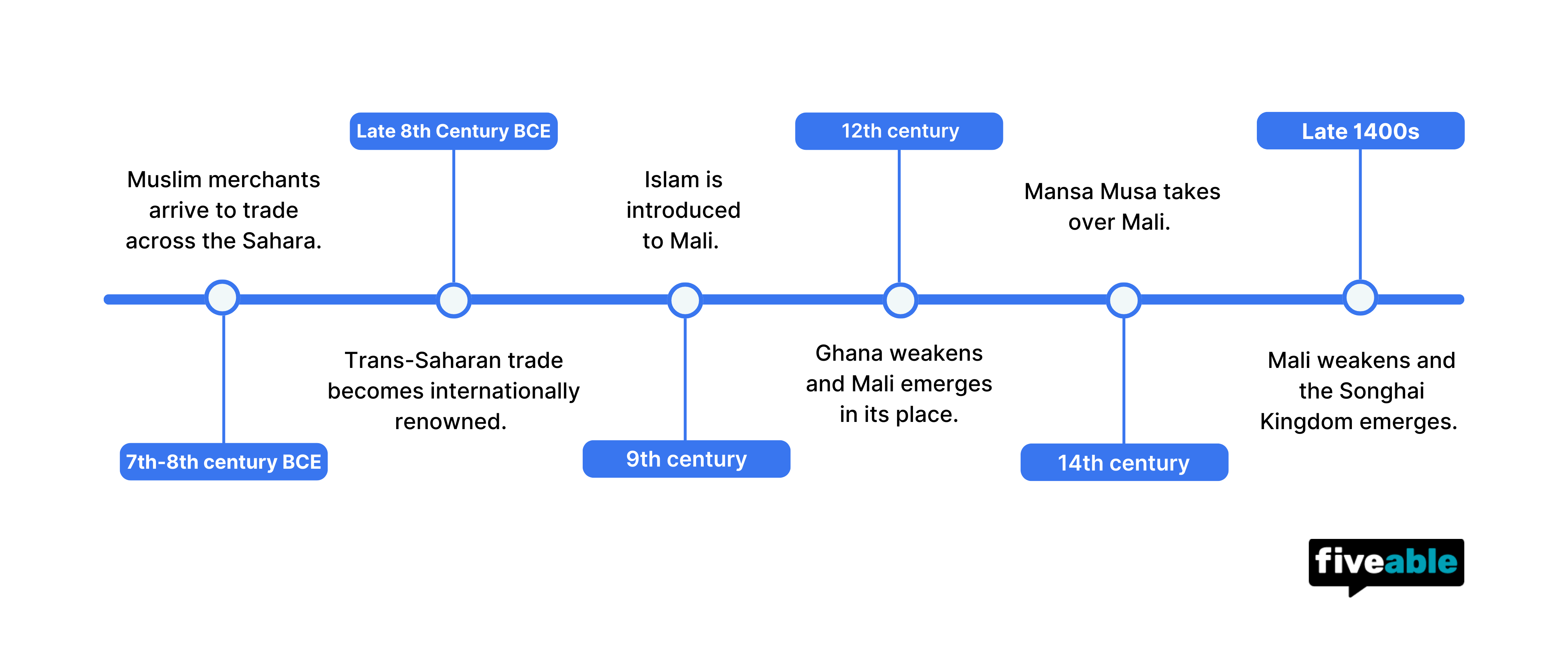
Timeline of West-African Kingdom Progression (Image Courtesy of Grace)
Key Takeaways
- Camels, load-carrying saddles, and caravans made it possible to move large amounts of goods between Saharan oases.
- Trans-Saharan routes carried gold and other goods from West Africa, brought salt and textiles from Arab and Berber merchants, and spread Islam into Sub-Saharan Africa.
- Wars weakened Ghana, while Mali grew wealthy by taxing trade entering West Africa; expansion drew more people into its trade networks.
- Most scholars believe Sundiata was Muslim; he used religious connections with North African and Arab merchants and built a thriving gold trade.
- Mansa Musa's 1324 pilgrimage displayed Mali's wealth, and his support for Islamic schools and mosques deepened Islam's presence, though most West Africans kept traditional beliefs.
- By the late 1400s, Songhai had replaced Mali as a larger, richer West African power, while Timbuktu and Gao remained trading cities tied to Muslim merchants.
Trans-Saharan Trade: Crossing the Desert
The Sahara is enormous, about 3.6 million square miles, roughly the size of China. Only about 800 square miles of it are oases, spots where underground water reaches the surface (naturally or through human-dug wells) and makes settlement and farming possible. Because the arid climate made farming nearly impossible, few societies lived in the Sahara itself. Nomadic communities traded across it in small volumes, but trade really took off when Muslim merchants arrived in the 7th and 8th centuries, and it expanded dramatically when Mali took over the region in the early 1200s.
Camels and Camel Saddles
Camels made desert crossing realistic. They were native to the Arabian Desert and appeared in North Africa by the 3rd century B.C.E. Why camels beat horses:
- A camel can drink over 50 gallons of water in three minutes, then go a long time without more
- Camels were already adapted to harsh, dry climates, so they handled the Sahara well
- After 300 C.E., camels steadily replaced horses and donkeys in Saharan travel
People developed as many as 15 types of camel saddles, each for a different job:
- South Arabian saddle: rider sits behind the hump and holds onto its hair, making riding easier
- North Arabian saddle: rider sits on top of the hump, gaining height and visibility in battle plus the best control of the animal
- Somali saddle: the game-changer for trade. The semi-nomadic Somalis of Eastern Africa designed a load-carrying saddle that let a camel haul up to 600 pounds of goods
Without that Somali cargo saddle, camels couldn't have carried heavy trade loads across the desert. This is the AP exam's favorite example of an innovation in existing transportation technology.
Caravans and Trade Routes
Caravans crossing the Sahara often included thousands of camels carrying trade goods plus enough provisions (including fresh water) to reach the next oasis. The people leading the caravans usually walked the whole way. There were seven north-south routes and two east-west routes, which connected Sub-Saharan Africa to an expanding number of cultures and trading partners.
What Was Traded
By the end of the 8th century C.E., trans-Saharan trade was famous across Europe and Asia.
- From West Africa: gold (the most precious commodity, gathered from the waters of the Senegal River near modern Senegal and Mauritania), ivory, hides, and enslaved people
- From Arab and Berber merchants: salt, cloth/textiles, paper, and horses
- The non-physical export: Islam spread into Sub-Saharan Africa along these routes
For more than 700 years, this trade brought serious wealth to West African societies, especially the kingdoms of Ghana and Mali. Compare this exchange of goods and faith with what was moving along the Indian Ocean network in AMSCO 2.3. Same era, same pattern, different geography.
From Ghana to Mali: West African Empire Expansion
Ghana rose first, profiting by taxing the gold and salt that crossed its borders. By the 12th century, wars with neighboring societies had permanently weakened the Ghanaian state. Several new trading societies rose in its place, and the most powerful was Mali. North African traders had introduced Islam to Mali back in the 9th century, so the empire was plugged into the Muslim commercial world from early on.
Mali's Riches
Mali profited from the gold trade, but its real money move was taxing nearly all other trade entering West Africa. That made it even more prosperous than Ghana had been.
- Most residents were farmers growing sorghum and rice
- The cities of Timbuktu and Gao accumulated the most wealth and became centers of Muslim life
- Timbuktu became a world-renowned center of Islamic learning; by the 1500s, books created and sold there fetched higher prices than most other goods
- In Gao and the city of Mali, people bought and sold with cowry shells (this is what Ibn Battuta witnessed)
The Expanding Role of States
More trade and more wealth meant governments had more to manage. The chapter highlights what rulers had to do:
- Establish currency with a widely understood value. In Mali, currency included cowrie shells, cotton cloth, gold, glass beads, and salt
- Protect trade routes and the areas where currencies and trade resources were produced
- Expand militarily into resource-rich areas, using armies provisioned with horses and iron weapons bought with tax revenue
Each expansion pulled more people into the empire's economy and trade networks, putting more people in touch with distant cultures. That's the exact cause-and-effect chain the AP exam wants you to explain: empire expansion facilitates trade and communication.
Sundiata, the Lion Prince
Sundiata was Mali's founding ruler and the subject of legend. When his father died, rivals invaded, killed most of the royal family, and seized the throne. They spared the young prince because he was crippled and seemed harmless. He learned to fight anyway, became a feared warrior, was forced into exile, and in 1235 returned, defeated his enemies, and reclaimed the throne.
Beyond the legend, Sundiata was a capable ruler. Most scholars believe he was a Muslim, and he used his religious connections to build trade relationships with North African and Arab merchants. He cultivated a thriving gold trade, and Mali's wealth grew tremendously under him.
Mansa Musa
Mansa Musa, Sundiata's grand-nephew, ruled in the 14th century and was known more for religious leadership than political or economic skill. A devout Muslim, he began a pilgrimage to Mecca in 1324 with an extravagant caravan: 100 camels, thousands of enslaved people and soldiers, and gold handed out to hosts along the way. The trip showed off Mali's wealth to the outside world.
After returning, Mansa Musa doubled down on Islam in West Africa:
- Established religious schools in Timbuktu
- Built mosques in Muslim trading cities
- Sponsored scholars to continue religious studies elsewhere
Most West Africans kept their traditional beliefs, but his reign deepened support for Islam in Mali. This blending of Islam with local practice is a thread that continues in AMSCO 2.5 on the cultural consequences of connectivity.
The Rise of Songhai
Within 100 years of Mansa Musa's death, Mali was declining. By the late 1400s, the Songhai Kingdom had replaced it as West Africa's powerhouse, following processes like Mali's and growing larger and richer than Mali. Timbuktu and Gao remained impressive trading cities, and Songhai's embrace of Islam kept the commercial ties with Muslim merchants from North Africa and the Middle East strong. Despite Mali's fall, Mansa Musa's efforts paid off long-term: Islam still holds a prominent place in West Africa today.
Key Terms to Know
| Term | Why it matters |
|---|---|
| Trans-Saharan trade | The network of caravan routes across the Sahara linking West Africa to North Africa; it grew in volume and range during this period. |
| Sahara Desert | A 3.6 million square mile desert (about the size of China) that trade technology turned from barrier into trade corridor. |
| Oases | The roughly 800 square miles of fertile spots where underground water reaches the surface, making settlement and caravan stops possible. |
| Camel saddles | Up to 15 saddle designs for different uses; the Somali cargo saddle let camels carry 600-pound loads, making large-scale trade possible. |
| Caravans | Groups of often thousands of camels carrying goods and provisions between oases; the basic unit of Saharan commerce. |
| Arabian Desert | The camel's native habitat, which pre-adapted the animal for life in the Sahara. |
| Mali | The West African empire that rose in the early 1200s, taxed nearly all trade entering West Africa, and grew richer than Ghana. |
| Sundiata | Mali's founding ruler, the "Lion Prince," who reclaimed his throne in 1235 and built the gold trade through Muslim merchant connections. |
| Mansa Musa | Sundiata's grand-nephew whose lavish 1324 pilgrimage to Mecca displayed Mali's wealth and who built schools and mosques afterward. |
| Songhai Kingdom | The kingdom that replaced declining Mali by the late 1400s and grew larger and richer than Mali. |
| Timbuktu | Mali's world-renowned center of Islamic learning; by the 1500s its books sold for more than most other goods. |
| Mecca | Islam's holiest city and the destination of Mansa Musa's famous pilgrimage. |
| Islam | The religion Muslim merchants carried across the Sahara; it spread into Sub-Saharan Africa through trade. |
| Ibn Battuta | The 14th-century Muslim scholar and traveler whose accounts describe trade and cowry-shell currency in Mali's cities. |
| Cowrie shells | Shells used as currency in Mali alongside gold, cotton cloth, glass beads, and salt; an example of states standardizing exchange. |
| Sorghum | A grain crop suited to hot, dry climates that most of Mali's farming population grew along with rice. |
Practice and Next Steps
These notes follow the AMSCO chapter; for the College Board-aligned version of this topic, review the 2.4 Trans-Saharan Trade Routes study guide. Then keep moving through Unit 2 with the rest of the AMSCO notes collection, starting with AMSCO 2.1 on the Silk Roads if you need to back up, or jumping ahead to 2.5.
To check yourself, run a few questions in AP World guided practice and look up anything fuzzy in the key terms glossary. When you've finished Unit 2, the full-length practice exam is the best way to see how these trade networks show up in real exam questions.
Frequently Asked Questions
What does AMSCO Topic 2.4 cover in AP World?
AMSCO 2.4 (p.103-110) covers the trans-Saharan trade routes from 1200-1450: how camels, camel saddles, and caravans made crossing the Sahara possible, the exchange of gold, salt, ivory, and enslaved people, and the rise of West African empires like Mali. It also covers Sundiata, Mansa Musa, and the spread of Islam into Sub-Saharan Africa.
Why were camel saddles important to trans-Saharan trade?
The Somali-designed cargo saddle let a single camel carry up to 600 pounds of goods, which made large-scale commercial caravans across the Sahara possible. People developed as many as 15 saddle types for different purposes, but the load-carrying saddle had the biggest impact on trade. The camel saddle is one of the AP exam's named examples of a transportation technology that encouraged interregional trade.
What was traded on the trans-Saharan trade routes?
West Africans traded gold (the most precious commodity, from the Senegal River region), ivory, hides, and enslaved people. In exchange, Arab and Berber merchants brought salt, cloth, paper, and horses. Islam also spread into Sub-Saharan Africa along these routes, which is why Timbuktu became a center of Islamic learning.
Was Mansa Musa more important for trade or religion?
The AMSCO chapter says Mansa Musa was better known for religious leadership than political or economic skill, which surprises students who only know his wealth. His 1324 pilgrimage to Mecca with 100 camels and huge amounts of gold displayed Mali's wealth, but his lasting impact was building religious schools in Timbuktu, mosques in trading cities, and sponsoring Islamic scholarship. Sundiata, not Mansa Musa, was the ruler who built Mali's gold trade.
How does Topic 2.4 show up on the AP World exam?
Questions on this topic ask you to explain the causes and effects of the growth of trans-Saharan trade and how empire expansion (especially Mali) influenced trade and communication. Be ready to cite the camel saddle and caravans as transportation innovations and to explain how Mali's taxation and military expansion drew more people into trade networks. Try guided practice questions to test these cause-and-effect chains.
See Fiveable more often in Google
Mark Fiveable as a preferred source and Google is more likely to show you our guides in Top Stories, with a "preferred" badge in AI Mode and AI Overviews.