AMSCO 5.8 Reactions to the Industrial Economy Notes

🌍AP World History: Modern Review
AMSCO 5.8 Reactions to the Industrial Economy Notes
🌍 AP World History: Modern
AMSCO 1.1 Developments in East Asia Notes
AMSCO 1.2 Developments in Dar al-Islam Notes
AMSCO 1.3 Developments in South and Southeast Asia Notes
AMSCO 1.4 Developments in the Americas Notes
AMSCO 1.5 Developments in Africa Notes
AMSCO 1.6 Developments in Europe Notes
AMSCO 1.7 Comparison in the Period from c.1200 to c.1450 Notes
AMSCO 2.1 The Silk Roads Notes
AMSCO 2.2 The Mongol Empire and the Modern World Notes
AMSCO 2.3 Exchange in the Indian Ocean Notes
AMSCO 2.4 Trans-Saharan Trade Routes Notes
AMSCO 2.5 Cultural Consequences of Connectivity Notes
AMSCO 2.6 Environmental Consequences of Connectivity Notes
AMSCO 2.7 Comparison of Economic Exchange Notes
AMSCO 3.1 European, East Asian, and Gunpowder Empires Expand Notes
AMSCO 3.2 Empires: Administrations Notes
AMSCO 3.3 Empires: Belief Systems Notes
AMSCO 3.4 Comparison in Land-Based Empires Notes
AMSCO 4.1 Technological Innovations Notes
AMSCO 4.2 Exploration: Causes and Events Notes
AMSCO 4.3 Columbian Exchange Notes
AMSCO 4.4 Maritime Empires Link Regions Notes
AMSCO 4.5 Maritime Empires Develop Notes
AMSCO 4.6 Internal and External Challenges to State Power Notes
AMSCO 4.7 Changing Social Hierarchies Notes
AMSCO 4.8 Continuity and Change from c.1450 to c.1750 Notes
AMSCO 5.1 The Enlightment Notes
AMSCO 5.2 Nationalism and Revolutions Notes
AMSCO 5.3 Industrial Revolution Begins Notes
AMSCO 5.4 Industrialization Spreads Notes
AMSCO 5.5 Technology in the Industrial Age Notes
AMSCO 5.6 Industrialization: Government's Role Notes
AMSCO 5.7 Economic Developments and Innovations Notes
AMSCO 5.8 Reactions to the Industrial Economy Notes
AMSCO 5.9 Society and the Industrial Age Notes
AMSCO 5.10 Continuity and Change in the Industrial Age Notes
AMSCO 6.1 Rationales for Imperialism Notes
AMSCO 6.2 State Expansion Notes
AMSCO 6.3 Indigenous Responses to State Expansion Notes
AMSCO 6.4 Global Economic Development Notes
AMSCO 6.5 Economic Imperialism Notes
AMSCO 6.6 Causes of Migration in an Interconnected World Notes
AMSCO 6.7 Effects of Migration Notes
AMSCO 6.8 Causation in the Imperial Age Notes
AMSCO 7.1 Shifting Power Notes
AMSCO 7.2 Causes of World War I Notes
AMSCO 7.3 Conducting World War I Notes
AMSCO 7.4 Economy in the Interwar Period Notes
AMSCO 7.5 Unresolved Tensions After World War I Notes
AMSCO 7.6 Causes of World War II Notes
AMSCO 7.7 Conducting World War II Notes
AMSCO 7.8 Mass Atrocities Notes
AMSCO 7.9 Causation in Global Conflict Notes
AMSCO 8.1 Setting the Stage for the Cold War and Decolonization Notes
AMSCO 8.2 The Cold War Notes
AMSCO 8.3 Effects of the Cold War Notes
AMSCO 8.4 Spread of Communism Notes
AMSCO 8.5 Decolonization after 1900 Notes
AMSCO 8.6 Newly Independent States Notes
AMSCO 8.7 Global Resistance to Established Power Structure Notes
AMSCO 8.8 End of the Cold War Notes
AMSCO 8.9 Causation in the Age of the Cold Ward and Decolonization Notes
AMSCO 9.1 Advances in Technology and Exchange Notes
AMSCO 9.2 Technological Advancements and Limitations Notes
AMSCO 9.3 Technology and the Environment Notes
AMSCO 9.4 Economics in the Global Age Notes
AMSCO 9.5 Calls for Reforms and Responses Notes
AMSCO 9.6 Globalized Culture Notes
AMSCO 9.7 Resistance to Globalization Notes
AMSCO 9.8 Institutions Developing in a Globalized World Notes
AMSCO 9.9 Continuity and Change in a Globalized World Notes
Overview
AMSCO Topic 5.8, Reactions to the Industrial Economy (p.332 - p.338), covers how workers, thinkers, and governments responded to the upheaval of industrialization between 1750 and 1900. In Britain, laborers formed unions and reformers like John Stuart Mill pushed for change within capitalism, while Karl Marx called for replacing it entirely. Meanwhile, the Ottoman Empire, Qing China, and Japan all launched modernization programs and all faced pushback from conservative elites. This chapter sits near the end of Unit 5 and sets up the comparisons in AMSCO 5.10 Continuity and Change in the Industrial Age.
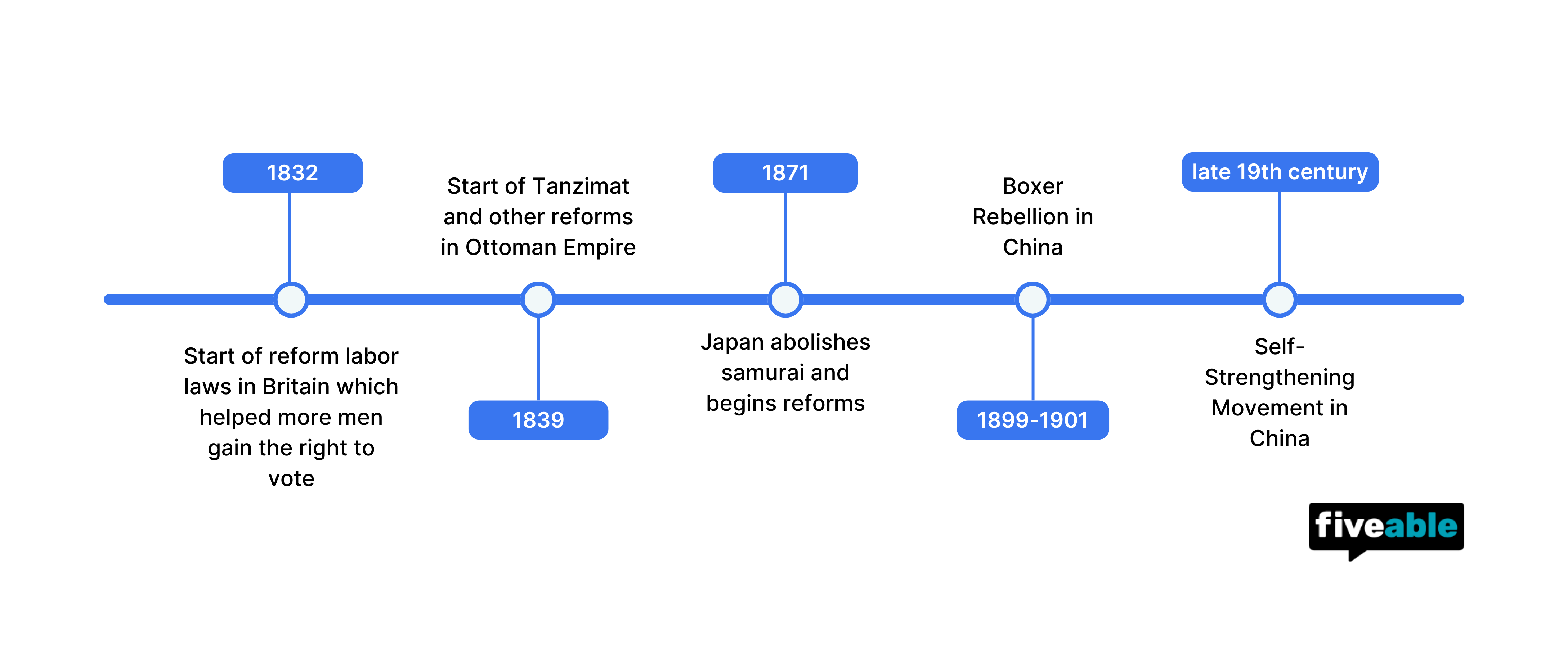
Timeline of events following reactions to the industrial economy. Courtesy of Lauren Hamlette.
Key Takeaways
- British workers formed unions to bargain for better conditions, while reforms expanded voting rights and restricted child labor.
- John Stuart Mill wanted gradual reforms within capitalism, while Karl Marx argued that workers should seize the means of production and replace capitalism with socialism.
- Mahmud II centralized Ottoman power, and the Tanzimat introduced secular schools and codified laws, but reforms faced protests and mostly benefited men.
- Qing China's Self-Strengthening Movement added military technology without overhauling tradition, while Cixi stopped the broader Hundred Days of Reform.
- Japan ended samurai privileges and industrialized rapidly, but some samurai resisted and army officers dominated the government again by the 1920s.
Labor Unions and Reform in Britain
Factory work in the 19th century meant dangerous conditions, low wages, and brutally long hours, and workers organized to fight back. The Sadler Report, released by a committee of Britain's Parliament in 1833, documented these conditions and made the case for reform impossible to ignore.
Workers formed labor unions, organizations that bargained with employers and locked agreements into contracts. For most of the 19th century, British unions had to organize in secret because the government treated them as enemies of trade. By the 20th century, unions were accepted and membership grew. Their wins reshaped working life:
- Minimum wage laws
- Limits on hours worked, plus overtime pay
- A five-day work week
Voting Rights
Unions sparked a broader push for working-class political power. Parliament passed reform bills in 1832, 1867, and 1884 that reduced property requirements for voting and gave cities more representation. All British men gained the vote in 1918. Women did not get equal suffrage until 1928.
Child Labor
Reformers especially changed life for children. An 1843 law banned children under 10 from working in coal mines, and in 1881 education became mandatory for British children ages 5 to 10. That shift, school instead of wages, permanently redefined childhood in urban society.
The Intellectual Reaction: Mill, Marx, and Socialism
Adam Smith (covered back in AMSCO 5.1) wrote in an age of small businesses. By the 19th century, huge transnational firms dominated, and thinkers responded in very different ways. Utopian socialists built experimental communities to demonstrate alternatives to capitalism.
John Stuart Mill and Utilitarianism
British philosopher John Stuart Mill (1806-1873) wanted to fix capitalism, not replace it. He championed legal reforms to allow labor unions, limit child labor, and ensure safe factory conditions. His philosophy, utilitarianism, judged policies by one standard: "the greatest good for the greatest number of people." Utilitarians saw themselves as moderate, rational advocates of gradual reform. Controversial in Mill's time, many of his ideas were eventually adopted across industrial societies.
Karl Marx and Scientific Socialism
Karl Marx (1818-1883), a German scholar, wanted far more sweeping change. He scorned utopian socialists for escaping problems rather than confronting them, and called his own approach "scientific socialism." In 1848, Marx and his wealthy supporter Friedrich Engels published the Communist Manifesto, which argued:
- Capitalism was an advance on feudalism because it produced tremendous wealth, but it also produced needless poverty and misery.
- Society split into two classes. The proletariat (working class) labored in factories and mines for little pay. The bourgeoisie (middle class and investors) owned the machinery and factories.
- Because the bourgeoisie owned the means of production (machines, factories, mines, land), they captured most of the wealth. Competition drove them to exploit workers for profit.
- The proletariat should recognize their shared class interest, seize the means of production, and share the wealth fairly.
For Marx, socialism would replace capitalism, and a final stage, communism, would end all class distinctions.
Ottoman Reforms: Mahmud II and the Tanzimat
The Ottoman Empire was past its political peak but still held economic power, and its sultans pushed modernization from the top down. Sultan Mahmud II (ruled 1808-1839) abolished the Janissary corps in 1826 after it opposed him, massacring the Istanbul Janissaries when they revolted. Abolishing the feudal system in 1831 finished off Janissary power: taxes now went straight to the central government, which paid the military and secured its loyalty. Mahmud also built roads, set up a postal service, created a government directory of charities to check the power of religious charities, and established European-style ministries.
The Tanzimat (1839-1876)
Tanzimat means "reorganization," and these reforms went further:
- Rooting out long-standing corruption in the central government
- Secular primary and secondary schools (education had been controlled by the ulama, the educated class of Muslim scholars), plus secular colleges for the military, engineering, translation, and civil service
- Codified laws, including a commercial code (1850) and penal code (1858) that made foreign business easier
- The Hatt-i Humayun (1856), an edict declaring equality for all men in education, government appointments, and justice regardless of religion or ethnicity, and regulating the millets, the separate religious court systems
Both sides protested. Balkan Christians felt the millet regulations threatened their autonomy; Muslims felt the reforms conflicted with traditional values.
Women and the Limits of Reform
Reform mostly benefited men. New industrial jobs went overwhelmingly to men, and secularizing the law actually cost women rights they had held under shariah, like distributing property through trusts. The 1839 Tanzimat reforms did not even mention women, though a few girls attended secondary schools by the early 1900s.
Abdulhamid and Backlash
Sultan Abdulhamid (took power 1876) initially accepted a new constitution and continued secularization, but grew fearful of "seditious" reform. He drove the reformist Young Turks into exile and whipped up anger against minorities. Between 1894 and 1896, between 100,000 and 250,000 Armenians were killed in the Hamidian massacres, earning him the nickname the Red Sultan.
Reform Efforts in Qing China
China's major late-19th-century reform push was the Self-Strengthening Movement, which aimed to advance military technology and train Chinese artisans for shipyards and arsenals, with help from French and British advisors. The strategy was to graft modern technology onto Chinese tradition rather than overhaul the system. China also set up a diplomatic corps and a customs service to collect taxes on trade.
The Hundred Days of Reform
After China lost the Sino-Japanese War (1894-1895), demand for change surged. Civil servant Kang Youwei convinced Emperor Guangxu to back the Hundred Days of Reform: abolishing the outdated civil service exam, eliminating corruption, and building Western-style industrial, commercial, and medical systems.
Empress Dowager Cixi
Empress Dowager Cixi, the emperor's aunt and the most powerful figure in China, opposed the reforms. In a coup d'etat, she imprisoned Guangxu and repealed his reform edicts. Fearing foreign influence, she even blocked railroad and telegraph lines into the interior. Late in her rule, though, Cixi reversed course on the civil service. Bribery and the sale of posts had gutted government revenue, so China abandoned nearly 2,500 years of exam tradition. Her overall conservatism still left China unable to cope with modernity.
Foreign Pressure
Unlike in the Ottoman Empire, Europeans actively encouraged change in China. After Cixi's conservatism and the 1900 Boxer Rebellion against foreign influence, China kept modernizing with American and European advisors, but had to accept territorial "protection" from Western powers in exchange for trade concessions. In 1911, China became a republic. The U.S. helped preserve China's territory by checking Japan after the Russo-Japanese War of 1905, settled by the Treaty of Portsmouth with President Theodore Roosevelt's help.
Resistance to Reform in Japan
Japan dismantled its own traditional power structure: the samurai. By 1876, samurai received a final lump-sum payment in government bonds and their privileges were legally dissolved. They could no longer carry swords, and bushido, their code of conduct, became a personal matter rather than official policy. Some samurai adapted by serving as genros (elder statesmen). Others, especially from Satsuma and Choshu, resisted. The last battle between samurai shogunate forces and forces loyal to the emperor came in the 1870s. Ironically, some defeated samurai leaders had supported the Meiji Restoration in the 1860s.
Many reforms worked. New schools quickly raised literacy, the economy industrialized rapidly, and Japan developed democratic traits like a free press, strong labor unions, and respect for individual liberties. But by the 1920s, army officers again dominated the government.
Comparing the Three Paths
Turkey reformed earliest, but Abdulhamid turned conservative over time. China reformed late, and Cixi moved the opposite direction, from skeptic to reformer. Japan changed fastest and deepest starting with the 1868 Meiji Restoration, and that very speed triggered a conservative backlash. That contrast (early vs. late, top-down vs. resisted) is exactly the kind of comparison AP World loves to ask about.
Key Terms to Know
| Term | Why it matters |
|---|---|
| Labor unions | Worker organizations that bargained for contracts and won the minimum wage, hour limits, overtime pay, and the five-day week. |
| John Stuart Mill | British philosopher who pushed reforms within capitalism: legal unions, limits on child labor, and safe factories. |
| Utilitarianism | Mill's philosophy of "the greatest good for the greatest number," favoring gradual reform over replacing capitalism. |
| Karl Marx | German scholar whose "scientific socialism" argued workers should seize the means of production. |
| Friedrich Engels | Marx's wealthy supporter and co-author of the Communist Manifesto (1848). |
| Communist Manifesto | The 1848 pamphlet arguing capitalism's wealth came with needless poverty and would be overthrown by the proletariat. |
| Proletariat | The working class laboring in factories and mines for barely enough to survive. |
| Bourgeoisie | The middle class and investors who owned the factories and machinery and captured most of the wealth. |
| Means of production | The machines, factories, mines, and land; whoever owns them controls the wealth, in Marx's analysis. |
| Socialism / communism | For Marx, socialism would replace capitalism, then give way to communism, ending all class distinctions. |
| Mahmud II | Ottoman sultan (1808-1839) who abolished the Janissaries, centralized taxes, and built European-style ministries. |
| Tanzimat | Ottoman "reorganization" reforms (1839-1876): anti-corruption efforts, secular schools, and codified law. |
| Hatt-i Humayun | The 1856 Ottoman edict declaring legal equality for all men regardless of religion or ethnicity. |
| Millets | Separate legal courts run by religious communities in the Ottoman Empire, each using its own religious law. |
| Self-Strengthening Movement | Qing China's effort to graft Western military technology onto Chinese tradition without major systemic change. |
| Hundred Days of Reform | Emperor Guangxu's sweeping 1898-era reforms, repealed when Empress Dowager Cixi imprisoned him in a coup. |
| Empress Dowager Cixi | China's most powerful conservative who blocked reform, then later abolished the 2,500-year-old civil service exam. |
| Bushido / genros | The samurai code that became a private matter after 1876, and the elder-statesmen roles some ex-samurai took on. |
Practice and Next Steps
Reinforce this chapter with the matching course-topic guide, 5.8 Reactions to Industrialization, 1750-1900, then continue to AMSCO 5.9 Society and the Industrial Age or review the full set of AP World AMSCO notes.
To check your understanding, try guided practice questions on Unit 5, drill terms in the key terms glossary, or get instant feedback on a comparison essay with FRQ practice. A compare-contrast prompt on Ottoman, Chinese, and Japanese reform responses is classic AP World material.
Frequently Asked Questions
What is AMSCO Topic 5.8 about in AP World?
AMSCO Topic 5.8, Reactions to the Industrial Economy (p.332-338), covers responses to industrialization from 1750 to 1900: British labor unions and reform laws, John Stuart Mill's utilitarianism, Karl Marx's socialism, plus modernization efforts in the Ottoman Empire (Tanzimat), Qing China (Self-Strengthening Movement, Hundred Days of Reform), and Meiji Japan. You can pair these notes with the 5.8 course topic guide.
What is the difference between the proletariat and the bourgeoisie?
In Marx's analysis, the proletariat is the working class, laboring in factories and mines for barely enough to survive. The bourgeoisie is the middle class and investors who own the means of production (machines, factories, mines, land) and therefore capture most of the wealth. Marx argued competition drove the bourgeoisie to exploit the proletariat, and urged workers to seize the means of production.
How was John Stuart Mill different from Karl Marx?
Mill wanted to fix capitalism; Marx wanted to replace it. Mill's utilitarianism sought 'the greatest good for the greatest number' through gradual reforms like legal unions, child labor limits, and safe factories. Marx's 'scientific socialism' argued capitalism's class conflict was built in, so the proletariat should take over the means of production, leading to socialism and eventually communism.
Did the Tanzimat reforms succeed in the Ottoman Empire?
Partially. The Tanzimat (1839-1876) created secular schools, codified commercial and penal law, and the 1856 Hatt-i Humayun declared legal equality for all men regardless of religion. But Balkan Christians and many Muslims both protested, women were largely excluded (the 1839 reforms didn't even mention them), and Sultan Abdulhamid later turned against reformers, exiling the Young Turks and overseeing the Hamidian massacres of 100,000 to 250,000 Armenians.
How does Topic 5.8 show up on the AP World exam?
Expect comparison and causation questions about how the Ottoman Empire, Qing China, and Japan responded to industrial pressure, and why elites like Empress Dowager Cixi or Sultan Abdulhamid resisted reform. Marx, socialism, and labor unions are also frequent multiple-choice and essay material. Practicing a compare prompt with FRQ practice is a smart way to prep this topic.
See Fiveable more often in Google
Mark Fiveable as a preferred source and Google is more likely to show you our guides in Top Stories, with a "preferred" badge in AI Mode and AI Overviews.