AMSCO 7.1 Shifting Power Notes

🌍AP World History: Modern Review
AMSCO 7.1 Shifting Power Notes
🌍 AP World History: Modern
AMSCO 1.1 Developments in East Asia Notes
AMSCO 1.2 Developments in Dar al-Islam Notes
AMSCO 1.3 Developments in South and Southeast Asia Notes
AMSCO 1.4 Developments in the Americas Notes
AMSCO 1.5 Developments in Africa Notes
AMSCO 1.6 Developments in Europe Notes
AMSCO 1.7 Comparison in the Period from c.1200 to c.1450 Notes
AMSCO 2.1 The Silk Roads Notes
AMSCO 2.2 The Mongol Empire and the Modern World Notes
AMSCO 2.3 Exchange in the Indian Ocean Notes
AMSCO 2.4 Trans-Saharan Trade Routes Notes
AMSCO 2.5 Cultural Consequences of Connectivity Notes
AMSCO 2.6 Environmental Consequences of Connectivity Notes
AMSCO 2.7 Comparison of Economic Exchange Notes
AMSCO 3.1 European, East Asian, and Gunpowder Empires Expand Notes
AMSCO 3.2 Empires: Administrations Notes
AMSCO 3.3 Empires: Belief Systems Notes
AMSCO 3.4 Comparison in Land-Based Empires Notes
AMSCO 4.1 Technological Innovations Notes
AMSCO 4.2 Exploration: Causes and Events Notes
AMSCO 4.3 Columbian Exchange Notes
AMSCO 4.4 Maritime Empires Link Regions Notes
AMSCO 4.5 Maritime Empires Develop Notes
AMSCO 4.6 Internal and External Challenges to State Power Notes
AMSCO 4.7 Changing Social Hierarchies Notes
AMSCO 4.8 Continuity and Change from c.1450 to c.1750 Notes
AMSCO 5.1 The Enlightment Notes
AMSCO 5.2 Nationalism and Revolutions Notes
AMSCO 5.3 Industrial Revolution Begins Notes
AMSCO 5.4 Industrialization Spreads Notes
AMSCO 5.5 Technology in the Industrial Age Notes
AMSCO 5.6 Industrialization: Government's Role Notes
AMSCO 5.7 Economic Developments and Innovations Notes
AMSCO 5.8 Reactions to the Industrial Economy Notes
AMSCO 5.9 Society and the Industrial Age Notes
AMSCO 5.10 Continuity and Change in the Industrial Age Notes
AMSCO 6.1 Rationales for Imperialism Notes
AMSCO 6.2 State Expansion Notes
AMSCO 6.3 Indigenous Responses to State Expansion Notes
AMSCO 6.4 Global Economic Development Notes
AMSCO 6.5 Economic Imperialism Notes
AMSCO 6.6 Causes of Migration in an Interconnected World Notes
AMSCO 6.7 Effects of Migration Notes
AMSCO 6.8 Causation in the Imperial Age Notes
AMSCO 7.1 Shifting Power Notes
AMSCO 7.2 Causes of World War I Notes
AMSCO 7.3 Conducting World War I Notes
AMSCO 7.4 Economy in the Interwar Period Notes
AMSCO 7.5 Unresolved Tensions After World War I Notes
AMSCO 7.6 Causes of World War II Notes
AMSCO 7.7 Conducting World War II Notes
AMSCO 7.8 Mass Atrocities Notes
AMSCO 7.9 Causation in Global Conflict Notes
AMSCO 8.1 Setting the Stage for the Cold War and Decolonization Notes
AMSCO 8.2 The Cold War Notes
AMSCO 8.3 Effects of the Cold War Notes
AMSCO 8.4 Spread of Communism Notes
AMSCO 8.5 Decolonization after 1900 Notes
AMSCO 8.6 Newly Independent States Notes
AMSCO 8.7 Global Resistance to Established Power Structure Notes
AMSCO 8.8 End of the Cold War Notes
AMSCO 8.9 Causation in the Age of the Cold Ward and Decolonization Notes
AMSCO 9.1 Advances in Technology and Exchange Notes
AMSCO 9.2 Technological Advancements and Limitations Notes
AMSCO 9.3 Technology and the Environment Notes
AMSCO 9.4 Economics in the Global Age Notes
AMSCO 9.5 Calls for Reforms and Responses Notes
AMSCO 9.6 Globalized Culture Notes
AMSCO 9.7 Resistance to Globalization Notes
AMSCO 9.8 Institutions Developing in a Globalized World Notes
AMSCO 9.9 Continuity and Change in a Globalized World Notes
Overview
AMSCO Topic 7.1, "Shifting Power" (AMSCO p. 453-460), covers how four long-standing authoritarian governments collapsed or transformed in the early 20th century: tsarist Russia, Qing China, the Ottoman Empire, and Díaz's Mexico. The pattern repeats in each case, so learn it once and apply it four times. Internal weaknesses (famine, low tax revenue, blocked political reform, land inequality) combined with external pressures (lost wars, foreign economic control) to bring down old regimes and open the door to revolutionaries. This chapter kicks off Unit 7's story of global conflict from 1900 to the present, and the new governments created here (communist Russia, the Chinese republic, the Republic of Turkey, post-revolutionary Mexico) shape everything that follows.
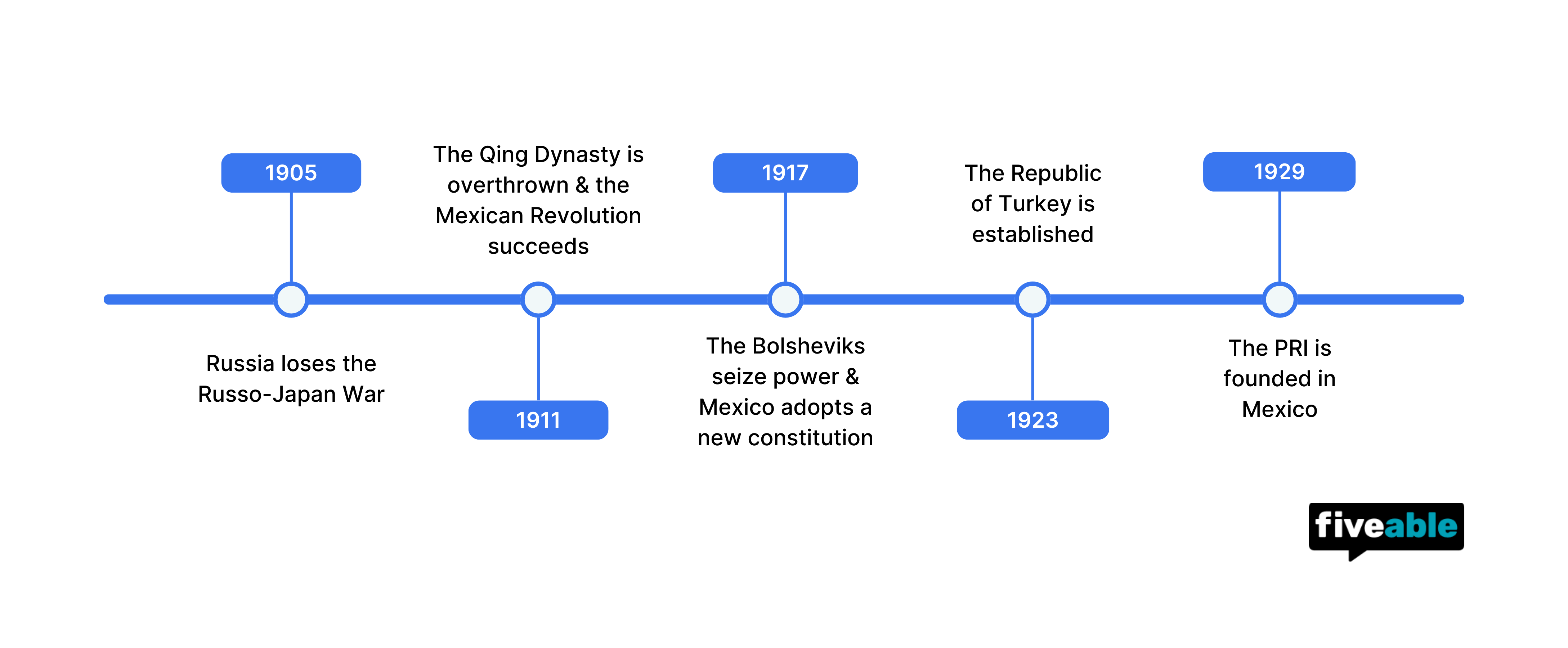
Timeline of events following shifting power after 1900. Image courtesy of Risha Vankalapati.
Key Takeaways
- Russia's weak economy contributed to military defeats, while Bloody Sunday and World War I brought deadly repression and food shortages.
- In 1917, Lenin's Bolsheviks seized power and established a communist government that abolished private trade and took over factories and heavy industries.
- Internal weakness and foreign pressure preceded the Qing Dynasty's overthrow in 1911, but warlords limited Sun Yat-sen's power in the new republic.
- After World War I defeat ended the Ottoman Empire, Mustafa Kemal's nationalists established the Republic of Turkey; Atatürk pursued secular, Western-style reforms while ruling as a dictator.
- Anger over Díaz's foreign ties and resistance to land reform fueled the Mexican Revolution; the 1917 constitution set reform goals, and the PRI later dominated politics.
Revolution in Russia
Russia fell behind Europe, the United States, and Japan in wealth and power, and the tsarist government refused to fix it. Nicholas II said it himself in 1905: he would "never, under any circumstances, agree to a representative form of government." He was assassinated in 1918.
The internal problems were structural:
- The government did little to promote economic growth while other industrializing states actively did.
- It was slow to expand peasant education, build roads and transportation networks, or support entrepreneurs with loans and contracts.
- It refused to recognize civil liberties or widen political participation.
A weak economy meant a weak military, which produced external humiliations:
- Russia lost the Crimean War (1853-1856) to the Ottoman Empire, backed by Britain and France.
- Russia lost the Russo-Japanese War (1904-1905) over influence in Korea and Manchuria. Japan won easily, the first time in modern history an East Asian state defeated a European power.
The road to 1917
- Bloody Sunday (January 22, 1905): Thousands of workers marched peacefully to petition the tsar for better working conditions, higher wages, and universal suffrage. The tsar's troops opened fire, killing about 1,300 marchers.
- The Revolution of 1905: In response, 400,000 workers went on strike. The tsar tried to appease the protesters, but thousands of workers ended up killed, injured, or exiled.
- World War I: Germany declared war on Russia in 1914. Russian troops were poorly trained and armed, and civilians faced extreme food shortages.
In fall 1917, the Bolsheviks, a party representing Russia's revolutionary working class under Vladimir Lenin, seized power and set up a communist government. Communists believed workers should eventually own the means of production, and that collective ownership would produce collective prosperity. The Soviet government abolished private trade, distributed peasants' crops to feed urban workers, and took over the country's factories and heavy industries (more on the Soviet economy in AMSCO 7.4 on the interwar economy).
Why this matters globally: the Bolsheviks were the first communists to run a large country. Capitalist nations from Europe to the United States to Japan now saw communism as a threat to their own governments, and the communism-versus-capitalism conflict shaped world affairs for the rest of the century.
Upheaval in China
The Qing Dynasty, in power since 1644, was overthrown by revolution in 1911 and replaced by a republic led first by Sun Yat-sen. Like Russia, China's collapse came from internal weakness plus foreign pressure.
Internal challenges
- Ethnic tension. The Qing rulers were Manchus from northeast of China, while the largest ethnic group was the Han. After two centuries of rule, the Qing remained ethnically distinct, and many Han never fully accepted them as legitimate.
- Famine. Population grew rapidly between the mid-1700s and mid-1800s, but farmland and productivity couldn't keep up. Any drought or flood could kill thousands.
- Low government revenue. The tax system was never updated for a changing economy, so the government couldn't maintain roads, bridges, or irrigation canals.
External challenges
China had been one of the world's wealthiest, most powerful states for most of its history, but European industrialization changed the balance starting in the late 18th century. Europeans could trade only at Canton (Guangzhou), buying tea, rhubarb, porcelain, and silk and paying in silver, because the Chinese didn't want European goods and viewed Europeans as violent and less civilized. As European influence grew, many Chinese rallied behind the empress in the 1890s, but it wasn't enough to save the dynasty.
Sun Yat-sen and the Chinese republic
Sun Yat-sen led the 1911 revolution. Though a Christian, he believed China should keep Confucian principles like loyalty, respect for ancestors, and social harmony. His book The Three People's Principles laid out his program:
- Democracy: sovereignty for the "able," meaning government by active, pragmatic experts in the name of the people. Expelling foreign capitalists would free up land-tax revenue (no more debts to foreigners) for fairer redistribution.
- Nationalism: patriotism and loyalty, primarily to central authority.
- Livelihood: ending China's extreme wealth inequality and harsh economic exploitation.
Sun's legacy outran his power. Warlords controlled most of the country, and after two months in office he handed power to a military leader. His party, the Kuomintang (Chinese Nationalist Party), later regained power and ruled for two decades before losing a civil war to the Chinese Communists (covered in AMSCO 7.5 on unresolved tensions after WWI). Both sides honored Sun as the republic's founder; neither fully implemented his principles.
Self-Determination in the Ottoman Collapse
By 1900 the Ottoman Empire was called "the sick man of Europe." It had few exports and a weakening agricultural economy, relying mostly on its position as a trade center (Egypt, by contrast, still profited from cotton).
The Young Turks and Turkification
As prosperity declined, reformers called the Young Turks pushed for a European-style constitution. They also pushed Turkification, an effort to make all citizens of the multiethnic empire identify with Turkish culture, which was heavily Islamic. For the millions of mostly Christian Armenians, this was a serious problem, and some Young Turks scapegoated Armenians for the empire's economic troubles.
World War I and the empire's end
Ottomans resented British and French economic policies. Foreign investment had given Europeans outsized power, and imposed trade privileges were unprofitable for the empire. That resentment pushed the Ottomans into a secret alliance with Germany in World War I (see AMSCO 7.2 on the causes of WWI). After Germany's defeat, the victors dismantled the empire and Allied troops occupied Anatolia. The sultan stayed on his throne but was a puppet for British forces.
Atatürk and the Republic of Turkey
The Turkish National Movement organized an army to fight for self-determination. Led by Mustafa Kemal, the Turkish Nationalists defeated British and other forces in 1921, and the Republic of Turkey was established in 1923 with Kemal as its first president. The national assembly gave him the surname Atatürk ("father of the Turks").
Atatürk wanted a secular, Western-style nation, not one shaped by strong Islamic influence. His reforms included public education for boys and girls, abolishing polygyny, and extending suffrage to women. He even wore Western suits and hats as a symbol. But don't confuse Westernizing with democratic: he ruled as a dictator for 15 years and held power until his death in 1938.
Power Shifts in Mexico
Mexico entered the 20th century under dictator Porfirio Díaz. He delivered stability and some economic progress, but at a cost. Foreign investors, especially from the United States, controlled many of Mexico's resources, and the wealthiest 1 percent of the population controlled 97 percent of the land. The typical peasant was landless.
The Mexican Revolution
In 1910, Díaz jailed opposition presidential candidate Francisco Madero. That move, plus anger over Díaz's strong-armed rule, accommodation of foreign powers, and resistance to land reform, ignited the Mexican Revolution. Madero escaped to El Paso, Texas, and set up revolutionary offices there. In 1911, his troops under Francisco "Pancho" Villa defeated Mexican forces and sent Díaz into exile. Emiliano Zapata began actually redistributing land to impoverished peasants.
The cost was staggering: between 1910 and 1920, conflict killed around 2 million people out of a population of about 15 million, and political violence continued for another decade.
Two lasting outcomes
- The Constitution of 1917 set goals of land redistribution, universal suffrage, and public education, principles that continued to guide Mexico's government.
- The Institutional Revolutionary Party (PRI), formed in 1929, dominated Mexican politics despite widespread criticism as corrupt. Every president until 2000 was a PRI member.
Key Terms to Know
| Term | Why it matters |
|---|---|
| Bolsheviks | Lenin's revolutionary working-class party that seized power in fall 1917 and set up the world's first communist government in a major country. |
| Communists | Believed workers should collectively own the means of production; in Russia they abolished private trade and took over factories. |
| Vladimir Lenin | Leader of the Bolsheviks and head of the new Soviet communist government. |
| Bloody Sunday | January 22, 1905 massacre of about 1,300 peaceful petitioning workers by the tsar's troops, sparking the Revolution of 1905. |
| Revolution of 1905 | Strike wave of 400,000 workers after Bloody Sunday; the tsar offered concessions but thousands were killed, injured, or exiled. |
| Russo-Japanese War | Russia's 1904-1905 loss to Japan over Korea and Manchuria, the first modern defeat of a European power by an East Asian state. |
| Sun Yat-sen | Led the 1911 revolution that ended the Qing Dynasty; his Three People's Principles were democracy, nationalism, and livelihood. |
| Kuomintang | Sun's Chinese Nationalist Party, which later ruled China for two decades before losing a civil war to the Communists. |
| Young Turks | Ottoman reformers who wanted a European-style constitution and pushed Turkification. |
| Turkification | Campaign to make all Ottoman citizens identify with Turkish (heavily Islamic) culture; mostly Christian Armenians were scapegoated under it. |
| Kemal Atatürk | Turkish Nationalist leader who founded the Republic of Turkey in 1923 and pushed secular, Western-style reforms while ruling as a dictator. |
| Porfirio Díaz | Mexican dictator whose foreign concessions and extreme land inequality (1 percent owned 97 percent of land) provoked revolution. |
| Francisco Madero | Opposition candidate whose 1910 jailing ignited the Mexican Revolution. |
| Francisco "Pancho" Villa | Commanded Madero's troops to victory in 1911, sending Díaz into exile. |
| Emiliano Zapata | Revolutionary leader who began redistributing land to landless peasants. |
| Mexican Revolution | The 1910-1920 uprising (roughly 2 million dead) that produced the Constitution of 1917 with land reform, universal suffrage, and public education. |
| Institutional Revolutionary Party (PRI) | Party founded in 1929 that supplied every Mexican president until 2000, bringing stability despite corruption. |
Practice and Next Steps
These notes pair with the 7.1 Shifting Power After 1900 course study guide, which frames the same content the way the AP exam tests it. Browse the rest of the chapter notes on the AP World AMSCO notes hub, starting with 7.2 on the causes of World War I, since the Russian and Ottoman stories here flow straight into that war.
To check yourself, run Unit 7 multiple-choice questions in guided practice and try a comparison or causation prompt in FRQ practice with instant scoring. The four-revolution structure of this topic is exactly the kind of internal-versus-external-factors setup that LEQ and SAQ prompts love.
Frequently Asked Questions
What is AMSCO Topic 7.1 Shifting Power about?
AMSCO 7.1 (p. 453-460) covers how internal weaknesses and external pressures brought down four authoritarian governments in the early 20th century: tsarist Russia, Qing China, the Ottoman Empire, and Porfirio Díaz's Mexico. Each collapse produced a new political order, including the world's first communist state in Russia, the Chinese republic, the Republic of Turkey, and Mexico's Constitution of 1917.
What internal and external factors caused the Russian Revolution?
Internally, the tsarist government failed to promote economic growth, expand education and infrastructure, or allow political participation, and Bloody Sunday (1905) killed about 1,300 peaceful petitioners. Externally, Russia lost the Crimean War and the Russo-Japanese War, then suffered badly in World War I with poorly armed troops and food shortages. The Bolsheviks under Lenin seized power in fall 1917 and set up a communist government.
What were Sun Yat-sen's Three People's Principles?
Democracy, nationalism, and livelihood. Democracy meant government by capable, pragmatic experts in the name of the people; nationalism meant patriotism and loyalty to central authority; livelihood meant ending China's extreme wealth inequality. Sun led the 1911 revolution that ended the Qing Dynasty, but warlords controlled most of China and he gave up power after two months.
Was Atatürk a democratic reformer or a dictator?
Both, which is the part students often miss. Atatürk founded the Republic of Turkey in 1923 and pushed Western-style reforms like public education for boys and girls, abolishing polygyny, and women's suffrage, but he ruled as a dictator for 15 years until his death in 1938. Westernizing reforms and authoritarian rule went together.
How does Topic 7.1 show up on the AP World exam?
Topic 7.1 is built for comparison and causation questions: explaining how internal and external factors caused state collapse in Russia, China, the Ottoman Empire, and Mexico. Practice pairing two of the four cases in an SAQ or LEQ format using FRQ practice with instant scoring, since prompts often ask you to compare causes or outcomes of early 20th-century revolutions.
See Fiveable more often in Google
Mark Fiveable as a preferred source and Google is more likely to show you our guides in Top Stories, with a "preferred" badge in AI Mode and AI Overviews.