AMSCO 9.3 Technology and the Environment Notes

🌍AP World History: Modern Review
AMSCO 9.3 Technology and the Environment Notes
🌍 AP World History: Modern
AMSCO 1.1 Developments in East Asia Notes
AMSCO 1.2 Developments in Dar al-Islam Notes
AMSCO 1.3 Developments in South and Southeast Asia Notes
AMSCO 1.4 Developments in the Americas Notes
AMSCO 1.5 Developments in Africa Notes
AMSCO 1.6 Developments in Europe Notes
AMSCO 1.7 Comparison in the Period from c.1200 to c.1450 Notes
AMSCO 2.1 The Silk Roads Notes
AMSCO 2.2 The Mongol Empire and the Modern World Notes
AMSCO 2.3 Exchange in the Indian Ocean Notes
AMSCO 2.4 Trans-Saharan Trade Routes Notes
AMSCO 2.5 Cultural Consequences of Connectivity Notes
AMSCO 2.6 Environmental Consequences of Connectivity Notes
AMSCO 2.7 Comparison of Economic Exchange Notes
AMSCO 3.1 European, East Asian, and Gunpowder Empires Expand Notes
AMSCO 3.2 Empires: Administrations Notes
AMSCO 3.3 Empires: Belief Systems Notes
AMSCO 3.4 Comparison in Land-Based Empires Notes
AMSCO 4.1 Technological Innovations Notes
AMSCO 4.2 Exploration: Causes and Events Notes
AMSCO 4.3 Columbian Exchange Notes
AMSCO 4.4 Maritime Empires Link Regions Notes
AMSCO 4.5 Maritime Empires Develop Notes
AMSCO 4.6 Internal and External Challenges to State Power Notes
AMSCO 4.7 Changing Social Hierarchies Notes
AMSCO 4.8 Continuity and Change from c.1450 to c.1750 Notes
AMSCO 5.1 The Enlightment Notes
AMSCO 5.2 Nationalism and Revolutions Notes
AMSCO 5.3 Industrial Revolution Begins Notes
AMSCO 5.4 Industrialization Spreads Notes
AMSCO 5.5 Technology in the Industrial Age Notes
AMSCO 5.6 Industrialization: Government's Role Notes
AMSCO 5.7 Economic Developments and Innovations Notes
AMSCO 5.8 Reactions to the Industrial Economy Notes
AMSCO 5.9 Society and the Industrial Age Notes
AMSCO 5.10 Continuity and Change in the Industrial Age Notes
AMSCO 6.1 Rationales for Imperialism Notes
AMSCO 6.2 State Expansion Notes
AMSCO 6.3 Indigenous Responses to State Expansion Notes
AMSCO 6.4 Global Economic Development Notes
AMSCO 6.5 Economic Imperialism Notes
AMSCO 6.6 Causes of Migration in an Interconnected World Notes
AMSCO 6.7 Effects of Migration Notes
AMSCO 6.8 Causation in the Imperial Age Notes
AMSCO 7.1 Shifting Power Notes
AMSCO 7.2 Causes of World War I Notes
AMSCO 7.3 Conducting World War I Notes
AMSCO 7.4 Economy in the Interwar Period Notes
AMSCO 7.5 Unresolved Tensions After World War I Notes
AMSCO 7.6 Causes of World War II Notes
AMSCO 7.7 Conducting World War II Notes
AMSCO 7.8 Mass Atrocities Notes
AMSCO 7.9 Causation in Global Conflict Notes
AMSCO 8.1 Setting the Stage for the Cold War and Decolonization Notes
AMSCO 8.2 The Cold War Notes
AMSCO 8.3 Effects of the Cold War Notes
AMSCO 8.4 Spread of Communism Notes
AMSCO 8.5 Decolonization after 1900 Notes
AMSCO 8.6 Newly Independent States Notes
AMSCO 8.7 Global Resistance to Established Power Structure Notes
AMSCO 8.8 End of the Cold War Notes
AMSCO 8.9 Causation in the Age of the Cold Ward and Decolonization Notes
AMSCO 9.1 Advances in Technology and Exchange Notes
AMSCO 9.2 Technological Advancements and Limitations Notes
AMSCO 9.3 Technology and the Environment Notes
AMSCO 9.4 Economics in the Global Age Notes
AMSCO 9.5 Calls for Reforms and Responses Notes
AMSCO 9.6 Globalized Culture Notes
AMSCO 9.7 Resistance to Globalization Notes
AMSCO 9.8 Institutions Developing in a Globalized World Notes
AMSCO 9.9 Continuity and Change in a Globalized World Notes
Overview
AMSCO Topic 9.3, "Technology and the Environment" (AMSCO p. 649-656), covers the causes and effects of environmental changes from 1900 to the present, the heart of Unit 9 (Globalization, 1900-present). The chapter explains how population growth, urbanization, and industrialization drove deforestation, desertification, declining air quality, and rising fresh water consumption, and how those changes sparked debates about global warming, agreements like the Kyoto Protocol and Paris Agreement, and movements like the Green Belt Movement. The essential question to keep in mind: what were the causes and effects of environmental changes from 1900 to the present?
The big picture: more people, bigger cities, and global industry put unprecedented pressure on Earth's resources, and humans competed over those resources more intensely than ever before. Then the world started arguing about what to do.
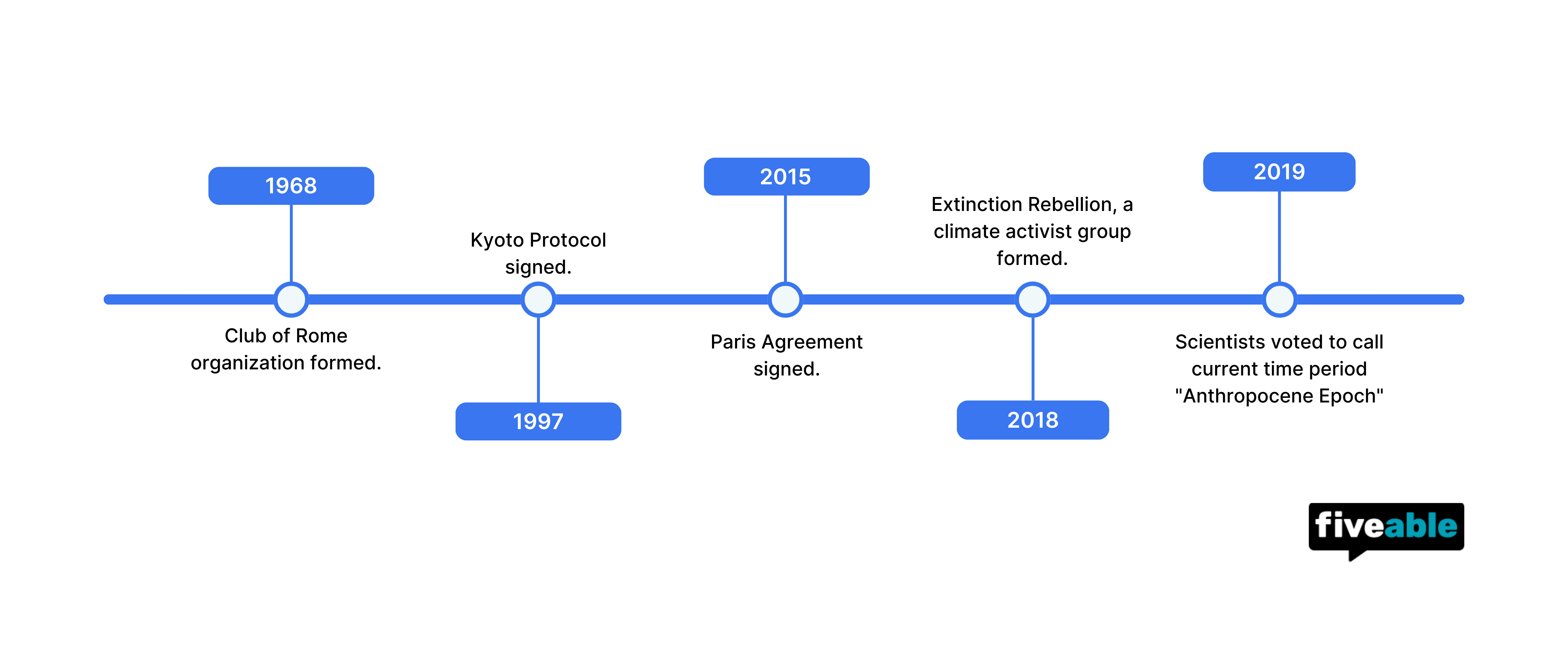
Timeline of events for Technology and the Environment. Image courtesy of Samhitha.
Key Takeaways
- Population growth increased demand for cropland, expanding cities put pressure on farms and forests, and industrialization raised demand for energy and natural resources.
- Industrial growth intensified resource depletion, while water scarcity hit poor regions hardest and left many women and children spending time collecting water instead of earning income or attending school.
- Industrialization increased greenhouse gas emissions; companies and nations invested in renewable energy, while Kenya's Green Belt Movement planted trees to protect ecosystems and improve soil.
- Scientists linked fossil fuel emissions to global warming, but skeptics questioned whether warming was happening or humans caused it, and governments disagreed over how to cut emissions.
- The Kyoto Protocol was weakened by the US refusal to ratify it and less strict terms for China and India; 195 countries signed the Paris Agreement, but the US later announced its withdrawal.
- Greta Thunberg's climate strikes and Extinction Rebellion's civil disobedience pressed for action, while some scientists proposed 'Anthropocene' as a name reflecting humans' widespread impact on Earth.
Causes of Environmental Change
Three interconnected forces drove environmental change after 1900: population growth, urbanization, and the global spread of industrialization. Each one multiplied the others.
Population Growth
The numbers tell the story. World population went from 1.6 billion in 1900 to 2.55 billion in 1950 to 6.12 billion by 2000.
- Billions more people meant billions more mouths to feed, so demand for cropland exploded. Converting land to agriculture caused deforestation, soil erosion, and shrinking habitats for plant and animal species.
- Water resources suffered too. Overfishing led to the near disappearance of cod, and growing populations consumed more and more fresh water (a renewable resource, but not an unlimited one).
Urbanization
Cities got bigger and more numerous. By some estimates, 5.1 billion people will live in cities by 2025.
- More city dwellers pressures farmers to use intensive farming methods that deplete soil and cause erosion, or to clear more forests for agriculture.
- Cities also produce massive amounts of waste, some of which pollutes the water people depend on.
Globalization and Industrialization
As industry spread to developing countries, demand for energy and natural resources drew further on the world's reserves. Industrial jobs created a new middle class in those countries, and that middle class wanted consumer goods like cars, which require metals to build and contribute to pollution once on the road. This connects directly to the technology story in AMSCO 9.1 on advances in technology and exchange.
Effects of Environmental Changes
Humans have always competed for raw materials, but industrialization made that competition far more intense. The chapter highlights four major effects: resource depletion, inequality tied to scarce resources, changes in the atmosphere, and a counter-trend of renewable energy and environmental awareness.
Resource Depletion
- Petroleum extraction began in earnest in the mid-1800s and powered the Industrial Revolution. About half of Earth's finite petroleum reserves have already been used up.
- Some experts predict the remaining half could be used up within the next 30 to 40 years given rapid urban and industrial growth.
- Coal supplies will last longer, but if coal replaces petroleum, coal reserves could be depleted in 60 years.
Inequality and Water Scarcity
Scarce resources hit poor regions hardest, and water is the clearest example.
- According to the United Nations, 31 countries face water scarcity, and more than 1 billion people lack clean, accessible drinking water.
- The World Health Organization predicts that by 2025, half of the world's population will lack clean and safe drinking water.
- Water scarcity deepens gender inequality. Surveys in 45 developing countries show women and children bear primary responsibility for collecting water, time not spent earning income or attending school. A study in Ghana found that cutting water collection time by 15 minutes raises girls' school attendance by 8 to 12 percent.
- In 2015, world leaders agreed to 17 goals for a better world by 2030, many addressing extreme poverty, inequality, and climate change.
Changes in the Atmosphere
Factories, automobiles, airplanes, and other products of industrialization emit huge amounts of pollutants, including carbon dioxide and other greenhouse gases. Greenhouse gases let the sun's heat reach Earth but trap it from escaping. Meanwhile, Earth's natural carbon-trapping resources (forests and ground cover on unused farmland) are shrinking. So more heat gets trapped just as nature's ability to absorb carbon declines.
Renewable Energy and Environmental Awareness
The pushback started in the late 20th century and gained momentum fast.
- Worried about unsustainable demand for fossil fuels (coal, oil, petroleum, natural gas), companies and nations invested in renewable energy from continuously replenished sources: wind, solar, tidal, and geothermal power.
- High costs slowed development at first, but new techniques and technologies cut costs. Renewables provide only about 7 percent of the world's energy needs, but a 2018 study predicted that by 2050, half the world's electricity will come from wind and solar power.
- In 1968, the Club of Rome (scientists, industrialists, diplomats, and others) formed in Europe to promote solutions to global challenges, warning that resource depletion would limit economic growth.
- People in many countries joined Green Parties focused on environmental issues.
- The Green Belt Movement worked to protect wilderness areas from urban growth. By the 21st century, it had planted more than 51 million trees in Kenya, preserving ecosystems, lessening greenhouse gas effects, creating jobs, and improving soil quality. This movement also shows up in AMSCO 9.5 on calls for reform.
Debates About Global Warming
Most government leaders agree that global warming requires a global response, but countries disagree on how to reduce carbon emissions. That disagreement is the core of this section.
The Scientific Case and the Skeptics
- Scientists, including the UN's Intergovernmental Panel on Climate Change (IPCC), cited data showing that carbon dioxide and other greenhouse gas emissions from burning fossil fuels were causing global warming, an increase in Earth's average temperature.
- Experts urged governments to reduce their carbon footprint, the amount of carbon dioxide each person produces. Without reductions, global warming would bring more powerful hurricanes, more severe droughts, and rising sea levels that could flood islands and coastal areas.
- Some activists argued "global warming" sounded too mild and used "climate emergency" or "climate crisis" instead.
- Climate-change skeptics questioned whether warming was happening and whether humans influenced it. Some in the energy industries resisted government interference, arguing market forces would push consumers to cut their carbon footprint if needed. Other energy company leaders began planning a shift to renewable fuels.
Kyoto Protocol (1997)
The first major international agreement to reduce carbon emissions. Developed nations in Western Europe and the United States argued that developing countries like China, India, Russia, and Brazil needed to curb their rapidly rising carbon dioxide output. The deal had two big weaknesses: the United States refused to ratify it, and China and India were not required to agree to the strictest terms.
Paris Agreement (2015)
In 2015, 195 countries signed the Paris Agreement, raising new hope for progress against global warming. Leaders of both the United States and China supported it, a big shift from Kyoto. However, in 2017, President Donald Trump announced the United States would withdraw from the agreement.
Climate Activism
- Greta Thunberg, a 15-year-old Swedish activist, told world leaders at a 2018 UN climate conference, "You say you love your children above all else, and yet you are stealing their future in front of their very eyes." Starting with a solo protest in Sweden, she eventually led a global climate strike with more than 1.6 million participants in over 125 countries.
- Extinction Rebellion, formed in 2018, used civil disobedience in London: blocking a main bridge and key intersections for over a week and chaining themselves to corporate headquarters. About a thousand people were arrested, but Members of Parliament called a citizens' assembly to discuss the climate emergency.
- Citizen groups in many countries continue pressuring lawmakers, drawing on IPCC reports predicting the consequences of continued warming. For more on grassroots pressure in this era, see AMSCO 9.7 on resistance to globalization.
A New Age? Holocene vs. Anthropocene
Some scientists argue humans have changed the planet so much that we need a new name for our geological epoch.
- Geologists traditionally call the current period the Holocene epoch, meaning "entirely recent." It began about 11,700 years ago at the end of the last significant ice age.
- Some scientists proposed the name Anthropocene, meaning "new man," because humans now affect almost the entire planet. In 2019, a panel of scientists voted to approve the name.
- The Anthropocene label captures the chapter's central idea: humans are now the strongest influence on Earth's climate and environment, for better and for worse.
Key Terms to Know
| Term | Why it matters |
|---|---|
| Deforestation | The loss of Earth's trees from cutting them down so land can be used for agriculture, driven by population growth after 1900. |
| Desertification | The removal of natural vegetation cover through expansion and intensive use of agricultural land in arid and semi-arid regions. |
| Air quality | Declined worldwide as industrialization pumped pollutants into the atmosphere from factories, cars, and airplanes. |
| Greenhouse gases | Gases like carbon dioxide that let the sun's heat reach Earth but trap it from escaping, the mechanism behind global warming. |
| Fossil fuels | Coal, oil, petroleum, and natural gas; burning them releases the greenhouse gases at the center of climate debates. |
| Water scarcity | A crisis facing 31 countries; over 1 billion people lack clean drinking water, and the burden falls hardest on women and children. |
| Renewable energy | Energy from continuously replenished sources (wind, solar, tidal, geothermal); about 7 percent of world energy, but growing fast. |
| Global warming | The increase in Earth's average temperature, which scientists link to fossil fuel emissions. |
| Carbon footprint | The amount of carbon dioxide each person produces; experts urge governments to reduce it. |
| Kyoto Protocol | The first major international agreement to cut carbon emissions (1997), weakened by US refusal to ratify it. |
| Paris Agreement | The 2015 climate deal signed by 195 countries, supported by the US and China until the announced US withdrawal in 2017. |
| Green Party | A political party focused on environmental issues; such parties emerged in many countries. |
| Green Belt Movement | A movement that planted over 51 million trees in Kenya, protecting ecosystems while creating jobs and improving soil. |
| Club of Rome | A 1968 European organization of scientists, industrialists, and diplomats warning that resource depletion would limit economic growth. |
| Anthropocene | The proposed name for our current epoch (approved by a scientific panel in 2019), reflecting humanity's dominant influence on Earth. |
| Holocene | The traditional name for our geological epoch, which began about 11,700 years ago after the last major ice age. |
Practice and Next Steps
Pair these notes with the Topic 9.3 course study guide on debates about the environment after 1900 for the College Board framing, and browse the full set of AP World AMSCO notes to keep moving through Unit 9. The next chapter, AMSCO 9.4 Economics in the Global Age, shifts from environmental to economic globalization.
To check yourself, run some guided multiple-choice practice on Unit 9, try an environment-themed prompt with FRQ practice and instant scoring, or quiz yourself on vocab with the key terms glossary. Cause-and-effect questions about environmental change from 1900 to the present are exactly what this topic feeds on the exam, so practice framing population growth, urbanization, and industrialization as causes and resource depletion, climate debates, and activism as effects.
Frequently Asked Questions
What is AMSCO Topic 9.3 about in AP World?
AMSCO 9.3, Technology and the Environment (p. 649-656), covers the causes and effects of environmental changes from 1900 to the present. Causes include population growth, urbanization, and industrialization; effects include deforestation, desertification, water scarcity, resource depletion, and debates over global warming and climate agreements.
What is the difference between the Kyoto Protocol and the Paris Agreement?
The Kyoto Protocol (1997) was the first major international agreement to reduce carbon emissions, but the United States refused to ratify it and China and India weren't held to its strictest terms. The Paris Agreement (2015) was signed by 195 countries with support from both the US and China, though the US announced its withdrawal in 2017.
What does Anthropocene mean in AP World History?
Anthropocene means "new man" and is the proposed name for our current geological epoch, replacing Holocene. A panel of scientists voted to approve the name in 2019 because humans are now the strongest influence on Earth's climate and environment. The Holocene began about 11,700 years ago at the end of the last major ice age.
Is global warming the same thing as greenhouse gases?
No, but they're connected. Greenhouse gases like carbon dioxide are gases that let the sun's heat reach Earth but trap it from escaping. Global warming is the result: the increase in Earth's average temperature that scientists link to greenhouse gas emissions from burning fossil fuels. On the exam, treat emissions as the cause and warming as the effect.
How does Topic 9.3 show up on the AP World exam?
Questions on this topic ask you to explain causes and effects of environmental change from 1900 to the present. Be ready to connect population growth, urbanization, and industrialization to deforestation, water scarcity, and resource competition, and to discuss debates over climate change like Kyoto and Paris. You can practice with FRQ prompts and instant scoring.
See Fiveable more often in Google
Mark Fiveable as a preferred source and Google is more likely to show you our guides in Top Stories, with a "preferred" badge in AI Mode and AI Overviews.