AMSCO 4.5 Maritime Empires Develop Notes

🌍AP World History: Modern Review
AMSCO 4.5 Maritime Empires Develop Notes
🌍 AP World History: Modern
AMSCO 1.1 Developments in East Asia Notes
AMSCO 1.2 Developments in Dar al-Islam Notes
AMSCO 1.3 Developments in South and Southeast Asia Notes
AMSCO 1.4 Developments in the Americas Notes
AMSCO 1.5 Developments in Africa Notes
AMSCO 1.6 Developments in Europe Notes
AMSCO 1.7 Comparison in the Period from c.1200 to c.1450 Notes
AMSCO 2.1 The Silk Roads Notes
AMSCO 2.2 The Mongol Empire and the Modern World Notes
AMSCO 2.3 Exchange in the Indian Ocean Notes
AMSCO 2.4 Trans-Saharan Trade Routes Notes
AMSCO 2.5 Cultural Consequences of Connectivity Notes
AMSCO 2.6 Environmental Consequences of Connectivity Notes
AMSCO 2.7 Comparison of Economic Exchange Notes
AMSCO 3.1 European, East Asian, and Gunpowder Empires Expand Notes
AMSCO 3.2 Empires: Administrations Notes
AMSCO 3.3 Empires: Belief Systems Notes
AMSCO 3.4 Comparison in Land-Based Empires Notes
AMSCO 4.1 Technological Innovations Notes
AMSCO 4.2 Exploration: Causes and Events Notes
AMSCO 4.3 Columbian Exchange Notes
AMSCO 4.4 Maritime Empires Link Regions Notes
AMSCO 4.5 Maritime Empires Develop Notes
AMSCO 4.6 Internal and External Challenges to State Power Notes
AMSCO 4.7 Changing Social Hierarchies Notes
AMSCO 4.8 Continuity and Change from c.1450 to c.1750 Notes
AMSCO 5.1 The Enlightment Notes
AMSCO 5.2 Nationalism and Revolutions Notes
AMSCO 5.3 Industrial Revolution Begins Notes
AMSCO 5.4 Industrialization Spreads Notes
AMSCO 5.5 Technology in the Industrial Age Notes
AMSCO 5.6 Industrialization: Government's Role Notes
AMSCO 5.7 Economic Developments and Innovations Notes
AMSCO 5.8 Reactions to the Industrial Economy Notes
AMSCO 5.9 Society and the Industrial Age Notes
AMSCO 5.10 Continuity and Change in the Industrial Age Notes
AMSCO 6.1 Rationales for Imperialism Notes
AMSCO 6.2 State Expansion Notes
AMSCO 6.3 Indigenous Responses to State Expansion Notes
AMSCO 6.4 Global Economic Development Notes
AMSCO 6.5 Economic Imperialism Notes
AMSCO 6.6 Causes of Migration in an Interconnected World Notes
AMSCO 6.7 Effects of Migration Notes
AMSCO 6.8 Causation in the Imperial Age Notes
AMSCO 7.1 Shifting Power Notes
AMSCO 7.2 Causes of World War I Notes
AMSCO 7.3 Conducting World War I Notes
AMSCO 7.4 Economy in the Interwar Period Notes
AMSCO 7.5 Unresolved Tensions After World War I Notes
AMSCO 7.6 Causes of World War II Notes
AMSCO 7.7 Conducting World War II Notes
AMSCO 7.8 Mass Atrocities Notes
AMSCO 7.9 Causation in Global Conflict Notes
AMSCO 8.1 Setting the Stage for the Cold War and Decolonization Notes
AMSCO 8.2 The Cold War Notes
AMSCO 8.3 Effects of the Cold War Notes
AMSCO 8.4 Spread of Communism Notes
AMSCO 8.5 Decolonization after 1900 Notes
AMSCO 8.6 Newly Independent States Notes
AMSCO 8.7 Global Resistance to Established Power Structure Notes
AMSCO 8.8 End of the Cold War Notes
AMSCO 8.9 Causation in the Age of the Cold Ward and Decolonization Notes
AMSCO 9.1 Advances in Technology and Exchange Notes
AMSCO 9.2 Technological Advancements and Limitations Notes
AMSCO 9.3 Technology and the Environment Notes
AMSCO 9.4 Economics in the Global Age Notes
AMSCO 9.5 Calls for Reforms and Responses Notes
AMSCO 9.6 Globalized Culture Notes
AMSCO 9.7 Resistance to Globalization Notes
AMSCO 9.8 Institutions Developing in a Globalized World Notes
AMSCO 9.9 Continuity and Change in a Globalized World Notes
Overview
AMSCO Topic 4.5, "Maritime Empires Develop" (starting on AMSCO p. 232), covers how European sea-based empires built economic power between 1450 and 1750 using mercantilism, joint-stock companies, and chartered monopolies, and how the Atlantic trading system reshaped Africa, the Americas, and global religion. The chapter's shorthand for the era: silver, sugar, and slavery built these empires. It sits in the middle of Unit 4, picking up right after AMSCO 4.4 on how maritime empires linked regions and tracing the effects of all that new connection.
The chapter's essential question asks what economic strategies maritime empires used to increase their power, and how those empires changed political, economic, religious, and cultural dynamics.
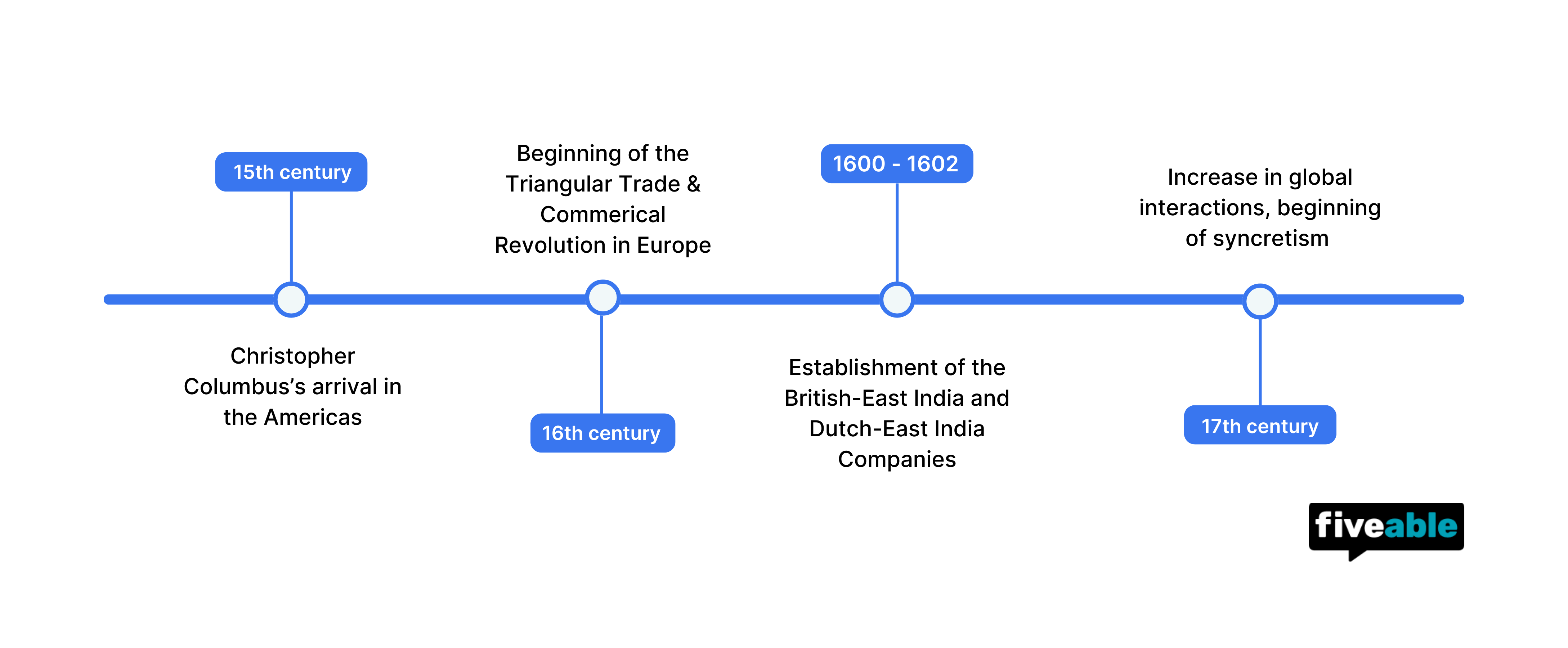
Timeline of events before and during the rise of maritime empires. Image courtesy of Ananya Uppu.
Key Takeaways
- Mercantilist states tried to gain gold and silver by selling more than they bought, while joint-stock companies let investors share the profits and risks of overseas trade.
- Triangular trade moved manufactured goods to Africa, enslaved Africans to the Americas, and American products to Europe; states also fought over Indian Ocean trade routes.
- American silver connected Asian goods to Atlantic markets, European rulers granted trading monopolies, and older regional trade networks continued alongside global trade.
- The Atlantic slave trade slowed population growth in parts of West Africa and skewed gender ratios, while American crops later helped spur population growth despite the loss of people.
- Spain governed its American colonies through viceroys and audiencias, while Spanish and Portuguese conquest erased many indigenous traditions; by 1750, creoles held political dominance in New Spain.
- Enslaved Africans blended Christianity with West African traditions in faiths such as Santería, while the Sunni-Shi'a split worsened conflict between the Ottoman and Safavid empires.
Economic Strategies and the Commercial Revolution
In the 17th century, Europeans measured a country's wealth by how much gold and silver it held. So states followed a simple playbook: sell as many goods as possible to other countries to pull in precious metals, and buy as little as possible from anyone else. That's mercantilism in a nutshell.
- Capital (wealth available to produce more wealth) piled up in Western Europe as entrepreneurs entered long-distance markets. Laborers got paid in money, which turned them into consumers and even small investors.
- Despite Church restrictions, lending money at interest became commonplace.
- Gold and silver from the Western Hemisphere pumped real wealth into the system.
The shift to a trade-based economy running on gold and silver is the Commercial Revolution. AMSCO names four causes: European overseas colonies, new ocean trade routes, population growth, and inflation. The intense inflation of the 16th and early 17th centuries, driven partly by all that newly mined silver flooding into circulation, is called the Price Revolution.
Joint-Stock Companies
Joint-stock companies were the engine of maritime empire. Investors bought shares in a company, then split both the profits and the risks of exploration and trading ventures. Limited liability made investing safer: you could only lose what you put in, never more.
- The Dutch, English, and French all built joint-stock companies in the 17th century, including the British East India Company (1600) and the Dutch East India Company (1602).
- Spain and Portugal took a different path. Their governments did most of the investing themselves through grants to individual explorers.
- A growing European middle class supplied the investment capital and the appetite for imported luxuries.
Dutch Finance and Financial Bubbles
The Dutch were Europe's commercial middlemen, with trade routes to Latin America, North America, South Africa, and Indonesia. Their ships were faster and lighter than rivals' for most of the 17th century, and the Dutch East India Company made enormous profits in the Spice Islands and Southeast Asia. The Dutch had a stock exchange by 1602, and by 1609 the Bank of Amsterdam traded currency internationally. Their standard of living was the highest in Europe.
France and England weren't so lucky. Early in the 18th century, both got burned by financial bubbles, speculative schemes where a buying frenzy drove share prices up until the bubble burst, bankrupting investors and damaging whole economies.
Triangular Trade and Rivalries Over Trade Routes
The triangular trade was the Atlantic system with three legs. A ship might carry European manufactured goods (like firearms) to West Africa, transport enslaved Africans across the Atlantic to the Americas, then load sugar or tobacco for Europe. Sugar was the most profitable American good. By the 1700s, Caribbean sugar and rum were financing fortunes in Britain, and to a lesser extent in France and the Netherlands.
The Indian Ocean Still Mattered
Atlantic trade was new and huge, but states kept fighting over Indian Ocean routes too.
- In 1509, the Portuguese defeated a combined Muslim and Venetian naval force in the Arabian Sea (covered in Topic 4.4).
- In 1578, the Portuguese lost a land battle against Moroccan forces.
- Morocco, broke after that victory, turned inland to seize the wealth of the Songhai Kingdom, even though attacking a fellow Muslim state was prohibited. In 1590, near Gao, Moroccan firearms and cannons overwhelmed Songhai's larger army. The empire crumbled, and the Spanish and Portuguese soon took over much of its territory.
The takeaway for the AP exam: economic competition over trade routes produced real military conflict, on both water and land.
Continuity and Change in Trade Networks
Trade became genuinely global for the first time, but old regional networks didn't disappear. This is a classic AP World continuity-and-change setup.
What changed:
- Silver from Spanish colonies in the Americas flowed to Asia, where Asians traded silks, porcelain, and steel products for it. Those Asian goods then sold in Atlantic markets.
- European rulers chartered monopolies, granting certain merchants (usually a joint-stock company) or the government itself the exclusive right to trade something. Spain's tobacco monopoly, first over domestic tobacco and then over its colonies' crop, supplied about one-third of total Spanish government revenue.
What continued:
- Traditional regional markets kept flourishing across Afro-Eurasia.
- Peasant and artisan labor intensified to feed global demand: wool and linen from Western Europe, cotton from India, silk from China, all changing hands in globally connected port cities. Improved shipping let merchants move bigger volumes than ever.
Effects of the Atlantic Slave Trade on Africa
The slave trade devastated several West African kingdoms, such as Kongo. Losing so many people slowed population growth, and competition over the trade made slave-raiding kingdoms economically dependent on European goods instead of developing their own complex economies. AMSCO argues this set the stage for European conquest of Africa in the late 19th century.
- Societies that conducted slave raids, like the Dahomey and the Oyo, got richer selling captives to Europeans.
- The trade had a gun-driven political effect: raiders who exchanged enslaved people for firearms could overpower rival societies that had none, which made raiders richer and better armed, which fueled more raids. Intergroup warfare became more common and bloodier.
Gender Imbalance
The hardest-hit regions were in present-day Ghana and Benin. More than two-thirds of those taken were males, leaving a severe gender imbalance. The resulting predominance of women drove a rise in polygyny (taking more than one wife) and pushed women into work that had traditionally been men's.
New Foods, Population Growth
One countervailing effect: the Columbian Exchange brought American crops like maize, peanuts, and manioc (cassava) to Africa. These became dietary staples and ultimately spurred population growth even as the slave trade drained people away.
Political and Cultural Changes for Indigenous Peoples
Earlier land-based empires (Roman, Muslim, Mongol) usually tolerated conquered peoples' traditions or grafted their own on top. The Spanish and Portuguese empires in the Americas were different: within a century of contact, they erased the basic social structures and many cultural traditions of indigenous Americans, and European actions nearly depopulated the Americas.
Colonial Administration
Spanish royalty appointed viceroys to govern as representatives of the crown. To keep viceroys in check, Spain set up audiencias, royal courts where settlers could appeal a viceroy's decisions. Even so, slow transatlantic transportation and communication made direct royal control difficult, so the Spanish throne didn't focus much on colonial affairs.
Cultural Erasure and the Sources Problem
Conquistadors such as Cortés in Mexico ordered native books burned as unholy, so very few original accounts in Nahuatl (the Aztec language) survive. That means most of what we know about the Aztec comes from documents written by Spanish conquistadores and priests after the conquest, sources limited by bias and unfamiliarity with Nahuatl. One reliable exception: the Florentine Codex, which the Spanish priest Bernardino de Sahagún began compiling in 1545. It remains one of the most cited sources on pre-conquest Aztec life. This is great DBQ-style sourcing material.
Spanish and Portuguese conquerors transplanted their languages and religion. Spanish dominates Latin America today (with indigenous languages surviving in places like Guatemala and the mountains of Mexico), and Brazilians overwhelmingly speak Portuguese. By 1750, creoles (people of Spanish origin born in the Americas) held political dominance in New Spain and were starting to push for independence.
Belief Systems: Syncretism and Conflict
New hemispheric connections extended existing religions, produced syncretic (blended) belief systems, and sparked religious conflicts.
Syncretic Religions in the Americas
Enslaved Africans melded Christianity (usually Roman Catholicism) with West African traditions like drumming, dancing, and belief in spirits acting through a person:
- Santería ("the way of the saints") became popular in Cuba, then spread through Latin America and to North America.
- Vodun ("spirit" or "deity") originated among enslaved Dahomey, Kongo, and Yoruba peoples in Saint-Domingue (now Haiti).
- Candomblé ("dance to honor the gods") combined Yoruba, Fon, and Bantu beliefs and developed in Brazil.
- In the United States, enslaved Africans laid the roots of the African American church, a hybrid of Christianity and African spiritual traditions.
About 1 in 10 enslaved Africans practiced Islam, making them the first significant Muslim presence in the Americas.
In Latin America, Catholic orders (Dominicans, Jesuits, Franciscans) sent missionaries so successfully that most Latin Americans today are Roman Catholic. Syncretism showed up here too: Catholic saints' days that coincided with indigenous holy days were especially celebrated, and a cult grew in Mexico around the dark-complexioned Virgin of Guadalupe, revered for performing miracles.
Syncretism and Conflict in Afro-Eurasia
- Sufism, with its focus on personal salvation, helped spread Islam and may have influenced Sikhism, which blended Muslim and Hindu beliefs. The Mughal leader Akbar tried to mediate Muslim-Hindu conflicts.
- The Sunni-Shi'a split worsened conflict between the Ottoman and Safavid empires.
- The Catholic-Protestant split, plus tensions between state churches like Anglicanism and other Protestant sects, helped drive settlement of North America as people sought freedom to worship.
Key Terms to Know
| Term | Why it matters |
|---|---|
| Capital | Wealth available to produce more wealth; its accumulation funded Europe's long-distance trade ventures. |
| Commercial Revolution | The shift to a trade-based economy using gold and silver, driven by colonies, new routes, population growth, and inflation. |
| Price Revolution | The high inflation of the 16th and early 17th centuries, fueled partly by American silver flooding into circulation. |
| Joint-stock companies | Investor-owned companies that spread the risk of exploration and colonization, powering maritime empires. |
| Limited liability | The rule that investors can only lose what they invested, which made backing risky voyages much safer. |
| British East India Company | English joint-stock company founded in 1600 to compete in Asian trade. |
| Dutch East India Company | Joint-stock company founded in 1602 that made enormous profits in the Spice Islands and Southeast Asia. |
| Triangular trade | The three-leg Atlantic system moving manufactured goods to Africa, enslaved people to the Americas, and sugar or tobacco to Europe. |
| Monopolies | Exclusive trading rights chartered by European rulers; Spain's tobacco monopoly supplied about a third of its revenue. |
| Viceroys | Royal administrators who governed Spanish America on behalf of the crown. |
| Audiencias | Royal courts where Spanish settlers could appeal a viceroy's decisions, a check on viceroy power. |
| Creoles | People of Spanish origin born in the Americas; politically dominant in New Spain by 1750 and soon pushing for independence. |
| Polygyny | The practice of taking more than one wife, which rose in West Africa after the slave trade skewed gender ratios. |
| Syncretism | The blending of different religious beliefs and practices, like African traditions merging with Catholicism. |
| Santería | Syncretic Afro-Caribbean faith ("the way of the saints") that became popular in Cuba and spread widely. |
| Vodun | Syncretic belief system ("spirit") created by enslaved Africans in Saint-Domingue, now Haiti. |
| Candomblé | Brazilian syncretic religion ("dance to honor the gods") blending Yoruba, Fon, and Bantu beliefs. |
| Virgin of Guadalupe | Miracle-working Marian figure in Mexico, a key example of Catholic-indigenous syncretism. |
Practice and Next Steps
Pair these notes with the 4.5 Maritime Empires Maintained and Developed study guide, which approaches the same topic from the course framework side. Then keep moving through the unit with the AMSCO 4.6 notes on internal and external challenges to state power, or browse the full set of AP World AMSCO notes.
To check your understanding, run through guided multiple-choice practice on Unit 4, and use the key terms glossary to drill vocabulary like mercantilism, syncretism, and joint-stock companies until the definitions come automatically.
Frequently Asked Questions
What is the main idea of AMSCO Topic 4.5 Maritime Empires Develop?
Topic 4.5 explains how European maritime empires built power between 1450 and 1750 through mercantilism, joint-stock companies, and chartered monopolies. AMSCO sums up the era with three keys: silver, sugar, and slavery. The chapter also traces effects on Africa (slave trade), the Americas (colonial administration and cultural erasure), and religion (syncretic faiths like Santería and Vodun).
What is the difference between the Commercial Revolution and the Price Revolution?
The Commercial Revolution was the broad shift to a trade-based economy using gold and silver, caused by overseas colonies, new ocean routes, population growth, and inflation. The Price Revolution was one piece of that: the intense inflation of the 16th and early 17th centuries, driven partly by American silver flooding into circulation. So the Price Revolution is a cause and component of the larger Commercial Revolution, not a synonym for it.
Why were joint-stock companies important for maritime empires?
Joint-stock companies let investors buy shares in trading ventures and split both profits and risks, while limited liability meant no one could lose more than they invested. That made it safe to fund risky exploration and colonization, so the British East India Company (1600) and Dutch East India Company (1602) became driving forces behind European maritime empires. Spain and Portugal differed: their governments invested directly through grants to explorers.
How did the Atlantic slave trade affect West Africa?
The slave trade weakened kingdoms like Kongo by slowing population growth, made slave-raiding societies like the Dahomey and Oyo dependent on European goods and guns, and made intergroup warfare more common and bloodier. Because more than two-thirds of those taken were male, gender ratios skewed, polygyny rose, and women took on traditionally male work. One counterweight: Columbian Exchange crops like maize, peanuts, and manioc improved diets and eventually spurred population growth.
How does Topic 4.5 show up on the AP World exam?
Topic 4.5 is prime material for continuity-and-change questions: silver flowing to Asia and chartered monopolies were new, while Afro-Eurasian regional markets and peasant/artisan labor (Indian cotton, Chinese silk, European wool) continued and intensified. It also feeds comparison questions on syncretic religions and DBQ sourcing skills, since AMSCO highlights why Spanish-written accounts of the Aztec are biased. Practice applying these with Fiveable's guided MCQ practice.
See Fiveable more often in Google
Mark Fiveable as a preferred source and Google is more likely to show you our guides in Top Stories, with a "preferred" badge in AI Mode and AI Overviews.