AMSCO 6.5 Economic Imperialism Notes

🌍AP World History: Modern Review
AMSCO 6.5 Economic Imperialism Notes
🌍 AP World History: Modern
AMSCO 1.1 Developments in East Asia Notes
AMSCO 1.2 Developments in Dar al-Islam Notes
AMSCO 1.3 Developments in South and Southeast Asia Notes
AMSCO 1.4 Developments in the Americas Notes
AMSCO 1.5 Developments in Africa Notes
AMSCO 1.6 Developments in Europe Notes
AMSCO 1.7 Comparison in the Period from c.1200 to c.1450 Notes
AMSCO 2.1 The Silk Roads Notes
AMSCO 2.2 The Mongol Empire and the Modern World Notes
AMSCO 2.3 Exchange in the Indian Ocean Notes
AMSCO 2.4 Trans-Saharan Trade Routes Notes
AMSCO 2.5 Cultural Consequences of Connectivity Notes
AMSCO 2.6 Environmental Consequences of Connectivity Notes
AMSCO 2.7 Comparison of Economic Exchange Notes
AMSCO 3.1 European, East Asian, and Gunpowder Empires Expand Notes
AMSCO 3.2 Empires: Administrations Notes
AMSCO 3.3 Empires: Belief Systems Notes
AMSCO 3.4 Comparison in Land-Based Empires Notes
AMSCO 4.1 Technological Innovations Notes
AMSCO 4.2 Exploration: Causes and Events Notes
AMSCO 4.3 Columbian Exchange Notes
AMSCO 4.4 Maritime Empires Link Regions Notes
AMSCO 4.5 Maritime Empires Develop Notes
AMSCO 4.6 Internal and External Challenges to State Power Notes
AMSCO 4.7 Changing Social Hierarchies Notes
AMSCO 4.8 Continuity and Change from c.1450 to c.1750 Notes
AMSCO 5.1 The Enlightment Notes
AMSCO 5.2 Nationalism and Revolutions Notes
AMSCO 5.3 Industrial Revolution Begins Notes
AMSCO 5.4 Industrialization Spreads Notes
AMSCO 5.5 Technology in the Industrial Age Notes
AMSCO 5.6 Industrialization: Government's Role Notes
AMSCO 5.7 Economic Developments and Innovations Notes
AMSCO 5.8 Reactions to the Industrial Economy Notes
AMSCO 5.9 Society and the Industrial Age Notes
AMSCO 5.10 Continuity and Change in the Industrial Age Notes
AMSCO 6.1 Rationales for Imperialism Notes
AMSCO 6.2 State Expansion Notes
AMSCO 6.3 Indigenous Responses to State Expansion Notes
AMSCO 6.4 Global Economic Development Notes
AMSCO 6.5 Economic Imperialism Notes
AMSCO 6.6 Causes of Migration in an Interconnected World Notes
AMSCO 6.7 Effects of Migration Notes
AMSCO 6.8 Causation in the Imperial Age Notes
AMSCO 7.1 Shifting Power Notes
AMSCO 7.2 Causes of World War I Notes
AMSCO 7.3 Conducting World War I Notes
AMSCO 7.4 Economy in the Interwar Period Notes
AMSCO 7.5 Unresolved Tensions After World War I Notes
AMSCO 7.6 Causes of World War II Notes
AMSCO 7.7 Conducting World War II Notes
AMSCO 7.8 Mass Atrocities Notes
AMSCO 7.9 Causation in Global Conflict Notes
AMSCO 8.1 Setting the Stage for the Cold War and Decolonization Notes
AMSCO 8.2 The Cold War Notes
AMSCO 8.3 Effects of the Cold War Notes
AMSCO 8.4 Spread of Communism Notes
AMSCO 8.5 Decolonization after 1900 Notes
AMSCO 8.6 Newly Independent States Notes
AMSCO 8.7 Global Resistance to Established Power Structure Notes
AMSCO 8.8 End of the Cold War Notes
AMSCO 8.9 Causation in the Age of the Cold Ward and Decolonization Notes
AMSCO 9.1 Advances in Technology and Exchange Notes
AMSCO 9.2 Technological Advancements and Limitations Notes
AMSCO 9.3 Technology and the Environment Notes
AMSCO 9.4 Economics in the Global Age Notes
AMSCO 9.5 Calls for Reforms and Responses Notes
AMSCO 9.6 Globalized Culture Notes
AMSCO 9.7 Resistance to Globalization Notes
AMSCO 9.8 Institutions Developing in a Globalized World Notes
AMSCO 9.9 Continuity and Change in a Globalized World Notes
Overview
AMSCO Topic 6.5, Economic Imperialism (AMSCO p. 407-416), explains how industrialized states like Britain, France, the United States, Germany, and Japan used business power instead of (or alongside) direct political control to extract wealth from Asia, Africa, and Latin America between 1750 and 1900. The core idea is economic imperialism: foreign business interests gaining so much economic influence over a region that they effectively control it. The chapter's biggest case studies are the Opium Wars in China, cash crop economies in colonial Africa, British investment in Argentina, and the United Fruit Company's "banana republics" in Central America. This topic sits in Unit 6 right after global economic development in 6.4, and it shows the money side of the imperialism story.
The pattern to watch: colonial powers turned colonies into export economies that produced raw materials and cash crops for the imperial power's profit, not for local use. India is the classic example. It went from the world's leading supplier of finished cotton textiles to a producer of raw cotton for British factories, which then sold finished textiles back to India at inflated prices.
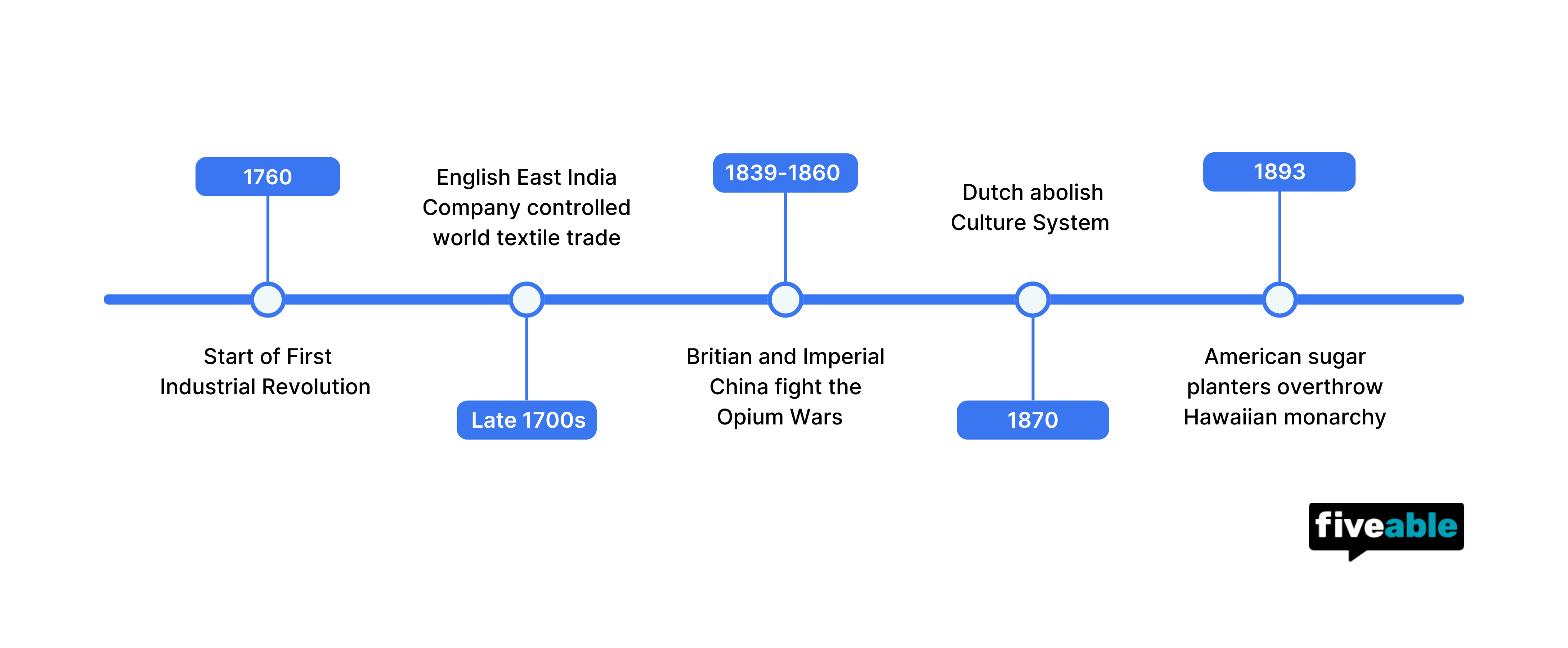
Timeline of events following economic imperialism after the Industrial Revolution. Image Courtesy of Sandra.
Key Takeaways
- British factory textiles pushed Indian weavers out of business, while India produced raw cotton for British mills and bought back finished cloth.
- The Dutch Culture System forced villagers in the East Indies to grow export crops on part of their land or perform unpaid labor.
- Britain sold Indian opium in China for silver, then its victories in the Opium Wars forced China to open more ports and give up territory.
- Foreign powers gained exclusive trading rights in Chinese spheres of influence, while the U.S. proposed equal access to China's trade through the Open Door policy.
- Colonial cash crops supplied European industries but made African colonies dependent and vulnerable to drought, falling prices, food shortages, and famine.
- British investment financed farming and infrastructure in Argentina, while the United Fruit Company pressured Central American governments; in Hawaii, American businesses and sugar planters overthrew the monarchy.
Economic Imperialism in Asia
In Asia, European trading companies evolved from merchants into rulers of entire economies. England's defeat of the Spanish Armada in 1588 opened the door for the British and Dutch to take over the Asian spice trade from Spain and Portugal.
India and the East India Company
- The English East India Company formed in 1600 to enter the spice trade, then pivoted. By the mid-1600s, cotton and silk textiles from India had become its major import, and by the 1700s it controlled the world textile trade.
- The Industrial Revolution flipped the relationship. Britain's factories (plus cheap American cotton) flooded the market with inexpensive textiles, pushing independent Indian weavers out of business.
- By the late 19th century, India produced raw cotton for British mills and then bought back British-made finished cloth at inflated prices. That's an export economy in one sentence.
The Dutch East Indies and the Culture System
- The Dutch East India Company (VOC) held a monopoly on trade in present-day Indonesia, home of the Spice Islands. In the second half of the 18th century it shifted from shipping to agricultural production.
- The Dutch government revoked the company's charter in 1799 and took direct control of the Dutch East Indies.
- In 1830, the Dutch introduced the Culture System. Villagers had to either set aside one-fifth of their rice fields for export crops (sugar, coffee, indigo) or, if landless, perform 66 days of corvée labor (compulsory unpaid work) in government fields. If crops failed, villagers ate the loss. The system lasted until 1870.
China and the Opium Wars
This is the chapter's headline example, and one of the most exam-relevant stories in Unit 6.
- The setup: Britain craved Chinese porcelain, silk, and tea, but China didn't want British goods. British silver reserves drained to pay for the trade imbalance.
- The British fix: the East India Company forced Indian farmers to grow opium, sold it in China for silver, and used the profits to buy tea. Millions of Chinese became addicted, even though the emperor had criminalized opium back in 1729.
- Commissioner Lin Zexu wrote directly to Queen Victoria in 1840 calling out the hypocrisy: opium was strictly forbidden in Britain, yet Britain pushed it on China.
- The first Opium War (1839-1842) broke out after China seized British opium warehoused at Canton (Guangzhou), the only port open to foreign trade. British steamships and weaponry overwhelmed Chinese forces, capturing Canton and finally Nanking.
- The Treaty of Nanking (1842) forced China to open four additional ports, cede Hong Kong to Britain, pay damages, and allow free trade (which the British interpreted to include opium).
- Neither side was satisfied. After Chinese officers boarded a British trading ship in October 1856, the second Opium War (1856-1860) began, with France joining Britain. The Treaty of Tientsin (Tianjin, 1858) let foreign envoys live in Beijing, opened more ports, and gave Christian missionaries freedom of movement. Later negotiations legalized opium and ceded southern Kowloon Peninsula (next to Hong Kong) to Britain.
The big takeaway: industrialized nations could now dominate states that lacked modern military technology. China hadn't anticipated how much the global balance of power had shifted.
Spheres of Influence and the Open Door
After Britain's wins, Japan, France, Germany, Russia, and the United States demanded the same privileges. By century's end they were carving China into spheres of influence, regions where one foreign power held exclusive trading rights. The U.S. proposed the Open Door policy, opening trade in China to all countries equally so no single power could control China outright.
Economic Imperialism in Africa
Colonization converted African farmland from food crops to cash crops, crops grown to sell rather than eat, feeding raw materials to European industries. In return, Africans got cotton textiles, canned food, and alcohol. This unequal trade made colonies economically dependent, and reliance on a single cash crop left people vulnerable to drought, falling world prices, food shortages, and even famine since the best land grew export crops.
Region by region:
- Egypt embraced cotton before the American Civil War and more than doubled production between 1861 and 1863. By century's end, cotton was 93 percent of Egypt's exports.
- In Sudan, the Plantation Syndicate (a group of British weaving companies) dictated land use to farmers. In Uganda, British-encouraged cotton replaced enslaved people and ivory as the chief export.
- In Kenya, herding groups like the Kikuyu were pushed onto reserves with poor soil while white settlers got the fertile Rift Valley. Africans who stayed became cheap labor and were banned from exporting cash crops or growing some (like coffee and tea) at all.
- On the Gold Coast, missionaries introduced cocoa in the 1880s, and the region became the world's largest cocoa producer. Cocoa also mattered in the Ivory Coast, Nigeria, São Tomé, and Angola.
- Palm oil, palm kernels, and peanuts were major West African exports even before colonization. Palm oil lubricated the machines of Europe's Industrial Revolution.
Slavery's persistence
Britain outlawed slavery in its colonies in 1833, but slavery persisted elsewhere in Africa. The French army paid African soldiers with enslaved people, and colonial administrators staffed offices with them. Slave raiding and trading wasn't suppressed in most of Africa until 1912, and slavery wasn't legally abolished across the continent until the first quarter of the 20th century. Slave labor produced cash crops like palm products, coffee, and cocoa. Some companies pushed back: Quaker-owned Cadbury's stopped buying slave-grown cocoa from Portuguese colonies in 1908 after the trade was exposed.
Economic Imperialism in Latin America
Latin America faced "new imperialism" from both Europe and the United States in the second half of the 19th century: a hunt for raw materials, low-wage labor, and new markets. Britain replaced Spain as the region's major trading partner, and Europeans invested over $10 billion in Latin America between 1870 and 1919, mostly in Argentina, Mexico, and Brazil.
The United States steps in
The Second Industrial Revolution gave the U.S. the prosperity to invest abroad, concentrated at first in Mexico and Cuba. American money funded railways, shipping, banking, mining, guano, and meat processing. The Monroe Doctrine (1823) had already declared Latin America part of the U.S. sphere of influence by opposing European colonialism in the Americas.
Argentina: Britain's biggest bet
Britain invested more in Argentina than in its own colony of India, up to 10 percent of all British foreign investment. British capital improved breeding stock, developed large-scale farming on the Pampas (the grassy plains), and financed railroads, telegraphs, and the new port of Puerto Madera at Buenos Aires. By World War I, Argentina was the richest country in Latin America and among the dozen richest in the world.
Chile, Brazil, and the banana republics
- Chile, colonized by Spain between 1540 and 1818, started with agricultural exports, but copper came to dominate. Mining eventually supplied more than one-third of government income.
- Brazil's rubber boom collapsed once Malaysia produced rubber more cheaply, showing how trade was organized to favor companies based in Europe and the U.S. Prosperity from export economies was always fragile.
- In Central America and the Caribbean, the American United Fruit Company allied with large landowners to pressure governments into keeping conditions favorable for U.S. business. Writer O. Henry coined "banana republics" for these politically unstable states whose economies depended on exporting one product, like bananas or minerals.
Hawaii and the Bigger Picture
Hawaii shows how investment power could topple a government entirely. In 1893, American businesses and sugar planters overthrew Hawaii's constitutional monarchy, hoping for U.S. annexation. In 1898, Hawaii became a U.S. territory.
The context tying it all together: the Industrial Revolution created both the demand for raw materials and the tools (steamships, railroads, military weapons) to control distant territories. That combination set the stage for economic imperialism, and it connects directly back to the rationales for imperialism in 6.1 and forward to the migration patterns these economies drove in 6.6.
Key Terms to Know
| Term | Why it matters |
|---|---|
| Economic imperialism | Foreign business interests gaining so much economic power over a region that they effectively control it, the chapter's central concept. |
| Cash crop | A crop grown to sell for export rather than to eat, which left colonies dependent and vulnerable to famine and price crashes. |
| Export economy | A colony's economy reorganized to produce goods for the imperial power's profit, not for domestic use. |
| East India Company (EIC) | The British company that controlled the world textile trade by the 1700s and ran the opium-for-silver trade with China. |
| Dutch East India Company (VOC) | Held the monopoly on Dutch East Indies trade until the Dutch government took direct control in 1799. |
| Culture System | The 1830 Dutch policy forcing East Indies villagers to grow export crops on one-fifth of their land or do 66 days of unpaid labor. |
| Corvée labor | Compulsory unpaid work, the labor backbone of the Culture System. |
| Opium War (1839-1842) | Britain defeated China after China seized British opium at Canton, proving industrialized states could dominate nonindustrialized ones. |
| Treaty of Nanking (1842) | Ended the first Opium War; opened four more Chinese ports, ceded Hong Kong to Britain, and forced free trade. |
| Treaty of Tientsin | 1858 treaty during the second Opium War (1856-1860); foreign envoys in Beijing, more open ports, missionary freedom, and (after further talks) legalized opium. |
| Spheres of influence | Regions of China where individual foreign powers held exclusive trading rights by the end of the 19th century. |
| Open Door policy | The U.S. proposal opening Chinese trade to all countries equally so no single power could control China. |
| Gold Coast | West African region (modern Ghana) that became the world's largest cocoa producer after missionaries introduced the crop in the 1880s. |
| Monroe Doctrine | The 1823 U.S. policy opposing European colonialism in the Americas, claiming Latin America as a U.S. sphere of influence. |
| Pampas | Argentina's grassy plains, where British investment built large-scale farming that made Argentina Latin America's richest country. |
| United Fruit Company | American corporation that pressured Central American governments, with help from large landowners, to protect its banana business. |
| Banana republics | O. Henry's term for unstable Central American states economically dependent on a single export controlled by foreign corporations. |
Practice and Next Steps
Go deeper with the 6.5 Economic Imperialism course topic study guide, which frames this same content the way the exam tests it. Then review the rest of the unit on the AMSCO notes hub, especially 6.8 on causation in the imperial age, which asks you to connect the threads from this chapter.
To check your understanding, try AP World guided practice questions on Unit 6, or write a timed response with FRQ practice and instant scoring. The Opium Wars and Latin American export economies are classic evidence for comparison and causation prompts.
Frequently Asked Questions
What is economic imperialism in AP World History?
Economic imperialism is when foreign business interests gain so much economic power over a region that they effectively control it, even without formal political rule. Between 1750 and 1900, industrialized states like Britain and the U.S. practiced it mainly in Asia and Latin America, turning regions into export economies that produced raw materials and cash crops for the imperial power's profit.
What caused the Opium Wars between Britain and China?
Britain wanted Chinese tea, silk, and porcelain, but China didn't want British goods, so British silver drained away. To fix the trade imbalance, the East India Company sold Indian-grown opium in China for silver, even though China had criminalized opium in 1729. The first Opium War (1839-1842) broke out after China seized British opium at Canton, and Britain's victory forced the Treaty of Nanking, which opened ports and ceded Hong Kong.
What's the difference between a sphere of influence and a colony?
A colony is territory a power formally rules; a sphere of influence is a region where a foreign power holds exclusive trading rights and economic control without governing it. China was never fully colonized, but by the end of the 19th century Britain, France, Germany, Russia, Japan, and the U.S. had carved it into spheres of influence, which is why the U.S. proposed the Open Door policy to keep China's trade open to everyone.
What is a banana republic and where did the term come from?
A banana republic is a politically unstable country whose economy depends on exporting a single product, like bananas or minerals, controlled by foreign corporations. The writer O. Henry coined the term in a short story to describe small Central American countries under the economic power of foreign-based companies like the American United Fruit Company.
How does AMSCO Topic 6.5 show up on the AP World exam?
Topic 6.5 examples like the Opium Wars, Egyptian cotton, Chilean copper, and British-financed Buenos Aires are classic evidence for causation and comparison questions about the global economy from 1750 to 1900. They work well in LEQs and DBQs about how trade was organized to advantage European and American companies. You can practice applying them with Fiveable's FRQ practice with instant scoring.
See Fiveable more often in Google
Mark Fiveable as a preferred source and Google is more likely to show you our guides in Top Stories, with a "preferred" badge in AI Mode and AI Overviews.