AMSCO 2.6 Environmental Consequences of Connectivity Notes

🌍AP World History: Modern Review
AMSCO 2.6 Environmental Consequences of Connectivity Notes
🌍 AP World History: Modern
AMSCO 1.1 Developments in East Asia Notes
AMSCO 1.2 Developments in Dar al-Islam Notes
AMSCO 1.3 Developments in South and Southeast Asia Notes
AMSCO 1.4 Developments in the Americas Notes
AMSCO 1.5 Developments in Africa Notes
AMSCO 1.6 Developments in Europe Notes
AMSCO 1.7 Comparison in the Period from c.1200 to c.1450 Notes
AMSCO 2.1 The Silk Roads Notes
AMSCO 2.2 The Mongol Empire and the Modern World Notes
AMSCO 2.3 Exchange in the Indian Ocean Notes
AMSCO 2.4 Trans-Saharan Trade Routes Notes
AMSCO 2.5 Cultural Consequences of Connectivity Notes
AMSCO 2.6 Environmental Consequences of Connectivity Notes
AMSCO 2.7 Comparison of Economic Exchange Notes
AMSCO 3.1 European, East Asian, and Gunpowder Empires Expand Notes
AMSCO 3.2 Empires: Administrations Notes
AMSCO 3.3 Empires: Belief Systems Notes
AMSCO 3.4 Comparison in Land-Based Empires Notes
AMSCO 4.1 Technological Innovations Notes
AMSCO 4.2 Exploration: Causes and Events Notes
AMSCO 4.3 Columbian Exchange Notes
AMSCO 4.4 Maritime Empires Link Regions Notes
AMSCO 4.5 Maritime Empires Develop Notes
AMSCO 4.6 Internal and External Challenges to State Power Notes
AMSCO 4.7 Changing Social Hierarchies Notes
AMSCO 4.8 Continuity and Change from c.1450 to c.1750 Notes
AMSCO 5.1 The Enlightment Notes
AMSCO 5.2 Nationalism and Revolutions Notes
AMSCO 5.3 Industrial Revolution Begins Notes
AMSCO 5.4 Industrialization Spreads Notes
AMSCO 5.5 Technology in the Industrial Age Notes
AMSCO 5.6 Industrialization: Government's Role Notes
AMSCO 5.7 Economic Developments and Innovations Notes
AMSCO 5.8 Reactions to the Industrial Economy Notes
AMSCO 5.9 Society and the Industrial Age Notes
AMSCO 5.10 Continuity and Change in the Industrial Age Notes
AMSCO 6.1 Rationales for Imperialism Notes
AMSCO 6.2 State Expansion Notes
AMSCO 6.3 Indigenous Responses to State Expansion Notes
AMSCO 6.4 Global Economic Development Notes
AMSCO 6.5 Economic Imperialism Notes
AMSCO 6.6 Causes of Migration in an Interconnected World Notes
AMSCO 6.7 Effects of Migration Notes
AMSCO 6.8 Causation in the Imperial Age Notes
AMSCO 7.1 Shifting Power Notes
AMSCO 7.2 Causes of World War I Notes
AMSCO 7.3 Conducting World War I Notes
AMSCO 7.4 Economy in the Interwar Period Notes
AMSCO 7.5 Unresolved Tensions After World War I Notes
AMSCO 7.6 Causes of World War II Notes
AMSCO 7.7 Conducting World War II Notes
AMSCO 7.8 Mass Atrocities Notes
AMSCO 7.9 Causation in Global Conflict Notes
AMSCO 8.1 Setting the Stage for the Cold War and Decolonization Notes
AMSCO 8.2 The Cold War Notes
AMSCO 8.3 Effects of the Cold War Notes
AMSCO 8.4 Spread of Communism Notes
AMSCO 8.5 Decolonization after 1900 Notes
AMSCO 8.6 Newly Independent States Notes
AMSCO 8.7 Global Resistance to Established Power Structure Notes
AMSCO 8.8 End of the Cold War Notes
AMSCO 8.9 Causation in the Age of the Cold Ward and Decolonization Notes
AMSCO 9.1 Advances in Technology and Exchange Notes
AMSCO 9.2 Technological Advancements and Limitations Notes
AMSCO 9.3 Technology and the Environment Notes
AMSCO 9.4 Economics in the Global Age Notes
AMSCO 9.5 Calls for Reforms and Responses Notes
AMSCO 9.6 Globalized Culture Notes
AMSCO 9.7 Resistance to Globalization Notes
AMSCO 9.8 Institutions Developing in a Globalized World Notes
AMSCO 9.9 Continuity and Change in a Globalized World Notes
Overview
AMSCO Topic 2.6, Environmental Consequences of Connectivity (AMSCO p.121-126), covers what trade routes moved besides goods and ideas: crops and disease. Between c. 1200 and c. 1450, exchange networks like the Silk Roads and Indian Ocean routes spread Champa rice to China, bananas to Sub-Saharan Africa, and citrus and sugar across Dar al-Islam, fueling population growth. Those same routes also carried the bubonic plague, which killed an estimated 75 to 200 million people across Eurasia and one-third of Europe's population. This chapter is the environmental flip side of 2.5's cultural consequences: connectivity changed landscapes and bodies, not just beliefs.
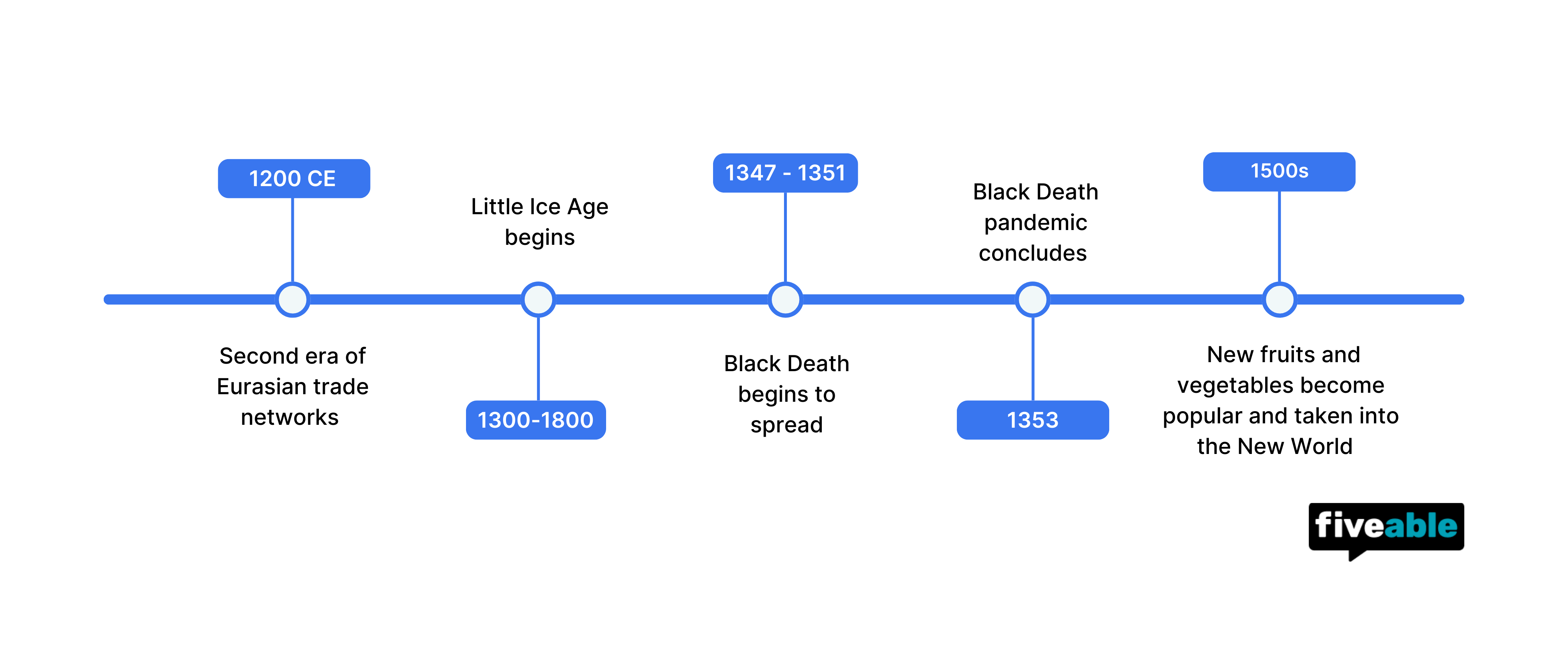
Timeline of events following the emergence of Eurasian trade networks. Image courtesy of Sandra.
Key Takeaways
- Champa rice grew on land once considered unusable for rice, produced two crops a year, and helped drive population growth and southward migration in China.
- Indonesian seafarers brought bananas to Sub-Saharan Africa, where the crop supported population growth and let Bantu-speaking peoples settle in regions where yams grew poorly.
- Islamic caliphates spread cotton, sugar, and citrus crops, while growing European demand for sugar later helped drive mass enslavement in the Americas.
- Population pressure damaged land through overgrazing near Great Zimbabwe and soil erosion in Europe; the Little Ice Age reduced agricultural output further.
- The bubonic plague spread along trade routes across Eurasia, killing an estimated 75 to 200 million people; caravanserai may have helped transmit infected fleas.
- After the plague killed so many workers in Europe, survivors could demand higher wages, a shift that helped lay the groundwork for feudalism's decline.
Migration of Crops Along Trade Routes
Merchants moved crops into regions where they had never grown before, and those crops reshaped land use, diets, and population size. Three examples come up constantly on the AP exam, and AMSCO hits all of them.
Champa Rice in China
Champa rice was the superstar crop of this period. Vietnam introduced it to the Champa states (in present-day central Vietnam), and Champa then offered it to China as tribute. Some scholars think it may have originally come from India, because of Hindu influence on Champa.
Why it mattered so much:
- It was drought-resistant AND flood-resistant
- It ripened quickly, yielding two crops a year instead of one
- Through terraced farming in the uplands and paddies in the lowlands, it grew on Chinese land once considered unusable for rice
More food meant more people. Champa rice was distributed widely to feed China's growing population, and that abundance pushed the population even higher. As China grew, people migrated southward toward the original rice-growing region, which fueled the growth of cities.
Bananas in Sub-Saharan Africa
Indonesian seafarers crossing the Indian Ocean brought bananas to Sub-Saharan Africa (many Indonesians also settled on the island of Madagascar). The nutrition-rich banana caused a population spike.
Bananas also changed migration patterns. Bantu-speaking peoples, who carried metallurgy skills and farming techniques, could now move into regions where yams (their traditional staple) didn't grow well. Farmers cleared more land for banana cultivation, which enriched diets and pushed population growth further.
Sugar, Citrus, and Cotton in Dar al-Islam
As caliphs conquered lands beyond the Arabian Peninsula, they spread Islam, the Arabic language, and the cultivation of cotton, sugar, and citrus crops. Markets along the trade routes, like the famous markets of Samarkand, introduced new fruits, vegetables, rice, and citrus products from Southwest Asia to Europe.
One detail with huge long-term consequences: European demand for sugar grew so intense that it became a key factor in the massive use of enslaved people in the Americas in the 1500s and after. That's a thread you'll pick up again in Unit 4.
Central Asian valleys also produced melons, grapes, apples, citrus fruits, pomegranates, apricots, and peaches, which merchants distributed widely along the Silk Roads.
Environmental Degradation
More people meant more pressure on land, and in several places that pressure broke the environment. AMSCO gives you three regional examples, which makes this a great comparison topic.
- Overgrazing around Great Zimbabwe got so severe that people abandoned the city in the late 1400s
- In feudal Europe, overuse of farmland and deforestation caused soil erosion, which reduced agricultural production
- Environmental degradation also contributed to the decline of the Maya in the Americas
On top of human damage, the Little Ice Age (c. 1300-c. 1800) cooled the climate and cut agricultural output further, especially in Europe.
Notice the cycle here: new crops cause population growth, growing populations strain resources, strained resources cause degradation and declining output, and decline can shrink the population again. That cause-and-effect loop is exactly the kind of relationship FRQ prompts love.
The Bubonic Plague: Disease Travels the Trade Routes
The most dramatic environmental consequence of connectivity wasn't food. It was disease. The bubonic plague, called the Black Death, swept out of Central Asia, struck China, India, Persia, and Egypt, and reached Europe in 1347. The epidemic killed an estimated 75 to 200 million people in Eurasia and peaked in Europe from 1347 to 1351.
How It Spread
The Mongol conquests helped transmit the fleas that carried the plague from southern China to Central Asia, and from there to Southeast Asia and Europe. Some historians point to caravanserai, the roadside inns that housed travelers and their animals together, as a factor in transmission, since the animals likely carried infected fleas. The same infrastructure that made long-distance trade possible made a pandemic possible.
The writer Giovanni Boccaccio lived through the plague in Europe and described its horrors ("Dead bodies filled every corner"). His experience inspired his famous work The Decameron.
Who Got Hit, and Who Didn't
- Europe lost about one-third of its population in just a few years
- About 25 million Chinese and other Asians died between 1332 and 1347
- North Africa and Central Asia suffered similar devastation
- South Asia and Sub-Saharan Africa were largely spared because those regions had few trading ports
That last point is the chapter's argument in one sentence: the plague followed trade. Less connectivity meant less disease.
Economic Aftermath in Europe
With so many workers dead, agricultural production kept declining. But scarcity changed the labor market. Each surviving worker's labor became more valuable, so workers could demand higher wages. That shift in the worker-employer relationship helped lay the groundwork for the decline of feudalism and the economic changes that followed. Keep this in your back pocket for continuity-and-change questions about Europe.
Key Terms to Know
| Term | Why it matters |
|---|---|
| Champa rice | Drought- and flood-resistant rice from the Champa states that yielded two crops a year and drove Chinese population growth |
| Terraced farming | Technique that let Chinese farmers grow Champa rice on upland terrain once thought unusable |
| Bananas | Nutrition-rich crop brought to Sub-Saharan Africa by Indonesian seafarers, sparking population growth and Bantu migration into yam-poor regions |
| Bantu-speaking peoples | Migrating groups whose metallurgy and farming skills spread across Sub-Saharan Africa, with bananas enabling new settlement areas |
| Sugar | Crop spread by Islamic caliphates whose soaring European demand later fueled mass enslavement in the Americas |
| Citrus crops | Mediterranean newcomers spread along with Islam and through markets like Samarkand |
| Cotton | Third major crop the caliphates spread alongside Islam and the Arabic language |
| Overgrazing | Resource overuse so severe outside Great Zimbabwe that the city was abandoned in the late 1400s |
| Deforestation | Clearing of European forests that, with overfarming, caused soil erosion and falling harvests |
| Soil erosion | Loss of fertile topsoil that cut agricultural production in feudal Europe |
| Little Ice Age | Cooling period (c. 1300-c. 1800) that further reduced agricultural output |
| Bubonic plague (Black Death) | Epidemic that spread along trade routes, killed 75-200 million in Eurasia, and reached Europe in 1347 |
| Caravanserai | Roadside inns housing people and animals together, which may have helped spread plague-carrying fleas |
| The Decameron | Boccaccio's famous work inspired by living through the plague in Europe |
| Environmental degradation | Umbrella term for the resource depletion (erosion, overgrazing, deforestation) caused by population pressure |
Practice and Next Steps
Reinforce this chapter with the matching course-topic guide on 2.6 Environmental Effects of Trade, then move ahead to AMSCO 2.7 Comparison of Economic Exchange, which pulls all of Unit 2's networks together. The full set of AMSCO notes covers every chapter in order.
To test yourself:
- Run guided MCQ practice on Unit 2 to check whether you can connect crops and disease to specific trade routes
- Try an FRQ with instant scoring, since cause-and-effect prompts about trade networks are a Unit 2 staple
- Look up any term that's still fuzzy in the AP World key terms glossary
Frequently Asked Questions
What does AMSCO Topic 2.6 Environmental Consequences of Connectivity cover?
AMSCO 2.6 (p.121-126) covers the environmental effects of Afro-Eurasian trade networks from c. 1200 to c. 1450. It has two main threads: the diffusion of crops (Champa rice to China, bananas to Sub-Saharan Africa, sugar and citrus across Dar al-Islam) and the spread of the bubonic plague along trade routes, plus environmental degradation like overgrazing at Great Zimbabwe and deforestation in Europe.
Why was Champa rice so important in AP World?
Champa rice was drought-resistant, flood-resistant, and ripened fast enough to yield two crops a year. After Champa offered it to China as tribute, terraced farming let it grow on land once thought unusable for rice, which drove major Chinese population growth, southward migration, and the growth of cities. It's the textbook example of crop diffusion changing land use and population.
How did the Black Death spread along trade routes?
The Mongol conquests helped transmit plague-carrying fleas from southern China to Central Asia, and from there the disease moved along trade routes to Southeast Asia and Europe, arriving in Europe in 1347. Caravanserai that housed travelers and animals together may have helped spread infected fleas. The plague killed an estimated 75 to 200 million people in Eurasia and about one-third of Europe's population.
Why were South Asia and Sub-Saharan Africa mostly spared from the Black Death?
Both regions had few trading ports, so the plague's main transmission route (maritime and overland trade) largely bypassed them. That's the chapter's core argument in reverse: the plague followed connectivity, so less-connected regions suffered far less. Meanwhile Europe, China, North Africa, and Central Asia, all heavily tied into exchange networks, lost enormous shares of their populations.
What environmental effects of trade show up on the AP World exam?
Expect questions on crop diffusion (bananas in Africa, new rice varieties in East Asia, citrus in the Mediterranean) and on epidemic disease, especially the bubonic plague spreading along trade routes. Cause-and-effect prompts about how trade changed populations and environments are common in Unit 2. Practice these connections with guided MCQ questions.
See Fiveable more often in Google
Mark Fiveable as a preferred source and Google is more likely to show you our guides in Top Stories, with a "preferred" badge in AI Mode and AI Overviews.