AMSCO 4.4 Maritime Empires Link Regions Notes

🌍AP World History: Modern Review
AMSCO 4.4 Maritime Empires Link Regions Notes
🌍 AP World History: Modern
AMSCO 1.1 Developments in East Asia Notes
AMSCO 1.2 Developments in Dar al-Islam Notes
AMSCO 1.3 Developments in South and Southeast Asia Notes
AMSCO 1.4 Developments in the Americas Notes
AMSCO 1.5 Developments in Africa Notes
AMSCO 1.6 Developments in Europe Notes
AMSCO 1.7 Comparison in the Period from c.1200 to c.1450 Notes
AMSCO 2.1 The Silk Roads Notes
AMSCO 2.2 The Mongol Empire and the Modern World Notes
AMSCO 2.3 Exchange in the Indian Ocean Notes
AMSCO 2.4 Trans-Saharan Trade Routes Notes
AMSCO 2.5 Cultural Consequences of Connectivity Notes
AMSCO 2.6 Environmental Consequences of Connectivity Notes
AMSCO 2.7 Comparison of Economic Exchange Notes
AMSCO 3.1 European, East Asian, and Gunpowder Empires Expand Notes
AMSCO 3.2 Empires: Administrations Notes
AMSCO 3.3 Empires: Belief Systems Notes
AMSCO 3.4 Comparison in Land-Based Empires Notes
AMSCO 4.1 Technological Innovations Notes
AMSCO 4.2 Exploration: Causes and Events Notes
AMSCO 4.3 Columbian Exchange Notes
AMSCO 4.4 Maritime Empires Link Regions Notes
AMSCO 4.5 Maritime Empires Develop Notes
AMSCO 4.6 Internal and External Challenges to State Power Notes
AMSCO 4.7 Changing Social Hierarchies Notes
AMSCO 4.8 Continuity and Change from c.1450 to c.1750 Notes
AMSCO 5.1 The Enlightment Notes
AMSCO 5.2 Nationalism and Revolutions Notes
AMSCO 5.3 Industrial Revolution Begins Notes
AMSCO 5.4 Industrialization Spreads Notes
AMSCO 5.5 Technology in the Industrial Age Notes
AMSCO 5.6 Industrialization: Government's Role Notes
AMSCO 5.7 Economic Developments and Innovations Notes
AMSCO 5.8 Reactions to the Industrial Economy Notes
AMSCO 5.9 Society and the Industrial Age Notes
AMSCO 5.10 Continuity and Change in the Industrial Age Notes
AMSCO 6.1 Rationales for Imperialism Notes
AMSCO 6.2 State Expansion Notes
AMSCO 6.3 Indigenous Responses to State Expansion Notes
AMSCO 6.4 Global Economic Development Notes
AMSCO 6.5 Economic Imperialism Notes
AMSCO 6.6 Causes of Migration in an Interconnected World Notes
AMSCO 6.7 Effects of Migration Notes
AMSCO 6.8 Causation in the Imperial Age Notes
AMSCO 7.1 Shifting Power Notes
AMSCO 7.2 Causes of World War I Notes
AMSCO 7.3 Conducting World War I Notes
AMSCO 7.4 Economy in the Interwar Period Notes
AMSCO 7.5 Unresolved Tensions After World War I Notes
AMSCO 7.6 Causes of World War II Notes
AMSCO 7.7 Conducting World War II Notes
AMSCO 7.8 Mass Atrocities Notes
AMSCO 7.9 Causation in Global Conflict Notes
AMSCO 8.1 Setting the Stage for the Cold War and Decolonization Notes
AMSCO 8.2 The Cold War Notes
AMSCO 8.3 Effects of the Cold War Notes
AMSCO 8.4 Spread of Communism Notes
AMSCO 8.5 Decolonization after 1900 Notes
AMSCO 8.6 Newly Independent States Notes
AMSCO 8.7 Global Resistance to Established Power Structure Notes
AMSCO 8.8 End of the Cold War Notes
AMSCO 8.9 Causation in the Age of the Cold Ward and Decolonization Notes
AMSCO 9.1 Advances in Technology and Exchange Notes
AMSCO 9.2 Technological Advancements and Limitations Notes
AMSCO 9.3 Technology and the Environment Notes
AMSCO 9.4 Economics in the Global Age Notes
AMSCO 9.5 Calls for Reforms and Responses Notes
AMSCO 9.6 Globalized Culture Notes
AMSCO 9.7 Resistance to Globalization Notes
AMSCO 9.8 Institutions Developing in a Globalized World Notes
AMSCO 9.9 Continuity and Change in a Globalized World Notes
Overview
AMSCO Topic 4.4, "Maritime Empires Link Regions" (AMSCO p. 218 - p. 231), explains how European states built maritime empires between 1450 and 1750 and what economic and labor systems kept those empires running. Driven by political, religious, and economic rivalries, the Portuguese, Spanish, Dutch, French, and British set up trading posts in Africa and Asia and full colonies in the Americas. The chapter also tracks the labor systems behind colonial profits, including the encomienda, hacienda, mit'a, indentured servitude, and chattel slavery, plus the devastating growth of the Atlantic slave trade. This builds directly on the exploration covered in AMSCO 4.2 and the biological exchange in AMSCO 4.3.
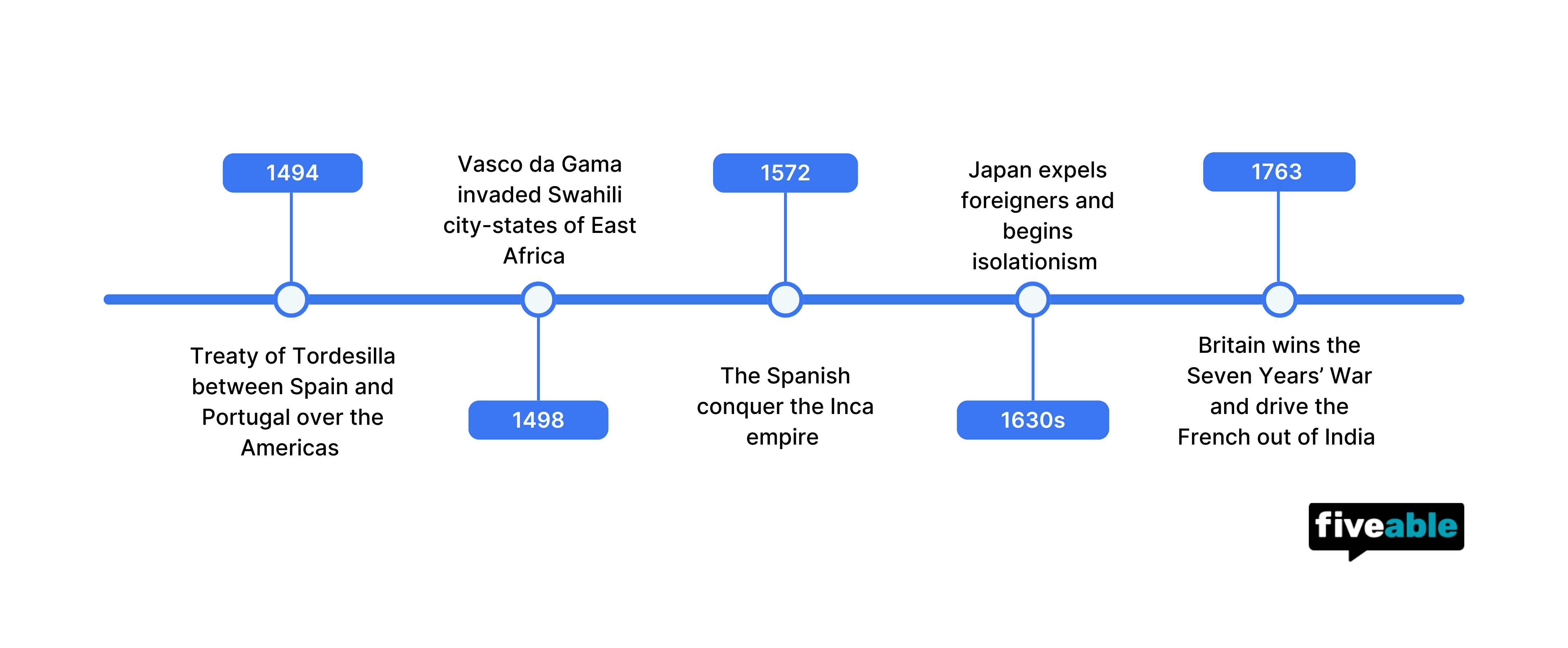
Timeline of conquests of European powers and establishment of maritime empires
Key Takeaways
- Europeans first built armed coastal trading posts in Africa and Asia, while some Asian states restricted European trade to limit its effects.
- The British East India Company moved inland through treaties, local tensions, and sepoys; Britain's victory over France in 1763 ended French control in India.
- In the Americas, Europeans built settler colonies, and disease weakened the Aztec and Inca empires before Spanish conquest; Spain and Portugal divided claims through the Treaty of Tordesillas.
- Indian Ocean trade kept flourishing despite Portuguese military force, while silver mining in Mexico and Peru made Spain rich.
- Spain used coerced labor under the mit'a, encomienda, and hacienda systems to support colonial production and mercantilist wealth.
- Plantation owners turned to the Atlantic slave trade for hereditary labor; many captives died during the Middle Passage, and African home regions experienced population decline.
Trading Posts in Africa and Asia
European empires in Africa and Asia started small: armed trading posts on the coasts, not full takeovers of the interior. Prince Henry the Navigator financed Portuguese expeditions along Africa's Atlantic coast and around the Cape of Good Hope, so Portugal got there first.
- With the cooperation of local rulers, Portuguese (then other European) traders set up posts along Africa's coasts. Some rulers traded enslaved people for gunpowder and cannons, gaining a military edge over neighboring villages.
- The Kingdom of Dahomey grew stronger by raiding other villages for captives to sell to European merchants.
- Maritime trade actually strengthened some African states. The Asante Empire and the Kingdom of the Kongo grew in influence through their participation in trade networks. Benin artisans even incorporated images of the European "intruder" into 16th-century carvings.
- In East Africa, Vasco da Gama reached the Swahili city-states in 1498, and Portuguese fleets attacked them in 1505. The Portuguese took over trade in Kilwa, Mombasa, and other commercial centers with heavily armed ships and fortresses, throwing the region into decline.
Japan and China Push Back
Not every state welcomed European trade. Some Asian states deliberately restricted it to limit disruptive economic and cultural effects.
- Japan initially tolerated Portuguese and Dutch traders and missionaries, and thousands of Japanese converted to Christianity. After some Christians destroyed Buddhist shrines, the government banned Christian worship in 1587. By the 1630s Japan had expelled nearly all foreigners, banned most foreign books, and prohibited Japanese people from traveling abroad. Only a few Dutch merchants remained, secluded on a small island in Nagasaki harbor, plus limited trade with China.
- China's Ming Dynasty, after Zheng He's voyages, prohibited private foreign trade, destroyed some dockyards, limited ship sizes, and rebuilt the Great Wall. This was part of a broader conservative turn to undo Mongol Yuan influence, reemphasizing Confucianism and the traditional exam system. Many trade limits were later reversed, and China stayed central to global trade.
European Rivalries on Five Continents
European rivalries (political, economic, and religious) shaped where empires expanded. India is the clearest example, with three powers holding posts at once.
- The British East India Company (EIC) began a commercial relationship with the Mughal Empire in the 17th century.
- Portugal controlled the coastal post of Goa; France controlled Pondicherry.
- In the Seven Years' War, France and Britain competed on five continents. Britain's 1763 victory drove the French out of India.
The EIC started as small coastal forts focused purely on trade profit, limited by Mughal power. It then expanded by exploiting Muslim-Hindu tensions, signing treaties with local rulers, and using European-trained Indian soldiers called sepoys to move inland. Eventually Britain controlled much of the subcontinent. Each British trading post in Africa, India, and elsewhere became a node, a trade center connecting goods from many parts of the world, paving the way for globalization. In West Africa, though, the Asante Empire limited British impact.
Conquest in the Americas
The Americas went differently. Instead of trading posts, Europeans built settler colonies, and disease did much of the conquering.
- The Aztec and Inca empires each had 10 to 15 million people before European arrival. European diseases caused populations to plummet, and both empires collapsed quickly under Spanish attack.
- Cortés, helped by groups the Aztecs had conquered, overthrew the Aztec by 1521 and established New Spain. The Spanish destroyed Tenochtitlán and built Mexico City on its ruins.
- Pizarro captured the Inca ruler Atahualpa, demanded a room filled with gold for his release, took the gold, and killed him anyway in 1533. The conquest of the Inca was complete by 1572.
- The Treaty of Tordesillas (1494) split the Americas between Spain and Portugal along a meridian through eastern South America. Portugal got Brazil; Spain claimed the rest.
- Spain also pushed into North America. Pedro Menéndez de Avilés founded St. Augustine, Florida in 1565, the oldest continuous settlement in what became the United States.
- France and Britain fought over North America too. The British allied with the Iroquois against French trade interests, but the Iroquois later signed the Great Peace of Montreal with France in 1701. In the same war that pushed France out of India, Britain drove France out of Canada (the North American theater is often called the French and Indian War).
Continuity and Change in Economic Systems
The big continuity: Indian Ocean trade absorbed the European disruption and kept flourishing, including intra-Asian trade run by Asian merchants. The big change: Europeans, especially the Portuguese, used military force in a network that had previously run on religious and ethnic ties, taxes, and port fees rather than arms.
- The Portuguese built a string of armed trading posts along Indian Ocean routes. In 1509 they won the Battle of Diu in the Arabian Sea against the combined forces of Gujaratis, the Mamluks of Egypt, and the Zamorin of Calicut (backed by Venice).
- Even so, merchants largely continued as before, paying for port access and trading through traditional networks of Swahili Arabs, Omanis, Gujaratis, and Javanese merchants.
Spanish Silver and Mercantilism
Gold was sparse in the Caribbean (Columbus found little on Hispaniola and instead kidnapped and enslaved Taino people). Silver, discovered in Mexico and Peru, is what made Spain rich.
- The use of mercury to separate silver from ore boosted profitability. By the end of the 16th century, Zacatecas in Mexico and Potosí in the Andes (modern Bolivia) were thriving silver-mining centers.
- To staff the mines, Spanish authorities in Peru transformed the traditional Incan mit'a (a labor obligation for public works) into a coerced labor system. Villages had to send a percentage of their men to do the most dangerous mine work for a paltry wage.
- The encomienda system let encomenderos (landowners) compel indigenous people to work in exchange for food and shelter, similar to European serfdom and notorious for brutality. The hacienda system grew when the crown granted land to conquistadores, who used coerced labor to farm wheat, fruit, vegetables, and sugar.
- All of this served mercantilism, an economic system that increased government control through high tariffs and colonies. Under mercantilism, a country wants to export more than it imports, and colonies exist to enrich the home country. A share of silver went straight to the Spanish crown, which used it to build the military and expand foreign trade.
Continuity and Change in Labor and Slavery
Colonial economies in the Americas depended on agriculture and used a mix of old and new labor systems. Know how these differ:
- Enslaved people were considered property with few or no rights (chattel slavery).
- Indentured servants got passage to a new location paid for, then worked without pay for up to about seven years before going free.
- Serfs were attached to the land with little legal protection; free peasants worked their own land but paid taxes and tithes.
Why Enslaved Africans?
Europeans first forced indigenous people to mine and farm, but European diseases wiped out huge portions of these laborers, and survivors often escaped because they knew the territory and had protective social networks. European indentured servants, mostly growing tobacco, struggled with the climate and only owed about seven years of labor. Plantation owners turned to the Atlantic slave trade for a permanent, hereditary labor force.
Slavery existed in Africa before European involvement, including the incorporation of enslaved women into households, and Arab merchants had long bought enslaved people on the Swahili Coast. But the Atlantic slave trade wreaked the most havoc. Some coastal African rulers raided neighbors for captives or sold prisoners of war, servants, or criminals. King Afonso of Kongo initially allowed the trade but resisted it once he saw it depopulating his kingdom and undermining his authority, since subjects could trade captives for European goods without him.
The Middle Passage and Its Consequences
Captives were held in coastal barracoons ("slave castles" like the House of Slaves on Gorée Island, Senegal), then crammed into ship cargo holds for the roughly six-week Atlantic crossing known as the Middle Passage. Up to half a ship's captives might die on a voyage; across the whole trade (early 1500s to mid-19th century), 10 to 15 percent of African captives died before reaching the Americas. Portuguese colonies received the largest share of enslaved Africans (39%), followed by British West Indian and Spanish colonies (18% each), French colonies (14%), and British mainland colonies (6%).
The plantation economy's growth drove major demographic, social, and cultural change. African home regions suffered a century-long population decline. Because more men than women were taken, polygyny became more common in Africa. In the Americas, enslaved Africans shaped language and culture everywhere they were taken, and the mixing of ethnic groups produced new multiracial populations such as mestizos and mulattos.
The Indian Ocean slave trade, which peaked in the 18th and 19th centuries, sent enslaved East Africans to northern Africa, the Middle East, India, and islands like Madagascar. Their experience differed: many worked in seaports, households, or as sailors and soldiers, lived in towns where they could form communities, and in Islamic communities held certain rights, such as the right to marry.
Key Terms to Know
| Term | Why it matters |
|---|---|
| Treaty of Tordesillas (1494) | Spain and Portugal split the Americas along a meridian, giving Portugal Brazil and Spain everything west. |
| Mercantilism | Economic system using high tariffs and colonies to boost government control and national wealth, exporting more than importing. |
| Chattel slavery | System treating enslaved people as property to be bought and sold, with no release date and hereditary status. |
| Indentured servitude | Labor contract trading passage to the colonies for up to about seven years of unpaid work. |
| Encomienda | Spanish system in which encomenderos compelled indigenous people to work in exchange for food and shelter; notoriously brutal. |
| Hacienda system | Agricultural estates on land granted to conquistadores, worked by coerced labor. |
| Mit'a system | Traditional Incan labor obligation that Spain transformed into forced silver-mine labor in Peru. |
| Middle Passage | The roughly six-week Atlantic crossing of enslaved Africans, with death rates of 10-15 percent overall. |
| Asante Empire | West African state whose trade participation increased its influence and limited British impact. |
| Kingdom of the Kongo | Central African kingdom that grew through trade; King Afonso later resisted the slave trade's depopulation of his realm. |
| Ming Dynasty | Chinese dynasty that restricted foreign trade and rebuilt the Great Wall to limit outside influence. |
| Aztec Empire | Mesoamerican empire of 10-15 million people, overthrown by Cortés by 1521 and replaced by New Spain. |
| Inca Empire | Andean empire conquered by Pizarro, who killed the captured ruler Atahualpa in 1533. |
| Conquistadores | Spanish conquerors rewarded with land grants, fueling the hacienda system. |
| Silver | The metal (mined at Potosí and Zacatecas) that enriched Spain and powered global trade. |
| Colonies | Lands claimed and settled by immigrants from the home country, central to mercantilist wealth. |
Practice and Next Steps
Check your understanding with the 4.4 Maritime Empires Established study guide, which covers the same College Board topic from the course-guide angle. The chapter continues in AMSCO 4.5 Maritime Empires Develop, which goes deeper into how these empires were maintained. You can find the rest of the chapter notes on the AMSCO notes page.
To test yourself, try AP World guided practice questions on Unit 4, or work a continuity-and-change prompt with FRQ practice and instant scoring. Labor systems and maritime empires show up constantly in LEQs and DBQs, so this is a high-value topic to practice writing about.
Frequently Asked Questions
What is AMSCO Topic 4.4 in AP World about?
AMSCO Topic 4.4, Maritime Empires Link Regions (p. 218-231), covers how Portugal, Spain, Britain, France, and the Dutch built maritime empires from 1450 to 1750 through trading posts in Africa and Asia and colonies in the Americas. It also covers the labor systems that fueled them: encomienda, hacienda, mit'a, indentured servitude, and chattel slavery.
What is the difference between the encomienda and hacienda systems?
The encomienda system let Spanish landowners (encomenderos) compel indigenous people to work in exchange for food and shelter, and it was notoriously brutal. The hacienda system came later, when the Spanish crown granted land to conquistadores who used coerced labor to grow crops like wheat, sugar, and fruit on large agricultural estates. Encomienda was about controlling labor; hacienda was about land-based agriculture worked by that coerced labor.
What was the mit'a system and how did Spain change it?
The mit'a was a traditional Incan labor obligation requiring young men to devote labor to public works projects. Spanish authorities in Peru transformed it into a coerced labor system, forcing villages to send a percentage of their men to do dangerous silver-mining work at Potosí for a paltry wage. It's a classic AP World example of Europeans adapting an existing labor system rather than inventing a new one.
How is chattel slavery different from indentured servitude?
Chattel slavery treated people as property to be bought and sold, with no rights, no end date, and status passed to children. Indentured servants signed contracts to work without pay for up to about seven years in exchange for passage to the colonies, and they became free laborers if they survived their term. Plantation owners shifted toward enslaved African labor partly because indentured servants eventually went free.
How does Topic 4.4 show up on the AP World exam?
Topic 4.4 is a continuity-and-change goldmine: Indian Ocean trade continued under Asian merchants despite Portuguese disruption, while new labor systems (chattel slavery, encomienda, hacienda) joined existing ones like the mit'a. Comparisons between the Atlantic and Indian Ocean slave trades and between isolationist states like Ming China and Tokugawa Japan are common too. Practice applying these with FRQ practice and instant scoring.
See Fiveable more often in Google
Mark Fiveable as a preferred source and Google is more likely to show you our guides in Top Stories, with a "preferred" badge in AI Mode and AI Overviews.