AMSCO 8.9 Causation in the Age of the Cold Ward and Decolonization Notes

🌍AP World History: Modern Review
AMSCO 8.9 Causation in the Age of the Cold Ward and Decolonization Notes
🌍 AP World History: Modern
AMSCO 1.1 Developments in East Asia Notes
AMSCO 1.2 Developments in Dar al-Islam Notes
AMSCO 1.3 Developments in South and Southeast Asia Notes
AMSCO 1.4 Developments in the Americas Notes
AMSCO 1.5 Developments in Africa Notes
AMSCO 1.6 Developments in Europe Notes
AMSCO 1.7 Comparison in the Period from c.1200 to c.1450 Notes
AMSCO 2.1 The Silk Roads Notes
AMSCO 2.2 The Mongol Empire and the Modern World Notes
AMSCO 2.3 Exchange in the Indian Ocean Notes
AMSCO 2.4 Trans-Saharan Trade Routes Notes
AMSCO 2.5 Cultural Consequences of Connectivity Notes
AMSCO 2.6 Environmental Consequences of Connectivity Notes
AMSCO 2.7 Comparison of Economic Exchange Notes
AMSCO 3.1 European, East Asian, and Gunpowder Empires Expand Notes
AMSCO 3.2 Empires: Administrations Notes
AMSCO 3.3 Empires: Belief Systems Notes
AMSCO 3.4 Comparison in Land-Based Empires Notes
AMSCO 4.1 Technological Innovations Notes
AMSCO 4.2 Exploration: Causes and Events Notes
AMSCO 4.3 Columbian Exchange Notes
AMSCO 4.4 Maritime Empires Link Regions Notes
AMSCO 4.5 Maritime Empires Develop Notes
AMSCO 4.6 Internal and External Challenges to State Power Notes
AMSCO 4.7 Changing Social Hierarchies Notes
AMSCO 4.8 Continuity and Change from c.1450 to c.1750 Notes
AMSCO 5.1 The Enlightment Notes
AMSCO 5.2 Nationalism and Revolutions Notes
AMSCO 5.3 Industrial Revolution Begins Notes
AMSCO 5.4 Industrialization Spreads Notes
AMSCO 5.5 Technology in the Industrial Age Notes
AMSCO 5.6 Industrialization: Government's Role Notes
AMSCO 5.7 Economic Developments and Innovations Notes
AMSCO 5.8 Reactions to the Industrial Economy Notes
AMSCO 5.9 Society and the Industrial Age Notes
AMSCO 5.10 Continuity and Change in the Industrial Age Notes
AMSCO 6.1 Rationales for Imperialism Notes
AMSCO 6.2 State Expansion Notes
AMSCO 6.3 Indigenous Responses to State Expansion Notes
AMSCO 6.4 Global Economic Development Notes
AMSCO 6.5 Economic Imperialism Notes
AMSCO 6.6 Causes of Migration in an Interconnected World Notes
AMSCO 6.7 Effects of Migration Notes
AMSCO 6.8 Causation in the Imperial Age Notes
AMSCO 7.1 Shifting Power Notes
AMSCO 7.2 Causes of World War I Notes
AMSCO 7.3 Conducting World War I Notes
AMSCO 7.4 Economy in the Interwar Period Notes
AMSCO 7.5 Unresolved Tensions After World War I Notes
AMSCO 7.6 Causes of World War II Notes
AMSCO 7.7 Conducting World War II Notes
AMSCO 7.8 Mass Atrocities Notes
AMSCO 7.9 Causation in Global Conflict Notes
AMSCO 8.1 Setting the Stage for the Cold War and Decolonization Notes
AMSCO 8.2 The Cold War Notes
AMSCO 8.3 Effects of the Cold War Notes
AMSCO 8.4 Spread of Communism Notes
AMSCO 8.5 Decolonization after 1900 Notes
AMSCO 8.6 Newly Independent States Notes
AMSCO 8.7 Global Resistance to Established Power Structure Notes
AMSCO 8.8 End of the Cold War Notes
AMSCO 8.9 Causation in the Age of the Cold Ward and Decolonization Notes
AMSCO 9.1 Advances in Technology and Exchange Notes
AMSCO 9.2 Technological Advancements and Limitations Notes
AMSCO 9.3 Technology and the Environment Notes
AMSCO 9.4 Economics in the Global Age Notes
AMSCO 9.5 Calls for Reforms and Responses Notes
AMSCO 9.6 Globalized Culture Notes
AMSCO 9.7 Resistance to Globalization Notes
AMSCO 9.8 Institutions Developing in a Globalized World Notes
AMSCO 9.9 Continuity and Change in a Globalized World Notes
Overview
AMSCO Topic 8.9, "Causation in the Age of the Cold War and Decolonization" (AMSCO p. 615 - p. 621), is the review chapter that ties Unit 8 together around one essential question: why and to what extent were the effects of the Cold War similar in the Eastern and Western Hemispheres? After World War II, Western Europe stopped dominating world affairs, the United States and the Soviet Union became superpowers, and colonial empires in Africa and Asia crumbled as anti-imperialist movements pushed for independence. This chapter compares the political, economic, social, and cultural effects of those changes across both hemispheres, which is exactly the kind of comparison the AP World exam loves to ask about in period 1900 to the present.
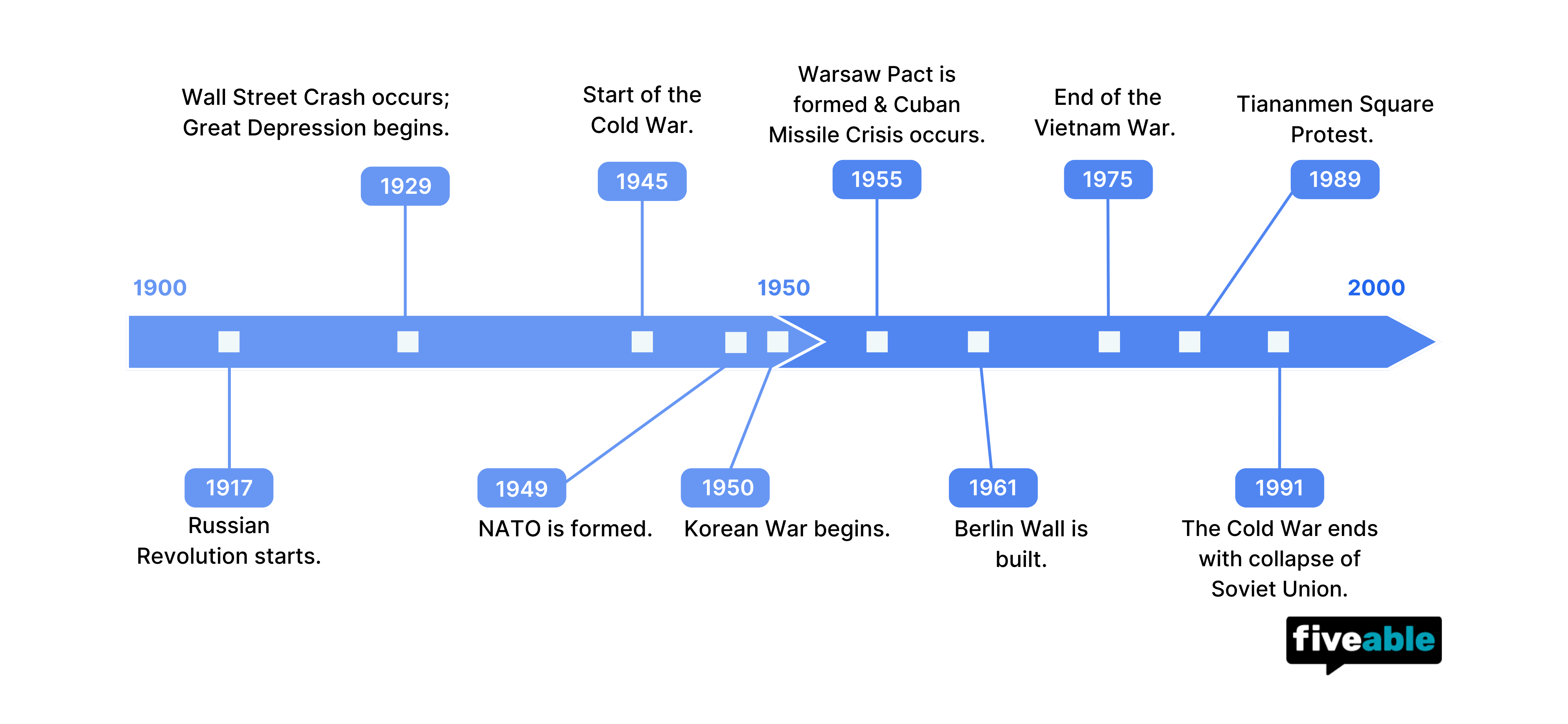
Timeline of key events in 1900-2000. Image Courtesy of Sitara Hariharan
Key Takeaways
- The Soviet Union kept Eastern Europe as a buffer, while the US adopted containment to stop communism from spreading beyond areas it already controlled.
- The nuclear arms race and the NATO and Warsaw Pact alliances deepened the rivalry, but the superpowers fought through proxy battles rather than directly.
- Decolonization more than doubled the number of independent states from 1945 to 2000, and both superpowers competed for influence in new states; major proxy wars hit Asia and Africa especially hard.
- The US often backed military or right-wing governments in Latin America to stop communism, while proxy wars cost millions of lives and Cold War suspicions ruined careers in the US.
- Marshall Plan aid helped Western Europe rebuild, while Eastern bloc economic reforms proved difficult and developing countries remained economically tied to former colonizers.
- Western Europe's cultural life flourished while Eastern European governments blocked Western culture; after the Cold War, organizations like the United Nations and World Trade Organization promoted cooperation.
Challenges to the Existing Order and the Three Worlds
After World War II, an ideological and economic rift split the "Big Three" Allies. The US, Britain, and France occupied western Germany while the Soviets occupied the east. Agreements made at Yalta and Potsdam were supposed to settle the future of Europe, but the Soviet Union refused to give up the Eastern European territories it occupied during the war. It treated these states as a buffer against future Western aggression. East Germany and these satellite nations made up the Soviet bloc, officially independent but controlled by Moscow.
The US believed the Soviets wanted a global communist revolution. After China became communist in 1949 and the US realized it could not free Eastern Europe from Soviet influence, it adopted containment, a policy of using military, economic, and political tools to stop communism from spreading beyond where it already existed. Containment drove US foreign policy for the entire Cold War. The lead-up to this split is covered in the AMSCO 8.1 notes on setting the stage for the Cold War.
The result was a world divided into three alignments:
- First World: the United States and its allies (Western Hemisphere superpower)
- Second World: the Soviet Union, the Soviet bloc of Eastern Europe, and other communist nations (Eastern Hemisphere superpower)
- Third World: more accurately, the non-aligned countries without close military or ideological ties to either side, mostly former colonies in Asia, Africa, Oceania, and Latin America
Superpower Rivalries and the Arms Race
The superpower rivalry physically divided Europe. The west was mostly democratic with free-market economies; the east was autocratic and communist. Germany split into two countries, West and East, and Berlin itself was divided. The Iron Curtain captured the Western view that Soviet-bloc states threatened individual freedom, while the Soviets, drawing on their own history, believed the Western democracies intended to invade them.
That mutual mistrust fueled a nuclear arms race. The US dropped atomic bombs on Hiroshima and Nagasaki to end the war with Japan, and the devastation shocked the world. The Soviets soon built their own nuclear weapon, and both sides kept stockpiling. Europe became an armed camp with millions of troops and both conventional and nuclear weapons facing off.
Two military alliances locked the rivalry in place: NATO (the US and its allies) and the Warsaw Pact (the Soviet Union and its allies), each promising collective security. The war stayed "cold" because the superpowers never fought each other directly. Instead, brinkmanship and proxy battles kept the world on edge whenever nuclear war seemed possible. For the full story of these flashpoints, see the AMSCO 8.2 Cold War notes.
Decolonization: Hopes for Self-Government
Empires peaked around World War I, when Europeans had colonized almost all of Africa, India, and Southeast Asia, dominated China, and the Ottoman Empire controlled the Middle East. World War I broke up two multiethnic empires (Austria-Hungary and Ottoman Turkey) but left most independence hopes unfulfilled.
World War II accelerated the collapse. Between 1945 and 2000, the number of independent states more than doubled, from around 75 to around 190. The Cold War then layered itself onto decolonization: as new states formed, both superpowers competed for influence over them, which is why the Cold War's effects reached nearly every part of the globe. The AMSCO 8.5 decolonization notes cover individual independence movements in detail.
Comparing the Cold War's Effects Across Hemispheres
Both hemispheres felt the Cold War because each was dominated by a superpower and contained former colonies. The key difference: most Western Hemisphere countries gained independence long before the Cold War, and the Eastern Hemisphere paid a heavier price because the major proxy wars happened in Asia and Africa.
Political Effects
Some transitions to independence were peaceful; others were armed rebellions. When insurgencies were communist-led and Soviet-backed (Vietnam, Angola), the US supported either the colonial power or non-communist opposition groups. These Western-backed governments were often unpopular, which only deepened anti-imperialist resentment.
| Region | What happened |
|---|---|
| Asia | Containment led to wars in Korea and Vietnam. Communist revolutions took over Cambodia and Laos. The Soviets invaded Afghanistan to prop up its communist government. Anti-communist crackdowns hit Indonesia and the Philippines. China split with the USSR and sought better US relations. |
| Africa | Communist governments came to power in Ethiopia and Angola. In Angola's independence war against Portugal, the superpowers fought a proxy war: the Soviets backed Cuban soldiers and supplied arms; the US armed anti-communist groups. |
| Latin America | Communist revolutions succeeded in Cuba and Nicaragua. Soviet- or Cuban-backed insurrections broke out in El Salvador, Colombia, Peru, and Guatemala. The US often backed the government in power, frequently a military or right-wing dictatorship, to stop communism. |
Economic Effects
Each part of the world responded differently to 20th-century economic challenges:
- Western Europe rebuilt with Marshall Plan aid, mixing free-market principles with state-sponsored development. Governments built welfare states (public health systems, public housing, unemployment insurance, state pensions) partly to counter communism's appeal. Western economies boomed.
- The Eastern bloc struggled. The Soviet military-industrial complex employed about 20 percent of workers, many of whom lost jobs in the peacetime transition. Moving from a state-controlled to a free-market economy proved extremely complex, with debates over gradual versus all-at-once reform and resistance from party officials. Eventually price controls were removed and state businesses privatized. China made a more gradual free-market transition and became a global economic powerhouse.
- Developing countries stayed economically tied to their former colonizers, dependent on extracting and exporting natural resources. Many saw this as exploitation, so gaining control of resources became a top priority. Angola's government-controlled oil conglomerate, for example, accounts for about 70 percent of government revenue and funded postwar rebuilding.
Social and Cultural Effects
Proxy wars cost millions of lives, especially in Southeast Asia. The Vietnam War alone killed two million soldiers and two million civilians over 20 years. Bombs destroyed villages, chemical defoliants ruined farmland, and Saigon tripled in size as rural refugees fled to the city.
The Cold War also bred suspicion at home. Americans feared communist infiltration, and careers were ruined by unjust accusations. In the Soviet Union, dissent could mean a political prison camp. Everywhere, people lived under the threat of nuclear attack, and some built bomb shelters.
Culturally, Western Europe experienced a rebirth after World War II, with scientific research, music, art, and architecture flourishing under greater personal freedom and US support. Eastern European governments blocked Western culture, so cultural life there was limited to government-approved work. Migration from former colonies to the metropole blended cultures, while imperial powers left legacies like language in their former colonies. Where a superpower had kept order and then retreated, violent culture clashes followed: in Yugoslavia, Slobodan Milosevic exploited ethnic tensions after the Soviet collapse left a power vacuum, and the resulting wars killed tens of thousands and displaced hundreds of thousands.
Global Institutions After the Cold War
The end of the Cold War and the rise of globalization reset the geopolitical framework. The old balance-of-power idea gave way to cooperation as countries recognized global interdependence. Organizations like the United Nations and the World Trade Organization promote cooperation, and others tackle transnational issues like environmental degradation, human rights, and epidemic diseases. The AMSCO 8.8 notes on the end of the Cold War explain how the Soviet collapse made this shift possible.
Key Terms to Know
| Term | Why it matters |
|---|---|
| Containment | The US policy of using military, economic, and political means to stop communism's spread, and the driver of US foreign policy throughout the Cold War. |
| Soviet bloc | East Germany plus the Soviet satellite nations of Eastern Europe, officially independent but controlled by the USSR as a buffer zone. |
| Iron Curtain | The ideological and physical dividing line between democratic Western Europe and the communist East. |
| First World | The United States and its allies. |
| Second World | The Soviet Union, the Eastern European bloc, and other communist nations. |
| Third World / non-aligned | Countries (mostly former colonies) without close military or ideological ties to either superpower. |
| NATO | The military alliance of the US and its allies, built for collective security against the Soviets. |
| Warsaw Pact | The Soviet answer to NATO, a military alliance of the USSR and its allies. |
| Arms race | The competition to stockpile nuclear weapons after the US bombed Hiroshima and Nagasaki and the Soviets built their own bomb. |
| Proxy war | A conflict where the superpowers backed opposing sides without fighting each other directly, as in Vietnam and Angola. |
| Brinkmanship | Pushing a dangerous standoff to the edge of war, which kept the world fearing nuclear annihilation. |
| Marshall Plan | US economic aid that helped Western Europe rebuild and prosper after World War II. |
| Welfare state | Western European systems of public health care, housing, unemployment insurance, and pensions created partly to counter communism's appeal. |
| Decolonization | The dissolution of colonial empires after 1945, more than doubling the number of independent states from about 75 to about 190 by 2000. |
| Metropole | The imperial home country, where many migrants from former colonies moved, blending cultures. |
| Yalta and Potsdam | Wartime conferences that were supposed to settle postwar Europe but failed to prevent the East-West split. |
| Slobodan Milosevic | Serbia's ultra-nationalist president who exploited ethnic tensions in Yugoslavia after the Soviet collapse, fueling deadly wars. |
Practice and Next Steps
AMSCO's review questions for this chapter (p. 625) are full LEQ-style prompts, so practice them like real essays:
- Evaluate the extent to which the effects of the Cold War were similar or different in the Eastern and Western Hemispheres.
- Evaluate the extent to which decolonization resulted in economic change or continuity over time from 1900 to the present.
- Evaluate the extent to which the spread of free-market ideas led to economic change in the late twentieth century (from the AP World History Exam, 2022).
For the first prompt, the comparison sections above are your evidence bank: proxy wars in Asia and Africa versus US intervention in Latin America, Marshall Plan prosperity versus Eastern bloc struggles, cultural rebirth in the West versus censorship in the East.
Pair these notes with the 8.9 Causation in the Age of the Cold War and Decolonization course study guide, then test yourself with AP World guided practice questions. When you're ready to write, get instant feedback on those LEQ prompts with FRQ practice and scoring. All Unit 8 chapter notes live on the AMSCO Notes hub.
Frequently Asked Questions
What is AMSCO Topic 8.9 about in AP World?
AMSCO 8.9 (pp. 615-621) is the Unit 8 review chapter. It compares the political, economic, social, and cultural effects of the Cold War and decolonization across the Eastern and Western Hemispheres, answering the essential question of how similar those effects were on each side of the world.
What were the First, Second, and Third Worlds during the Cold War?
The First World was the United States and its allies, and the Second World was the Soviet Union, the Eastern European Soviet bloc, and other communist nations. The 'Third World' is more accurately called the non-aligned countries, mostly former colonies in Asia, Africa, Oceania, and Latin America that lacked close military or ideological ties to either superpower.
Were the effects of the Cold War the same in the Eastern and Western Hemispheres?
Similar but not identical. Both hemispheres were dominated by a superpower and saw proxy conflicts, but the Eastern Hemisphere paid a heavier price because major proxy wars like Korea, Vietnam, Afghanistan, and Angola happened in Asia and Africa. In the Western Hemisphere, most countries were already independent, so the conflict showed up as revolutions in Cuba and Nicaragua and US-backed governments fighting insurgencies in places like El Salvador and Guatemala.
If the Cold War was 'cold,' why did millions of people die?
The war was only 'cold' between the two superpowers, who never fought each other directly. Their proxy wars were very hot: the Vietnam War alone killed two million soldiers and two million civilians over 20 years, and conflicts in Korea, Angola, and Afghanistan added to the toll. The label describes the US-Soviet relationship, not the global experience.
How does Topic 8.9 show up on the AP World exam?
As a causation and comparison review topic, 8.9 feeds directly into LEQ-style prompts. AMSCO's own review questions ask you to evaluate how similar the Cold War's effects were across hemispheres and whether decolonization brought economic change or continuity, and a real 2022 AP exam prompt asked about the spread of free-market ideas. You can practice writing these with Fiveable's FRQ practice tool.
How many countries became independent through decolonization after World War II?
Between 1945 and 2000, the number of independent states more than doubled, going from around 75 to around 190. World War II accelerated the collapse of European colonial empires in Africa and Asia, and the Cold War superpowers then competed for influence over the newly independent states.
See Fiveable more often in Google
Mark Fiveable as a preferred source and Google is more likely to show you our guides in Top Stories, with a "preferred" badge in AI Mode and AI Overviews.