AMSCO 7.3 Conducting World War I Notes

🌍AP World History: Modern Review
AMSCO 7.3 Conducting World War I Notes
🌍 AP World History: Modern
AMSCO 1.1 Developments in East Asia Notes
AMSCO 1.2 Developments in Dar al-Islam Notes
AMSCO 1.3 Developments in South and Southeast Asia Notes
AMSCO 1.4 Developments in the Americas Notes
AMSCO 1.5 Developments in Africa Notes
AMSCO 1.6 Developments in Europe Notes
AMSCO 1.7 Comparison in the Period from c.1200 to c.1450 Notes
AMSCO 2.1 The Silk Roads Notes
AMSCO 2.2 The Mongol Empire and the Modern World Notes
AMSCO 2.3 Exchange in the Indian Ocean Notes
AMSCO 2.4 Trans-Saharan Trade Routes Notes
AMSCO 2.5 Cultural Consequences of Connectivity Notes
AMSCO 2.6 Environmental Consequences of Connectivity Notes
AMSCO 2.7 Comparison of Economic Exchange Notes
AMSCO 3.1 European, East Asian, and Gunpowder Empires Expand Notes
AMSCO 3.2 Empires: Administrations Notes
AMSCO 3.3 Empires: Belief Systems Notes
AMSCO 3.4 Comparison in Land-Based Empires Notes
AMSCO 4.1 Technological Innovations Notes
AMSCO 4.2 Exploration: Causes and Events Notes
AMSCO 4.3 Columbian Exchange Notes
AMSCO 4.4 Maritime Empires Link Regions Notes
AMSCO 4.5 Maritime Empires Develop Notes
AMSCO 4.6 Internal and External Challenges to State Power Notes
AMSCO 4.7 Changing Social Hierarchies Notes
AMSCO 4.8 Continuity and Change from c.1450 to c.1750 Notes
AMSCO 5.1 The Enlightment Notes
AMSCO 5.2 Nationalism and Revolutions Notes
AMSCO 5.3 Industrial Revolution Begins Notes
AMSCO 5.4 Industrialization Spreads Notes
AMSCO 5.5 Technology in the Industrial Age Notes
AMSCO 5.6 Industrialization: Government's Role Notes
AMSCO 5.7 Economic Developments and Innovations Notes
AMSCO 5.8 Reactions to the Industrial Economy Notes
AMSCO 5.9 Society and the Industrial Age Notes
AMSCO 5.10 Continuity and Change in the Industrial Age Notes
AMSCO 6.1 Rationales for Imperialism Notes
AMSCO 6.2 State Expansion Notes
AMSCO 6.3 Indigenous Responses to State Expansion Notes
AMSCO 6.4 Global Economic Development Notes
AMSCO 6.5 Economic Imperialism Notes
AMSCO 6.6 Causes of Migration in an Interconnected World Notes
AMSCO 6.7 Effects of Migration Notes
AMSCO 6.8 Causation in the Imperial Age Notes
AMSCO 7.1 Shifting Power Notes
AMSCO 7.2 Causes of World War I Notes
AMSCO 7.3 Conducting World War I Notes
AMSCO 7.4 Economy in the Interwar Period Notes
AMSCO 7.5 Unresolved Tensions After World War I Notes
AMSCO 7.6 Causes of World War II Notes
AMSCO 7.7 Conducting World War II Notes
AMSCO 7.8 Mass Atrocities Notes
AMSCO 7.9 Causation in Global Conflict Notes
AMSCO 8.1 Setting the Stage for the Cold War and Decolonization Notes
AMSCO 8.2 The Cold War Notes
AMSCO 8.3 Effects of the Cold War Notes
AMSCO 8.4 Spread of Communism Notes
AMSCO 8.5 Decolonization after 1900 Notes
AMSCO 8.6 Newly Independent States Notes
AMSCO 8.7 Global Resistance to Established Power Structure Notes
AMSCO 8.8 End of the Cold War Notes
AMSCO 8.9 Causation in the Age of the Cold Ward and Decolonization Notes
AMSCO 9.1 Advances in Technology and Exchange Notes
AMSCO 9.2 Technological Advancements and Limitations Notes
AMSCO 9.3 Technology and the Environment Notes
AMSCO 9.4 Economics in the Global Age Notes
AMSCO 9.5 Calls for Reforms and Responses Notes
AMSCO 9.6 Globalized Culture Notes
AMSCO 9.7 Resistance to Globalization Notes
AMSCO 9.8 Institutions Developing in a Globalized World Notes
AMSCO 9.9 Continuity and Change in a Globalized World Notes
Overview
AMSCO Topic 7.3, "Conducting World War I," covers how governments actually fought the first total war: new military technology that produced massive casualties, total war strategies that mobilized entire economies and populations, the global reach of the fighting, and the peace settlement at Versailles that set up the next world war. These notes summarize AMSCO pages 469-475 and fit into Unit 7 (Global Conflict, 1900-present), picking up right where the causes of World War I leave off.
The chapter opens with Wilfred Owen's poem "Dulce et Decorum Est," which calls the idea that it is "sweet and noble to die for one's country" the "old Lie." That sets the tone: the romanticized vision of war that sent teenage boys rushing to enlist in 1914 collapsed under the reality of trenches, poison gas, and a four-year stalemate.
Key Takeaways
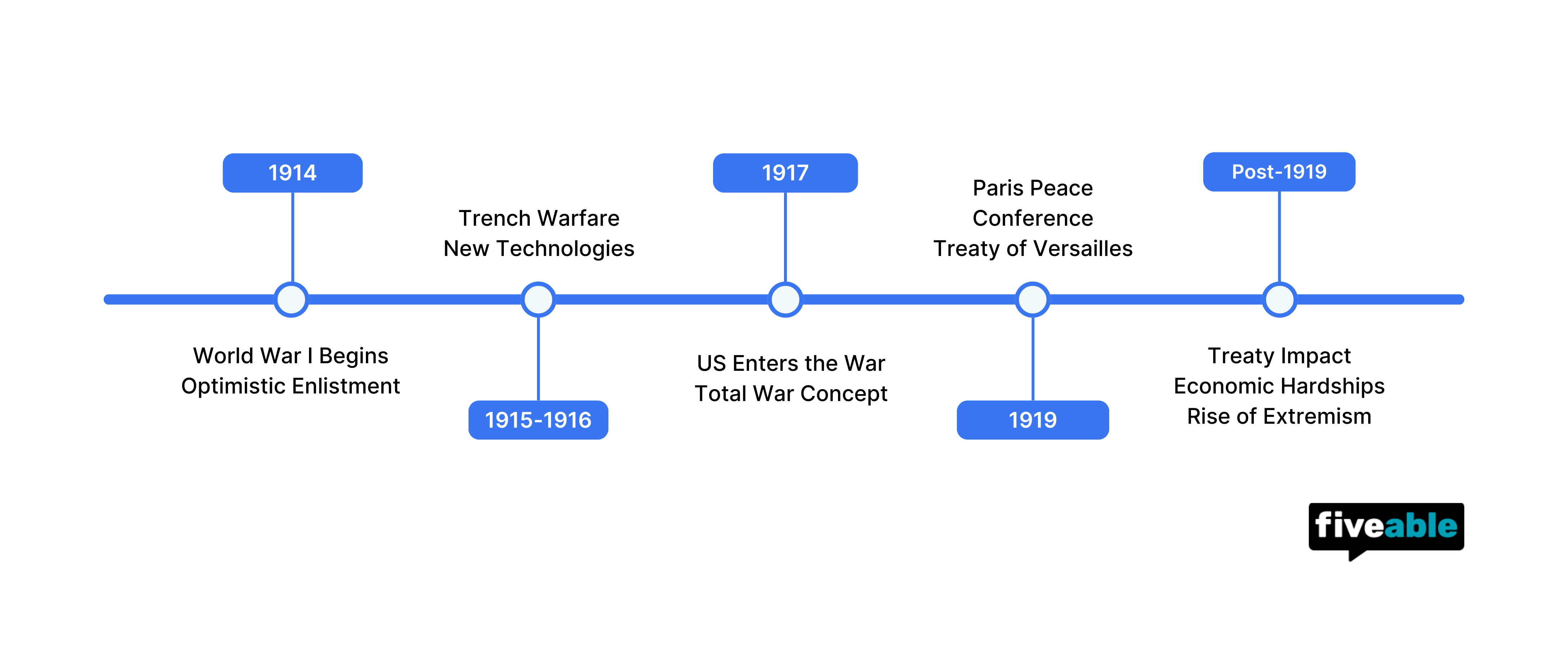
- Trenches and new weapons turned early hopes for a quick war into a bloody four-year stalemate.
- German submarine attacks pushed the U.S. toward war, and the Zimmermann Telegram was the final trigger for its entry in 1917.
- Total war drew civilians and entire economies into the war effort as governments rationed supplies and used propaganda to build support.
- Colonial empires stretched the fighting across continents, and many colonial troops hoped their service would earn self-rule.
- Women replaced enlisted men on farms and in factories, served near the front, and fought in combat for some countries.
- Wilson's Fourteen Points proposed self-determination and a League of Nations, while the Treaty of Versailles imposed reparations, military limits, and war guilt on Germany.
Changes in Warfare: New Technology, Old Expectations
When the war began in June 1914, most Europeans expected it to be "over by Christmas." Wartime rallies sounded like pep rallies, and hundreds of thousands of teenage boys enlisted dreaming of heroism. Only some socialist party leaders spoke out against the war, and even socialists were divided, with many backing their own nation's war effort.
Britain was the only major power to enter the war without universal conscription (compulsory military enlistment). To recruit volunteers, the British Army formed "Pals Battalions" made up of men who already knew each other, starting with a group of London stockbrokers. By war's end, one in four British men had served.
New technology made this war deadlier than anything before it:
- Trench warfare was the defining experience for most soldiers. Armies dug hundreds of miles of trenches facing each other, and soldiers slept, ate, and fought in them for months. Trenches were cold, muddy, and rat-infested, and many soldiers died from disease caused by unhygienic conditions. Erich Maria Remarque's 1929 novel All Quiet on the Western Front (Remarque was a young German soldier in the war) captures trench life vividly.
- Poison gas included chlorine, phosgene, and mustard gas. Gas masks limited fatalities, but attacks caused extreme pain and permanent lung damage for many veterans. International treaties outlawed poison gas after the war.
- Machine guns, developed in the late 1800s, fired more than 500 rounds per minute and made it nearly impossible for either side to gain territory.
- Submarines had appeared briefly in the American Civil War, but in WWI they wreaked havoc on Atlantic shipping lanes.
- Airplanes started as reconnaissance (observation) tools because they were too small to carry many weapons. By 1915 they were fitted with machine guns, and "air aces" fought "dog fights."
- Tanks were developed by Britain's Royal Navy, originally called "landships." They got their name because they were disguised as water tanks during development. Tanks protected troops crossing difficult terrain, even rolling over trenches.
The result of all this firepower on both sides: a bloody four-year stalemate where neither the Allies nor the Central Powers could win, while the death toll kept climbing.
The United States Enters the War
The U.S. joined the Allies in 1917 for three underlying reasons plus one triggering event:
- Economic ties. The U.S. had strong economic links to the Allies.
- Democratic sympathy. Many Americans saw the Allied nations as more democratic than the Central Powers.
- Anger at German U-boats. German submarine attacks on ships carrying civilians fueled resentment. On May 7, 1915, a U-boat sank the Lusitania, an ocean liner carrying more than 100 U.S. citizens.
- The Zimmermann Telegram was the final push. Intercepted in January 1917, it revealed Germany's offer to help Mexico reclaim territory lost to the U.S. in 1848 if Mexico allied with Germany.
Total War: Mobilizing Entire Societies
Total war means a nation commits all its resources, including the civilian population, to winning. This is the core concept the AP exam wants from Topic 7.3: governments used propaganda, art, media, and intensified nationalism to mobilize people at home and in the colonies.
- Millions of civilians, including women, worked in factories producing war materials. Workers imported from China helped cover labor shortages in Britain, France, and Russia.
- Governments set up planning boards that controlled production quotas, prices, and wages, and rationed food and supplies. Entire economies revolved around the war.
- Governments censored the media and imprisoned people who spoke out against the war.
Propaganda was the other half of total war. Propaganda is communication designed to shape attitudes by spreading inaccurate or slanted information. American and British propaganda demonized the German army and exaggerated reports of atrocities against civilians; German propaganda did the same to the Americans and British. Some propaganda was subtler, like the U.S. government sending artists to the front lines to glorify Allied soldiers. Recruitment posters in the U.S. and Britain used art and media to stir nationalist feeling.
A Global War Fought by Colonial Troops
World War I was fought in Europe, Asia, Africa, and the Pacific and Atlantic Oceans, the most global conflict since the Seven Years' War. Because the major combatants ruled colonies worldwide, imperialism stretched the war's boundaries, with major battles in North Africa and the Middle East.
- Japan joined the Allies to grab German colonies in the Pacific (the Marshall Islands, Mariana Islands, Palau, and the Carolines) and occupied Tsingtao (Qingdao), a German-held port in China.
- Britain seized most of Germany's African colonies, though Germany held on to German East Africa (later Tanzania). The British also defended the Suez Canal from an Ottoman attack.
- ANZAC (Australian and New Zealand troops, about half a million enlisted) fought a bloody year-long campaign at Gallipoli, a peninsula in northwestern Turkey, with heavy Allied losses and little gained.
- Roughly 1.3 million soldiers served in the Indian Army, including some 90,000 Gurkhas from Nepal. The French Army included 450,000 Africans (mostly from West Africa and Algeria), 110,000 Europeans from North Africa, and 44,000 Indochinese soldiers plus nearly 50,000 more in support roles.
- Many colonial troops fought hoping their service would earn self-rule, which colonizers often promised for after the war.
- Arabs under Ottoman rule fought with the Allies after Britain promised self-rule. Arab troops attacked Ottoman forts and helped the British take Baghdad, Damascus, and Jerusalem.
Women and the War
With so many men enlisted, women's roles changed dramatically even though most countries didn't let women vote or serve as soldiers. Women replaced men on farms and in factories, and thousands served at the front as nurses, ambulance drivers, and switchboard operators.
Russia, Serbia, Romania, and Bulgaria allowed women in combat. In 1917, the Russian government created an all-female unit, the First Russian Women's Battalion of Death led by Maria Bochkareva, partly as propaganda to shame men into continuing to fight.
The Paris Peace Conference and the Treaty of Versailles
The peace settlement reshaped the world even more than the war itself. The Big Four led the Paris Peace Conference: Woodrow Wilson (U.S.), David Lloyd George (Britain), Georges Clemenceau (France), and Vittorio Orlando (Italy). Italy walked out angry after being denied Dalmatia and Fiume, territories promised for joining the Allies. Russia wasn't invited because of its communist revolution; the Bolsheviks refused to honor Russia's debts, and the Allies refused to recognize the Bolshevik government.
The leaders clashed over goals. Wilson wanted "peace without victory," meaning no country should be severely punished or greatly rewarded. Clemenceau rejected that, arguing France had suffered the most and that the victors should punish the Central Powers. Lloyd George leaned toward Clemenceau but often played intermediary.
The Fourteen Points
Wilson's Fourteen Points laid out his vision. Two ideas matter most for AP World:
- The League of Nations, an organization where all nations would discuss conflicts openly to prevent another war. The other nations agreed to create it, but the U.S. Senate voted against joining and against ratifying the Treaty of Versailles.
- Self-determination, the right of conquered peoples under the defeated Central Powers to decide their own political futures. As the Austro-Hungarian and Ottoman empires broke apart, new or resurrected nations appeared in Europe: Finland, Estonia, Latvia, Lithuania, Poland, Czechoslovakia, and Yugoslavia.
Harsh Terms for Germany
Wilson failed to talk France and Britain out of punishing Germany, so the Treaty of Versailles (1919) hit hard. Germany had to pay billions in reparations, give up all its colonies, restrict its armed forces, and accept full blame for the war. Reparations helped fuel sky-high inflation in the German economy. Bitterness toward the Weimar Republic, the German government that signed the treaty, set the stage for the Nazis to take power barely 15 years later. That thread runs straight into the causes of World War II.
Key Terms to Know
| Term | Why it matters |
|---|---|
| Conscription | Compulsory military enlistment; Britain was the only major power to start the war without it. |
| Trench warfare | The defining soldier experience of WWI: months in cold, muddy, rat-infested ditches where disease killed alongside bullets. |
| Stalemate | Four years of deadlock because new weapons made gaining territory nearly impossible. |
| Total war | Committing a nation's entire economy and civilian population to the war effort, the core concept of this topic. |
| Propaganda | Slanted or inaccurate communication governments used to demonize enemies and mobilize populations. |
| U-boat | German submarines whose attacks on civilian ships pushed the U.S. toward war. |
| Lusitania | Ocean liner sunk by a German U-boat in May 1915 with more than 100 U.S. citizens aboard. |
| Zimmermann Telegram | Intercepted January 1917; Germany's offer to help Mexico reclaim land from the U.S., the final trigger for American entry. |
| ANZAC | Australian and New Zealand corps that fought the bloody, failed Gallipoli campaign. |
| Gallipoli | Year-long Allied campaign on a Turkish peninsula with heavy losses and little gained. |
| Paris Peace Conference | Post-war meeting where the Big Four set peace terms; Russia was excluded and Italy walked out. |
| Big Four | Wilson (U.S.), Lloyd George (Britain), Clemenceau (France), Orlando (Italy). |
| Fourteen Points | Wilson's peace principles, including self-determination and the League of Nations. |
| Self-determination | The right of conquered peoples to choose their own political futures; produced new nations like Poland, Czechoslovakia, and Yugoslavia. |
| League of Nations | Wilson's international peace organization; created, but the U.S. Senate refused to join. |
| Treaty of Versailles | The 1919 treaty that forced reparations, full war guilt, and military limits on Germany. |
| Reparations | Billions in payments Germany owed, fueling inflation and German resentment. |
| Weimar Republic | Germany's postwar democratic government, blamed for signing Versailles, which opened the door for the Nazis. |
Practice and Next Steps
For the College Board framing of this material, review the Topic 7.3 Conducting World War I study guide, then continue the AMSCO sequence with 7.4 Economy in the Interwar Period. All chapter summaries live on the AMSCO notes page.
To check yourself, run multiple-choice questions on Unit 7 with guided practice, or write a causation response about WWI's outbreak and conduct using FRQ practice with instant scoring.
Frequently Asked Questions
What is total war in AP World History?
Total war means a nation commits all its resources, including the civilian population, to winning a war. In World War I, governments set up planning boards to control production, prices, and rationing, censored the media, imprisoned war critics, and used propaganda to mobilize people at home and in the colonies. WWI is considered the first total war.
What new technologies were used in World War I?
WWI introduced trench warfare, poison gas (chlorine, phosgene, mustard gas), machine guns firing over 500 rounds per minute, submarines, airplanes, and tanks. Because both sides had these weapons, neither could break through, producing a bloody four-year stalemate with unprecedented casualties.
Why did the United States enter World War I?
Three underlying reasons: economic ties to the Allies, the belief that the Allies were more democratic than the Central Powers, and anger over German U-boat attacks like the 1915 sinking of the Lusitania, which carried over 100 U.S. citizens. The trigger was the Zimmermann Telegram, intercepted in January 1917, in which Germany offered to help Mexico reclaim territory lost to the U.S. in 1848.
Was World War I only fought in Europe?
No. WWI was fought across Europe, Asia, Africa, and the Pacific and Atlantic Oceans, the most global war since the Seven Years' War. Japan seized German Pacific colonies and Tsingtao in China, Britain took most of Germany's African colonies, ANZAC troops fought at Gallipoli, and about 1.3 million Indian soldiers plus hundreds of thousands of African and Indochinese troops served, many hoping for postwar self-rule.
How does Topic 7.3 show up on the AP World exam?
The big skill is explaining how governments used methods like propaganda, art, media, and intensified nationalism to mobilize populations for total war, and how new military technology drove up casualties. That makes 7.3 strong material for causation and continuity-change essays about global conflict. You can practice with FRQ prompts with instant scoring.
See Fiveable more often in Google
Mark Fiveable as a preferred source and Google is more likely to show you our guides in Top Stories, with a "preferred" badge in AI Mode and AI Overviews.