AMSCO 2.3 Exchange in the Indian Ocean Notes

🌍AP World History: Modern Review
AMSCO 2.3 Exchange in the Indian Ocean Notes
🌍 AP World History: Modern
AMSCO 1.1 Developments in East Asia Notes
AMSCO 1.2 Developments in Dar al-Islam Notes
AMSCO 1.3 Developments in South and Southeast Asia Notes
AMSCO 1.4 Developments in the Americas Notes
AMSCO 1.5 Developments in Africa Notes
AMSCO 1.6 Developments in Europe Notes
AMSCO 1.7 Comparison in the Period from c.1200 to c.1450 Notes
AMSCO 2.1 The Silk Roads Notes
AMSCO 2.2 The Mongol Empire and the Modern World Notes
AMSCO 2.3 Exchange in the Indian Ocean Notes
AMSCO 2.4 Trans-Saharan Trade Routes Notes
AMSCO 2.5 Cultural Consequences of Connectivity Notes
AMSCO 2.6 Environmental Consequences of Connectivity Notes
AMSCO 2.7 Comparison of Economic Exchange Notes
AMSCO 3.1 European, East Asian, and Gunpowder Empires Expand Notes
AMSCO 3.2 Empires: Administrations Notes
AMSCO 3.3 Empires: Belief Systems Notes
AMSCO 3.4 Comparison in Land-Based Empires Notes
AMSCO 4.1 Technological Innovations Notes
AMSCO 4.2 Exploration: Causes and Events Notes
AMSCO 4.3 Columbian Exchange Notes
AMSCO 4.4 Maritime Empires Link Regions Notes
AMSCO 4.5 Maritime Empires Develop Notes
AMSCO 4.6 Internal and External Challenges to State Power Notes
AMSCO 4.7 Changing Social Hierarchies Notes
AMSCO 4.8 Continuity and Change from c.1450 to c.1750 Notes
AMSCO 5.1 The Enlightment Notes
AMSCO 5.2 Nationalism and Revolutions Notes
AMSCO 5.3 Industrial Revolution Begins Notes
AMSCO 5.4 Industrialization Spreads Notes
AMSCO 5.5 Technology in the Industrial Age Notes
AMSCO 5.6 Industrialization: Government's Role Notes
AMSCO 5.7 Economic Developments and Innovations Notes
AMSCO 5.8 Reactions to the Industrial Economy Notes
AMSCO 5.9 Society and the Industrial Age Notes
AMSCO 5.10 Continuity and Change in the Industrial Age Notes
AMSCO 6.1 Rationales for Imperialism Notes
AMSCO 6.2 State Expansion Notes
AMSCO 6.3 Indigenous Responses to State Expansion Notes
AMSCO 6.4 Global Economic Development Notes
AMSCO 6.5 Economic Imperialism Notes
AMSCO 6.6 Causes of Migration in an Interconnected World Notes
AMSCO 6.7 Effects of Migration Notes
AMSCO 6.8 Causation in the Imperial Age Notes
AMSCO 7.1 Shifting Power Notes
AMSCO 7.2 Causes of World War I Notes
AMSCO 7.3 Conducting World War I Notes
AMSCO 7.4 Economy in the Interwar Period Notes
AMSCO 7.5 Unresolved Tensions After World War I Notes
AMSCO 7.6 Causes of World War II Notes
AMSCO 7.7 Conducting World War II Notes
AMSCO 7.8 Mass Atrocities Notes
AMSCO 7.9 Causation in Global Conflict Notes
AMSCO 8.1 Setting the Stage for the Cold War and Decolonization Notes
AMSCO 8.2 The Cold War Notes
AMSCO 8.3 Effects of the Cold War Notes
AMSCO 8.4 Spread of Communism Notes
AMSCO 8.5 Decolonization after 1900 Notes
AMSCO 8.6 Newly Independent States Notes
AMSCO 8.7 Global Resistance to Established Power Structure Notes
AMSCO 8.8 End of the Cold War Notes
AMSCO 8.9 Causation in the Age of the Cold Ward and Decolonization Notes
AMSCO 9.1 Advances in Technology and Exchange Notes
AMSCO 9.2 Technological Advancements and Limitations Notes
AMSCO 9.3 Technology and the Environment Notes
AMSCO 9.4 Economics in the Global Age Notes
AMSCO 9.5 Calls for Reforms and Responses Notes
AMSCO 9.6 Globalized Culture Notes
AMSCO 9.7 Resistance to Globalization Notes
AMSCO 9.8 Institutions Developing in a Globalized World Notes
AMSCO 9.9 Continuity and Change in a Globalized World Notes
Overview
AMSCO Topic 2.3, "Exchange in the Indian Ocean" (AMSCO pp. 95-102), covers how the Indian Ocean became the world's busiest sea trade network between c. 1200 and c. 1450. The chapter has two halves: the causes of expanded exchange (the spread of Islam, demand for specialized goods, monsoon wind knowledge, new maritime technology, and the growth of trading states like Malacca) and the effects (diasporic merchant communities, the rise of Gujarat and the Swahili city-states, and cultural transfers like Zheng He's voyages). It pairs with the Silk Roads notes and Trans-Saharan trade notes as the three big trade routes of Unit 2.
Key Takeaways
- The spread of Islam connected more Indian Ocean ports, while demand for regional goods, including enslaved East Africans, kept trade growing.
- Merchants timed voyages around seasonal monsoon winds, while lateen sails, stern rudders, astrolabes, and dhows helped them travel across the ocean.
- Malacca grew wealthy by taxing ships passing through its strait, but the Portuguese conquest in 1511 pushed traders toward other routes and ports.
- Merchants waiting for monsoon winds settled abroad, forming diasporic communities that spread Islam and blended their traditions with local cultures.
- Gujarat collected substantial customs revenue as an East-West trade hub, while Swahili city-states grew wealthy trading East African goods for imports.
- Zheng He's voyages displayed Ming power and collected tribute, but Zhu Gaozhi later ended the voyages and discouraged ocean sailing.
Why Indian Ocean Trade Exploded After 1200
Indian Ocean trade had existed since around 200 B.C.E., but the expansion of Islam connected more cities than ever before. Dar al-Islam (the "House of Islam," the Muslim world) linked societies from North Africa to South Asia, and Muslim merchants often reached new lands before missionaries or armies did.
- Muslim Persians and Arabs were the dominant seafarers, moving goods between port cities across the Indian Ocean Basin.
- West Indian coastal cities like Calicut and Cambay thrived on this traffic. Calicut became the meeting point where Arab merchants (bringing Western goods) and Chinese merchants (bringing Eastern goods) exchanged cargo. Local rulers welcomed them because the trade brought wealth and prestige.
- South Asia sat in the geographic center of the whole network, so it benefited enormously.
Demand for Specialized Products
Each region had a signature export, and growing demand for these goods kept the network expanding:
- India: high-quality cotton fabrics, woven carpets, high-carbon steel (for knives and swords), tanned leather, stonework, and pepper from southern coastal cities
- Malaysia and Indonesia (the Spice Islands): nutmeg, cinnamon, cloves, cardamom
- Swahili coast (Mombasa, Mogadishu, Sofala): enslaved people, ivory, gold
- China: silk and porcelain (this is literally why fancy dishes are still called "fine china")
- Southwest Asia: horses, figs, dates
The Indian Ocean Slave Trade
A slave trade ran out of East Africa long before the Atlantic slave trade began after 1500. Enslaved East Africans were sold to buyers in North Africa, the Middle East, and India, with many transported to islands like Madagascar. The trade peaked in the 18th and 19th centuries.
Conditions differed from the Atlantic trade in ways the AP exam loves to ask about:
- Enslaved people in the Indian Ocean trade more often worked in seaports, shipping, and households, and some served as sailors or soldiers.
- Living in towns and cities, they had more chances to build communities and work alongside free laborers.
- Those in Islamic communities held certain rights, like the right to marry.
- The result was lasting cultural diffusion: African words, music, and customs survive in Oman, India, and elsewhere.
Monsoon Winds and Maritime Technology
Knowledge of the monsoon winds was essential for Indian Ocean trade. Winds blew from the northeast in winter and from the southwest in spring and summer, so merchants timed voyages carefully and often waited in port cities for months until the winds turned. That waiting time is a huge deal for the effects section below, because stranded merchants put down roots.
New tools made ocean travel safer and longer-range:
- Lateen sails: triangular sails (possibly an Arab invention) that could catch winds from many directions
- Stern rudder: a Chinese invention from the classical period that made ships more stable and easier to maneuver
- Astrolabe: improved by Muslim navigators in the 12th century, it let sailors calculate their latitude (distance north or south of the equator)
- Dhows: small wooden ships used by Arab and Indian sailors that dominated the seas in this era
Trade itself spread these technologies quickly around the rim of the Indian Ocean.
Growth of States: Malacca
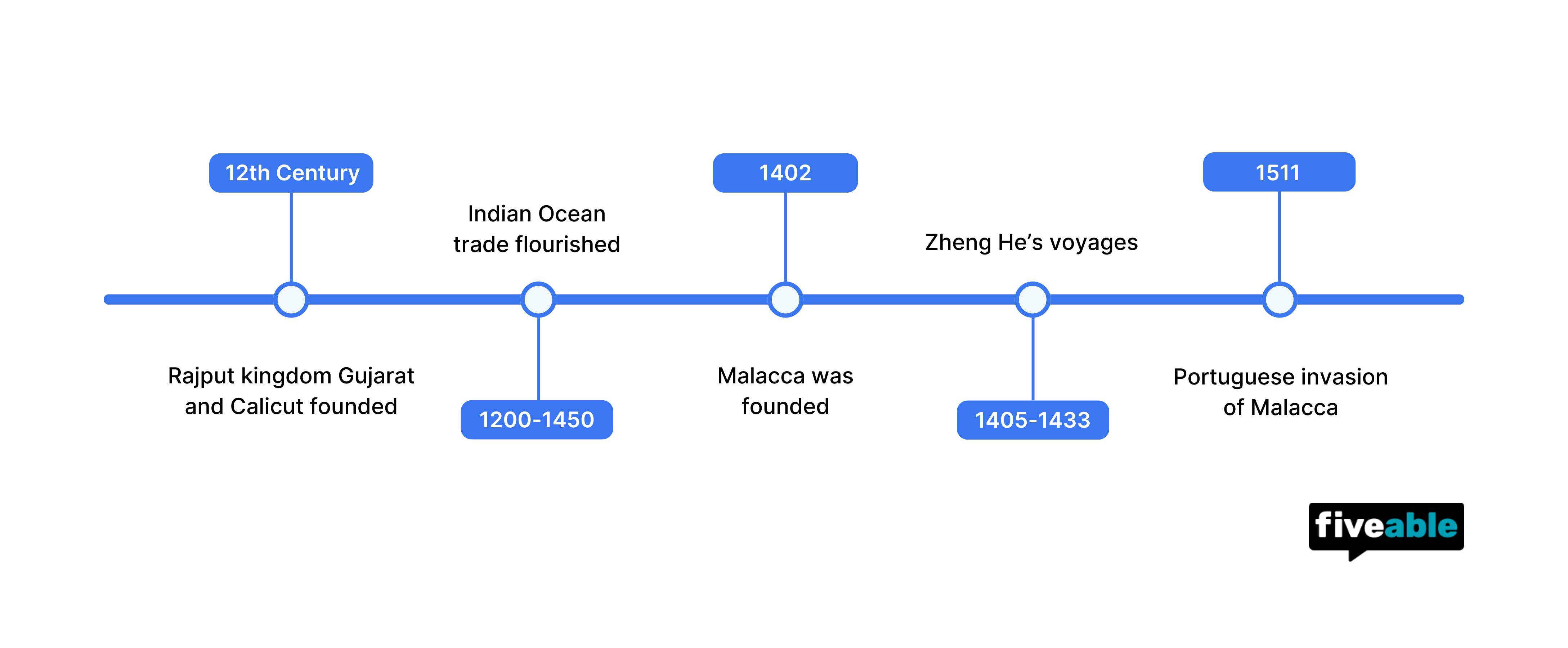
Indian Ocean trade fostered the growth of states built on commerce rather than agriculture, mining, or manufacturing. The clearest example is Malacca (Melaka), a Muslim city-state that got rich by building a navy and charging fees on ships passing through the Strait of Malacca, the narrow chokepoint between Indian and Chinese ports. By the 1400s, the Sultan of Malacca was powerful enough to expand into Sumatra and the southern Malay Peninsula.
The sultanate ended in 1511 when the Portuguese invaded, hoping to control all trade flowing between Europe, India, and China. They got rich, but less rich than they hoped. The conquest sparked regional conflicts and pushed traders to diversify their routes and ports.
Effects: Diasporas, Gujarat, and the Swahili City-States
Diasporic Communities
A diaspora is a settlement of people living away from their homeland. Because merchants had to wait out the monsoon winds, many Arab and East African merchants settled permanently in western Indian port cities, often marrying local women. Arab and Persian merchants settled in East Africa too. This is how Islam first reached southern Asia: not by conquest or missionary work, but by intermarriage, with children raised in Muslim traditions. Settlers introduced their cultural traditions to indigenous cultures, and indigenous cultures reshaped merchant culture in return.
Major diasporic merchant communities from the chapter:
| Merchant Community | Region(s) | Products |
|---|---|---|
| Muslim | China, Indian Ocean Basin, Europe | Silk, paper, porcelain, spices, gems, woods, gold, salt, amber, furs |
| Chinese | Southeast Asia, Africa | Cotton, tea, silk, metals, opium, salt |
| Sogdian (in Samarkand) | Main caravan merchants along Silk Roads, China | Silk, gold, wine, linens |
| Jewish | China, India, Europe | Glass beads, linens, dyes, spices |
| Malay | Sri Lanka | Nutmeg, pepper, cloves |
Responding to Demand: Gujarat
Rising demand forced producers to get more efficient (grow more crops, weave more textiles, make more iron), and states stepped in to manage that efficiency and collect revenue through customs (taxes on imported goods) and port fees. The western Indian Rajput kingdom of Gujarat became the go-between for East-West trade, and its customs revenue was many times the entire worth of some European states.
Swahili City-States
Indian Ocean trade also created the Swahili city-states along East Africa's coast, including Kilwa, Mombasa (modern Kenya), and Zanzibar (modern Tanzania). "Swahili" literally means "coasters." Traders of this "Zanj Coast" (the Arabic name) sold ivory, gold, and enslaved people to Arab partners, plus exotic goods like tortoise shells, peacock feathers, and rhinoceros horns. In exchange they received Chinese porcelain, Indian cotton, and ironwork. Trade with East Asia was so heavy that Chinese porcelain is still a common find in Swahili ruins. At the trade's height, Kilwa's mosques and merchant homes were built of stone or coral instead of the traditional mud and clay, a visible marker of trade wealth.
Zheng He's Voyages and Cultural Transfer
Zheng He (1371-1433), a Muslim admiral, led seven great voyages starting in 1405 on orders from the Ming emperor Yongle. He sailed to Indonesia, Ceylon, coastal areas around the Indian Ocean, Arabia, the east coast of Africa, and the Cape of Good Hope. At its height his fleet had more than 300 ships carrying 28,000 people.
- The voyages' purposes were to display Ming might and collect tribute, not to trade or conquer.
- They won prestige for China, opened new markets for Chinese goods, brought back exotic treasures (including the first giraffe the Chinese had ever seen), and inspired some Chinese to emigrate to Southeast Asian ports.
- Confucian scholars objected. Confucianism promoted a stable, agrarian lifestyle, and critics worried foreign contact threatened China's social order, looked down on other cultures as inferior, or thought the voyages cost too much.
- Yongle's successor, his son Zhu Gaozhi, ended the voyages and discouraged ocean sailing entirely, making it a punishable offense to build a ship with more than two masts.
- One short-term win: the voyages stopped pirate activity off China and Southeast Asia. Once China pulled its armed ships back, piracy returned, especially on the China Sea.
The Zheng He story is the chapter's prime example of how interregional contact drove technological and cultural transfer, and how states could choose to shut that contact down.
Key Terms to Know
| Term | Why it matters |
|---|---|
| Indian Ocean Basin | The sea network connecting East Africa, the Middle East, South Asia, and Southeast Asia with China; the era's biggest trade zone. |
| Calicut | West Indian port where Arab and Chinese merchants met to exchange spices and goods from West and East. |
| Spice Islands | Modern Malaysia and Indonesia, famous for exporting nutmeg, cinnamon, cloves, and cardamom. |
| Monsoon winds | Seasonal winds (northeast in winter, southwest in spring/summer) that dictated when and where sailors could travel. |
| Lateen sails | Triangular sails that catch wind from many directions, making ocean sailing far more flexible. |
| Stern rudder | Chinese invention that made ships more stable and easier to steer. |
| Astrolabe | Navigation tool improved by Muslim navigators in the 12th century; let sailors calculate latitude. |
| Dhow | Small wooden ship used by Arab and Indian sailors that dominated Indian Ocean trade. |
| Malacca | Muslim city-state that grew rich taxing ships in the Strait of Malacca; conquered by Portugal in 1511. |
| Gujarat | Western Indian Rajput kingdom whose customs revenue from East-West trade exceeded the worth of some European states. |
| Swahili city-states | East African trading centers (Kilwa, Mombasa, Zanzibar) that grew wealthy selling gold, ivory, and enslaved people. |
| Indian Ocean slave trade | Long-running trade in enslaved East Africans sold to North Africa, the Middle East, and India; conditions differed from the Atlantic trade. |
| Diaspora | A settlement of people away from their homeland; merchant diasporas blended cultures across the ocean's rim. |
| Zheng He | Ming Muslim admiral who led seven voyages (1405-1433) to display Chinese power and collect tribute before China ended ocean expeditions. |
Practice and Next Steps
Pair these notes with the Topic 2.3 Exchange in the Indian Ocean study guide for the course-aligned version of this material, then continue to AMSCO 2.4 Trans-Saharan Trade Routes notes to round out Unit 2's three trade networks. You'll eventually compare all of them, so the AMSCO 2.7 Comparison of Economic Exchange notes are worth bookmarking now.
To check your understanding, try AP World guided practice questions on Unit 2, or browse the full set of AMSCO chapter notes. When you're further along, the full-length practice exam shows how trade-network questions appear on test day.
Frequently Asked Questions
What caused the expansion of Indian Ocean trade after 1200?
Five main causes: the spread of Islam connected more trading cities than ever, demand grew for specialized goods like Indian cotton and Chinese porcelain, sailors used knowledge of monsoon winds to time voyages, maritime technology improved (lateen sails, stern rudder, astrolabe, dhows), and trading states like Malacca grew by taxing ship traffic. The Topic 2.3 study guide covers the same causes in course-aligned form.
How was the Indian Ocean slave trade different from the Atlantic slave trade?
Enslaved people in the Indian Ocean trade came mostly from East Africa and were sold to North Africa, the Middle East, and India, often working in seaports, shipping, and households rather than on plantations. Living in towns, they had more opportunity to form communities and work alongside free laborers, and those in Islamic communities held certain rights like the right to marry. The trade also spread African words, music, and customs to places like Oman and India.
Why did China end Zheng He's voyages?
After Emperor Yongle died, his son Zhu Gaozhi ended the voyages and discouraged ocean sailing, even making it a punishable offense to build a ship with more than two masts. Confucian scholars had argued the voyages were too expensive, that foreign contact threatened China's agrarian social order, and that other cultures were inferior. Once China stopped sending armed ships out, pirate activity returned on the China Sea.
What is a diasporic community in AP World Unit 2?
A diaspora is a settlement of people living away from their homeland. In the Indian Ocean trade, merchants waiting out the monsoon winds often settled permanently in port cities, like Arab and Persian merchants in western India and East Africa. They introduced their own traditions (including Islam, spread through intermarriage) while absorbing indigenous culture in return.
What were the Swahili city-states and why were they important?
The Swahili city-states were trading centers on East Africa's coast, including Kilwa, Mombasa, and Zanzibar, that grew rich through Indian Ocean trade. They sold ivory, gold, and enslaved people to Arab partners in exchange for Chinese porcelain, Indian cotton, and ironwork. Their wealth shows in Kilwa's ruins, where mosques and merchant homes were built of stone and coral instead of mud and clay.
How does Topic 2.3 show up on the AP World exam?
Indian Ocean trade is a favorite for comparison questions: you may be asked to compare it with the Silk Roads or Trans-Saharan routes, explain how environmental factors like monsoon winds shaped trade, or analyze effects like diasporic communities and Zheng He's voyages. Practicing with guided MCQ questions on Unit 2 is a good way to test these connections.
See Fiveable more often in Google
Mark Fiveable as a preferred source and Google is more likely to show you our guides in Top Stories, with a "preferred" badge in AI Mode and AI Overviews.