AMSCO 5.4 Industrialization Spreads Notes

🌍AP World History: Modern Review
AMSCO 5.4 Industrialization Spreads Notes
🌍 AP World History: Modern
AMSCO 1.1 Developments in East Asia Notes
AMSCO 1.2 Developments in Dar al-Islam Notes
AMSCO 1.3 Developments in South and Southeast Asia Notes
AMSCO 1.4 Developments in the Americas Notes
AMSCO 1.5 Developments in Africa Notes
AMSCO 1.6 Developments in Europe Notes
AMSCO 1.7 Comparison in the Period from c.1200 to c.1450 Notes
AMSCO 2.1 The Silk Roads Notes
AMSCO 2.2 The Mongol Empire and the Modern World Notes
AMSCO 2.3 Exchange in the Indian Ocean Notes
AMSCO 2.4 Trans-Saharan Trade Routes Notes
AMSCO 2.5 Cultural Consequences of Connectivity Notes
AMSCO 2.6 Environmental Consequences of Connectivity Notes
AMSCO 2.7 Comparison of Economic Exchange Notes
AMSCO 3.1 European, East Asian, and Gunpowder Empires Expand Notes
AMSCO 3.2 Empires: Administrations Notes
AMSCO 3.3 Empires: Belief Systems Notes
AMSCO 3.4 Comparison in Land-Based Empires Notes
AMSCO 4.1 Technological Innovations Notes
AMSCO 4.2 Exploration: Causes and Events Notes
AMSCO 4.3 Columbian Exchange Notes
AMSCO 4.4 Maritime Empires Link Regions Notes
AMSCO 4.5 Maritime Empires Develop Notes
AMSCO 4.6 Internal and External Challenges to State Power Notes
AMSCO 4.7 Changing Social Hierarchies Notes
AMSCO 4.8 Continuity and Change from c.1450 to c.1750 Notes
AMSCO 5.1 The Enlightment Notes
AMSCO 5.2 Nationalism and Revolutions Notes
AMSCO 5.3 Industrial Revolution Begins Notes
AMSCO 5.4 Industrialization Spreads Notes
AMSCO 5.5 Technology in the Industrial Age Notes
AMSCO 5.6 Industrialization: Government's Role Notes
AMSCO 5.7 Economic Developments and Innovations Notes
AMSCO 5.8 Reactions to the Industrial Economy Notes
AMSCO 5.9 Society and the Industrial Age Notes
AMSCO 5.10 Continuity and Change in the Industrial Age Notes
AMSCO 6.1 Rationales for Imperialism Notes
AMSCO 6.2 State Expansion Notes
AMSCO 6.3 Indigenous Responses to State Expansion Notes
AMSCO 6.4 Global Economic Development Notes
AMSCO 6.5 Economic Imperialism Notes
AMSCO 6.6 Causes of Migration in an Interconnected World Notes
AMSCO 6.7 Effects of Migration Notes
AMSCO 6.8 Causation in the Imperial Age Notes
AMSCO 7.1 Shifting Power Notes
AMSCO 7.2 Causes of World War I Notes
AMSCO 7.3 Conducting World War I Notes
AMSCO 7.4 Economy in the Interwar Period Notes
AMSCO 7.5 Unresolved Tensions After World War I Notes
AMSCO 7.6 Causes of World War II Notes
AMSCO 7.7 Conducting World War II Notes
AMSCO 7.8 Mass Atrocities Notes
AMSCO 7.9 Causation in Global Conflict Notes
AMSCO 8.1 Setting the Stage for the Cold War and Decolonization Notes
AMSCO 8.2 The Cold War Notes
AMSCO 8.3 Effects of the Cold War Notes
AMSCO 8.4 Spread of Communism Notes
AMSCO 8.5 Decolonization after 1900 Notes
AMSCO 8.6 Newly Independent States Notes
AMSCO 8.7 Global Resistance to Established Power Structure Notes
AMSCO 8.8 End of the Cold War Notes
AMSCO 8.9 Causation in the Age of the Cold Ward and Decolonization Notes
AMSCO 9.1 Advances in Technology and Exchange Notes
AMSCO 9.2 Technological Advancements and Limitations Notes
AMSCO 9.3 Technology and the Environment Notes
AMSCO 9.4 Economics in the Global Age Notes
AMSCO 9.5 Calls for Reforms and Responses Notes
AMSCO 9.6 Globalized Culture Notes
AMSCO 9.7 Resistance to Globalization Notes
AMSCO 9.8 Institutions Developing in a Globalized World Notes
AMSCO 9.9 Continuity and Change in a Globalized World Notes
Overview
AMSCO Topic 5.4, Industrialization Spreads (p. 304-306), explains how the Industrial Revolution moved beyond Britain to Belgium, France, Germany, the United States, Russia, and Japan between 1750 and 1900, and why the Middle East and Asia lost their share of global manufacturing at the same time. The big pattern to remember: countries that industrialized shared Britain's key ingredients (capital, natural resources, and water transportation), while British colonial policy actively dismantled industries in India and undercut Egypt's textile trade. This is the flip side of Topic 5.3, where the Industrial Revolution begins. Industrialization didn't spread evenly; it made some regions world powers and deindustrialized others.
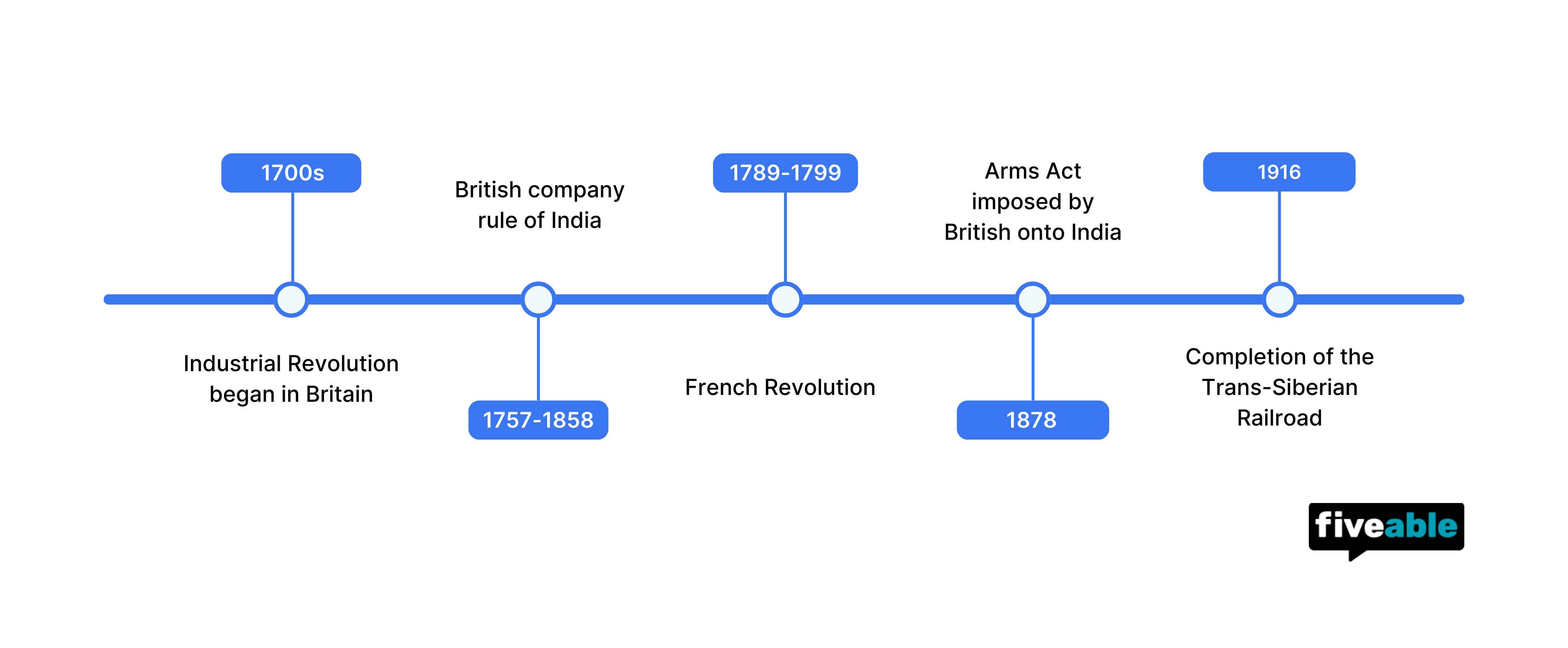
Timeline of events following the spread of industrialization around the world. Image Courtesy of Siya
Key Takeaways
- Industrialization spread to countries with capital, natural resources, and water transportation; France lacked a large factory workforce, while Germany industrialized quickly after unification.
- Immigrants and rural migrants supplied U.S. factory labor, while Russia expanded its railroads but remained overwhelmingly agricultural.
- Japan adopted Western technology and institutions to protect its traditional culture and became a leading world power in the late 19th century.
- British control displaced India's navy, while British tariffs and restrictions on minerals damaged Indian mining and metalworking.
- A British tax hurt Bombay's textile mills, while European textile production took away Egypt's export market and much of its domestic market.
- Industrial economies drew food and raw materials from around the world, with Britain using products such as rubber, palm oil, and cotton.
Spread of Industrialization
After Britain, industrialization spread first to Belgium, then to France and Germany, and eventually to the United States, Russia, and Japan. Each of these countries had the same basic advantages Britain did: capital to invest, natural resources like coal and iron, and water transportation to move goods. Britain's factory system also replaced its older cottage industry, where merchants gave raw cotton to workers to spin into cloth at home. Factory productivity was so much higher that British cotton pushed Indian and Middle Eastern goods out of world markets.
France and Germany
Both countries industrialized later than Britain, but for different reasons.
- France had sparsely populated urban centers, so there wasn't a big pool of factory labor. On top of that, the French Revolution (1789-1799) and the wars that followed absorbed the attention and capital of France's elites.
- Germany was politically fragmented into many small states, which slowed everything down. Once Germany unified in 1871, it industrialized fast and became a leading producer of steel and coal.
The United States
The U.S. began its industrial revolution in the 19th century and was a leading industrial power by 1900. The key factor was human capital, meaning the workforce itself. Political upheaval and poverty pushed large numbers of immigrants from Europe and East Asia to the U.S., and migrants from rural America joined them. Together they supplied the labor that filled the factories.
Russia
Russia industrialized with a focus on railroads and exports.
- By 1900, Russia had more than 36,000 miles of railroad linking its commercial and industrial areas.
- The Trans-Siberian Railroad ran from Moscow to the Pacific Ocean, opening up trade with East Asian countries like China and Japan.
- Coal, iron, and steel industries grew alongside the railroads, mostly in the 1890s. By 1900, Russia was the fourth largest steel producer in the world.
- Important caveat for essays: despite all this, Russia's economy stayed overwhelmingly agricultural until after the Communists seized power in 1917.
Japan
Japan was the first Asian country to industrialize, which is striking because it had the least contact with Europe since the 17th century. In the mid-19th century, Japan pursued defensive modernization. That means it deliberately borrowed Western technology and institutions in order to protect its own traditional culture, not replace it. By building military and economic strength on the Western model, Japan emerged as a leading world power in the last four decades of the 19th century. The state's role in this transformation gets full coverage in AMSCO 5.6 on industrialization and the government's role.
Shifts in Manufacturing
While the Middle East and Asia kept producing manufactured goods, their share of global manufacturing declined during this period. The AMSCO chapter gives three illustrative examples, all worth knowing as specific evidence for essays.
Shipbuilding in India and Southeast Asia
Indian shipbuilding actually rebounded at the end of the 17th century, helped by political alliances between India and Western countries. Then British colonization reversed it. British officials mismanaged resources and provided ineffective leadership through the late 17th and 18th centuries. In 1830, Britain designated British East India Company ships as the Indian Navy, but by 1863 the Indian Navy was disbanded and Britain's Royal Navy took complete control of the Indian Ocean.
Iron Works in India
British policy gutted Indian mining and metalworking.
- During company rule (the British East India Company's control over parts of the Indian subcontinent from 1757 to 1858), steep British tariffs caused India's mining and metalworking to decline.
- After the Rebellion of 1857, the British began closing mines completely because they feared the mines were being used to extract lead for ammunition.
- Fear of another uprising produced the Arms Act of 1878, which restricted access to minerals and the production of firearms.
- In mineral-rich Rajasthan, most mines were abandoned by the early 19th century and the mining industry went extinct there.
The long-term damage: years of abandoned mines meant no technological innovation, so when mining resumed it used crude, labor-intensive methods. That created the false impression that India's mineral resources were simply inaccessible.
Textile Production in India and Egypt
India and Egypt were among the first regions to produce and trade textiles, and both got squeezed by European industrial growth.
- India: as Indian textiles flourished, they undermined British mills in Lancaster. The Lancaster mill owners pressured the British government in India to impose an "equalizing" five percent tax on all textiles produced at the more than 80 mills operating in Bombay, destroying their profitability. Notice the direction here: Indian mills were competitive, and Britain taxed them into the ground.
- Egypt: in the 18th century, Egypt exported carpets, silks, and other textiles to Europe. By the mid-19th century, massive European textile production had taken away not just Egypt's export market but much of its domestic market too.
Agricultural Products for Trade in the Nineteenth Century
Industrial economies pulled in raw materials and food from around the world. The chapter's table is great comparison evidence, and notice how often Britain shows up as the end user.
| Product | Producers | Users (Finished Products) |
|---|---|---|
| Wheat | Russia, Britain | Britain (food) |
| Rubber | Brazilian Amazon | Britain (tires, footwear, fabrics) |
| Palm Oil | West Africa, Indonesia | Britain (cooking oil, soap) |
| Sugar | Caribbean Islands, Brazil | Britain (refined sugar) |
| Cattle and Hogs | United States, Ireland, Argentina | Britain, United States (meat) |
| Cotton | United States | Britain (textiles) |
Primary Sources in the Chapter
The chapter includes two documents that show how late industrializers thought about catching up. Both are classic DBQ-style sources.
The Charter Oath of the Meiji Restoration (1868)
Japan's Meiji government laid out its modernization goals, including: "Knowledge shall be sought throughout the world so as to strengthen the foundations of imperial rule" and "Evil customs of the past shall be broken off and everything based upon the just laws of Nature." This is defensive modernization in writing. Japan would learn from the West specifically to strengthen Japanese rule.
Sergei Witte's Secret Report to Tsar Nicholas II (1899)
Russia's finance minister argued that Russia's economic relationship with western Europe looked like a colony's relationship with its metropole, "generously providing them with the cheap products of her soil and buying dearly the products of their labor." But Witte insisted Russia was different: "Russia is an independent and strong power... She wants to be a metropolis herself." His point was that industrialization was a matter of national independence, not just economics.
Key Terms to Know
| Term | Why it matters |
|---|---|
| Cottage industry | The home-based system where merchants supplied raw cotton for workers to spin into cloth; factories replaced it. |
| Human capital | The economic value of a workforce; immigrant and rural migrant labor powered U.S. industrialization. |
| Trans-Siberian Railroad | The rail line from Moscow to the Pacific that connected Russia to trade with East Asia, including China and Japan. |
| Defensive modernization | Japan's strategy of adopting Western technology and institutions to protect its traditional culture and independence. |
| Meiji Restoration | The transformation of Japan starting in 1868 that made it a leading world power by the end of the 19th century. |
| Charter Oath | The 1868 Meiji statement of goals, including seeking knowledge "throughout the world" to strengthen imperial rule. |
| British East India Company | The British company whose ships became the Indian Navy in 1830 and whose rule reshaped India's economy. |
| Company rule | British East India Company control over parts of the Indian subcontinent from 1757 to 1858. |
| Rebellion of 1857 | The Indian uprising that led Britain to close mines out of fear they supplied lead for ammunition. |
| Arms Act of 1878 | British law restricting Indian access to minerals and firearm production, driven by fear of another uprising. |
| Indian Navy | The fleet of British East India Company ships created in 1830 and disbanded by 1863 when the Royal Navy took over the Indian Ocean. |
| "Equalizing" tax | The five percent tax on Bombay's 80-plus textile mills, pushed by Lancaster mill owners to wipe out Indian competition. |
| Sergei Witte | Russian finance minister who argued in 1899 that Russia must industrialize to avoid being an economic colony of western Europe. |
| Deindustrialization | The decline of Middle Eastern and Asian manufacturing share as Europe and the U.S. industrialized. |
Practice and Next Steps
For the College Board framing of this material, read the 5.4 Industrialization Spreads course topic study guide, then continue the AMSCO sequence with 5.5 Technology in the Industrial Age. The full chapter list lives on the AP World AMSCO notes page.
To check yourself, run a few Unit 5 questions in guided MCQ practice. Causes and effects of the spread of industrialization make frequent LEQ and DBQ material, so try a prompt with FRQ practice and instant scoring once the chapter feels solid.
Frequently Asked Questions
What does AMSCO Topic 5.4 Industrialization Spreads cover?
AMSCO 5.4 (p. 304-306) covers how the Industrial Revolution spread from Britain to Belgium, France, Germany, the United States, Russia, and Japan, and why Middle Eastern and Asian regions lost their share of global manufacturing. The three key examples of that decline are shipbuilding in India and Southeast Asia, iron works in India, and textile production in India and Egypt.
Why was industrialization delayed in France and Germany?
France had sparsely populated urban centers, so factory labor was scarce, and the French Revolution (1789-1799) plus the wars that followed consumed the attention and capital of its elites. Germany was politically fragmented into many small states; once it unified in 1871, it quickly became a leading producer of steel and coal.
What is defensive modernization in Japan?
Defensive modernization was Japan's mid-19th-century strategy of deliberately adopting Western technology and institutions in order to protect its traditional culture and independence, not replace them. The 1868 Charter Oath captured this with the line that knowledge "shall be sought throughout the world so as to strengthen the foundations of imperial rule." By the end of the 1800s, Japan had emerged as a leading world power.
Why did India's manufacturing decline during British rule?
British policy actively dismantled it rather than India simply falling behind. Steep tariffs during company rule (1757-1858) hurt mining and metalworking, the British closed mines after the Rebellion of 1857 fearing they supplied lead for ammunition, the Arms Act of 1878 restricted mineral access, and Lancaster mill owners got a five percent "equalizing" tax placed on Bombay's 80-plus textile mills to destroy their profitability.
Was Russia fully industrialized by 1900?
No, and that nuance earns points on essays. By 1900 Russia had over 36,000 miles of railroad including the Trans-Siberian Railroad and was the fourth largest steel producer in the world, but its economy remained overwhelmingly agricultural until after the Communists seized power in 1917. Finance minister Sergei Witte argued in 1899 that Russia had to industrialize to avoid becoming an economic colony of western Europe.
How does Topic 5.4 show up on the AP World exam?
Topic 5.4 supports questions about how modes and locations of production changed from 1750 to 1900, which is common comparison and causation material for MCQs, LEQs, and DBQs. Specific evidence like Japan's defensive modernization, the Trans-Siberian Railroad, and India's deindustrialization works well in essays. Try a Unit 5 prompt with FRQ practice and instant scoring.
See Fiveable more often in Google
Mark Fiveable as a preferred source and Google is more likely to show you our guides in Top Stories, with a "preferred" badge in AI Mode and AI Overviews.