AMSCO 4.3 Columbian Exchange Notes

🌍AP World History: Modern Review
AMSCO 4.3 Columbian Exchange Notes
🌍 AP World History: Modern
AMSCO 1.1 Developments in East Asia Notes
AMSCO 1.2 Developments in Dar al-Islam Notes
AMSCO 1.3 Developments in South and Southeast Asia Notes
AMSCO 1.4 Developments in the Americas Notes
AMSCO 1.5 Developments in Africa Notes
AMSCO 1.6 Developments in Europe Notes
AMSCO 1.7 Comparison in the Period from c.1200 to c.1450 Notes
AMSCO 2.1 The Silk Roads Notes
AMSCO 2.2 The Mongol Empire and the Modern World Notes
AMSCO 2.3 Exchange in the Indian Ocean Notes
AMSCO 2.4 Trans-Saharan Trade Routes Notes
AMSCO 2.5 Cultural Consequences of Connectivity Notes
AMSCO 2.6 Environmental Consequences of Connectivity Notes
AMSCO 2.7 Comparison of Economic Exchange Notes
AMSCO 3.1 European, East Asian, and Gunpowder Empires Expand Notes
AMSCO 3.2 Empires: Administrations Notes
AMSCO 3.3 Empires: Belief Systems Notes
AMSCO 3.4 Comparison in Land-Based Empires Notes
AMSCO 4.1 Technological Innovations Notes
AMSCO 4.2 Exploration: Causes and Events Notes
AMSCO 4.3 Columbian Exchange Notes
AMSCO 4.4 Maritime Empires Link Regions Notes
AMSCO 4.5 Maritime Empires Develop Notes
AMSCO 4.6 Internal and External Challenges to State Power Notes
AMSCO 4.7 Changing Social Hierarchies Notes
AMSCO 4.8 Continuity and Change from c.1450 to c.1750 Notes
AMSCO 5.1 The Enlightment Notes
AMSCO 5.2 Nationalism and Revolutions Notes
AMSCO 5.3 Industrial Revolution Begins Notes
AMSCO 5.4 Industrialization Spreads Notes
AMSCO 5.5 Technology in the Industrial Age Notes
AMSCO 5.6 Industrialization: Government's Role Notes
AMSCO 5.7 Economic Developments and Innovations Notes
AMSCO 5.8 Reactions to the Industrial Economy Notes
AMSCO 5.9 Society and the Industrial Age Notes
AMSCO 5.10 Continuity and Change in the Industrial Age Notes
AMSCO 6.1 Rationales for Imperialism Notes
AMSCO 6.2 State Expansion Notes
AMSCO 6.3 Indigenous Responses to State Expansion Notes
AMSCO 6.4 Global Economic Development Notes
AMSCO 6.5 Economic Imperialism Notes
AMSCO 6.6 Causes of Migration in an Interconnected World Notes
AMSCO 6.7 Effects of Migration Notes
AMSCO 6.8 Causation in the Imperial Age Notes
AMSCO 7.1 Shifting Power Notes
AMSCO 7.2 Causes of World War I Notes
AMSCO 7.3 Conducting World War I Notes
AMSCO 7.4 Economy in the Interwar Period Notes
AMSCO 7.5 Unresolved Tensions After World War I Notes
AMSCO 7.6 Causes of World War II Notes
AMSCO 7.7 Conducting World War II Notes
AMSCO 7.8 Mass Atrocities Notes
AMSCO 7.9 Causation in Global Conflict Notes
AMSCO 8.1 Setting the Stage for the Cold War and Decolonization Notes
AMSCO 8.2 The Cold War Notes
AMSCO 8.3 Effects of the Cold War Notes
AMSCO 8.4 Spread of Communism Notes
AMSCO 8.5 Decolonization after 1900 Notes
AMSCO 8.6 Newly Independent States Notes
AMSCO 8.7 Global Resistance to Established Power Structure Notes
AMSCO 8.8 End of the Cold War Notes
AMSCO 8.9 Causation in the Age of the Cold Ward and Decolonization Notes
AMSCO 9.1 Advances in Technology and Exchange Notes
AMSCO 9.2 Technological Advancements and Limitations Notes
AMSCO 9.3 Technology and the Environment Notes
AMSCO 9.4 Economics in the Global Age Notes
AMSCO 9.5 Calls for Reforms and Responses Notes
AMSCO 9.6 Globalized Culture Notes
AMSCO 9.7 Resistance to Globalization Notes
AMSCO 9.8 Institutions Developing in a Globalized World Notes
AMSCO 9.9 Continuity and Change in a Globalized World Notes
Overview
AMSCO Topic 4.3, "Columbian Exchange" (AMSCO p.209-214), covers the massive transfer of diseases, foods, animals, and people between the Eastern and Western Hemispheres after Columbus's 1492 voyage. This is the biological and demographic core of Unit 4 (1450-1750): smallpox wiping out indigenous American populations, horses transforming the Plains, potatoes fueling European population growth, and sugar driving the transatlantic slave trade. The chapter also tracks how African cultures survived and reshaped life in the Americas, and how European colonization changed the American environment.
The chapter opens with an Aztec poem ("Flowers and Songs of Sorrow," c. 1521-1540) mourning the destruction of Mexico and Tlatelolco. That sets the tone: contact and conquest were disastrous for native peoples, but out of the collision of indigenous American, European, and African traditions, new ways of life emerged. One ripple effect to remember for later topics: Spanish silver mined in the Americas sparked inflation back in Spain, which contributed to the empire's eventual decline.
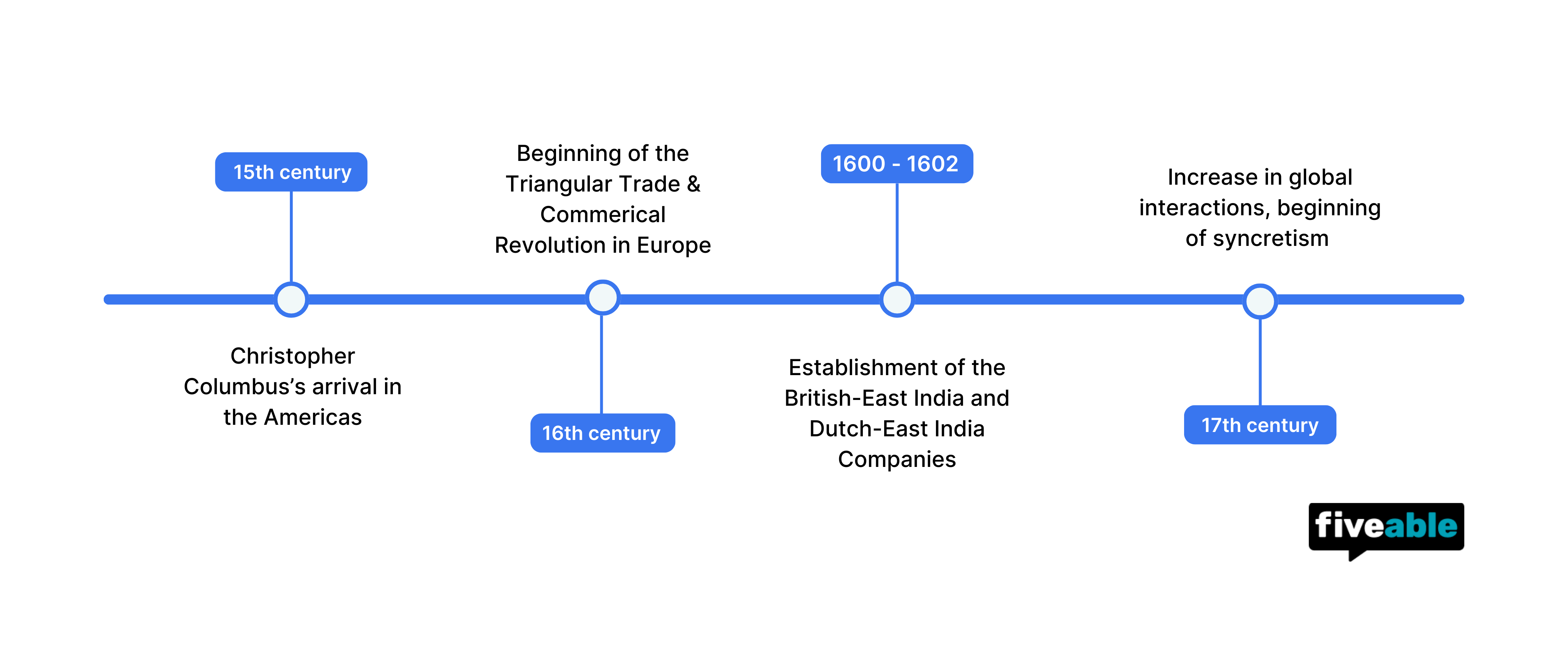
Timeline of the origin and impacts of the Columbian Exchange from Columbus's arrival in 1492 to the 19th century. Image courtesy of Rashmi Korukonda.
Key Takeaways
- Indigenous Americans had no immunity to Afro-Eurasian diseases, and disease killed more than half of the Americas' indigenous population in less than a century.
- Horses changed Plains Indian buffalo hunting, while American crops such as maize and potatoes helped drive European population growth.
- Brazilian sugar plantations relied on enslaved African labor, and sugar's profitability expanded the transatlantic slave trade.
- Enslaved Africans and their descendants shaped life in the Americas through creole languages, music, and foods such as rice and okra.
- European farming and denser settlements in the Americas caused deforestation, soil depletion, and pressure on water resources.
Diseases and Population Catastrophe
Disease, not weapons, killed the majority of indigenous Americans after contact. Before 1492, the Western and Eastern Hemispheres were almost completely isolated from each other, so the peoples of the Americas had no exposure to Afro-Eurasian germs and no immunity to them.
- Spanish conquistadores like Hernán Cortés and Francisco Pizarro carried smallpox, which spreads through the respiratory system. Europeans were largely immune after millennia of exposure; indigenous Americans were not.
- As colonists settled, disease-carrying insects and rats arrived too. Measles, influenza, and malaria killed alongside smallpox.
- The indigenous population of the Americas fell by more than 50 percent from disease alone in less than a century. Some areas lost up to 90 percent of their people.
The AMSCO text calls this one of the greatest population disasters in human history. Horses, gunpowder, and metal weapons helped Europeans conquer, but on the exam, disease is your go-to explanation for the demographic collapse.
Animals and Foods
The exchange of crops and livestock ran in both directions, and it reshaped diets and cultures on every continent involved.
Eastern Hemisphere to the Americas
- Europeans introduced pigs and cows to a Mesoamerica that ate very little meat before contact (pork, beef, and cheese in Mexican food all came later).
- Mediterranean foods like wheat and grapes became staples of the American diet.
- The horse transformed Plains Indian culture. Hunting buffalo on horseback was so efficient, and covered so much more territory, that tribes had a food surplus, freeing time for art and spirituality. The flip side: competition and armed conflict between tribes increased, and tribes with the most horses held the most power.
Americas to the Eastern Hemisphere
- Explorers carried maize (corn), potatoes, tomatoes, beans, peppers, and cacao back to Europe.
- Potatoes became so embedded in places like Ireland that people assume they're native there. They're American.
- These nutritious new crops caused tremendous population growth in Europe in the 16th and 17th centuries.
That last bullet is a classic AP World cause-and-effect chain: American crops cross the Atlantic, European nutrition improves, European population booms.
Cash Crops and Forced Labor
People became part of the exchange too. The transatlantic slave trade forcibly brought millions of Africans to the Americas, and with them came biological and demographic changes. Africans brought okra and rice to the Americas, while tobacco and cacao grown on plantations with forced labor were sold to consumers in Europe, Africa, and the Middle East.
Here's a counterintuitive fact the chapter highlights: even though slave traders kidnapped millions of people, Africa's population actually grew during the 16th and 17th centuries. Why? Nutritious American crops like maize, sweet potatoes, and manioc arrived from Brazil and boosted food supplies.
The Lure of Sugar
While Spain profited from silver, Portugal built its American empire on agriculture. Brazil's tropical climate and vast land made it perfect for sugarcane. But disease had decimated the indigenous population, and many forced laborers escaped into the uncharted Brazilian jungle. The Portuguese response: import enslaved Africans, especially from the Kongo Kingdom and cities on the Swahili coast.
Slavery and the Engenhos
Sugar's profitability in European markets dramatically increased the number of Africans captured and sold through the transatlantic slave trade. Key numbers to know:
- More than 90 percent of enslaved Africans were sold to the Caribbean and South America. Only about 6 percent went to British North America.
- Until the mid-1800s, more Africans than Europeans went to the Americas.
- African laborers were so numerous in Brazil that their descendants became the majority population of the region.
Brazilian sugar plantations processed so much sugar they were called engenhos, Portuguese for "engines." Conditions were brutal: backbreaking labor, poor nutrition, inadequate shelter, tropical heat, and disease. Plantation owners lost 5 to 10 percent of their labor force every year, which fueled constant new importation of enslaved people. Slavery gets fuller treatment in AMSCO 4.4 on maritime empires.
Growing Cash Crops
Spain noticed Portugal's plantation profits and returned to the Caribbean to grow cash crops like sugar and tobacco. A cash crop is grown for sale, not for the grower's own subsistence. Soon sugar eclipsed silver as the main moneymaker for European empires. That's a big deal: the most valuable American export shifted from a mineral to a plantation crop.
African Presence in the Americas
Enslaved Africans kept parts of their cultures alive in the Americas during the African Diaspora, the dispersion of Africans out of Africa. The chapter traces this through three threads.
Languages
Most Africans could not transplant their languages. Captives came from many different cultural groups across West Africa (and on some ships, East Africa), so most shipmates shared no common language. After about a generation of linguistic isolation, original languages were largely lost. What emerged instead were creole languages, blends of European colonizers' languages (English, Spanish, French, Portuguese) with West African vocabulary and grammatical patterns.
- Creole languages still dominate in the Caribbean, where enslaved Africans were a large concentration of the population.
- In the United States, the notable exception is Gullah (or Geechee) along coastal South Carolina and Georgia, where enslaved people once made up 75 percent of the population.
Music
African syncopated rhythms and percussion influenced gospel, blues, jazz, rock and roll, hip-hop, rap, samba, reggae, and country. Music was a survival tool: enslaved people sang to endure long workdays and to communicate, including when planning escapes. Blending European Christian music with African religious songs produced Negro spirituals, foundational to American folk music. Enslaved people also invented the banjo, modeled on West African stringed instruments.
Food
Africans brought rice and okra plus the knowledge of how to cook them. Gumbo, the southern US dish, has roots in African cooking.
Environmental and Demographic Impact
European colonization changed the American environment itself, beyond the biological exchange. Europeans farmed land more intensively than American Indians did:
- Colonists cut down trees to clear fields and cultivated the same large fields year after year, causing deforestation and soil depletion.
- Europeans lived in more densely populated communities than American Indians, straining water resources and creating concentrated pollution.
For a DBQ or LEQ on the environment in 1450-1750, this section plus the disease catastrophe gives you ready-made evidence.
Key Terms to Know
| Term | Why it matters |
|---|---|
| Columbian Exchange | The transfer of plants, animals, diseases, and people between the Eastern and Western Hemispheres after 1492, the central concept of this topic. |
| Smallpox | The deadliest European disease in the Americas, the main driver of indigenous population collapse. |
| Conquistadores | Spanish soldiers like Cortés and Pizarro who conquered American empires and unknowingly carried disease. |
| Horse | European animal that transformed Plains Indian buffalo hunting, creating food surpluses but also intertribal conflict. |
| Maize | American corn carried to Europe, one of the crops behind Europe's 16th- and 17th-century population growth. |
| Cacao | American crop turned plantation cash crop, sold to consumers in Europe, Africa, and the Middle East. |
| Okra | Food crop brought to the Americas by enslaved Africans, part of Africa's contribution to the exchange. |
| Rice | Another African-brought crop, foundational to plantation agriculture and African American cooking. |
| Sugarcane | The crop that made Brazil profitable and drove demand for enslaved African labor. |
| Cash crop | A crop grown for sale rather than subsistence; sugar and tobacco eventually out-earned silver. |
| Transatlantic slave trade | The forced migration of millions of Africans to the Americas, with over 90 percent sent to the Caribbean and South America. |
| Engenhos | Brazilian sugar plantations ("engines") with conditions so deadly that owners lost 5-10 percent of laborers yearly. |
| African Diaspora | The dispersion of Africans out of Africa, through which African languages, music, and food shaped the Americas. |
| Creole | New languages blending European colonizers' languages with West African grammar and vocabulary, like Gullah in coastal South Carolina and Georgia. |
| Gumbo | Southern US dish with African roots, evidence of lasting African culinary influence. |
| Deforestation | Result of intensive European land clearing in the Americas, paired with soil depletion from repeated cultivation. |
Practice and Next Steps
Pair these notes with the Fiveable 4.3 Columbian Exchange course study guide for the College Board framing of the same content, then test yourself:
- Run timed multiple choice on this topic with AP World guided practice.
- Try a causation prompt on the Columbian Exchange with FRQ practice and instant scoring.
- Look up any term that's still fuzzy in the AP World key terms glossary.
When you're ready, move on to AMSCO 4.4 Maritime Empires Link Regions Notes, which picks up the slave trade and trading-post empires, or review the full set on the AMSCO notes unit page. If you skipped ahead, AMSCO 4.2 on the causes of exploration explains how Europeans got to the Americas in the first place.
Frequently Asked Questions
What was the Columbian Exchange in AP World?
The Columbian Exchange was the transfer of plants, animals, diseases, and people between the Eastern and Western Hemispheres after Columbus's 1492 voyage. Europeans brought horses, pigs, cattle, wheat, and smallpox to the Americas, while maize, potatoes, tomatoes, and cacao traveled to Afro-Eurasia. It's named for Columbus because his voyages established the permanent link between the hemispheres.
What killed most indigenous Americans after European contact?
Disease, not warfare. Indigenous Americans had no immunity to Afro-Eurasian diseases like smallpox, measles, influenza, and malaria, and the population of the Americas fell by more than 50 percent from disease alone in under a century. Some regions lost up to 90 percent of their people, making it one of the greatest population disasters in history.
Why did Africa's population grow during the slave trade?
Even though slave traders kidnapped millions of Africans, Africa's population grew in the 16th and 17th centuries because nutritious American crops like yams and manioc arrived from Brazil and improved food supplies. This is a favorite AP World twist: the Columbian Exchange's nutritional benefits outpaced the demographic losses from the slave trade during this period.
What were engenhos and why do they matter?
Engenhos were Brazilian sugar plantations, named from the Portuguese word for "engines" because of how much sugar they processed. Conditions were so brutal that owners lost 5 to 10 percent of their enslaved labor force every year, which drove constant new importation of enslaved Africans. They're key evidence for explaining how sugar fueled the transatlantic slave trade.
How does the Columbian Exchange show up on the AP World exam?
It's a core Unit 4 topic and a frequent target for causation and effects questions, like explaining why indigenous populations collapsed or how American crops fueled European population growth. Specific evidence like the 50 percent disease death toll, the horse on the Plains, and sugar eclipsing silver makes strong FRQ support. Try a timed prompt with Fiveable's FRQ practice.
See Fiveable more often in Google
Mark Fiveable as a preferred source and Google is more likely to show you our guides in Top Stories, with a "preferred" badge in AI Mode and AI Overviews.