AMSCO 1.3 Developments in South and Southeast Asia Notes

🌍AP World History: Modern Review
AMSCO 1.3 Developments in South and Southeast Asia Notes
🌍 AP World History: Modern
AMSCO 1.1 Developments in East Asia Notes
AMSCO 1.2 Developments in Dar al-Islam Notes
AMSCO 1.3 Developments in South and Southeast Asia Notes
AMSCO 1.4 Developments in the Americas Notes
AMSCO 1.5 Developments in Africa Notes
AMSCO 1.6 Developments in Europe Notes
AMSCO 1.7 Comparison in the Period from c.1200 to c.1450 Notes
AMSCO 2.1 The Silk Roads Notes
AMSCO 2.2 The Mongol Empire and the Modern World Notes
AMSCO 2.3 Exchange in the Indian Ocean Notes
AMSCO 2.4 Trans-Saharan Trade Routes Notes
AMSCO 2.5 Cultural Consequences of Connectivity Notes
AMSCO 2.6 Environmental Consequences of Connectivity Notes
AMSCO 2.7 Comparison of Economic Exchange Notes
AMSCO 3.1 European, East Asian, and Gunpowder Empires Expand Notes
AMSCO 3.2 Empires: Administrations Notes
AMSCO 3.3 Empires: Belief Systems Notes
AMSCO 3.4 Comparison in Land-Based Empires Notes
AMSCO 4.1 Technological Innovations Notes
AMSCO 4.2 Exploration: Causes and Events Notes
AMSCO 4.3 Columbian Exchange Notes
AMSCO 4.4 Maritime Empires Link Regions Notes
AMSCO 4.5 Maritime Empires Develop Notes
AMSCO 4.6 Internal and External Challenges to State Power Notes
AMSCO 4.7 Changing Social Hierarchies Notes
AMSCO 4.8 Continuity and Change from c.1450 to c.1750 Notes
AMSCO 5.1 The Enlightment Notes
AMSCO 5.2 Nationalism and Revolutions Notes
AMSCO 5.3 Industrial Revolution Begins Notes
AMSCO 5.4 Industrialization Spreads Notes
AMSCO 5.5 Technology in the Industrial Age Notes
AMSCO 5.6 Industrialization: Government's Role Notes
AMSCO 5.7 Economic Developments and Innovations Notes
AMSCO 5.8 Reactions to the Industrial Economy Notes
AMSCO 5.9 Society and the Industrial Age Notes
AMSCO 5.10 Continuity and Change in the Industrial Age Notes
AMSCO 6.1 Rationales for Imperialism Notes
AMSCO 6.2 State Expansion Notes
AMSCO 6.3 Indigenous Responses to State Expansion Notes
AMSCO 6.4 Global Economic Development Notes
AMSCO 6.5 Economic Imperialism Notes
AMSCO 6.6 Causes of Migration in an Interconnected World Notes
AMSCO 6.7 Effects of Migration Notes
AMSCO 6.8 Causation in the Imperial Age Notes
AMSCO 7.1 Shifting Power Notes
AMSCO 7.2 Causes of World War I Notes
AMSCO 7.3 Conducting World War I Notes
AMSCO 7.4 Economy in the Interwar Period Notes
AMSCO 7.5 Unresolved Tensions After World War I Notes
AMSCO 7.6 Causes of World War II Notes
AMSCO 7.7 Conducting World War II Notes
AMSCO 7.8 Mass Atrocities Notes
AMSCO 7.9 Causation in Global Conflict Notes
AMSCO 8.1 Setting the Stage for the Cold War and Decolonization Notes
AMSCO 8.2 The Cold War Notes
AMSCO 8.3 Effects of the Cold War Notes
AMSCO 8.4 Spread of Communism Notes
AMSCO 8.5 Decolonization after 1900 Notes
AMSCO 8.6 Newly Independent States Notes
AMSCO 8.7 Global Resistance to Established Power Structure Notes
AMSCO 8.8 End of the Cold War Notes
AMSCO 8.9 Causation in the Age of the Cold Ward and Decolonization Notes
AMSCO 9.1 Advances in Technology and Exchange Notes
AMSCO 9.2 Technological Advancements and Limitations Notes
AMSCO 9.3 Technology and the Environment Notes
AMSCO 9.4 Economics in the Global Age Notes
AMSCO 9.5 Calls for Reforms and Responses Notes
AMSCO 9.6 Globalized Culture Notes
AMSCO 9.7 Resistance to Globalization Notes
AMSCO 9.8 Institutions Developing in a Globalized World Notes
AMSCO 9.9 Continuity and Change in a Globalized World Notes
Overview
AMSCO Topic 1.3, "Developments in South and Southeast Asia" (AMSCO p.23 - p.29), covers how Hindu, Muslim, and Buddhist states formed and held power across India and Southeast Asia from c. 1200 to c. 1450. The big story: South Asia stayed politically decentralized (Delhi Sultanate in the north, Vijayanagara and Rajput kingdoms among the Hindu states), while Southeast Asian kingdoms like Srivijaya, Majapahit, and the Khmer Empire built power through sea trade or irrigation. Running through all of it is the interaction of Hinduism, Islam, and Buddhism, which reshaped religion, language, art, and architecture across the region.
This chapter pairs with AMSCO 1.2 on Dar al-Islam, since Islam's spread into India and Indonesia is a direct continuation of that story.
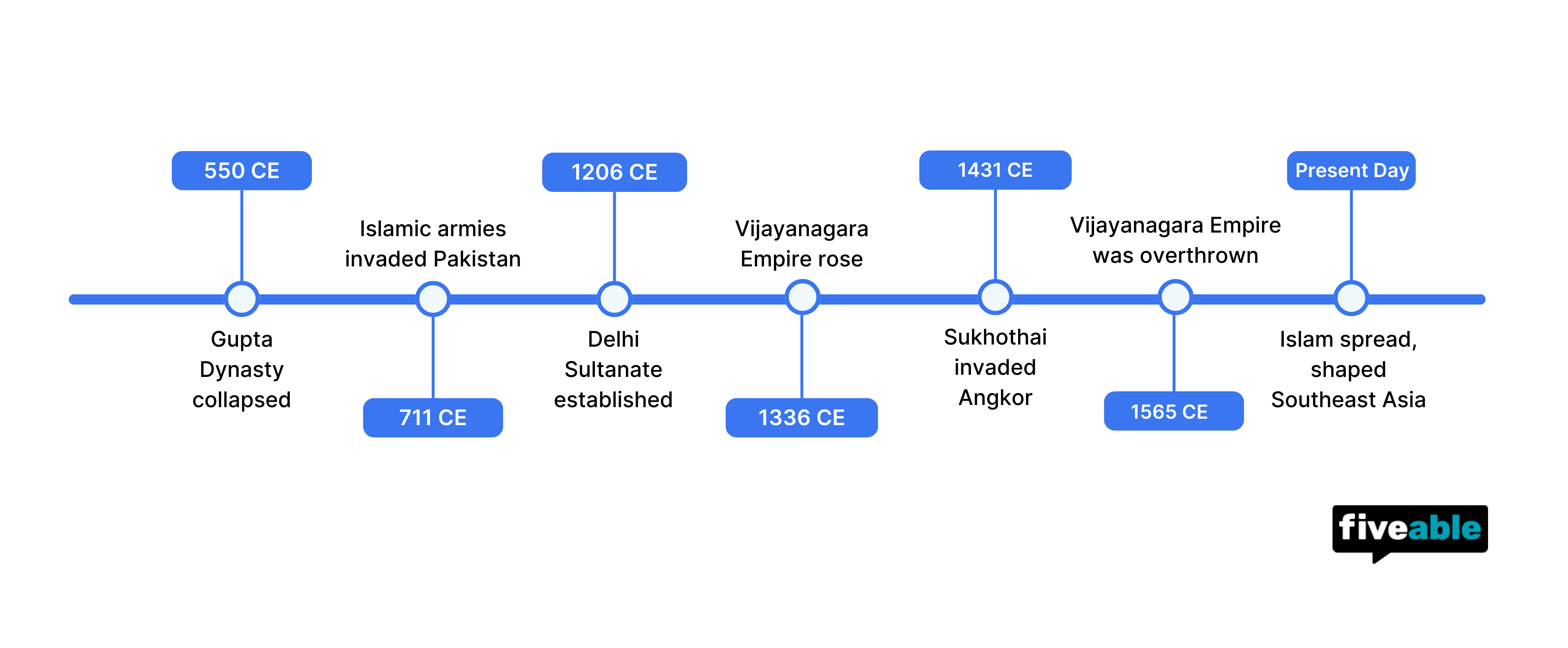
Timeline of South and Southeast Asian History. Image Courtesy of Riya Patel.
Key Takeaways
- Rajput rivalries left northern India open to invasion, while the Delhi Sultanate imposed the jizya and struggled to govern; Harihara and Bukka founded Hindu Vijayanagara in the south.
- Most Indian converts to Islam converted voluntarily, with Buddhists forming the largest group, but Islam's arrival did little to change South Asia's social structure.
- Hindu-Muslim exchange shaped architecture and Urdu, while Bhakti and Sufi movements both emphasized a personal relationship with the divine over strict ritual.
- Buddhist Srivijaya prospered by charging ships traveling between India and China, while Hindu Majapahit also built power through sea routes.
- The Buddhist Sinhala dynasties used reservoirs and canals, while the Khmer Empire prospered through irrigation and drainage.
- Local merchants converted to Islam to improve trade relations, and Sufi missionaries helped spread the faith by allowing converts to keep honoring local deities.
Political Structures in South Asia
South Asia was rarely united as a single state. After the Gupta Dynasty collapsed in 550, ending India's Classical "Golden Age," the region stayed politically fragmented for most of the next 1,000 years. Northern and southern India developed separately, but Hinduism gave the region cultural unity even without political unity. That combination (political decentralization plus shared religious culture) is the chapter's core pattern.
Southern India: Chola and Vijayanagara
Southern India was more stable than the north.
- The Chola Dynasty ruled southern India for over 400 years (850-1267) and in the 11th century extended its rule to Ceylon (modern Sri Lanka).
- The Vijayanagara Empire (1336-1646), whose name means "the victorious city," was founded by two brothers, Harihara and Bukka. The Delhi Sultanate sent them south to extend Muslim rule. Instead, they returned to the Hinduism of their birth (they had converted to Islam for upward mobility) and built their own Hindu kingdom.
- Vijayanagara dominated the south until a group of Muslim kingdoms overthrew it in the mid-1500s.
The Harihara and Bukka story is a favorite on the exam because it shows religious conversion working as a political tool, in both directions.
Northern India: Rajput Kingdoms and the Delhi Sultanate
Northern India saw far more upheaval. After the Gupta collapse, the Rajput kingdoms formed in northern India and present-day Pakistan. These were Hindu kingdoms led by rival clans that fought each other constantly, so no centralized government emerged. That disunity left them vulnerable to Muslim invasions through the northwest mountain passes (the Himalayas blocked invasion from the north and east, but not the northwest).
Islam's presence grew in stages:
- 8th century: Islamic armies invaded what is now Pakistan, but everyday life changed little. The region sat on the eastern fringe of Dar al-Islam, and Rajput princes limited the conquerors' influence.
- 11th century: Islamic forces plundered Hindu temples and Buddhist shrines for riches and built mosques on Hindu and Buddhist holy sites, fueling resentment.
- Early 13th century: Islamic forces conquered Delhi and much of northern South Asia, founding the Delhi Sultanate, which ruled for 300 years (13th-16th centuries).
Key facts about the Delhi Sultanate:
- It imposed the jizya, a tax on all non-Muslim subjects, which deepened Hindu resentment.
- It never built an efficient bureaucracy like China's, so sultans struggled to enforce policy across a vast, diverse land. Local Hindu kingdoms kept real power.
- It blocked the Mongols from conquering South Asia, but in 1526 it fell to the Mughals, whose leaders traced their ancestry to the Mongols.
Religion and Society in South Asia
Before Islam arrived, most South Asians were Hindu and a smaller number were Buddhist. Islam was strikingly different from Hinduism on almost every axis:
- Hindus pray to many gods; Islam is strictly monotheistic.
- Hindu temples are full of images of deities; Muslims disapprove of visual representations of Allah.
- Hinduism was tied to a hierarchical caste system; Islam calls for the equality of all believers.
- Hindus recognize several sacred texts; Muslims look primarily to the Quran.
How Islam Spread (Mostly Voluntarily)
Islam entered India forcefully at first, but Muslim rulers learned that forcing Hindus and Buddhists to convert didn't work. Islam is a universalizing religion that seeks to proselytize (actively win converts), and most Indian converts came voluntarily:
- Muslim merchants in Indian Ocean trade settled in Indian port cities and married locally; their wives often converted.
- Low-caste Hindus converted hoping equality of believers would raise their social status. The AMSCO chapter compares this to Christianity's appeal in the Roman Empire: both attracted people at the bottom of the existing social order.
- The largest group of converts was actually Buddhists. Corruption among monks and Muslim raids on monasteries left Buddhism disorganized, and Islam's spread helped make Buddhism a minority religion in its own birthplace.
Social Structures: The Caste System Endures
Islam's arrival did little to change South Asia's basic social structure. The caste system is India's strongest historical continuity. It was inequitable but provided stability in a politically decentralized land, and it was flexible enough to absorb newcomers. Muslim merchants and migrants were slotted into occupational subcastes that worked like workers' guilds.
Two continuities to remember:
- Low-caste converts to Islam usually did not actually improve their status. Changing religion didn't change access to education or jobs.
- Gender norms barely shifted. South Asian women had been confined to a separate social sphere under Hindu tradition, and Islamic women received similar treatment. In Southeast Asia, women had more independence before Islam, and that pattern continued after conversion. Converts adapted the new faith to existing traditions rather than abandoning them.
Cultural Interactions in South Asia
Hindu-Muslim interaction produced major intellectual and artistic blending.
- Mathematics and science: Arab astronomers and mathematicians built on Indian work. Indian advances in algebra and geometry were translated into Arabic and spread across Dar al-Islam. The numerals the West calls "Arabic numerals" actually originated in India.
- Architecture: Sultans built structures blending intricate Hindu artistic detail with Islamic geometric patterns. The Qutub Minar in southern Delhi is the famous example: rulers of the Delhi Sultanate built a mosque on top of a Hindu temple using materials from nearby shrines, topped by a gigantic leaning tower that is the tallest structure in India today and stood as a symbol of Islamic influence over northern India.
- Language: A new language, Urdu, developed among South Asian Muslims. It melds Hindi grammar with Arabic vocabulary and some Farsi (Persian) elements. Urdu is the official language of Pakistan today.
The Bhakti Movement
Starting in the 12th century in southern India, the Bhakti Movement emphasized emotional devotion to a particular deity over studying texts or performing rituals. It appealed widely because it did not discriminate against women or low-status people; one of its most famous figures, the poet Mira Bai, was a woman of the 16th century.
The exam-ready comparison: bhaktis were Hindu, but they paralleled Sufi Muslims. Both were mystical movements emphasizing inner reflection and a direct personal relationship with the divine, both downplayed strict ritual, and both attracted people outside their own traditions. Sufis helped spread Islam; bhaktis helped spread Hinduism.
Southeast Asia: Sea-Based and Land-Based Kingdoms
Like China, India strongly influenced its neighbors. Indian merchants traded with Southeast Asia (today's Indonesia, Malaysia, Cambodia, Thailand, Laos, and Vietnam) as early as 500 B.C.E., selling gold, silver, metal goods, and textiles and bringing back spices. Those trade voyages carried Hinduism and Buddhism into the region, which became (and largely remains) mostly Buddhist. Whoever controlled Southeast Asia could influence the valuable trade between South and East Asia, so several powerful kingdoms emerged there.
Sea-Based Kingdoms
- Srivijaya Empire (670-1025): a primarily Buddhist kingdom based on Sumatra. It built a strong navy and prospered by charging fees on ships traveling between India and China. A regional religious center, it was eventually weakened by rising powers, including Majapahit.
- Majapahit Kingdom (1293-1520): a Hindu kingdom (with strong Buddhist influences) based on Java, with 98 tributaries at its height. Like Srivijaya, it sustained power by controlling sea routes. It declined after the deaths of key leaders and as Islamic influence grew.
Watch the religions here. Srivijaya was Buddhist and Majapahit was Hindu, an easy pair to mix up on a quiz.
Land-Based Kingdoms
- Sinhala dynasties (Sri Lanka): rooted in early immigrants from north India. Buddhists arrived in the 3rd century B.C.E., and the island became a center of Buddhist study with flourishing monasteries and nunneries. Buddhist priests advised monarchs, and a government-built network of reservoirs and canals powered economic growth. Invasions from India and conflict between monarchy and priests eventually weakened these kingdoms.
- Khmer Empire / Angkor Kingdom (802-1431): based near the Mekong River, it relied on complex irrigation and drainage rather than naval power. Irrigation let farmers harvest rice several times a year, and drainage handled monsoon rains, making it one of Southeast Asia's most prosperous kingdoms. The capital, Angkor Thom, was full of Hindu artwork, but when Khmer rulers became Buddhist in the 12th-13th centuries, they added Buddhist sculptures without destroying the Hindu art. Nearby stands Angkor Wat, built in the 12th century as a Hindu temple to Vishnu and later converted to Buddhist use. In 1431, the Thais of the Sukhothai Kingdom invaded and forced the Khmers out.
Islam Reaches Southeast Asia
The first Southeast Asian Muslims were local merchants who converted in the 700s to improve trading relations with Muslim merchants arriving on their shores. Islam was strongest in urban areas and spread to Sumatra, Java, and the Malay Peninsula. Sufi missionaries accelerated conversions because their tolerance for local faiths meant people could become Muslim while still honoring local deities. Today Indonesia has more Muslims than any other country.
Key Terms to Know
| Term | Why it matters |
|---|---|
| Vijayanagara Empire | Hindu kingdom (1336-1646) founded in southern India by Harihara and Bukka, who reconverted from Islam; overthrown by Muslim kingdoms. |
| Rajput kingdoms | Rival Hindu clan kingdoms in northern India and Pakistan whose lack of central government left them open to Muslim invasion. |
| Delhi Sultanate | Muslim state ruling northern India for 300 years (13th-16th centuries); imposed the jizya, never built an efficient bureaucracy, fell to the Mughals in 1526. |
| Jizya | Tax the Delhi Sultanate placed on all non-Muslim subjects, a key source of Hindu resentment. |
| Proselytize | To actively seek converts; Islam is a universalizing religion that proselytizes. |
| Bhakti Movement | 12th-century Hindu devotional movement from southern India emphasizing emotional attachment to a deity; welcomed women and low castes. |
| Sufism | Mystical Islam whose tolerance and missionary work spread the faith in South and Southeast Asia; the chapter's parallel to the bhaktis. |
| Qutub Minar | Towering Delhi monument built by the Delhi Sultanate on a Hindu temple site; symbol of Islamic influence and Hindu-Islamic architectural blending. |
| Urdu | New language blending Hindi grammar with Arabic and Farsi vocabulary; official language of Pakistan today. |
| Srivijaya Empire | Buddhist sea-based kingdom on Sumatra (670-1025) that prospered by charging fees on India-China shipping. |
| Majapahit Kingdom | Hindu sea-based kingdom on Java (1293-1520) with 98 tributaries; declined as Islam spread in the region. |
| Sinhala dynasties | Buddhist kingdoms in Sri Lanka where monasteries thrived and priests advised monarchs; supported by reservoir-and-canal irrigation. |
| Khmer Empire | Land-based Angkor Kingdom (802-1431) made prosperous by irrigation and drainage; built Angkor Thom and Angkor Wat. |
| Sukhothai Kingdom | Thai kingdom that invaded Angkor in 1431, ending Khmer rule there. |
Practice and Next Steps
Reinforce these notes with the Fiveable course version of this topic, the 1.3 Developments in South and Southeast Asia study guide, which frames the same content the way the AP exam tests it. Then continue through the unit with AMSCO 1.4 Developments in the Americas, or browse every chapter on the AMSCO notes hub.
To check yourself, try topic-based multiple choice in guided practice and review definitions in the AP World key terms glossary. State-building in South and Southeast Asia is a classic comparison prompt, so the FRQ practice tool is worth a run once you finish Unit 1.
Frequently Asked Questions
What does AMSCO Topic 1.3 cover in AP World?
AMSCO Topic 1.3 (p.23-29) covers state-building and religion in South and Southeast Asia from c. 1200 to c. 1450. Key states include the Delhi Sultanate, Vijayanagara Empire, Rajput kingdoms, Srivijaya, Majapahit, the Khmer Empire, and the Sinhala dynasties, plus how Hinduism, Islam, and Buddhism interacted across the region.
What was the Delhi Sultanate and why does it matter?
The Delhi Sultanate was the Muslim state that ruled northern India for 300 years, from the 13th through the 16th centuries. It imposed the jizya tax on non-Muslims, never built an efficient Chinese-style bureaucracy, blocked the Mongols from conquering South Asia, and fell to the Mughals in 1526. It's the centerpiece of Hindu-Muslim interaction in Unit 1.
Was Srivijaya Buddhist or Hindu?
Srivijaya (670-1025) was primarily Buddhist, based on Sumatra, and grew rich charging fees on ships traveling between India and China. Students often mix it up with Majapahit (1293-1520), which was a Hindu kingdom (with Buddhist influences) based on Java with 98 tributaries. Both were sea-based powers that controlled trade routes.
How are the Bhakti Movement and Sufism similar?
Both were mystical movements that emphasized inner reflection and a direct personal relationship with a deity instead of strict rituals and texts. The Bhakti Movement was Hindu (starting in 12th-century southern India and open to women and low castes), while Sufism was Islamic. Each helped spread its religion to outsiders, which makes them a go-to comparison on AP World free-response questions.
How is Topic 1.3 tested on the AP World exam?
Topic 1.3 shows up in questions about how South and Southeast Asian states formed and maintained power and how Hinduism, Islam, and Buddhism shaped society. Expect comparison-style prompts (sea-based Srivijaya vs. land-based Khmer, bhaktis vs. Sufis) and continuity questions about the caste system. You can drill this with guided practice questions.
See Fiveable more often in Google
Mark Fiveable as a preferred source and Google is more likely to show you our guides in Top Stories, with a "preferred" badge in AI Mode and AI Overviews.