AMSCO 2.5 Cultural Consequences of Connectivity Notes

🌍AP World History: Modern Review
AMSCO 2.5 Cultural Consequences of Connectivity Notes
🌍 AP World History: Modern
AMSCO 1.1 Developments in East Asia Notes
AMSCO 1.2 Developments in Dar al-Islam Notes
AMSCO 1.3 Developments in South and Southeast Asia Notes
AMSCO 1.4 Developments in the Americas Notes
AMSCO 1.5 Developments in Africa Notes
AMSCO 1.6 Developments in Europe Notes
AMSCO 1.7 Comparison in the Period from c.1200 to c.1450 Notes
AMSCO 2.1 The Silk Roads Notes
AMSCO 2.2 The Mongol Empire and the Modern World Notes
AMSCO 2.3 Exchange in the Indian Ocean Notes
AMSCO 2.4 Trans-Saharan Trade Routes Notes
AMSCO 2.5 Cultural Consequences of Connectivity Notes
AMSCO 2.6 Environmental Consequences of Connectivity Notes
AMSCO 2.7 Comparison of Economic Exchange Notes
AMSCO 3.1 European, East Asian, and Gunpowder Empires Expand Notes
AMSCO 3.2 Empires: Administrations Notes
AMSCO 3.3 Empires: Belief Systems Notes
AMSCO 3.4 Comparison in Land-Based Empires Notes
AMSCO 4.1 Technological Innovations Notes
AMSCO 4.2 Exploration: Causes and Events Notes
AMSCO 4.3 Columbian Exchange Notes
AMSCO 4.4 Maritime Empires Link Regions Notes
AMSCO 4.5 Maritime Empires Develop Notes
AMSCO 4.6 Internal and External Challenges to State Power Notes
AMSCO 4.7 Changing Social Hierarchies Notes
AMSCO 4.8 Continuity and Change from c.1450 to c.1750 Notes
AMSCO 5.1 The Enlightment Notes
AMSCO 5.2 Nationalism and Revolutions Notes
AMSCO 5.3 Industrial Revolution Begins Notes
AMSCO 5.4 Industrialization Spreads Notes
AMSCO 5.5 Technology in the Industrial Age Notes
AMSCO 5.6 Industrialization: Government's Role Notes
AMSCO 5.7 Economic Developments and Innovations Notes
AMSCO 5.8 Reactions to the Industrial Economy Notes
AMSCO 5.9 Society and the Industrial Age Notes
AMSCO 5.10 Continuity and Change in the Industrial Age Notes
AMSCO 6.1 Rationales for Imperialism Notes
AMSCO 6.2 State Expansion Notes
AMSCO 6.3 Indigenous Responses to State Expansion Notes
AMSCO 6.4 Global Economic Development Notes
AMSCO 6.5 Economic Imperialism Notes
AMSCO 6.6 Causes of Migration in an Interconnected World Notes
AMSCO 6.7 Effects of Migration Notes
AMSCO 6.8 Causation in the Imperial Age Notes
AMSCO 7.1 Shifting Power Notes
AMSCO 7.2 Causes of World War I Notes
AMSCO 7.3 Conducting World War I Notes
AMSCO 7.4 Economy in the Interwar Period Notes
AMSCO 7.5 Unresolved Tensions After World War I Notes
AMSCO 7.6 Causes of World War II Notes
AMSCO 7.7 Conducting World War II Notes
AMSCO 7.8 Mass Atrocities Notes
AMSCO 7.9 Causation in Global Conflict Notes
AMSCO 8.1 Setting the Stage for the Cold War and Decolonization Notes
AMSCO 8.2 The Cold War Notes
AMSCO 8.3 Effects of the Cold War Notes
AMSCO 8.4 Spread of Communism Notes
AMSCO 8.5 Decolonization after 1900 Notes
AMSCO 8.6 Newly Independent States Notes
AMSCO 8.7 Global Resistance to Established Power Structure Notes
AMSCO 8.8 End of the Cold War Notes
AMSCO 8.9 Causation in the Age of the Cold Ward and Decolonization Notes
AMSCO 9.1 Advances in Technology and Exchange Notes
AMSCO 9.2 Technological Advancements and Limitations Notes
AMSCO 9.3 Technology and the Environment Notes
AMSCO 9.4 Economics in the Global Age Notes
AMSCO 9.5 Calls for Reforms and Responses Notes
AMSCO 9.6 Globalized Culture Notes
AMSCO 9.7 Resistance to Globalization Notes
AMSCO 9.8 Institutions Developing in a Globalized World Notes
AMSCO 9.9 Continuity and Change in a Globalized World Notes
Overview
AMSCO Topic 2.5, Cultural Consequences of Connectivity (AMSCO p.111 - p.117), covers what happened when goods, people, and ideas moved freely across Afro-Eurasia's exchange networks between c. 1200 and c. 1450. The Pax Mongolica made travel safer, so religions like Buddhism and Islam spread and blended with local traditions, technologies like gunpowder and paper diffused out of China, some cities boomed while others collapsed, and travelers like Marco Polo, Ibn Battuta, and Margery Kempe wrote it all down. This is the "so what" chapter for Unit 2: after learning the routes in the Silk Roads, the Indian Ocean, and the trans-Saharan network, here you see what trade actually changed.
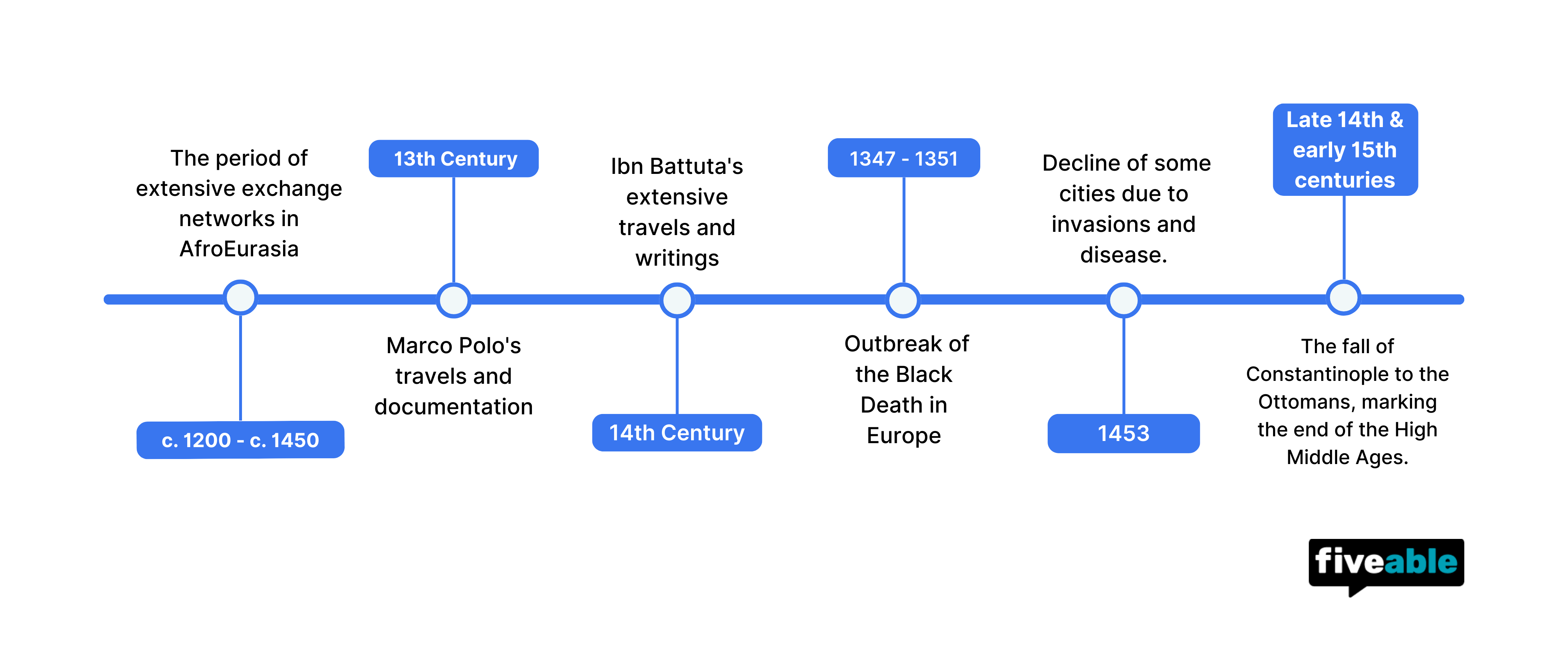
Timeline of AfroEurasia from 1200 to the early 15th Century. Image Courtesy of Rashmi Korukonda
Key Takeaways
- Buddhism blended with Daoism in China, while Islam spread through merchants, missionaries, and conquest and blended with local cultures across Africa and Asia.
- Islamic scholars shared Greek, Indian, and Chinese knowledge; Champa rice supported population and industry growth, while gunpowder from China changed warfare.
- Political stability, transportation, and commerce helped cities grow, while invasions, disease, and falling agricultural productivity contributed to decline; Kashgar experienced both growth and conquest.
- The Crusades increased European demand for goods from the East, but trade also brought disease; labor shortages after the Black Death weakened serfdom.
- Marco Polo focused on trade, Ibn Battuta wrote about Islam, and Margery Kempe's account offered a rare view of a medieval woman's life.
How Religions Spread and Blended Along Trade Routes
Religious diffusion between c. 1200 and c. 1450 didn't replace local beliefs so much as mix with them. The chapter's big pattern is syncretism, the fusing of a spreading religion with native traditions.
Buddhism in East Asia
- Buddhism traveled from India to China via the Silk Roads, and the 7th-century monk Xuanzang helped popularize it.
- Monks explained Buddhism using familiar Daoist principles. The fusion produced Chan Buddhism (Zen Buddhism), which stayed popular with ordinary Chinese people even when some leaders worried about native religions being diminished.
- Under the Song Dynasty (960-1279), Confucian scholar gentry adopted Buddhist ideals into daily life, helped by printing, which made Buddhist scriptures widely available.
- Buddhist writers used the vernacular (everyday language) instead of formal Confucian scholarly language, and that practice spread through Chinese literature.
- Neo-Confucianism, another syncretic faith, fused rational Confucian thought with abstract Daoist and Buddhist ideas. It appeared in the Tang Dynasty, developed under the Song, spread to Japan and Vietnam, and became Korea's official state ideology.
- In Korea, the educated elite studied Confucian classics while Buddhist doctrine attracted peasants.
Hinduism and Buddhism in Southeast Asia
- Trade carried both Indian religions into Southeast Asia. The sea-based Srivijaya Empire on Sumatra was Hindu; the later Majapahit Kingdom on Java was Buddhist.
- Sri Lanka's Sinhala dynasties became centers of Buddhist study with many monasteries. Buddhist priests there often advised monarchs on government.
- The Khmer Empire (Angkor Kingdom) in present-day Cambodia was Southeast Asia's most successful kingdom. The monuments at Angkor Thom show layered influence: Hindu artwork and sculptures of Hindu gods came first, and when Khmer rulers later converted to Buddhism, they added Buddhist art without removing the Hindu pieces. That's syncretism carved in stone.
The Spread of Islam
Islam spread across Africa, South Asia, and Southeast Asia through merchants, missionaries, and conquest. Each region shows a different cultural blend:
- Africa: The Swahili language blended Bantu and Arabic (it's still widely spoken today). Timbuktu became a center of Islamic learning, and African rulers deepened ties to the Islamic world through pilgrimages to Mecca.
- South Asia: Buddhists converted more readily than Hindus, partly out of disillusionment with corruption among Buddhist priests. Islam's emphasis on equality attracted lower-caste Hindus. Architecture blended Hindu designs with Islamic patterns, the Urdu language drew on Sanskrit-based Hindi plus Arabic and Farsi, and Bhakti poets and missionaries looked for links between Hinduism and Islam.
- Southeast Asia: Muslim rulers on Java combined Indian Islamic influences, local traditions, and Chinese-Buddhist and Confucian traits. Traditional Javanese stories, puppetry, and poetry absorbed Muslim characters and techniques.
Scientific and Technological Innovations
Science and technology traveled the same routes as religion, and Islamic scholars were the great connectors. They translated Greek classics into Arabic, saving the works of Aristotle and other Greek thinkers from oblivion, brought mathematics texts from India and papermaking techniques from China, and built on Greek, Mesopotamian, and Egyptian medicine to make advances in hospital care, including surgery.
Other key transfers:
- Agriculture: Champa rice spread from India to Vietnam and China. A reliable food supply grew the population, which grew cities and industries like porcelain, silk, steel, and iron production.
- Paper and printing: Papermaking reached Europe from China in the 13th century. Together with printing technology, it raised literacy.
- Seafaring: Lateen sails, the stern rudder, the astrolabe, and the magnetic compass improved navigation as Chinese, Indian, and Southwest Asian scholars expanded their knowledge of astronomy.
- Warfare: Gunpowder and gun production spread outward from China and changed how wars were fought.
Why Cities Grew and Why They Declined
The fate of cities varied dramatically in this era. The same connectivity that built cities up could tear them down.
Cities that thrived
- Hangzhou in China had about one million people (Chang'an had about two million). Sitting at the southern end of the Grand Canal, Hangzhou was both a trade hub and the cultural center of southern China, home to poets like Lu Yu and Xin Qiji. Trade brought diversity, including a thriving Arab community.
- Samarkand and Kashgar on the Silk Roads were centers of Islamic scholarship, bustling markets, and sources of fresh water and food for traveling merchants.
- Novgorod in Russia, Timbuktu in Africa, and Calicut in India grew the same way: merchants exchanging goods.
Growth factors to remember: political stability and fewer invasions, safe and reliable transportation, rising commerce, plentiful labor, and increased agricultural output.
Cities that declined
- Kashgar fell after repeated nomadic conquests and was ravaged by Tamerlane in 1389-90.
- Constantinople suffered a string of disasters: mutinous Crusader armies weakened it during the Fourth Crusade in 1204, the bubonic plague killed about half its people in 1346 and 1349, and after a 53-day siege the city fell to the Ottomans in 1453. Some historians treat that fall as the end of the High Middle Ages.
Decline factors: political instability and invasions, disease, and falling agricultural productivity. Notice these are the growth factors flipped.
The Crusades and the Black Death
The Crusades opened Western Europe to the wider world, for better and worse. Crusaders encountered Byzantine and Islamic cultures, which increased European demand for goods from the East. But opening up to global trade also opened Europe to disease.
- The Black Death arrived via trading routes. A major epidemic broke out between 1347 and 1351, with more outbreaks in later decades.
- As many as 25 million Europeans may have died. Economic activity declined, and the labor shortage on the land had lasting effects on the feudal system. Fewer workers meant peasants could demand more, which weakened serfdom over time.
- Exposure to ideas from Byzantium and the Muslim world would later feed the Renaissance and the rise of secularism.
Travelers' Tales: Polo, Battuta, and Kempe
As exchange networks intensified and paper and printing spread literacy, more travelers wrote about their journeys for eager readers. These three are the go-to examples, and their differing perspectives matter for document analysis.
Marco Polo
Marco Polo, an Italian from Venice, visited the court of Kublai Khan in the late 13th century and returned to Italy in 1295. His book described China's size, wealth, and urbanization, but many Europeans refused to believe him until later travelers confirmed it. His famous line captures the doubt: "I have not told half of what I saw, for I knew I would not be believed." Key point of view detail: Polo was a merchant, so his account stays focused on trade, like Hangzhou's silk production and China's use of paper money.
Ibn Battuta
Ibn Battuta (1304-1353), a Muslim scholar from Morocco, set out alone at age 21 and traveled for over 30 years through Central Asia, Southeast Asia, South Asia, China, Spain, North Africa, and Mali, mainly through Muslim lands. The Sultan of Morocco had him dictate his experiences, producing A Gift to Those Who Contemplate the Wonders of Cities and the Marvels of Traveling. Unlike Polo, Battuta wrote as a devout Muslim, and his journey aimed to learn about Islam, its people, and its accomplishments.
Margery Kempe
Margery Kempe (c. 1373-c. 1440), an English mystic, could neither read nor write, so she dictated The Book of Margery Kempe to scribes. It's one of the earliest autobiographies in English, possibly the first. It records her pilgrimages to Jerusalem, Rome, Germany, and Spain (she was so overcome at the sight of Jerusalem she nearly fell off her donkey) and gives a rare firsthand account of a middle-class medieval woman's life, including raising 14 children alongside her intense spiritual visions.
Key Terms to Know
| Term | Why it matters |
|---|---|
| Chan Buddhism | Syncretic blend of Buddhism and Daoism (also called Zen) that stayed popular with ordinary Chinese people. |
| Neo-Confucianism | Fusion of Confucian rational thought with Daoist and Buddhist ideas; spread to Japan and Vietnam and became Korea's state ideology. |
| Khmer Empire | Southeast Asia's most successful kingdom (Angkor); its monuments mix Hindu and Buddhist art, showing layered religious influence. |
| Swahili | African language blending Bantu and Arabic, evidence of Islam's cultural influence through trade. |
| Urdu | South Asian language drawing on Sanskrit-based Hindi, Arabic, and Farsi, another product of Islamic cultural blending. |
| Champa rice | Fast-growing rice that spread from India to Vietnam and China, boosting food supply, population, and industry. |
| Lateen sail | Triangular sail that improved seafaring along the exchange networks. |
| Stern rudder | Steering innovation that made ships more maneuverable. |
| Astrolabe | Navigation tool tied to expanding knowledge of astronomy. |
| Magnetic compass | Chinese navigation technology that made long-distance sea travel more reliable. |
| Hangzhou | Chinese city of about one million at the southern end of the Grand Canal; a model of trade-driven urbanization. |
| Samarkand | Silk Road city known for Islamic scholarship and busy markets. |
| Kashgar | Silk Road city that thrived, then declined after nomadic conquests and Tamerlane's destruction in 1389-90. |
| Constantinople | Walled Byzantine capital weakened by the Fourth Crusade (1204) and plague, falling to the Ottomans in 1453. |
| Black Death | Plague that killed as many as 25 million Europeans (1347-1351) and undermined the feudal system through labor shortages. |
| Marco Polo | Venetian merchant whose account of Kublai Khan's China shaped European views of Asia. |
| Ibn Battuta | Moroccan Muslim scholar who traveled the Islamic world for over 30 years and dictated a detailed travel account. |
| Margery Kempe | English mystic whose dictated book is one of the first English autobiographies and a rare middle-class woman's perspective. |
Practice and Next Steps
Pair these notes with the Fiveable course guide on 2.5 Cultural Effects of Trade for the College Board framing of the same material. Since the Pax Mongolica underpins everything here, the AMSCO 2.2 Mongol Empire notes are worth a re-read, and AMSCO 2.6 on environmental consequences picks up the Black Death story from the disease angle. When you're ready to test yourself, run through guided practice questions on Unit 2, drill vocab with the key terms glossary, or write a response in the FRQ practice tool for instant scoring. The full set of Unit 2 chapters lives on the AMSCO notes page.
Frequently Asked Questions
What is AMSCO Topic 2.5 about in AP World?
AMSCO 2.5, Cultural Consequences of Connectivity (p.111-117), covers the effects of Afro-Eurasian trade networks from c. 1200 to c. 1450: the spread and blending of religions like Buddhism and Islam, the diffusion of technologies like gunpowder and paper from China, the growth and decline of cities, and travelers like Marco Polo and Ibn Battuta. It pairs with the 2.5 Cultural Effects of Trade course guide.
What is Chan Buddhism and why is it a syncretism example?
Chan Buddhism (also called Zen) formed when Buddhist monks in China explained Buddhism using familiar Daoist principles, and the two traditions fused into one faith. It's a textbook example of syncretism because it shows a spreading religion blending with native beliefs rather than replacing them. It stayed popular with ordinary Chinese people even when some leaders pushed back.
How were Marco Polo and Ibn Battuta different?
Marco Polo was a Venetian merchant, so his account of Kublai Khan's China focuses on trade, cities, and wealth, like paper money and silk production in Hangzhou. Ibn Battuta was a Muslim scholar from Morocco who traveled over 30 years mainly through Muslim lands to learn about Islam and its people. Their differing points of view make them a favorite source-analysis pairing on the AP exam.
Why did some cities grow and others decline between 1200 and 1450?
Cities like Hangzhou, Samarkand, and Timbuktu grew because of political stability, safe transportation, rising commerce, plentiful labor, and increased agricultural output. Decline came from the reverse: invasions (Tamerlane ravaged Kashgar in 1389-90), disease (plague killed about half of Constantinople's people in 1346 and 1349), and falling farm productivity. Constantinople finally fell to the Ottomans in 1453 after a 53-day siege.
How does Topic 2.5 show up on the AP World exam?
Topic 2.5 feeds questions about the cultural and intellectual effects of trade networks, a core Unit 2 theme. Expect multiple-choice stimulus questions using traveler accounts like Polo or Battuta, and short-answer or essay prompts on religious diffusion, syncretism, or technology transfer. Practicing with guided MCQs on Unit 2 is a solid way to check your fluency.
See Fiveable more often in Google
Mark Fiveable as a preferred source and Google is more likely to show you our guides in Top Stories, with a "preferred" badge in AI Mode and AI Overviews.