AMSCO 8.3 Effects of the Cold War Notes

🌍AP World History: Modern Review
AMSCO 8.3 Effects of the Cold War Notes
🌍 AP World History: Modern
AMSCO 1.1 Developments in East Asia Notes
AMSCO 1.2 Developments in Dar al-Islam Notes
AMSCO 1.3 Developments in South and Southeast Asia Notes
AMSCO 1.4 Developments in the Americas Notes
AMSCO 1.5 Developments in Africa Notes
AMSCO 1.6 Developments in Europe Notes
AMSCO 1.7 Comparison in the Period from c.1200 to c.1450 Notes
AMSCO 2.1 The Silk Roads Notes
AMSCO 2.2 The Mongol Empire and the Modern World Notes
AMSCO 2.3 Exchange in the Indian Ocean Notes
AMSCO 2.4 Trans-Saharan Trade Routes Notes
AMSCO 2.5 Cultural Consequences of Connectivity Notes
AMSCO 2.6 Environmental Consequences of Connectivity Notes
AMSCO 2.7 Comparison of Economic Exchange Notes
AMSCO 3.1 European, East Asian, and Gunpowder Empires Expand Notes
AMSCO 3.2 Empires: Administrations Notes
AMSCO 3.3 Empires: Belief Systems Notes
AMSCO 3.4 Comparison in Land-Based Empires Notes
AMSCO 4.1 Technological Innovations Notes
AMSCO 4.2 Exploration: Causes and Events Notes
AMSCO 4.3 Columbian Exchange Notes
AMSCO 4.4 Maritime Empires Link Regions Notes
AMSCO 4.5 Maritime Empires Develop Notes
AMSCO 4.6 Internal and External Challenges to State Power Notes
AMSCO 4.7 Changing Social Hierarchies Notes
AMSCO 4.8 Continuity and Change from c.1450 to c.1750 Notes
AMSCO 5.1 The Enlightment Notes
AMSCO 5.2 Nationalism and Revolutions Notes
AMSCO 5.3 Industrial Revolution Begins Notes
AMSCO 5.4 Industrialization Spreads Notes
AMSCO 5.5 Technology in the Industrial Age Notes
AMSCO 5.6 Industrialization: Government's Role Notes
AMSCO 5.7 Economic Developments and Innovations Notes
AMSCO 5.8 Reactions to the Industrial Economy Notes
AMSCO 5.9 Society and the Industrial Age Notes
AMSCO 5.10 Continuity and Change in the Industrial Age Notes
AMSCO 6.1 Rationales for Imperialism Notes
AMSCO 6.2 State Expansion Notes
AMSCO 6.3 Indigenous Responses to State Expansion Notes
AMSCO 6.4 Global Economic Development Notes
AMSCO 6.5 Economic Imperialism Notes
AMSCO 6.6 Causes of Migration in an Interconnected World Notes
AMSCO 6.7 Effects of Migration Notes
AMSCO 6.8 Causation in the Imperial Age Notes
AMSCO 7.1 Shifting Power Notes
AMSCO 7.2 Causes of World War I Notes
AMSCO 7.3 Conducting World War I Notes
AMSCO 7.4 Economy in the Interwar Period Notes
AMSCO 7.5 Unresolved Tensions After World War I Notes
AMSCO 7.6 Causes of World War II Notes
AMSCO 7.7 Conducting World War II Notes
AMSCO 7.8 Mass Atrocities Notes
AMSCO 7.9 Causation in Global Conflict Notes
AMSCO 8.1 Setting the Stage for the Cold War and Decolonization Notes
AMSCO 8.2 The Cold War Notes
AMSCO 8.3 Effects of the Cold War Notes
AMSCO 8.4 Spread of Communism Notes
AMSCO 8.5 Decolonization after 1900 Notes
AMSCO 8.6 Newly Independent States Notes
AMSCO 8.7 Global Resistance to Established Power Structure Notes
AMSCO 8.8 End of the Cold War Notes
AMSCO 8.9 Causation in the Age of the Cold Ward and Decolonization Notes
AMSCO 9.1 Advances in Technology and Exchange Notes
AMSCO 9.2 Technological Advancements and Limitations Notes
AMSCO 9.3 Technology and the Environment Notes
AMSCO 9.4 Economics in the Global Age Notes
AMSCO 9.5 Calls for Reforms and Responses Notes
AMSCO 9.6 Globalized Culture Notes
AMSCO 9.7 Resistance to Globalization Notes
AMSCO 9.8 Institutions Developing in a Globalized World Notes
AMSCO 9.9 Continuity and Change in a Globalized World Notes
Overview
AMSCO Topic 8.3, Effects of the Cold War (AMSCO p.167 - p.176), covers how the US-Soviet rivalry reshaped the world after 1945: the division of Germany and Berlin, the creation of military alliances like NATO and the Warsaw Pact, proxy wars in Korea, Vietnam, Angola, and Nicaragua, the near-miss of the Cuban Missile Crisis, and the antinuclear weapons movement that pushed back against the arms race. The big idea for AP World is that the superpowers never fought each other directly. Instead, they competed through alliances, nuclear buildup, and wars fought by stand-in armies in postcolonial states across Latin America, Africa, and Asia. This chapter follows AMSCO 8.2 The Cold War and sets up the spread of communism in AMSCO 8.4.
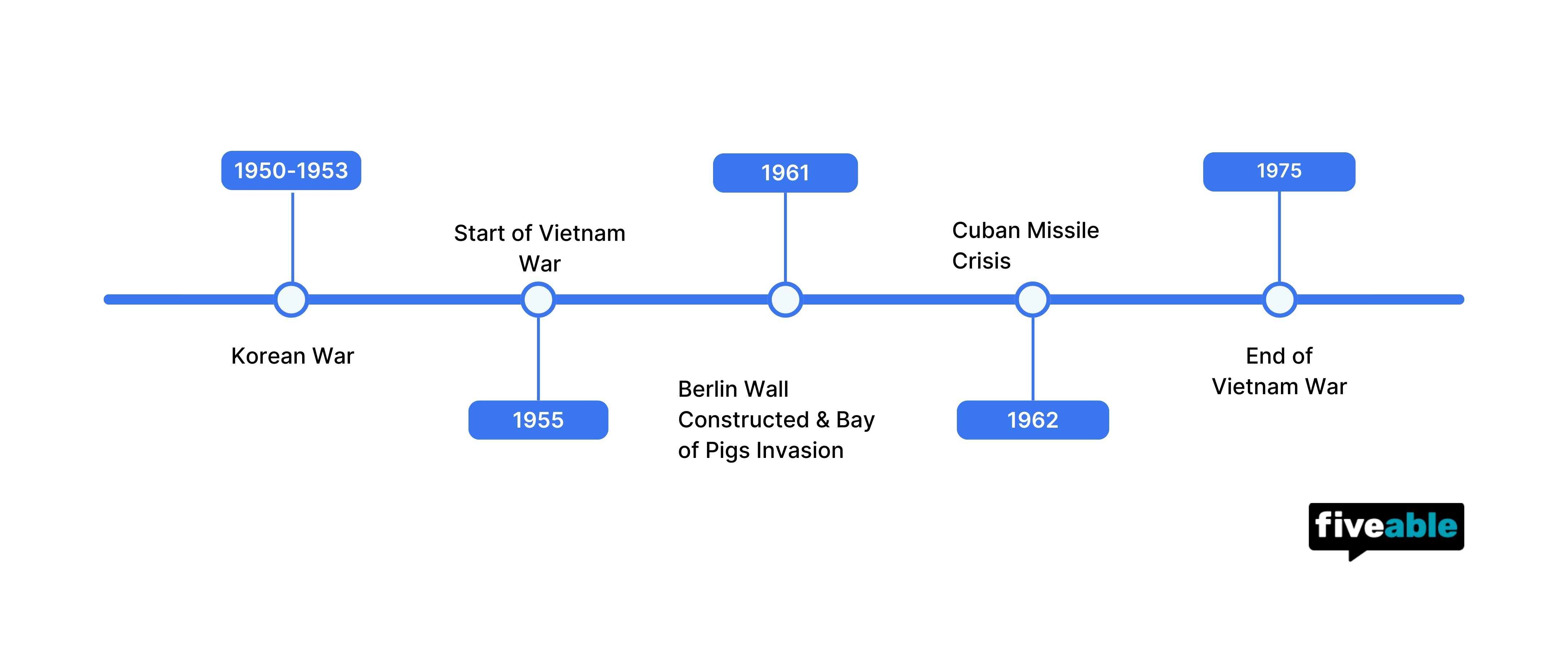
Timeline of events following effects of the Cold War. Image Courtesy of Julia.
Key Takeaways
- The Berlin Airlift ended the Soviet blockade without a shooting war; Germany then split into two states, and East Germany and the USSR built the Berlin Wall.
- Western nations formed NATO for mutual defense, while the Soviet-led Warsaw Pact joined Eastern European armies under Moscow's command.
- The Korean War ended in stalemate with Korea still divided, while US escalation in Vietnam ended with the country reunified under communist rule.
- In Angola, the USSR, Cuba, South Africa, and the US backed different groups during a long civil war; in Nicaragua, US-backed Contras fought the Sandinistas.
- The failed Bay of Pigs invasion strengthened Cuba's Soviet alliance; during the Cuban Missile Crisis, the USSR removed missiles from Cuba and the US pledged to remove its missiles from Turkey.
- Antinuclear protests began in Japan, and the Nuclear Test-Ban and Non-Proliferation treaties sought to limit nuclear testing and the spread of military nuclear technology.
Allied Occupation of Germany
After World War II, the Allies partitioned Germany among France, Great Britain, the United States, and the Soviet Union, and the disagreement over what to do next became the first major Cold War flashpoint in Europe. The three Western Allies wanted to merge their zones into one democratic state. The Soviets did not.
Berlin Blockade and Airlift
- Berlin, the capital, sat deep inside the Soviet zone but was itself divided into four zones. The three Western zones were supposed to become a free city.
- The Soviets blockaded all land routes into West Berlin to force the Western Allies out.
- Rather than risk a shooting war, the Allies ran the Berlin Airlift, flying supplies into the Western zones from February 1948 until May 1949, when the Soviets gave up and lifted the blockade.
Two Germanys and the Berlin Wall
- After the blockade, Germany split into two states. West Germany became the Federal Republic of Germany; East Germany became the German Democratic Republic. The East-West division of Europe was now complete.
- Between 1949 and 1961, about 2.5 million East Germans fled west, drawn by West Germany's prosperity. This embarrassed the communist system and drained East Germany's economy.
- In August 1961, the East German and Soviet governments replaced barbed-wire fences in Berlin with the Berlin Wall. Between 1961 and the wall's fall in 1989, soldiers killed about 150 people trying to escape over it.
NATO, the Warsaw Pact, and Other Alliances
The Cold War produced rival military alliances on each side of the Iron Curtain, plus regional pacts designed to contain communism elsewhere. This is the heart of the AP World comparison: both superpowers maintained influence by binding smaller states into defense networks.
- NATO (1949). Western nations created the North Atlantic Treaty Organization in April 1949, pledging mutual support against attack. Original members: Belgium, Canada, Denmark, France, Great Britain, Iceland, Italy, Luxembourg, the Netherlands, Norway, Portugal, and the United States. The Brussels-based alliance expanded considerably afterward.
- Warsaw Pact (1955). The Soviet answer to NATO. Original members: Albania, Bulgaria, Czechoslovakia, East Germany, Hungary, Poland, Romania, and the USSR. Member armies were combined and commanded from Moscow. Together these nations formed the communist bloc.
- Resisting Soviet control. Two communist countries stayed out of Moscow's orbit. Albania withdrew from the Warsaw Pact in 1968 and aligned with China. Yugoslavia, under Marshall Josip Broz Tito, never joined at all (it later broke apart along ethnic lines in the 1990s into countries including Slovenia, Serbia, and Croatia).
- SEATO (1954). Australia, France, Great Britain, New Zealand, Pakistan, the Philippines, Thailand, and the US formed the Southeast Asia Treaty Organization to block communism in Southeast Asia.
- CENTO. Great Britain, Iran, Iraq, Pakistan, and Turkey formed the Central Treaty Organization to prevent the spread of communism in the Middle East. The US was not a full member but joined its military committee.
The United States ultimately formed alliances with more than 40 states. Working through these smaller alliances was often easier than negotiating through the United Nations.
Proxy Wars in Korea, Vietnam, Angola, and Nicaragua
A proxy war is a conflict where the superpowers back opposing sides without (usually) fighting each other directly. These "hot" wars erupted across Asia, Africa, Latin America, and the Caribbean, blending local issues like anticolonialism and land reform with the global communism-vs-democracy struggle. Small countries, enormous death tolls.
Korean War (1950-1953)
- Like Germany, Korea was divided after WWII: Soviets in the north, the US and its allies in the south.
- North Korea invaded South Korea in 1950 to reunify the peninsula under communism. The UN voted to defend the South. The USSR could have vetoed the resolution but was boycotting Security Council meetings over a dispute about China's seat.
- 16 UN member countries sent forces; the US supplied the most troops and the overall commander, General Douglas MacArthur. The Soviets sent money and weapons to the North but no troops.
- When UN forces pushed toward the Chinese border, China entered the war on North Korea's side, fearing an invasion.
- After three years and roughly four million civilian and military casualties, the war ended in stalemate. Korea stayed divided, separated by a demilitarized zone.
Vietnam War
- President Eisenhower, following Truman's containment policy, sent military advisers to train South Vietnam's army against a communist takeover by the North. Kennedy raised the adviser count from 1,000 to 16,000.
- The US backed an undemocratic, unpopular South Vietnamese ruler, Ngo Dinh Diem. In 1963, Buddhist monk Thich Quang Duc set himself on fire in Saigon to protest Diem's favoring of Catholics over Buddhists. A US-supported military coup soon overthrew Diem.
- In 1964, President Lyndon Johnson escalated with more troops. He believed in the domino theory, the idea that if one country in a region went communist, its neighbors would fall next. The war ultimately ended with Vietnam reunified under communist rule.
Angolan Civil War
- Angola won independence from Portugal in 1975 after 14 years of armed struggle. But colonial borders had lumped three distinct cultural groups into one country, each wanting control of Angola's lucrative diamond mines.
- The USSR and Cuba backed the Mbundu; South Africa backed the Ovimbundu; the United States backed the Bankongo.
- Civil war broke out at independence and lasted 27 years until a 2002 cease-fire.
Contra War in Nicaragua
- In 1979, the socialist Sandinista rebels ended the Somoza family's 43-year dictatorship.
- From 1981 to 1988, conservative opponents called Contras fought to overthrow the Sandinistas, with heavy covert backing from the United States.
- Tens of thousands of Nicaraguans died. The war ended with the 1989 Tela Accord and the demobilization of both armies.
Cold War in Cuba
Cuba brought the superpower standoff within 100 miles of Florida and produced the closest the world ever came to nuclear war. Fidel Castro and fellow communist revolutionaries overthrew dictator Fulgencio Batista in 1959.
Bay of Pigs (1961)
- Starting August 6, 1960, Castro's government nationalized foreign-owned industries, including US oil companies (Texaco, Esso, Sinclair), the telephone and electric companies, and 36 US-owned sugar mills.
- The US responded by cutting trade and diplomatic ties. Castro turned to Soviet aid and aligned Cuba's foreign policy with Moscow.
- In 1961, President Kennedy backed an invasion by anti-Castro Cuban exiles. The Bay of Pigs invasion failed completely and cemented the Cuba-Soviet alliance, the opposite of what the US wanted.
Cuban Missile Crisis (1962)
- Soviet Premier Nikita Khrushchev shipped nuclear missiles to Cuba in 1962, arguing the US had already placed nuclear missiles in Turkey, on the USSR's border, in 1961.
- When US intelligence learned more missiles were on the way, Kennedy ordered the Navy to stop them. He called it a "quarantine" because a blockade was technically an act of war.
- Both leaders pulled back from the brink. Khrushchev recalled the ships and removed the missiles already in Cuba; the US pledged to quietly remove its missiles from Turkey.
- In 1963, the two countries set up a Hot Line, a direct telegraph/teleprinter link between the leaders' offices, so a future crisis wouldn't spiral from poor communication.
Antinuclear Weapons Movement
The nuclear arms race triggered a global protest movement and the first treaties limiting nuclear weapons. The movement began in Japan in 1954 in opposition to US nuclear testing in the Pacific. By 1955, more than one-third of Japan's population had signed a petition against nuclear weapons. The movement spread to the US and Western Europe in the late 1970s and early 1980s, and on June 6, 1982, about one million people demonstrated in New York City against nuclear weapons.
Two key agreements:
- Nuclear Test-Ban Treaty (1963). Signed by the USSR, the US, and more than 100 other states (France and China refused). It outlawed nuclear testing above ground, underwater, and in space to cut radiation exposure. Underground testing stayed legal.
- Nuclear Non-Proliferation Treaty (1968). Called on nuclear powers to prevent the spread of military nuclear technology and materials to non-nuclear countries.
Key Terms to Know
| Term | Why it matters |
|---|---|
| Proxy war | A conflict where superpowers back opposing sides in smaller countries instead of fighting each other directly; the defining war type of the Cold War. |
| Berlin Airlift | The Western Allies' operation flying supplies into West Berlin (February 1948 - May 1949) that defeated the Soviet blockade without a shot. |
| Berlin Wall | Built in August 1961 to stop East Germans from fleeing west; the physical symbol of Europe's Cold War division until 1989. |
| NATO | The 1949 Western mutual-defense alliance against Soviet expansion, with 12 original members including the US, Britain, France, and Canada. |
| Warsaw Pact | The 1955 Soviet-led counter-alliance of Eastern European states, with armies commanded from Moscow. |
| Communist bloc | The Warsaw Pact nations aligned with the USSR under communist governments. |
| SEATO | The 1954 treaty organization meant to contain communism in Southeast Asia. |
| CENTO | The anti-Soviet treaty organization (Britain, Iran, Iraq, Pakistan, Turkey) aimed at containing communism in the Middle East. |
| Korean War | The 1950-1953 proxy war that killed some four million people and ended in stalemate, leaving Korea divided at a demilitarized zone. |
| Vietnam War | The proxy war where US containment policy escalated from advisers to combat troops; it ended with communist reunification of Vietnam. |
| Domino theory | Johnson's belief that one country falling to communism would topple its neighbors, used to justify escalation in Vietnam. |
| Angolan Civil War | The 27-year post-independence proxy conflict where the USSR/Cuba, South Africa, and the US each backed a different ethnic group. |
| Contra War | The 1981-1988 Nicaraguan conflict where US-backed Contras fought the socialist Sandinistas; ended by the 1989 Tela Accord. |
| Bay of Pigs | The failed 1961 US-backed exile invasion of Cuba that pushed Castro firmly into the Soviet camp. |
| Cuban Missile Crisis | The 1962 standoff over Soviet missiles in Cuba; the closest the Cold War came to nuclear war. |
| Hot Line | The direct US-Soviet communication link set up in 1963 after the missile crisis. |
| Nuclear Test-Ban Treaty | The 1963 agreement banning nuclear tests above ground, underwater, and in space (France and China did not sign). |
| Nuclear Non-Proliferation Treaty | The 1968 agreement asking nuclear powers to keep military nuclear technology from spreading to non-nuclear states. |
Practice and Next Steps
Pair these notes with the Fiveable 8.3 Effects of the Cold War course-topic study guide for the College Board framing of the topic, then continue to AMSCO 8.4 Spread of Communism. Browse the full chapter list on the AP World AMSCO notes page.
To check yourself, run Unit 8 multiple-choice sets in guided practice, try a Cold War prompt with FRQ practice and instant scoring, or quiz definitions in the key terms glossary. A reliable comparison move for this topic: explain how BOTH superpowers used alliances, aid, and proxy forces (NATO/Warsaw Pact, Korea, Angola, Nicaragua) rather than direct war.
Frequently Asked Questions
What is a proxy war in AP World Unit 8?
A proxy war is a conflict where a major power helps bring about or supports a war between other nations without fighting directly itself. During the Cold War, the US and USSR backed opposing sides in Korea, Vietnam, Angola, and Nicaragua instead of attacking each other, partly because nuclear weapons made direct war too dangerous.
What were the main effects of the Cold War in AMSCO 8.3?
The Cold War produced new military alliances (NATO in 1949, the Warsaw Pact in 1955, plus SEATO and CENTO), nuclear proliferation, and proxy wars in postcolonial states like Korea, Vietnam, Angola, and Nicaragua. It also divided Germany into two states, led to the Berlin Wall, and sparked crises in Cuba and an antinuclear weapons movement.
What's the difference between NATO and the Warsaw Pact?
NATO was the Western mutual-defense alliance formed in April 1949 by 12 countries including the US, Britain, France, and Canada. The Warsaw Pact was the Soviet response, created in 1955, combining Eastern European armies under command based in Moscow. Together the Warsaw Pact nations were called the communist bloc.
How did the Cuban Missile Crisis end?
Khrushchev recalled the Soviet ships and removed the missiles already in Cuba, while the US pledged to quietly remove its own missiles from Turkey. A common mix-up: the US did not remove missiles from Cuba, the Soviets did. Afterward, the two countries set up the Hot Line in 1963 for direct communication between leaders.
How does Topic 8.3 show up on the AP World exam?
Topic 8.3 asks you to compare how the US and USSR maintained influence during the Cold War, so expect comparison-style questions about alliances, nuclear proliferation, and proxy wars in Latin America, Africa, and Asia. The Korean War, the Angolan Civil War, and the Sandinista-Contra conflict are the go-to proxy war examples. Practice with Unit 8 guided practice questions.
See Fiveable more often in Google
Mark Fiveable as a preferred source and Google is more likely to show you our guides in Top Stories, with a "preferred" badge in AI Mode and AI Overviews.