AMSCO 5.3 Industrial Revolution Begins Notes

🌍AP World History: Modern Review
AMSCO 5.3 Industrial Revolution Begins Notes
🌍 AP World History: Modern
AMSCO 1.1 Developments in East Asia Notes
AMSCO 1.2 Developments in Dar al-Islam Notes
AMSCO 1.3 Developments in South and Southeast Asia Notes
AMSCO 1.4 Developments in the Americas Notes
AMSCO 1.5 Developments in Africa Notes
AMSCO 1.6 Developments in Europe Notes
AMSCO 1.7 Comparison in the Period from c.1200 to c.1450 Notes
AMSCO 2.1 The Silk Roads Notes
AMSCO 2.2 The Mongol Empire and the Modern World Notes
AMSCO 2.3 Exchange in the Indian Ocean Notes
AMSCO 2.4 Trans-Saharan Trade Routes Notes
AMSCO 2.5 Cultural Consequences of Connectivity Notes
AMSCO 2.6 Environmental Consequences of Connectivity Notes
AMSCO 2.7 Comparison of Economic Exchange Notes
AMSCO 3.1 European, East Asian, and Gunpowder Empires Expand Notes
AMSCO 3.2 Empires: Administrations Notes
AMSCO 3.3 Empires: Belief Systems Notes
AMSCO 3.4 Comparison in Land-Based Empires Notes
AMSCO 4.1 Technological Innovations Notes
AMSCO 4.2 Exploration: Causes and Events Notes
AMSCO 4.3 Columbian Exchange Notes
AMSCO 4.4 Maritime Empires Link Regions Notes
AMSCO 4.5 Maritime Empires Develop Notes
AMSCO 4.6 Internal and External Challenges to State Power Notes
AMSCO 4.7 Changing Social Hierarchies Notes
AMSCO 4.8 Continuity and Change from c.1450 to c.1750 Notes
AMSCO 5.1 The Enlightment Notes
AMSCO 5.2 Nationalism and Revolutions Notes
AMSCO 5.3 Industrial Revolution Begins Notes
AMSCO 5.4 Industrialization Spreads Notes
AMSCO 5.5 Technology in the Industrial Age Notes
AMSCO 5.6 Industrialization: Government's Role Notes
AMSCO 5.7 Economic Developments and Innovations Notes
AMSCO 5.8 Reactions to the Industrial Economy Notes
AMSCO 5.9 Society and the Industrial Age Notes
AMSCO 5.10 Continuity and Change in the Industrial Age Notes
AMSCO 6.1 Rationales for Imperialism Notes
AMSCO 6.2 State Expansion Notes
AMSCO 6.3 Indigenous Responses to State Expansion Notes
AMSCO 6.4 Global Economic Development Notes
AMSCO 6.5 Economic Imperialism Notes
AMSCO 6.6 Causes of Migration in an Interconnected World Notes
AMSCO 6.7 Effects of Migration Notes
AMSCO 6.8 Causation in the Imperial Age Notes
AMSCO 7.1 Shifting Power Notes
AMSCO 7.2 Causes of World War I Notes
AMSCO 7.3 Conducting World War I Notes
AMSCO 7.4 Economy in the Interwar Period Notes
AMSCO 7.5 Unresolved Tensions After World War I Notes
AMSCO 7.6 Causes of World War II Notes
AMSCO 7.7 Conducting World War II Notes
AMSCO 7.8 Mass Atrocities Notes
AMSCO 7.9 Causation in Global Conflict Notes
AMSCO 8.1 Setting the Stage for the Cold War and Decolonization Notes
AMSCO 8.2 The Cold War Notes
AMSCO 8.3 Effects of the Cold War Notes
AMSCO 8.4 Spread of Communism Notes
AMSCO 8.5 Decolonization after 1900 Notes
AMSCO 8.6 Newly Independent States Notes
AMSCO 8.7 Global Resistance to Established Power Structure Notes
AMSCO 8.8 End of the Cold War Notes
AMSCO 8.9 Causation in the Age of the Cold Ward and Decolonization Notes
AMSCO 9.1 Advances in Technology and Exchange Notes
AMSCO 9.2 Technological Advancements and Limitations Notes
AMSCO 9.3 Technology and the Environment Notes
AMSCO 9.4 Economics in the Global Age Notes
AMSCO 9.5 Calls for Reforms and Responses Notes
AMSCO 9.6 Globalized Culture Notes
AMSCO 9.7 Resistance to Globalization Notes
AMSCO 9.8 Institutions Developing in a Globalized World Notes
AMSCO 9.9 Continuity and Change in a Globalized World Notes
Overview
AMSCO Topic 5.3, Industrial Revolution Begins, explains why industrialization started in Great Britain in the mid-1700s and how it transformed economies and societies. The chapter (AMSCO p.297-303) covers the agricultural revolution, the cottage industry, key textile inventions like the spinning jenny and water frame, and the environmental and economic advantages that made Britain the world's first industrial nation. This is the launch point for Unit 5's industrialization story, which continues in AMSCO 5.4 Industrialization Spreads.
The chapter opens with Adam Smith's famous pin factory example from Wealth of Nations (1776), where making a single pin is split into about eighteen separate operations. That image of divided, mechanized work captures the big shift: industrialization means the increased mechanization of production, plus all the social changes that came with it. Its roots include the Columbian Exchange, maritime trading empires, rising agricultural productivity, and the accumulation of capital.
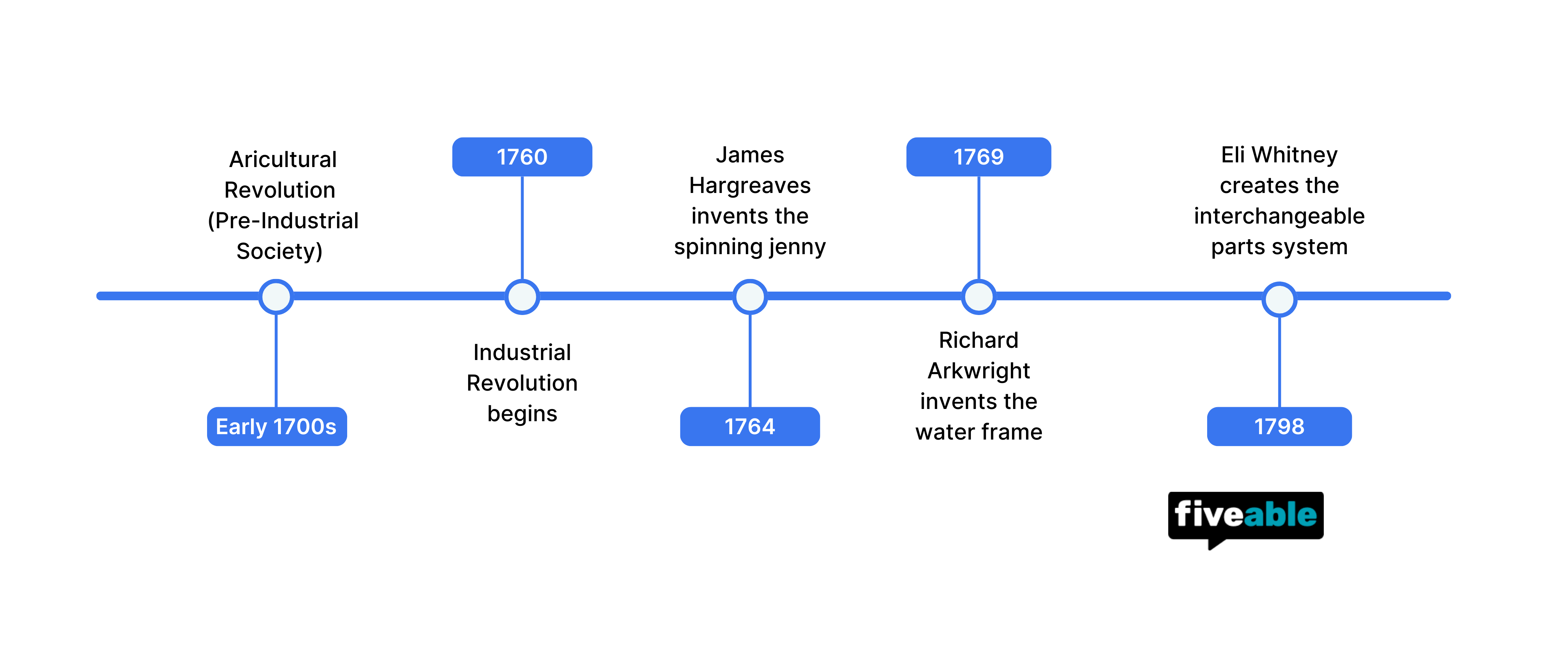
Timeline of events surrounding the beginning of the Industrial Revolution. Image Courtesy of Liv
Key Takeaways
- Crop rotation, the seed drill, and potatoes increased food supplies, helping populations grow and providing factories with workers and customers.
- Demand for cotton cloth led British investors to use the cottage industry, but slow home production pushed them to seek faster machines.
- The spinning jenny sped up spinning, while the larger, water-powered water frame moved textile production from homes into factories.
- Eli Whitney's interchangeable parts made components replaceable, and division of labor assigned workers separate production tasks.
- Britain's seaways, coal, transport networks, fleets, colonial resources, investment capital, and property protections helped it industrialize first.
- Enclosure ended access to common land for many small farmers, pushing displaced rural people into cities to work in growing industries.
Agricultural Improvements Set the Stage
Before factories could fill up with workers, farms had to produce more food with fewer people. An agricultural revolution in the early 1700s did exactly that.
- Crop rotation (rotating different crops in and out of a field each year) kept soil productive and boosted harvests.
- The seed drill placed seeds efficiently in designated spots in the ground instead of scattering them, which increased food production.
- The potato, introduced from South America, added cheap calories to people's diets.
More food meant more people. Populations grew as nations industrialized, and improved medical care lowered infant mortality and lengthened lifespans. These demographic changes mattered in two ways: more people were available to work in factories, and more people were available to buy manufactured goods. Industrialization needed both workers and customers, and agriculture supplied them.
Preindustrial Societies and the Cottage Industry
In the early 18th century, most British families lived in rural areas, grew most of their food, and made most of their clothes. For centuries they had raised wool and flax domestically and spun their own fabric at home.
Then maritime empires changed the game. The commercial revolution brought Indian cotton to Britain, and demand exploded. Wool and flax simply could not be produced fast enough or in large enough quantities to compete. So British investors built a domestic cotton cloth industry using raw cotton produced by slave labor in the Americas.
Their solution was the cottage industry, also called the putting-out system:
- Merchants supplied raw cotton to women, who spun it into finished cloth in their own homes.
- The work was hard and the pay was low, but it gave women weavers some independence and let them stay close to their children.
- The catch: home production was slow. Investors wanted faster output, and that demand drove the invention of new machines.
That cause-and-effect chain (cotton demand → cottage industry → demand for speed → new technology) is exactly the kind of reasoning the AP World exam rewards.
Growth of Technology
New machines in the mid-1700s made textile production dramatically faster and pulled work out of homes and into factories.
Spinning Jenny and Water Frame
- The spinning jenny, invented by James Hargreaves in the 1760s, let a weaver spin more than one thread at a time.
- The water frame, patented by Richard Arkwright in 1769, used waterpower to drive the spinning wheel. It out-produced any single person's labor.
The water frame was too big and powerful for a cottage. Production moved into factories large enough to house these bulky machines, which doomed the household textile cottage industry. Arkwright is considered the father of the factory system.
Interchangeable Parts and Division of Labor
In 1798, Eli Whitney created a system of interchangeable parts while manufacturing firearms for the U.S. military. If a component broke, you could swap in a new, identical part instead of replacing or hand-repairing the whole machine. Entrepreneurs quickly adapted the idea to other products, making it a pivotal contribution to industrial technology.
Interchangeable parts led directly to the division of labor. Factory owners no longer needed skilled craftsmen to build every piece of a product. With specialization of labor, each worker focused on one task (one casts a part, another installs it). In the early 20th century, Henry Ford expanded this concept into the moving assembly line to build his Model T automobiles.
Britain's Industrial Advantages
Why Britain first? The chapter gives a stack of environmental, geographic, and economic reasons, and the AP course frames this as how environmental factors contributed to industrialization. Know this list cold.
Geography and Resources
- Seaways and location. Britain sits on the Atlantic Ocean, perfectly placed to import raw materials and export finished goods.
- Coal deposits. Britain happened to sit atop immense coal reserves. Burning this fossil fuel powered the steam engine and was essential for separating iron from its ore. Iron (and later steel) made possible larger bridges, taller buildings, and stronger ships. Coal mining became the major industry of northern and western Britain, including South Wales, Yorkshire, and Lancashire. (When the U.S. industrialized, coal regions developed in West Virginia, Pennsylvania, and Kentucky.)
- Rivers and canals. A natural river network, supplemented by publicly funded canals and harbors, made transporting raw materials and finished products cheap. The northeastern United States had a similar advantage.
- Strong fleets. Britain had the world's strongest fleet, both naval ships for defense and commercial ships for trade, bringing in agricultural products to be turned into finished goods.
Colonies and Capital
- Britain's colonies supplied resources like timber for ships.
- Wealth accumulated during the trans-Atlantic slave trade gave British capitalists excess capital, money available to invest in businesses. Without that capital, private entrepreneurs could not have launched new commercial ventures.
Legal Protection of Private Property
Entrepreneurs needed assurance that the businesses they built would not be taken away by the government or by rivals. Britain's legal protection of private property provided that security, encouraging investment and innovation. Not all nations offered these guarantees, which helps explain why they industrialized later.
Growing Population and Urbanization
Rising agricultural productivity created a double shift: more people could be fed, but a smaller percentage of the population was needed on farms. Where did the extra rural population go?
The enclosure movement pushed them out. English towns had traditionally let farmers cultivate land or graze sheep on government property called "the commons." The enclosure movement ended that custom, as the government fenced off the commons for exclusive use by those who paid for the privilege or purchased the land. Many small farmers became landless and destitute, and migration to cities was often the best of bad options.
These displaced farmers flooded into urban areas like Manchester and Liverpool, where they became the workforce for the new and growing industries. Enclosure, in other words, accidentally manufactured the factory labor supply.
Key Terms to Know
| Term | Why it matters |
|---|---|
| Industrial Revolution | The dramatic shift from agricultural economies to mechanized industrial production, starting in Britain in the 1700s. |
| Industrialization | The increased mechanization of production, plus the social changes that came with it. |
| Agricultural revolution | The early-1700s jump in farm productivity that fed population growth and freed workers for factories. |
| Crop rotation | Rotating different crops through a field each year to boost food production. |
| Seed drill | A device that places seeds efficiently in designated spots, increasing yields. |
| Cottage industry | The putting-out system where merchants gave raw cotton to women who spun cloth at home. |
| Spinning jenny | James Hargreaves's 1760s invention that let a weaver spin multiple threads at once. |
| Water frame | Richard Arkwright's 1769 water-powered spinning machine that pushed production into factories. |
| Factory system | Centralized production in large buildings housing big machines; Arkwright is its "father." |
| Interchangeable parts | Eli Whitney's 1798 system of identical, swappable components, first used for firearms. |
| Division of labor | Splitting production into separate tasks assigned to different workers. |
| Specialization of labor | Each worker focusing on one task, getting fast and efficient through repetition. |
| Assembly line | Henry Ford's early-1900s expansion of division of labor, used to build the Model T. |
| Capital | Money available to invest in businesses; British capitalists had plenty, partly from the slave trade. |
| Enclosure movement | The fencing off of common lands, which pushed landless farmers into cities like Manchester and Liverpool. |
| Raw materials | Inputs like cotton and timber that Britain imported and turned into finished goods. |
Practice and Next Steps
Pair these notes with the Fiveable course guide for Topic 5.3 Industrialization Begins, then continue the chapter sequence with AMSCO 5.4 Industrialization Spreads. If you need to back up, AMSCO 5.2 Nationalism and Revolutions covers the political revolutions that ran alongside this economic one. The full chapter set lives on the AP World AMSCO notes page.
To check yourself, run through guided multiple-choice practice on Unit 5, or try a causation prompt in FRQ practice with instant scoring. Why-Britain-first is a classic exam angle, so be ready to list those environmental advantages from memory.
Frequently Asked Questions
What does AMSCO Topic 5.3 Industrial Revolution Begins cover?
AMSCO 5.3 (p.297-303) covers why industrialization began in Great Britain in the mid-1700s. It includes the agricultural revolution (crop rotation, seed drill), the cottage industry, inventions like the spinning jenny and water frame, interchangeable parts, and Britain's advantages such as coal deposits, rivers, capital, and legal protection of private property.
Why did the Industrial Revolution begin in Britain?
Britain had a unique stack of advantages: immense coal deposits to power steam engines, an Atlantic location with rivers and canals for cheap transport, the world's strongest fleet, colonial resources, excess capital (much of it from the trans-Atlantic slave trade), and legal protection of private property. Rising agricultural productivity and the enclosure movement also pushed farmers into cities, creating a factory workforce.
What is the difference between the spinning jenny and the water frame?
The spinning jenny, invented by James Hargreaves in the 1760s, let one weaver spin multiple threads at a time and could still be used at home. The water frame, patented by Richard Arkwright in 1769, used waterpower to drive the spinning wheel and was too big for a cottage, so production moved into factories. That's why Arkwright is called the father of the factory system.
What was the enclosure movement and why does it matter for AP World?
The enclosure movement was when the British government fenced off common lands ('the commons') that farmers had traditionally used, giving exclusive use to people who paid for or purchased the land. Many small farmers became landless and migrated to cities like Manchester and Liverpool, where they became the workforce for new factories. It's a key cause-and-effect link between agriculture and industrialization.
How does Topic 5.3 show up on the AP World exam?
Expect questions on how environmental factors contributed to industrialization from 1750 to 1900, like coal and iron deposits, waterways, agricultural productivity, capital, and access to foreign resources. The 'why Britain first' question is a classic causation prompt, so practice listing those factors with FRQ practice and instant scoring.
See Fiveable more often in Google
Mark Fiveable as a preferred source and Google is more likely to show you our guides in Top Stories, with a "preferred" badge in AI Mode and AI Overviews.