AMSCO 3.3 Empires: Belief Systems Notes

🌍AP World History: Modern Review
AMSCO 3.3 Empires: Belief Systems Notes
🌍 AP World History: Modern
AMSCO 1.1 Developments in East Asia Notes
AMSCO 1.2 Developments in Dar al-Islam Notes
AMSCO 1.3 Developments in South and Southeast Asia Notes
AMSCO 1.4 Developments in the Americas Notes
AMSCO 1.5 Developments in Africa Notes
AMSCO 1.6 Developments in Europe Notes
AMSCO 1.7 Comparison in the Period from c.1200 to c.1450 Notes
AMSCO 2.1 The Silk Roads Notes
AMSCO 2.2 The Mongol Empire and the Modern World Notes
AMSCO 2.3 Exchange in the Indian Ocean Notes
AMSCO 2.4 Trans-Saharan Trade Routes Notes
AMSCO 2.5 Cultural Consequences of Connectivity Notes
AMSCO 2.6 Environmental Consequences of Connectivity Notes
AMSCO 2.7 Comparison of Economic Exchange Notes
AMSCO 3.1 European, East Asian, and Gunpowder Empires Expand Notes
AMSCO 3.2 Empires: Administrations Notes
AMSCO 3.3 Empires: Belief Systems Notes
AMSCO 3.4 Comparison in Land-Based Empires Notes
AMSCO 4.1 Technological Innovations Notes
AMSCO 4.2 Exploration: Causes and Events Notes
AMSCO 4.3 Columbian Exchange Notes
AMSCO 4.4 Maritime Empires Link Regions Notes
AMSCO 4.5 Maritime Empires Develop Notes
AMSCO 4.6 Internal and External Challenges to State Power Notes
AMSCO 4.7 Changing Social Hierarchies Notes
AMSCO 4.8 Continuity and Change from c.1450 to c.1750 Notes
AMSCO 5.1 The Enlightment Notes
AMSCO 5.2 Nationalism and Revolutions Notes
AMSCO 5.3 Industrial Revolution Begins Notes
AMSCO 5.4 Industrialization Spreads Notes
AMSCO 5.5 Technology in the Industrial Age Notes
AMSCO 5.6 Industrialization: Government's Role Notes
AMSCO 5.7 Economic Developments and Innovations Notes
AMSCO 5.8 Reactions to the Industrial Economy Notes
AMSCO 5.9 Society and the Industrial Age Notes
AMSCO 5.10 Continuity and Change in the Industrial Age Notes
AMSCO 6.1 Rationales for Imperialism Notes
AMSCO 6.2 State Expansion Notes
AMSCO 6.3 Indigenous Responses to State Expansion Notes
AMSCO 6.4 Global Economic Development Notes
AMSCO 6.5 Economic Imperialism Notes
AMSCO 6.6 Causes of Migration in an Interconnected World Notes
AMSCO 6.7 Effects of Migration Notes
AMSCO 6.8 Causation in the Imperial Age Notes
AMSCO 7.1 Shifting Power Notes
AMSCO 7.2 Causes of World War I Notes
AMSCO 7.3 Conducting World War I Notes
AMSCO 7.4 Economy in the Interwar Period Notes
AMSCO 7.5 Unresolved Tensions After World War I Notes
AMSCO 7.6 Causes of World War II Notes
AMSCO 7.7 Conducting World War II Notes
AMSCO 7.8 Mass Atrocities Notes
AMSCO 7.9 Causation in Global Conflict Notes
AMSCO 8.1 Setting the Stage for the Cold War and Decolonization Notes
AMSCO 8.2 The Cold War Notes
AMSCO 8.3 Effects of the Cold War Notes
AMSCO 8.4 Spread of Communism Notes
AMSCO 8.5 Decolonization after 1900 Notes
AMSCO 8.6 Newly Independent States Notes
AMSCO 8.7 Global Resistance to Established Power Structure Notes
AMSCO 8.8 End of the Cold War Notes
AMSCO 8.9 Causation in the Age of the Cold Ward and Decolonization Notes
AMSCO 9.1 Advances in Technology and Exchange Notes
AMSCO 9.2 Technological Advancements and Limitations Notes
AMSCO 9.3 Technology and the Environment Notes
AMSCO 9.4 Economics in the Global Age Notes
AMSCO 9.5 Calls for Reforms and Responses Notes
AMSCO 9.6 Globalized Culture Notes
AMSCO 9.7 Resistance to Globalization Notes
AMSCO 9.8 Institutions Developing in a Globalized World Notes
AMSCO 9.9 Continuity and Change in a Globalized World Notes
Overview
AMSCO Topic 3.3, "Empires: Belief Systems" (AMSCO p.167 - p.176), covers how religions endured and changed from 1450 to 1750, when faith was both the glue holding empires together and the spark that set them on fire. The chapter tracks the Protestant Reformation splitting Christianity, the Catholic Counter-Reformation fighting back, Europe's wars of religion, the Sunni-Shi'a divide deepening between the Ottomans and Safavids, Sikhism emerging in South Asia, and the Scientific Revolution introducing reason-based thinking. The big takeaway: rulers like Henry IV of France ("Paris is well worth a Mass") often treated religion as a political tool, choosing practicality over theology.
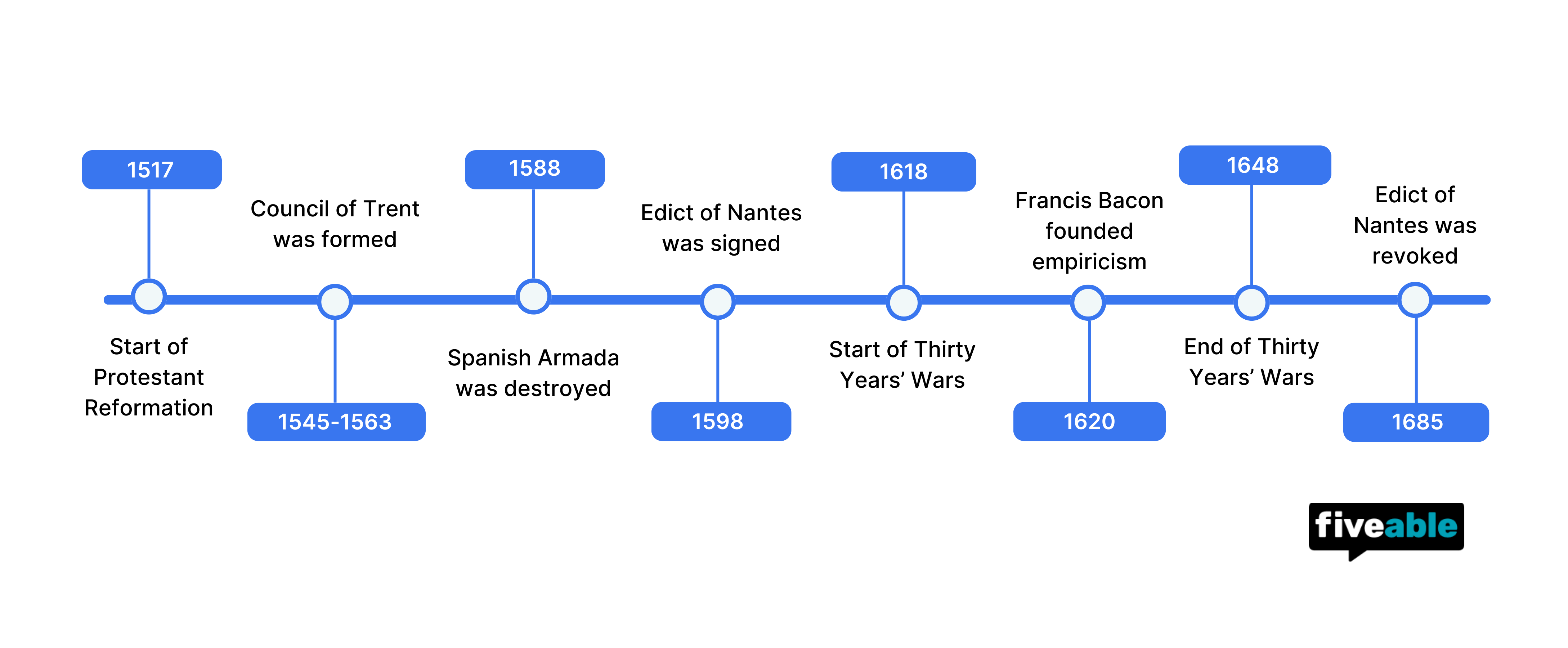
Timeline of events following the belief systems of empires. Image Courtesy of Siya
Key Takeaways
- Luther argued for salvation by faith alone, Calvin's Geneva community was led by the predestined elect, and Henry VIII created the Anglican Church free of papal control.
- Peter the Great brought the Russian Orthodox Church under state control, while the Catholic Counter-Reformation used the Inquisition, Jesuits, and Council of Trent to fight Protestantism.
- The Peace of Augsburg let German rulers choose Catholicism or Lutheranism; after the Thirty Years' War, the Peace of Westphalia added Calvinism as an option and increased state autonomy.
- Ottoman rule replaced Justinian Law with shariah, while Safavid ruler Shah Ismail used Shi'a Islam to unify his rule and fueled conflict with the Sunni Ottomans.
- Akbar eased Hindu-Muslim tensions through Hindu appointments and tax exemptions and gave land grants to Sikhism, a monotheistic faith that recognized other religions.
- Francis Bacon's empiricism demanded evidence for hypotheses, and Newton described gravitational force; the idea that natural laws could apply to society helped set up the Enlightenment.
The Protestant Reformation
The Protestant Reformation broke Western Christianity apart in the 16th century, but the Catholic Church's problems started much earlier. The Church was huge, international, and bureaucratic, which made it prone to corruption. Reform councils kept failing to fix it.
Early cracks in the Church:
- John Wycliffe and the Lollards (England, late 14th century) argued priests were unnecessary for salvation. Wycliffe was vilified for translating parts of the Bible into English so ordinary people could read it.
- Jan Hus and the Hussites (Bohemia) held similar beliefs and were declared heretics. Hus was burned at the stake.
- Huldrych Zwingli in Geneva pushed for religion based strictly on scripture, opposing later customs like clergy celibacy.
- The Babylonian Captivity (1309-1377) put the papacy in France instead of Rome, letting French rulers influence even who became pope.
- The Church's failure to stop the Black Death damaged its credibility with believers.
Lutheranism
Martin Luther, a monk in Wittenberg (a German city in the Holy Roman Empire), concluded that Church practices violated biblical teachings. He objected to the sale of indulgences (paying for absolution from punishment for sin) and simony (selling church offices). He nailed his 95 Theses to a church door and argued for "sola fide," salvation by faith alone.
Pope Leo X excommunicated Luther in January 1521. Several German princes sided with Luther, partly to free themselves from the pope's power, and a minor academic debate became a major split in both the Church and the Holy Roman Empire.
Luther was not a social revolutionary (he refused to support rebelling German peasants), but his ideas had social impact. He taught that women had direct access to God just like men, which promoted women's literacy. The trade-off: Protestants generally didn't organize convents, so Protestant women lost the leadership opportunities Catholic women had in religious institutions.
Calvinism
John Calvin, a French theologian, broke with the Catholic Church around 1530 and wrote The Institutes of the Christian Religion (1536). In Geneva, Switzerland, the elect (those predestined for heaven) ran a community built on plain living, simple churches, and governance by church elders.
Calvinism spread widely:
- Huguenots were Calvin's followers in France.
- John Knox led the Reformed Church of Scotland.
- The Puritans in England (and later Boston) wanted to purify the Church of England of Catholic remnants.
Historian Max Weber later coined the "Protestant work ethic" to describe Calvinism's socioeconomic impact: work hard, reinvest your profits, and treat prosperity as a sign that God favors you and that you're among the elect.
Anglicanism
King Henry VIII of England (ruled 1509-1547) wanted a male heir, but the pope refused to annul his marriage so he could marry Anne Boleyn. The pope feared angering Charles V, the powerful Holy Roman Emperor. So Henry, with Parliament's approval, made himself head of the new Anglican Church (Church of England), free of papal control. Notice the pattern: this split was about power and succession, not theology.
The Orthodox Church and Reforms in Russia
Peter the Great brought the Russian Orthodox Church under state control, just as Charles V tried to assert authority over religion in the Holy Roman Empire. The Orthodox Church had long unified the Russian people and the tsars, who claimed to rule by divine right. Peter abolished the position of patriarch (head of the Church) and replaced it with the Holy Synod, a body of clergymen overseen by a secular official who answered to the tsar. He also raised the minimum age for monks to 50, preferring that young men serve as soldiers first. Many peasants and Old Believers (a sect that opposed earlier church reforms) rejected these changes.
The Counter-Reformation
The Catholic Church fought back against Protestantism with a vigorous Counter-Reformation built on a three-pronged strategy, and it worked well enough that Catholicism remains the largest Christian denomination in the world:
- The Inquisition, established in the late 12th century, was used more aggressively to root out and punish nonbelievers, sometimes with torture.
- The Jesuits (Society of Jesus), founded in 1540 by Ignatius of Loyola, undertook missionary work throughout the Spanish Empire, Japan, and India.
- The Council of Trent (1545-1563) corrected the worst Church abuses, reaffirmed sacraments like marriage, improved priest education, and published the Index of Prohibited Books, banning Protestant Bibles and the writings of Copernicus.
The result: Catholicism stayed dominant in Mediterranean Western Europe, and colonies followed their home country's religion, so Spanish, Portuguese, and French colonies became mostly Catholic.
Charles V abdicated in 1555, discouraged by his failure to stop Lutheranism. His son Philip II got Spain and carried the Catholic crusade to the Netherlands (ruling its 17 provinces from 1556 to 1581), then tried to conquer and convert England. His Spanish Armada was defeated by English naval power in 1588.
Wars of Religion
Europe's religious divisions produced nearly a century of war, ending in treaties that let rulers pick their state's religion.
- Peace of Augsburg (1555): After Charles V fought the Lutheran Schmalkaldic League, this agreement let each German state choose whether its ruler would be Catholic or Lutheran. Inhabitants had to practice the state religion or move to a state that practiced theirs.
- France: Catholics and Huguenots fought for nearly half a century. In 1593, Henry IV (raised Protestant) converted to Catholicism to unify the country, and in 1598 issued the Edict of Nantes, allowing Huguenots to practice their faith. It provided toleration for 87 years, until Louis XIV revoked it in 1685. Many skilled Huguenot craftsmen then left France, taking valuable industrial knowledge with them.
- Thirty Years' War (1618-1648): The last great Catholic-Protestant conflict started as a religious dispute within the Holy Roman Empire and grew into a general European war. Looting troops, famine, starvation, and disease made it an economic catastrophe for most of the continent.
The Peace of Westphalia ended the war by letting each area of the Holy Roman Empire choose Roman Catholicism, Lutheranism, or Calvinism. Afterward, France, Spain, and Italy were predominantly Catholic; northern Europe was Lutheran or Calvinist; England was Protestant with a state church. Politically, Westphalia gave states much more autonomy. Prussia and Austria began asserting themselves, and Prussia built a strong military after wartime devastation, a military tradition that shaped European politics into the 20th century.
Islamic Religious Schisms
Political rivalry between the Ottoman and Safavid empires deepened the Sunni-Shi'a split within Islam, mirroring how religion and state were intertwined in Europe.
- Ottoman Empire: After the siege of Constantinople in 1453, the formerly Byzantine, Eastern Orthodox region became Ottoman and Islamic. A sultan replaced the emperor, and Justinian Law was replaced by shariah, a strict Islamic legal system covering criminal justice, marriage, inheritance, and all aspects of life.
- The Safavids: Shah Ismail used Shi'a Islam as a unifying force for his rule and denied legitimacy to any Sunni, fueling frequent hostilities with the Sunni Ottomans.
Mughal Toleration Under Akbar
Akbar took the opposite approach: tolerate everyone. He gave money or land to Hindus and Muslims, funded a Catholic church in Goa, and provided land grants for Sikhism, a monotheistic faith that developed from Hinduism, may have been influenced by Sufi Islamic mysticism, and recognized other faiths' right to exist. By the 21st century, Sikhism was the fifth most popular religion in the world.
Akbar eased Hindu-Muslim tensions by appointing Hindus as zamindars (high and low positions), marrying Hindu wives, and exempting Hindus from the poll tax on non-Muslims. He even invited Catholic priests to Delhi to explain Christianity because he enjoyed religious discussion. His failures: he couldn't end child marriage or sati (the ritual where widows jumped onto their husbands' funeral pyres), and his syncretic religion Din-i Ilahi ("divine faith"), meant to reconcile Hinduism and Islam, won few converts before his death in 1605.
The Scientific Revolution
In the early 1600s, scientific thinking spread through northern Europe as Renaissance curiosity and investigation took hold. In an age of religious schisms, this was a fundamentally different way of thinking, based on reason rather than faith.
- Francis Bacon developed empiricism in 1620, an early scientific method insisting that data must back up a hypothesis. He challenged centuries-old accepted ideas and demanded evidence.
- Scholars corresponded across borders even during the religious wars, and Royal Academies of Science were established in France and England.
- Sir Isaac Newton combined Galileo's laws of terrestrial motion with Kepler's laws of planetary motion in Principia (1687), describing gravitational force.
Many intellectuals concluded the world was ordered and rational, and that natural laws could apply to governments and society too. That idea is the seed of the Enlightenment, which you'll see in Unit 5.
Key Terms to Know
| Term | Why it matters |
|---|---|
| Protestant Reformation | The 16th-century movement that began as an attempt to reform the Catholic Church and ended up creating new Protestant churches. |
| Martin Luther | German monk whose 95 Theses attacked indulgences and simony, triggering the Reformation. |
| 95 Theses | Luther's charges against Church practices, nailed to a Wittenberg church door in 1517. |
| Indulgences | Payments that granted absolution from punishment for sin, a key abuse Luther attacked. |
| Simony | The buying and selling of church offices. |
| John Calvin | French theologian whose Geneva community was run by the elect, those predestined for heaven. |
| Puritans | Calvinist-influenced English group that wanted to purify the Church of England of Catholic remnants. |
| Anglican Church | The Church of England, created when Henry VIII made himself its head to escape papal control. |
| Counter-Reformation | The Catholic Church's fight against Protestantism using the Inquisition, Jesuits, and Council of Trent. |
| Jesuits | Missionary order founded in 1540 by Ignatius of Loyola to resist Protestantism, active in the Spanish Empire, Japan, and India. |
| Council of Trent | Catholic council (1545-1563) that corrected Church abuses, reaffirmed sacraments, and banned prohibited books. |
| Peace of Augsburg | 1555 agreement letting each German state's ruler choose Catholicism or Lutheranism. |
| Edict of Nantes | Henry IV's 1598 edict granting Huguenots freedom of worship, revoked by Louis XIV in 1685. |
| Thirty Years' War | The 1618-1648 Catholic-Protestant conflict that devastated Europe and ended with the Peace of Westphalia. |
| Peace of Westphalia | 1648 treaty letting each Holy Roman Empire area choose Catholicism, Lutheranism, or Calvinism, boosting state autonomy. |
| Holy Synod | Peter the Great's replacement for the Orthodox patriarch, run by clergymen under a secular official answering to the tsar. |
| Shariah | The Islamic legal system that replaced Justinian Law after the Ottomans took Constantinople. |
| Sikhism | Monotheistic South Asian faith that developed from Hinduism with possible Sufi influence and tolerated other religions. |
| Empiricism | Francis Bacon's method requiring data and observation to support a hypothesis. |
Practice and Next Steps
Pair these notes with the Topic 3.3 Belief Systems of Land-Based Empires study guide to see how this material connects to the broader Unit 3 themes. For the chapters around it, review AMSCO 3.2 Empires: Administrations notes and AMSCO 3.4 Comparison in Land-Based Empires notes, or browse the full set of AP World AMSCO notes.
To check yourself, try AP World guided practice questions on Unit 3, or quiz the vocab with the AP World key terms glossary. When you're ready to write, get instant feedback with FRQ practice. Comparison and continuity-change questions about belief systems show up often, so be ready to explain how the Ottoman-Safavid rivalry deepened the Sunni-Shi'a split and how both the Protestant and Catholic reformations grew Christianity.
Frequently Asked Questions
What does AMSCO Topic 3.3 Empires: Belief Systems cover?
AMSCO 3.3 (p.167-176) covers how belief systems endured or changed from 1450 to 1750. It includes the Protestant Reformation (Lutheranism, Calvinism, Anglicanism), the Catholic Counter-Reformation, Europe's wars of religion ending in the Peace of Westphalia, the Ottoman-Safavid Sunni-Shi'a rivalry, Sikhism's development, and the start of the Scientific Revolution.
What is the difference between the Protestant Reformation and the Counter-Reformation?
The Protestant Reformation was the break from the Catholic Church started by Martin Luther's 95 Theses in 1517, creating new churches like Lutheranism, Calvinism, and Anglicanism. The Counter-Reformation was the Catholic Church's response: it expanded the Inquisition, sent Jesuit missionaries to the Spanish Empire, Japan, and India, and held the Council of Trent (1545-1563) to fix abuses. Both movements actually contributed to the overall growth of Christianity.
Why did the Sunni-Shi'a split intensify between 1450 and 1750?
Political rivalry between the Sunni Ottoman Empire and the Shi'a Safavid Empire deepened the existing split within Islam. Safavid ruler Shah Ismail used Shi'a Islam to unify his power base and denied legitimacy to any Sunni, which caused frequent hostilities with the Ottomans. This is a go-to example of religion and state power reinforcing each other in land-based empires.
What ended the Thirty Years' War and what did the Peace of Westphalia do?
The Peace of Westphalia ended the Thirty Years' War in 1648. It let each area of the Holy Roman Empire choose Roman Catholicism, Lutheranism, or Calvinism, and it gave states much more political autonomy, helping Prussia and Austria assert themselves. The war itself caused widespread famine, starvation, and disease across Europe.
How does Topic 3.3 show up on the AP World exam?
Topic 3.3 supports continuity-and-change and comparison questions about belief systems from 1450 to 1750, such as comparing how the Ottomans, Safavids, and Mughals handled religion or explaining the effects of the Reformation. Practice applying it with AP World FRQ practice with instant scoring. Akbar's tolerance versus Safavid Shi'a exclusivity is an especially useful contrast for essays.
See Fiveable more often in Google
Mark Fiveable as a preferred source and Google is more likely to show you our guides in Top Stories, with a "preferred" badge in AI Mode and AI Overviews.