AMSCO 8.4 Spread of Communism Notes

🌍AP World History: Modern Review
AMSCO 8.4 Spread of Communism Notes
🌍 AP World History: Modern
AMSCO 1.1 Developments in East Asia Notes
AMSCO 1.2 Developments in Dar al-Islam Notes
AMSCO 1.3 Developments in South and Southeast Asia Notes
AMSCO 1.4 Developments in the Americas Notes
AMSCO 1.5 Developments in Africa Notes
AMSCO 1.6 Developments in Europe Notes
AMSCO 1.7 Comparison in the Period from c.1200 to c.1450 Notes
AMSCO 2.1 The Silk Roads Notes
AMSCO 2.2 The Mongol Empire and the Modern World Notes
AMSCO 2.3 Exchange in the Indian Ocean Notes
AMSCO 2.4 Trans-Saharan Trade Routes Notes
AMSCO 2.5 Cultural Consequences of Connectivity Notes
AMSCO 2.6 Environmental Consequences of Connectivity Notes
AMSCO 2.7 Comparison of Economic Exchange Notes
AMSCO 3.1 European, East Asian, and Gunpowder Empires Expand Notes
AMSCO 3.2 Empires: Administrations Notes
AMSCO 3.3 Empires: Belief Systems Notes
AMSCO 3.4 Comparison in Land-Based Empires Notes
AMSCO 4.1 Technological Innovations Notes
AMSCO 4.2 Exploration: Causes and Events Notes
AMSCO 4.3 Columbian Exchange Notes
AMSCO 4.4 Maritime Empires Link Regions Notes
AMSCO 4.5 Maritime Empires Develop Notes
AMSCO 4.6 Internal and External Challenges to State Power Notes
AMSCO 4.7 Changing Social Hierarchies Notes
AMSCO 4.8 Continuity and Change from c.1450 to c.1750 Notes
AMSCO 5.1 The Enlightment Notes
AMSCO 5.2 Nationalism and Revolutions Notes
AMSCO 5.3 Industrial Revolution Begins Notes
AMSCO 5.4 Industrialization Spreads Notes
AMSCO 5.5 Technology in the Industrial Age Notes
AMSCO 5.6 Industrialization: Government's Role Notes
AMSCO 5.7 Economic Developments and Innovations Notes
AMSCO 5.8 Reactions to the Industrial Economy Notes
AMSCO 5.9 Society and the Industrial Age Notes
AMSCO 5.10 Continuity and Change in the Industrial Age Notes
AMSCO 6.1 Rationales for Imperialism Notes
AMSCO 6.2 State Expansion Notes
AMSCO 6.3 Indigenous Responses to State Expansion Notes
AMSCO 6.4 Global Economic Development Notes
AMSCO 6.5 Economic Imperialism Notes
AMSCO 6.6 Causes of Migration in an Interconnected World Notes
AMSCO 6.7 Effects of Migration Notes
AMSCO 6.8 Causation in the Imperial Age Notes
AMSCO 7.1 Shifting Power Notes
AMSCO 7.2 Causes of World War I Notes
AMSCO 7.3 Conducting World War I Notes
AMSCO 7.4 Economy in the Interwar Period Notes
AMSCO 7.5 Unresolved Tensions After World War I Notes
AMSCO 7.6 Causes of World War II Notes
AMSCO 7.7 Conducting World War II Notes
AMSCO 7.8 Mass Atrocities Notes
AMSCO 7.9 Causation in Global Conflict Notes
AMSCO 8.1 Setting the Stage for the Cold War and Decolonization Notes
AMSCO 8.2 The Cold War Notes
AMSCO 8.3 Effects of the Cold War Notes
AMSCO 8.4 Spread of Communism Notes
AMSCO 8.5 Decolonization after 1900 Notes
AMSCO 8.6 Newly Independent States Notes
AMSCO 8.7 Global Resistance to Established Power Structure Notes
AMSCO 8.8 End of the Cold War Notes
AMSCO 8.9 Causation in the Age of the Cold Ward and Decolonization Notes
AMSCO 9.1 Advances in Technology and Exchange Notes
AMSCO 9.2 Technological Advancements and Limitations Notes
AMSCO 9.3 Technology and the Environment Notes
AMSCO 9.4 Economics in the Global Age Notes
AMSCO 9.5 Calls for Reforms and Responses Notes
AMSCO 9.6 Globalized Culture Notes
AMSCO 9.7 Resistance to Globalization Notes
AMSCO 9.8 Institutions Developing in a Globalized World Notes
AMSCO 9.9 Continuity and Change in a Globalized World Notes
Overview
AMSCO Topic 8.4, "Spread of Communism after 1900" (AMSCO pages 571-578), covers how communist and socialist movements pushed for land redistribution around the world during the Cold War. Centuries of feudalism, capitalism, and colonialism left many countries with a tiny class of powerful landowners and a huge class of landless peasants. When governments or revolutionaries tried to fix that imbalance, they got pulled into the U.S.-Soviet ideological fight. The chapter's big case study is communist China under Mao Zedong, then it tracks land reform in Iran, Latin America (Venezuela and Guatemala), Vietnam, Ethiopia, and India.
This topic sits in the middle of Unit 8 (Cold War and Decolonization, 1900-present). It builds directly on the superpower rivalry from AMSCO 8.2 The Cold War and the proxy conflicts in AMSCO 8.3 Effects of the Cold War.
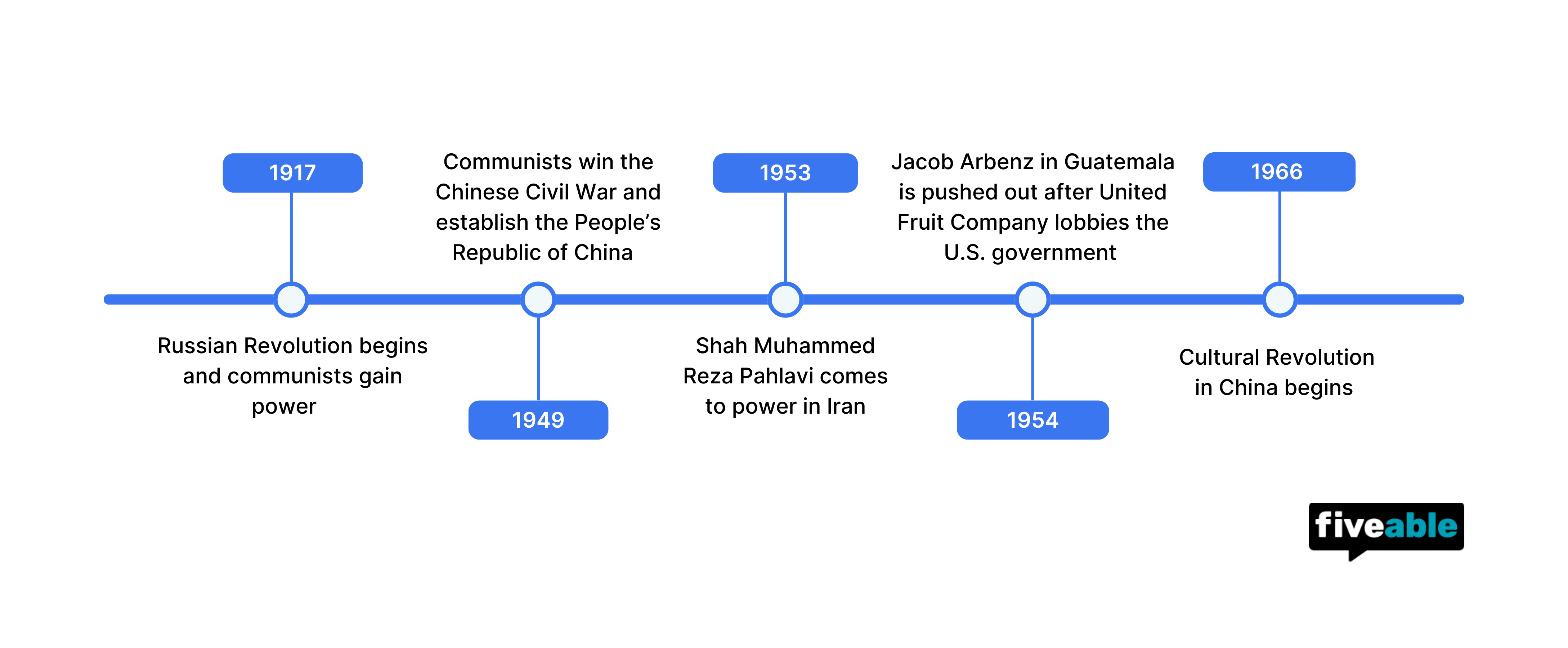
Timeline of events following the spread of communism throughout the 1900s. Image Courtesy of Sandra.
Key Takeaways
- Mao's Communists gained peasant support through land redistribution and took power in 1949. His Great Leap Forward brought deadly food shortages, while the Cultural Revolution silenced his critics.
- The U.S. and Britain restored Iran's shah in a coup. His White Revolution left most peasants without land, and the 1979 revolution replaced his rule with a theocracy.
- Venezuela's land redistribution divided supporters and opponents of its government, while Guatemala's elected leader Jacobo Arbenz was overthrown after his land reform threatened the United Fruit Company.
- In Vietnam, the Communist promise to redistribute land won peasant support; Communists carried out land reform in the north, while slow reform hurt the southern government's popularity.
- Ethiopia's Haile Selassie failed to implement land reform and was deposed in 1974. The new socialist government received Soviet aid, but famine, failed policies, and rebellion marked Mengistu's rule.
- India's land reforms had mixed results, but Kerala's laws gave tenants ownership rights and set minimum wages before the central government intervened.
Communism in China
China is the chapter's main event. Internal tension plus Japanese aggression opened the door for the Communists to seize power, and once they did, the government took control of the national economy with repressive results.
How the Communists won
- The Communists and Nationalists started fighting for control of China in 1927, paused to fight the Japanese invasion together, then resumed the civil war after Japan's defeat in 1945.
- Mao Zedong's Communists won popular support by redistributing land to peasants, opening schools and hospitals, and punishing soldiers who mistreated civilians. Peasants saw them as more nationalist and less corrupt than the Nationalists.
- In 1949, the Communists won and established the People's Republic of China. Mao nationalized Chinese industries and launched five-year plans modeled on the Soviet system, emphasizing heavy industry over consumer goods.
The Great Leap Forward (1958)
- Peasant lands were reorganized into communes, large agricultural communities where the state, not private owners, held the land. Protesters could be sent to "reeducation camps" or killed.
- Harvests failed and food shortages turned deadly, but China kept exporting grain to Africa and Cuba because Mao wanted the world to believe his plans were working. Roughly 20 million Chinese died of starvation.
- Small backyard steel furnaces were supposed to boost industry, but the steel was so poor the effort was dropped.
- The Great Leap Forward was abandoned by 1960.
The Cultural Revolution (1966)
- Officially an effort to reinvigorate China's commitment to communism. In practice, it silenced Mao's critics and locked in his power, similar to Stalin's purges in the USSR.
- Mao ordered the Red Guards, groups of revolutionary students, to seize government officials, teachers, and others and send them to the countryside for reeducation: hard physical labor plus group meetings where they were pressured to confess they had not been revolutionary enough.
The Sino-Soviet split
Communist did not mean friendly. China and the USSR skirmished over their border from 1961 onward and competed for influence worldwide. Albania, originally a Soviet satellite, exploited the split by allying with China instead, gaining more autonomy and Chinese financial aid.
Turmoil and Land Reform in Iran
Iran shows how Cold War powers intervened to keep a strategic, oil-rich country out of the communist orbit. Britain and Russia had competed for control of Iran since the late 19th century, and the discovery of oil in the early 20th century raised the stakes.
Foreign influence and the 1953 coup
- Early in World War II, Iran's leader considered backing Nazi Germany, so Britain and Russia invaded, forced him to abdicate to his young son, Shah Muhammad Reza Pahlavi, and kept troops there until the war ended.
- Nationalists saw the new shah as a Western puppet and forced him to flee in 1951. Iran chose Mohammad Mosaddegh as prime minister, and he vowed to nationalize the oil companies.
- The U.S. and Britain engineered the overthrow of the democratically chosen Mosaddegh and put the shah back in power. The shah then ruled as an authoritarian backed by a ruthless secret police force.
The White Revolution
The shah's reform program got its name because the changes came without bloodshed. Reforms included women's right to vote, a social welfare system, and village literacy programs. The centerpiece was land reform: the government bought land from landlords and resold it cheaply to peasants, aiming to undercut traditional landowners and win peasant loyalty. Many peasants became first-time landowners, but the program failed to reach a majority of them.
Opposition came from every direction. Landowners resented being forced to sell, most peasants got nothing, religious conservatives opposed modernization (especially changing gender relations), and pro-democracy advocates opposed the shah's harsh rule.
The Iranian Revolution (1979)
A revolution toppled the shah, fueled partly by memories of the 1953 Mosaddegh overthrow. The winners rejected the shah's secular worldview and built a theocracy, a government where religion is the supreme authority. A cleric headed the state alongside a Guardian Council of civil and religious legal experts who interpreted the constitution and ensured all laws complied with shariah (Islamic law). The clergy could approve or reject anyone running for office. The new Iran opposed Western policies in the Middle East and the state of Israel.
Land Reform in Latin America
Latin American leaders saw concentrated land ownership as a barrier to progress, so post-colonial governments took up land reform. Mexico's effort dates to the 1930s, but most Latin American land reform happened in the 1960s or later.
Venezuela
- The government redistributed about five million acres, some state-owned and uncultivated, some seized from large landowners, starting with a 2001 law.
- Landowners protested that the state took property already under cultivation, and illegal squatters settled on land not scheduled for reform.
- Politics followed the land: beneficiaries voted for the reforming government, while those who lost land turned against it.
Guatemala
The democratically elected government of Jacobo Arbenz started land reform. The United Fruit Company felt threatened and lobbied the U.S. government to remove him, and Arbenz was overthrown in 1954. U.S. Secretary of State John Foster Dulles called it a "glorious victory for democracy." Mexican muralist Diego Rivera used that phrase ironically as the title of his 1954 mural condemning the coup, which showed Dulles holding a bomb with President Eisenhower's face on it.
Notice the pattern with Iran: in both 1953 Tehran and 1954 Guatemala, the U.S. helped remove a democratically chosen leader whose economic nationalism threatened Western interests.
Land Reform in Asia and Africa
After World War II, new and newly assertive nations across Asia and Africa tried to fix unequal land ownership, sometimes through peaceful laws, sometimes through violence.
Vietnam
- Japan occupied Vietnam during World War II while France still claimed it as a colony. Vietnam declared independence from both in 1945.
- Vietnam was agricultural, with a few people controlling most of the land. The Communist pledge to seize land from large landowners and redistribute it to peasants won huge peasant support.
- When Communists took power in the north, they carried out redistribution, sometimes violently. South Vietnam's government was slow on land reform, which is one reason it stayed unpopular.
Ethiopia
- Ethiopia stayed independent except for Italian occupation from 1936 to 1941. Exiled leader Haile Selassie returned during World War II, aligned with the Western powers, and built economic success on the coffee trade, bringing Western-style political and cultural reforms.
- Selassie could not effectively implement land reform, and by the 1960s many Ethiopians saw him as a pawn of U.S. imperialism.
- In 1974, military and civilian leaders deposed him. A key figure, Mengistu Haile Mariam, ordered the assassination of 60 former regime officials. The new government declared itself socialist and got aid and weapons from the USSR and other communist countries.
- Famine, failed economic policies, and rebellion marked Mengistu's rule. By 1991 he resigned and fled to Zimbabwe.
India and Kerala
- British rule over southern Asia (since 1858) ended in 1947, when independence and partition created Pakistan (overwhelmingly Muslim) and India (largely Hindu). Gandhi had led the independence movement since the 1920s.
- India's land reforms tried to redistribute land to the landless, abolish the power of rent collectors, protect renters, and promote cooperative farming. Results were mixed.
- The state of Kerala had more success: land reform passed in 1960 (overturned by courts), tenants won the right to purchase land in 1963, new laws made tenants full owners in 1969, and 1974 laws set fixed work hours and minimum wages. Despite the program's popularity, India's central government took direct rule of Kerala to slow or reverse it.
Key Terms to Know
| Term | Why it matters |
|---|---|
| Land reform | Government redistribution of agricultural land to people who own little or none; the thread connecting every region in this chapter. |
| Mao Zedong | Leader of China's Communists who won the civil war in 1949 and ruled the People's Republic with sweeping economic and cultural campaigns. |
| Great Leap Forward | Mao's 1958 plan reorganizing peasant land into communes; failed harvests killed some 20 million people, and it was abandoned by 1960. |
| Communes | Large state-held agricultural communities that replaced private peasant landholding during the Great Leap Forward. |
| Cultural Revolution | Mao's 1966 campaign to reinvigorate communism that in practice silenced critics and cemented his power, much like Stalin's purges. |
| Red Guards | Revolutionary students Mao mobilized to seize officials and teachers and send them to the countryside for reeducation. |
| Reeducation camps | Where people deemed insufficiently revolutionary did hard labor and faced pressured confessions; also a punishment for resisting communes. |
| Shah Muhammad Reza Pahlavi | Western-backed ruler of Iran installed in 1941 and restored in 1953; ran an authoritarian state with a brutal secret police until 1979. |
| Mohammad Mosaddegh | Iran's democratically chosen prime minister who vowed to nationalize oil; overthrown by a U.S.-British coup in 1953. |
| White Revolution | The shah's bloodless reform program (women's suffrage, social welfare, literacy, land redistribution) that still left most peasants empty-handed. |
| Theocracy | Government where religion is the supreme authority; Iran became one after the 1979 revolution, with a Guardian Council enforcing shariah. |
| Jacobo Arbenz | Guatemala's elected president whose land reform threatened the United Fruit Company; overthrown with U.S. backing in 1954. |
| Haile Selassie | Ethiopian leader who aligned with the West and built a coffee economy but failed at land reform; deposed in 1974. |
| Mengistu Haile Mariam | Leader of Ethiopia's socialist regime after 1974, backed by Soviet aid; his rule brought famine and rebellion before he fled in 1991. |
| Kerala land reform | Indian state's series of laws (1960-1974) that made tenants landowners and set minimum wages, until the central government intervened. |
Practice and Next Steps
Pair these notes with the Fiveable course study guide for Topic 8.4 Spread of Communism After 1900 to reinforce the College Board framing, then keep moving through the unit with AMSCO 8.5 Decolonization after 1900, where many of these same new nations take center stage. The full set of AMSCO Unit 8 notes covers the whole Cold War and decolonization era.
To check your understanding, run targeted multiple-choice sets in AP World guided practice, drill vocab in the key terms glossary, and try writing about land reform causation with FRQ practice and instant scoring.
Frequently Asked Questions
What does AMSCO Topic 8.4 Spread of Communism cover?
AMSCO 8.4 (pages 571-578) covers communist China under Mao Zedong, including the Great Leap Forward and Cultural Revolution, plus land redistribution movements in Iran, Venezuela, Guatemala, Vietnam, Ethiopia, and India during the Cold War. The connecting theme is governments and revolutionaries trying to redistribute land from elites to peasants, often getting pulled into the U.S.-Soviet rivalry.
What was the Great Leap Forward and why did it fail?
The Great Leap Forward was Mao's 1958 policy that reorganized peasant land into state-held communes and pushed projects like backyard steel furnaces. Harvests failed, but China kept exporting grain to Africa and Cuba to make the plan look successful, and roughly 20 million Chinese died of starvation. The policy was abandoned by 1960.
Were China and the Soviet Union allies since both were communist?
No. Despite sharing a communist ideology, China and the USSR were often hostile, skirmishing over their border from 1961 onward and competing for influence worldwide. Albania even switched from being a Soviet satellite to allying with China, gaining more autonomy and Chinese financial aid. The Sino-Soviet split is a favorite AP World detail because it complicates the simple 'communist bloc' picture.
What was the White Revolution in Iran?
The White Revolution was Shah Muhammad Reza Pahlavi's bloodless reform program, which included women's right to vote, a social welfare system, village literacy programs, and land reform where the government bought land from landlords and resold it cheaply to peasants. It made many peasants first-time landowners but failed to reach most of them, and opposition from landowners, religious conservatives, and pro-democracy advocates helped fuel the 1979 Iranian Revolution.
How does Topic 8.4 show up on the AP World exam?
You need to explain the causes and consequences of China's adoption of communism and the causes and effects of movements to redistribute land and resources in Africa, Asia, and Latin America. Strong evidence includes the Great Leap Forward, the Communist Revolution for Vietnamese independence, Mengistu Haile Mariam in Ethiopia, land reform in Kerala, and Iran's White Revolution. Practice applying that evidence with Fiveable's FRQ practice.
See Fiveable more often in Google
Mark Fiveable as a preferred source and Google is more likely to show you our guides in Top Stories, with a "preferred" badge in AI Mode and AI Overviews.