AMSCO 8.7 Global Resistance to Established Power Structure Notes

🌍AP World History: Modern Review
AMSCO 8.7 Global Resistance to Established Power Structure Notes
🌍 AP World History: Modern
AMSCO 1.1 Developments in East Asia Notes
AMSCO 1.2 Developments in Dar al-Islam Notes
AMSCO 1.3 Developments in South and Southeast Asia Notes
AMSCO 1.4 Developments in the Americas Notes
AMSCO 1.5 Developments in Africa Notes
AMSCO 1.6 Developments in Europe Notes
AMSCO 1.7 Comparison in the Period from c.1200 to c.1450 Notes
AMSCO 2.1 The Silk Roads Notes
AMSCO 2.2 The Mongol Empire and the Modern World Notes
AMSCO 2.3 Exchange in the Indian Ocean Notes
AMSCO 2.4 Trans-Saharan Trade Routes Notes
AMSCO 2.5 Cultural Consequences of Connectivity Notes
AMSCO 2.6 Environmental Consequences of Connectivity Notes
AMSCO 2.7 Comparison of Economic Exchange Notes
AMSCO 3.1 European, East Asian, and Gunpowder Empires Expand Notes
AMSCO 3.2 Empires: Administrations Notes
AMSCO 3.3 Empires: Belief Systems Notes
AMSCO 3.4 Comparison in Land-Based Empires Notes
AMSCO 4.1 Technological Innovations Notes
AMSCO 4.2 Exploration: Causes and Events Notes
AMSCO 4.3 Columbian Exchange Notes
AMSCO 4.4 Maritime Empires Link Regions Notes
AMSCO 4.5 Maritime Empires Develop Notes
AMSCO 4.6 Internal and External Challenges to State Power Notes
AMSCO 4.7 Changing Social Hierarchies Notes
AMSCO 4.8 Continuity and Change from c.1450 to c.1750 Notes
AMSCO 5.1 The Enlightment Notes
AMSCO 5.2 Nationalism and Revolutions Notes
AMSCO 5.3 Industrial Revolution Begins Notes
AMSCO 5.4 Industrialization Spreads Notes
AMSCO 5.5 Technology in the Industrial Age Notes
AMSCO 5.6 Industrialization: Government's Role Notes
AMSCO 5.7 Economic Developments and Innovations Notes
AMSCO 5.8 Reactions to the Industrial Economy Notes
AMSCO 5.9 Society and the Industrial Age Notes
AMSCO 5.10 Continuity and Change in the Industrial Age Notes
AMSCO 6.1 Rationales for Imperialism Notes
AMSCO 6.2 State Expansion Notes
AMSCO 6.3 Indigenous Responses to State Expansion Notes
AMSCO 6.4 Global Economic Development Notes
AMSCO 6.5 Economic Imperialism Notes
AMSCO 6.6 Causes of Migration in an Interconnected World Notes
AMSCO 6.7 Effects of Migration Notes
AMSCO 6.8 Causation in the Imperial Age Notes
AMSCO 7.1 Shifting Power Notes
AMSCO 7.2 Causes of World War I Notes
AMSCO 7.3 Conducting World War I Notes
AMSCO 7.4 Economy in the Interwar Period Notes
AMSCO 7.5 Unresolved Tensions After World War I Notes
AMSCO 7.6 Causes of World War II Notes
AMSCO 7.7 Conducting World War II Notes
AMSCO 7.8 Mass Atrocities Notes
AMSCO 7.9 Causation in Global Conflict Notes
AMSCO 8.1 Setting the Stage for the Cold War and Decolonization Notes
AMSCO 8.2 The Cold War Notes
AMSCO 8.3 Effects of the Cold War Notes
AMSCO 8.4 Spread of Communism Notes
AMSCO 8.5 Decolonization after 1900 Notes
AMSCO 8.6 Newly Independent States Notes
AMSCO 8.7 Global Resistance to Established Power Structure Notes
AMSCO 8.8 End of the Cold War Notes
AMSCO 8.9 Causation in the Age of the Cold Ward and Decolonization Notes
AMSCO 9.1 Advances in Technology and Exchange Notes
AMSCO 9.2 Technological Advancements and Limitations Notes
AMSCO 9.3 Technology and the Environment Notes
AMSCO 9.4 Economics in the Global Age Notes
AMSCO 9.5 Calls for Reforms and Responses Notes
AMSCO 9.6 Globalized Culture Notes
AMSCO 9.7 Resistance to Globalization Notes
AMSCO 9.8 Institutions Developing in a Globalized World Notes
AMSCO 9.9 Continuity and Change in a Globalized World Notes
Overview
AMSCO Topic 8.7, "Global Resistance to Established Power Structures," covers how individuals, groups, and states challenged existing political order after 1900, from Gandhi's nonviolent campaigns to terrorist groups like Shining Path and al-Qaeda. The chapter (AMSCO p. 599-604) sits near the end of Unit 8 (Cold War and Decolonization, 1900-present) and shows the flip side of the unit's wars: some people resisted conflict peacefully, while others, including militarized states, made conflicts worse. The big idea to hold onto is that resistance took three main forms: nonviolence, violence against civilians, and state crackdowns backed by military power.
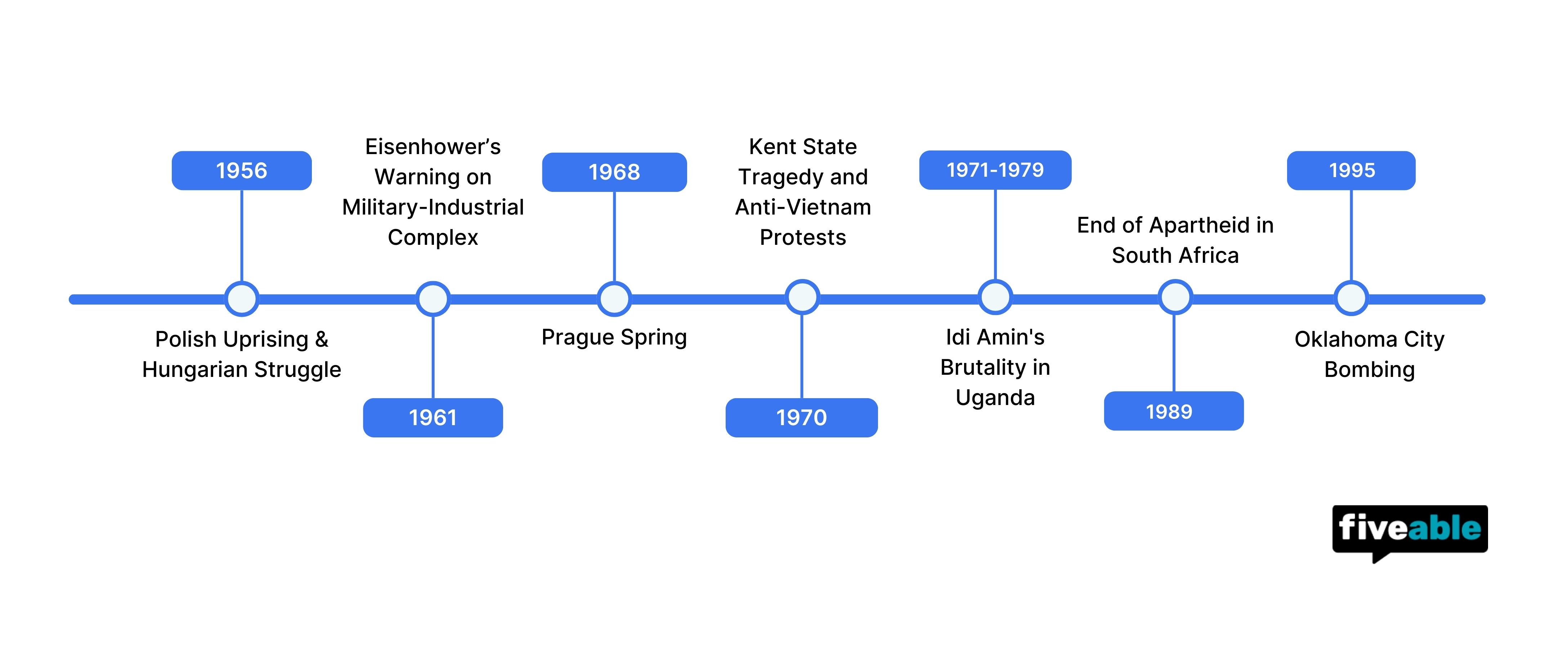
Timeline of Global Resistance to Power Structures. Image courtesy of Riya Patel.
Key Takeaways
- Gandhi used marches, boycotts, and fasts against British rule; King used nonviolent tactics against U.S. segregation; Mandela became known for nonviolent protests against apartheid.
- Poland gained partial reform while staying loyal to the USSR, but Soviet forces invaded Hungary and Warsaw Pact armies crushed Czechoslovakia's Prague Spring.
- Protests spread across university campuses in 1968, French workers joined students in a massive strike, and U.S. antiwar protests continued into 1970, when National Guard members killed four students at Kent State.
- The IRA bombed English cities, Shining Path used bombings and assassinations in Peru, and al-Qaeda carried out the September 11 attacks.
- Franco's government imprisoned or executed political dissenters, while Amin expelled 60,000 Asians from Uganda and is believed responsible for up to 500,000 deaths.
- Eisenhower warned that the military-industrial complex could threaten American democracy, while jobs tied to defense industries made spending cuts politically painful.
Nonviolent Resistance as a Path to Change
Three movements led by visionary leaders proved that nonviolence could actually overturn entrenched power. These three names show up constantly on the AP World exam, so know what each one resisted and how.
Mohandas Gandhi
- Led nonviolent marches, boycotts, and fasts against British colonial rule in India.
- India won independence in 1947. This connects directly to the decolonization story in AMSCO 8.5.
Martin Luther King Jr.
A Baptist minister, King was the most prominent African American civil rights leader of the 1950s and 1960s. The movement's tactics included:
- Court decisions, like Brown v. Board of Education of Topeka, Kansas, which banned forced racial segregation in U.S. schools
- The Montgomery bus boycott (1955-1956), a year-long boycott that ended segregation on public transit
- Massive marches, including the 250,000-person March on Washington for Jobs and Freedom
These tactics laid the foundation for landmark civil rights legislation in the mid-1960s.
Nelson Mandela
- In South Africa, the white-minority government wrote racial segregation into law as apartheid.
- Mandela (1918-2013), a socialist lawyer, led the black resistance. Early in life he sometimes supported sabotage, but he became known for leading nonviolent protests against apartheid.
Challenges to Soviet Power in Eastern Europe
In the 1950s and 1960s, reformers in Soviet satellite states tried to loosen Moscow's grip, and the Soviets usually clamped down hard. The pattern to remember: reform attempt, then Soviet response. (For background on how these satellites formed, see AMSCO 8.2 on the Cold War.)
Poland (1956)
- Polish workers demonstrated against Soviet domination and demanded better living conditions.
- Wladyslaw Gomulka became the new secretary of the Polish Communist Party. He pursued an independent domestic policy but stayed loyal to the USSR and kept Soviet troops in Poland.
- Forced collectivization of farms ended. Poland got partial reform without an invasion.
Hungary (1956)
- Protesters pushed leader Imre Nagy to declare Hungary free from Soviet control, demand Soviet troop withdrawal, promise free multiparty elections, declare Cold War neutrality, and withdraw from the Warsaw Pact.
- The Soviets invaded, took Budapest in 1956, and captured and executed Nagy. Many Hungarians fled west as refugees.
Czechoslovakia and the Prague Spring (1968)
- Alexander Dubcek, first secretary of the Communist Party, expanded freedom of speech, press, and travel and agreed to democratize the political system.
- Armies of four Warsaw Pact nations crushed the Prague Spring.
- The Soviets justified the invasion with the Brezhnev Doctrine (named for Leonid Brezhnev): the USSR and its allies would intervene if one socialist country's actions threatened other socialist countries. In plain terms, once you're in the Soviet bloc, you don't get to leave.
1968: The Year of Revolt
Protests erupted worldwide in 1968, much of it on university campuses. After World War II, higher education opened up to far more people in Western society, facilities got crowded, and by the 1960s student discontent was boiling over alongside movements for civil rights, women's rights, workers' rights, and opposition to the Vietnam War.
- Yugoslavia: students marched against authoritarian government.
- Poland and Northern Ireland: protests over religious issues.
- Brazil: marchers demanded better public education and fairer treatment of workers.
- Japan: students protested university financial policies and government support for the U.S. war in Vietnam.
- Mexico: armored vehicles rolled into Mexico City to suppress the student movement two months before the 1968 Olympics.
France
Hundreds of thousands of students took to the streets of Paris in 1968, and violence broke out when police moved in. Roughly 10 million French workers went on strike in sympathy, the largest general strike in French history. President Charles de Gaulle called new elections and kept his office when his party won.
The United States
Americans demonstrated for women's rights and African American rights, but the largest protests targeted the Vietnam War. On May 4, 1970, Ohio National Guard members killed four unarmed students during an antiwar demonstration at Kent State University. Students and faculty at hundreds of U.S. colleges went on strike in response.
An Age of Terrorism
After the Cold War, open war between sovereign states became rare. Instead, individuals unaffiliated with any government used terrorism, the use of violence to achieve political ends, against civilians in Western Europe, South America, the Islamic world, and the United States.
Northern Ireland
- Most of Ireland (majority Roman Catholic) became independent from the UK in 1922, but Protestant-dominated Northern Ireland stayed British. Catholics there faced discrimination and many wanted to join the Irish Republic; Protestants refused.
- The conflict turned violent in the 1960s: Catholics fought with the Irish Republican Army (IRA), Protestants with the Ulster Defence Association. Some 3,500 people died between 1969 and 1994.
- The IRA set off bombs in London and other English cities. A cease-fire came in 1994, and the IRA later renounced violence and turned to politics.
Basque Separatists in Spain
- Basque Homeland and Freedom (ETA), founded in 1959, wanted independence for the Basque region of northern Spain.
- ETA killed more than 800 people, including Francisco Franco's hand-picked successor in 1973.
- In 2011, ETA declared an end to violence and promised to work within the political system.
Peru's Shining Path
- Former philosophy professor Abimael Guzmán built Shining Path in the 1970s on the ideas of Mao Zedong and Cambodia's Khmer Rouge.
- Starting in 1980, the group used bombings and assassinations to try to replace Peru's government with a communist one. Roughly 37,000 people died over 20 years of terrorism.
- Guzmán was arrested and sentenced to life in prison in 1992. A top leader admitted defeat and began negotiating with Peru's government in 2011.
Islamic Terrorism
- Small groups used a fundamentalist interpretation of Islam, widely condemned by mainstream Muslims, to justify terrorism: Boko Haram (West Africa), al-Shabaab (East Africa), ISIL (Middle East), and the Taliban (Afghanistan). Most victims were Muslims. High-profile attacks hit Madrid, London, and Paris.
- Al-Qaeda, financed by Saudi billionaire Osama bin Laden, was among the deadliest. On September 11, 2001, hijackers crashed planes in New York City, near Washington, D.C., and in rural Pennsylvania, killing more than 3,000 people. Most of the world, even bitter U.S. foes like Iran, rallied behind the United States. Allied efforts severely weakened al-Qaeda, and bin Laden was killed in a 2011 raid.
Terrorism Inside the United States
Domestic terrorism also struck the U.S., some of it tied to white-nationalist or extreme right-wing views. In 1995, two anti-government extremists bombed a federal building in Oklahoma City, killing 168 people. Other attacks targeted Muslims, Jews, and blacks.
Militarized States and the Military-Industrial Complex
Military dictatorships tended to respond to internal conflict in ways that made it worse. AMSCO highlights two examples.
Franco's Spain (1939-1975)
- Francisco Franco took power by overthrowing a popularly elected government that included many leftists.
- His fierce anti-communism made him a U.S. ally, but it also drove his government to execute, imprison, or send hundreds of thousands of political dissenters to labor camps.
- Opposition persisted, and after Franco died in 1975, Spain moved toward democracy.
Idi Amin's Uganda (1971-1979)
- Amin, a military dictator nicknamed the "Butcher of Uganda," declared himself president for life. He was aligned with Western democracies early on but later backed by the Soviet Union and East Germany.
- In 1972 he expelled 60,000 Asians (most of Indian descent) and handed their businesses to his supporters. He is believed responsible for up to 500,000 deaths among targeted ethnic groups.
- When Amin threatened Tanzania, Ugandan nationalists joined Tanzanian troops and forced him into exile.
Eisenhower's Warning
Threatened countries like the U.S. and USSR built huge militaries, which required massive defense factories, and the international weapons trade boomed since many countries couldn't make their own arms. As defense industries grew, so did the jobs depending on them, making spending cuts politically painful. In 1961, U.S. President Dwight Eisenhower, himself a decorated WWII general, named this combination of government defense departments and private suppliers the military-industrial complex and warned it could grow powerful enough to threaten American democracy.
Key Terms to Know
| Term | Why it matters |
|---|---|
| Martin Luther King Jr. | Civil rights leader whose nonviolent tactics (boycotts, marches, court cases) helped end legal segregation in the U.S. |
| Nelson Mandela | Socialist lawyer who led the black resistance to apartheid in South Africa, known for nonviolent protest. |
| Apartheid | South Africa's legal system of racial segregation imposed by the white-minority government. |
| Wladyslaw Gomulka | Polish Communist leader who won an independent domestic policy in 1956 while staying loyal to the USSR. |
| Imre Nagy | Hungarian leader who declared independence from Soviet control in 1956; the Soviets invaded and executed him. |
| Prague Spring | Czechoslovakia's 1968 reform period of expanded speech, press, and travel freedoms, crushed by Warsaw Pact armies. |
| Alexander Dubcek | Czechoslovak Communist Party leader whose reforms triggered the Prague Spring. |
| Brezhnev Doctrine | Soviet policy justifying intervention in any socialist country whose actions threatened other socialist states. |
| Kent State University | Site of the May 4, 1970 shooting where the Ohio National Guard killed four unarmed antiwar protesters. |
| Irish Republican Army (IRA) | Catholic paramilitary group in Northern Ireland that used bombings in England before a 1994 cease-fire and a turn to politics. |
| Ulster Defence Association | Protestant paramilitary group that fought the IRA in Northern Ireland's conflict. |
| Basque Homeland and Freedom (ETA) | Basque separatist group in Spain (founded 1959) that killed over 800 people before renouncing violence in 2011. |
| Shining Path | Maoist revolutionary group in Peru whose bombings and assassinations caused roughly 37,000 deaths. |
| Abimael Guzmán | Former philosophy professor who founded Shining Path; arrested and imprisoned for life in 1992. |
| Al-Qaeda | Terrorist network financed by Osama bin Laden that carried out the September 11, 2001 attacks. |
| Military-industrial complex | Eisenhower's 1961 term for the alliance of defense departments and private arms suppliers that he warned could threaten democracy. |
Practice and Next Steps
For the College Board framing of this topic, read the 8.7 Global Resistance to Established Power Structures study guide, then continue to AMSCO 8.8 End of the Cold War notes to see how the Soviet bloc these reformers challenged finally collapsed. The full chapter sequence lives on the AP World AMSCO notes page.
To check yourself, run Unit 8 questions in guided practice, try a comparison or continuity prompt in FRQ practice with instant scoring, and review tricky vocab in the key terms glossary.
Frequently Asked Questions
What is AMSCO Topic 8.7 about in AP World?
Topic 8.7, Global Resistance to Established Power Structures (AMSCO p. 599-604), covers how people challenged existing political order after 1900. It includes nonviolent movements led by Gandhi, Martin Luther King Jr., and Nelson Mandela, anti-Soviet uprisings in Poland, Hungary, and Czechoslovakia, the 1968 protests, terrorist groups like the IRA, ETA, Shining Path, and al-Qaeda, and militarized states like Franco's Spain and Idi Amin's Uganda.
What was the Brezhnev Doctrine?
The Brezhnev Doctrine was the Soviet policy, named for leader Leonid Brezhnev, stating that the USSR and its allies would intervene if one socialist country's actions threatened other socialist countries. The Soviets used it to justify crushing the Prague Spring in Czechoslovakia in 1968 with Warsaw Pact armies. In practice, it meant satellite states could not leave the Soviet bloc.
Was all resistance to established power after 1900 violent?
No. Some of the most successful challenges were nonviolent: Gandhi's marches, boycotts, and fasts helped India win independence in 1947, King's boycotts and marches helped end legal segregation in the U.S., and Mandela led nonviolent protests against apartheid in South Africa. Other movements, like Peru's Shining Path and al-Qaeda, used violence against civilians, and that contrast is exactly what the topic asks you to explain.
What was the Shining Path in Peru?
Shining Path was a revolutionary organization built in the 1970s by former philosophy professor Abimael Guzmán, based on the ideas of Mao Zedong and Cambodia's Khmer Rouge. Starting in 1980 it used bombings and assassinations to try to replace Peru's government with a communist one, causing roughly 37,000 deaths. Guzmán was arrested and sentenced to life in prison in 1992.
How does Topic 8.7 show up on the AP World exam?
Topic 8.7 asks you to explain various reactions to existing power structures after 1900, which is great material for comparison questions: nonviolent movements versus terrorism versus state crackdowns. Examples like the Prague Spring, the Hungarian uprising, and Franco's Spain also work as evidence in Unit 8 essays. You can drill this material with AP World guided practice questions.
See Fiveable more often in Google
Mark Fiveable as a preferred source and Google is more likely to show you our guides in Top Stories, with a "preferred" badge in AI Mode and AI Overviews.