AMSCO 1.5 Developments in Africa Notes

🌍AP World History: Modern Review
AMSCO 1.5 Developments in Africa Notes
🌍 AP World History: Modern
AMSCO 1.1 Developments in East Asia Notes
AMSCO 1.2 Developments in Dar al-Islam Notes
AMSCO 1.3 Developments in South and Southeast Asia Notes
AMSCO 1.4 Developments in the Americas Notes
AMSCO 1.5 Developments in Africa Notes
AMSCO 1.6 Developments in Europe Notes
AMSCO 1.7 Comparison in the Period from c.1200 to c.1450 Notes
AMSCO 2.1 The Silk Roads Notes
AMSCO 2.2 The Mongol Empire and the Modern World Notes
AMSCO 2.3 Exchange in the Indian Ocean Notes
AMSCO 2.4 Trans-Saharan Trade Routes Notes
AMSCO 2.5 Cultural Consequences of Connectivity Notes
AMSCO 2.6 Environmental Consequences of Connectivity Notes
AMSCO 2.7 Comparison of Economic Exchange Notes
AMSCO 3.1 European, East Asian, and Gunpowder Empires Expand Notes
AMSCO 3.2 Empires: Administrations Notes
AMSCO 3.3 Empires: Belief Systems Notes
AMSCO 3.4 Comparison in Land-Based Empires Notes
AMSCO 4.1 Technological Innovations Notes
AMSCO 4.2 Exploration: Causes and Events Notes
AMSCO 4.3 Columbian Exchange Notes
AMSCO 4.4 Maritime Empires Link Regions Notes
AMSCO 4.5 Maritime Empires Develop Notes
AMSCO 4.6 Internal and External Challenges to State Power Notes
AMSCO 4.7 Changing Social Hierarchies Notes
AMSCO 4.8 Continuity and Change from c.1450 to c.1750 Notes
AMSCO 5.1 The Enlightment Notes
AMSCO 5.2 Nationalism and Revolutions Notes
AMSCO 5.3 Industrial Revolution Begins Notes
AMSCO 5.4 Industrialization Spreads Notes
AMSCO 5.5 Technology in the Industrial Age Notes
AMSCO 5.6 Industrialization: Government's Role Notes
AMSCO 5.7 Economic Developments and Innovations Notes
AMSCO 5.8 Reactions to the Industrial Economy Notes
AMSCO 5.9 Society and the Industrial Age Notes
AMSCO 5.10 Continuity and Change in the Industrial Age Notes
AMSCO 6.1 Rationales for Imperialism Notes
AMSCO 6.2 State Expansion Notes
AMSCO 6.3 Indigenous Responses to State Expansion Notes
AMSCO 6.4 Global Economic Development Notes
AMSCO 6.5 Economic Imperialism Notes
AMSCO 6.6 Causes of Migration in an Interconnected World Notes
AMSCO 6.7 Effects of Migration Notes
AMSCO 6.8 Causation in the Imperial Age Notes
AMSCO 7.1 Shifting Power Notes
AMSCO 7.2 Causes of World War I Notes
AMSCO 7.3 Conducting World War I Notes
AMSCO 7.4 Economy in the Interwar Period Notes
AMSCO 7.5 Unresolved Tensions After World War I Notes
AMSCO 7.6 Causes of World War II Notes
AMSCO 7.7 Conducting World War II Notes
AMSCO 7.8 Mass Atrocities Notes
AMSCO 7.9 Causation in Global Conflict Notes
AMSCO 8.1 Setting the Stage for the Cold War and Decolonization Notes
AMSCO 8.2 The Cold War Notes
AMSCO 8.3 Effects of the Cold War Notes
AMSCO 8.4 Spread of Communism Notes
AMSCO 8.5 Decolonization after 1900 Notes
AMSCO 8.6 Newly Independent States Notes
AMSCO 8.7 Global Resistance to Established Power Structure Notes
AMSCO 8.8 End of the Cold War Notes
AMSCO 8.9 Causation in the Age of the Cold Ward and Decolonization Notes
AMSCO 9.1 Advances in Technology and Exchange Notes
AMSCO 9.2 Technological Advancements and Limitations Notes
AMSCO 9.3 Technology and the Environment Notes
AMSCO 9.4 Economics in the Global Age Notes
AMSCO 9.5 Calls for Reforms and Responses Notes
AMSCO 9.6 Globalized Culture Notes
AMSCO 9.7 Resistance to Globalization Notes
AMSCO 9.8 Institutions Developing in a Globalized World Notes
AMSCO 9.9 Continuity and Change in a Globalized World Notes
Overview
AMSCO Topic 1.5, "Developments in Africa" (AMSCO p.43 - p.49), covers how African states formed and changed between c. 1200 and c. 1450, from decentralized kin-based networks in inland Sub-Saharan Africa to powerful trading kingdoms like Ghana, Mali, Zimbabwe, and Ethiopia. The chapter opens with Ibn Battuta's account of Mali around 1352, which shows two ideas you'll see all over Unit 1: Islam connected Africa to Asia and southern Europe, and African societies that adopted Islam still kept their own traditions. The big takeaway is that African state systems showed continuity, innovation, and diversity, just like states in Eurasia and the Americas.
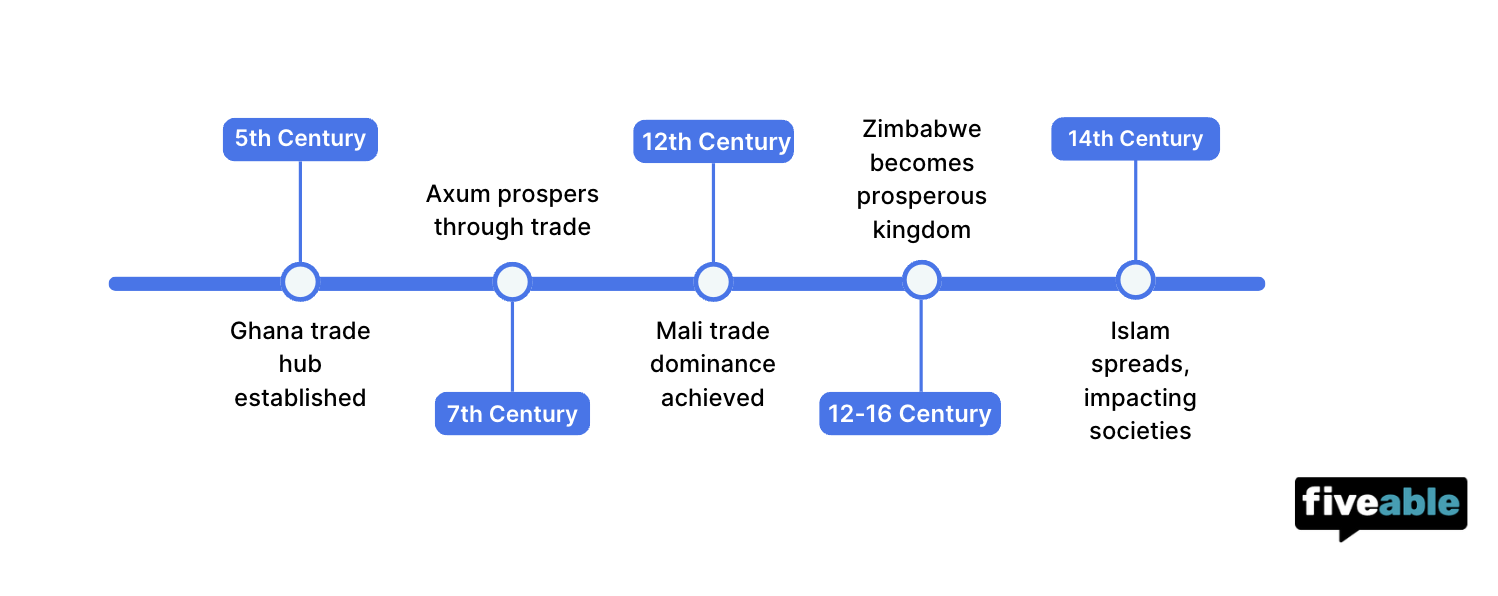
Timeline of African Kingdoms and Trade. Image Courtesy of Riya Patel.
Key Takeaways
- Many inland communities used kin-based networks instead of centralized rule; the Hausa Kingdoms also lacked central authority, which left them vulnerable to outside domination.
- Ghana grew wealthy trading gold and ivory, while Mali rose after Ghana weakened and expanded its gold trade through Sundiata's merchant connections.
- Zimbabwe gained wealth from gold and Indian Ocean trade, which helped produce Swahili along the coast; overgrazing later led residents to abandon Great Zimbabwe.
- Ethiopia's Christian rulers built rock-carved churches, while Ethiopian Christianity developed apart from other churches and blended with local traditions.
- Kinship, age, and gender shaped social roles in Sub-Saharan communities; slavery took several forms, and demand in the Middle East drove an Indian Ocean slave trade.
- Music and art carried religious meaning, while griots and griottes preserved stories, lineages, and advice through oral performance.
Political Structures in Inland Africa
Inland Sub-Saharan Africa mostly did NOT centralize power under one ruler. That's the key contrast with Asia and Europe in this period.
- The Bantu migrations spread out from west-central Africa, and by the year 1000 most of Sub-Saharan Africa had adopted agriculture.
- Settled farming required more complex governance, but instead of empires, communities formed kin-based networks in which families governed themselves.
- A male chief mediated conflicts within the network and dealt with neighboring groups. Groups of villages became districts, and groups of chiefs worked out district-level problems together.
- As populations grew, kin-based networks got harder to govern. Competition and fighting among villages increased, so larger kingdoms grew in prominence after 1000. Kin-based communities didn't disappear, though; many lasted into the 19th century.
The Hausa Kingdoms
Sometime before 1000, the Hausa ethnic group in what is now Nigeria formed seven loosely connected states, the Hausa Kingdoms. They had no central authority, just kinship ties.
- Each city-state had a specialty. Several sat in plains where cotton grew well, and one on the western edge specialized in military defense.
- The region was landlocked, but many Hausa profited from the trans-Saharan trade, the network of routes across the great desert.
- The downside of no central authority: the Hausa states were frequently subject to domination from outside.
- Missionaries introduced Islam to the region in the 14th century.
Kingdoms of West and East Africa: Ghana, Mali, Zimbabwe, Ethiopia
Trade made kingdoms on both coasts wealthy, politically powerful, and culturally diverse. The spread of Islam added to a religious mix that already included animism and Christianity.
Ghana
The kingdom of Ghana sat between the Sahara and the West African coastal rain forests (not in the same location as modern Ghana). Founded around the 5th century, at least two centuries before Muhammad, it peaked from the 8th to the 11th centuries.
- Ghana's rulers traded gold and ivory to Muslim traders for salt, copper, cloth, and tools.
- From the capital, Koumbi Saleh, the king ran a centralized government with nobles and an army equipped with iron weapons.
Mali
By the 12th century, wars with neighbors had permanently weakened Ghana, and Mali rose as the most powerful of the new trading societies.
- Most scholars believe Mali's founder, Sundiata, was a Muslim who used his religious connections to build trade relationships with North African and Arab merchants.
- Sundiata cultivated a thriving gold trade, and Mali's wealth grew tremendously.
- His nephew, Mansa Musa, made a pilgrimage to Mecca where his lavish displays of gold left a lasting impression. (AMSCO picks Mali back up in Topic 2.4 with Timbuktu and the Songhai Empire.)
Zimbabwe
In southern Africa, Zimbabwe (from the Bantu word for "dwellings") was one of the most powerful kingdoms between the 12th and 15th centuries, located between the Zambezi and Limpopo rivers.
- Its prosperity came from agriculture, grazing, trade, and above all gold. Like Ghana and Mali, it had rich gold fields, and taxes on gold transport made it wealthy.
- Here's the comparison the AP exam loves: Ghana and Mali relied on land-based trans-Saharan trade, while Zimbabwe traded through coastal city-states like Mombasa, Kilwa, and Mogadishu, plugging into the Indian Ocean trade that connected East Africa, the Middle East, South Asia, and East Asia.
- That coastal exchange produced Swahili, a new language blending Bantu and Arabic, still spoken today in the African Great Lakes region and Southeast Africa.
- By the end of the 13th century, a stone wall 30 feet tall and 15 feet thick surrounded the capital, the Great Zimbabwe. It was the continent's first large wall built without mortar, and most royal buildings inside were stone too.
- Nearly 20,000 people lived there in the late 15th century, but overgrazing damaged the environment so badly that residents abandoned the city by the end of the 1400s. The wall still stands.
Ethiopia
Christianity had spread from the eastern Mediterranean into Egypt and beyond, and the kingdom of Axum in today's Ethiopia prospered by trading goods from India, Arabia, the Roman Empire, and the African interior. Islam's spread starting in the 7th century made the region more religiously diverse.
- In the 12th century, a new Christian-led kingdom emerged in Ethiopia. Its rulers expressed power through architecture, ordering 11 massive churches carved entirely from rock.
- From the 12th through the 16th centuries, Ethiopia was an island of Christianity in Africa. Cut off from both the Roman Catholic and Orthodox churches, Ethiopian Christianity developed independently, blending traditional practices like ancestor veneration and spirit beliefs with Christian faith.
Social Structures of Sub-Saharan Africa
Sub-Saharan communities organized themselves around three things: kinship, age, and gender.
- Kinship came first. People identified primarily as members of a clan or family.
- Communities divided work by age, creating age grades or age sets. An 18-year-old could do more hard labor than a 60-year-old, but younger people relied on elders' advice.
- Gender shaped work too. Men dominated specialized skills like leather tanning and blacksmithing. Women generally did agriculture and food gathering, plus domestic chores and childrearing.
Slavery in Sub-Saharan Africa and Southwest Asia
Slavery had a long history in Africa. Prisoners of war, debtors, and criminals were often enslaved. In many kin-based societies people could not own land privately, so owning a large number of enslaved people was how you displayed social status. AMSCO compares three forms of slavery:
| Comparing Three Forms of Slavery | |||
|---|---|---|---|
| Chattel | Domestic | Debt Bondage | |
| Description | People were the legal property of the owner. | People served as cooks, cleaners, or other household workers. | People became enslaved, sometimes through mutual agreement, to repay a debt. |
| Examples | Common in the Americas, 16th century to 19th century | Common in Classical Greece and Rome, and in the Middle East | Common in East Africa before the 15th century and in European colonies in the Americas |
| Was enslavement permanent? | Yes | Often | Not in theory, but it often happened in practice |
| Were the children of enslaved people automatically enslaved? | Yes | Often | Children often inherited the debts of their parents |
| Did enslaved people have any rights? | No | Some: laws or customs might prevent a master from selling a person | Some: laws or customs might limit how severely a master could punish a person |
- Strong demand in the Middle East for enslaved workers created the Indian Ocean slave trade between East Africa and the Middle East. It began several centuries before the Atlantic slave trade and lasted in some places into the 20th century.
- Enslaved East Africans, called zanj in Arabic, labored on sugar plantations in Mesopotamia. Between 869 and 883, they and many Arab workers mounted the Zanj Rebellion. Zanj rebels, many of them enslaved East Africans, sacked the city of Basra in 871 and controlled much of southern Iraq for over a decade. Its size and length make it one of the most successful slave revolts in history.
Cultural Life in Sub-Saharan Africa
Music, visual arts, and storytelling marked rituals like weddings and funerals, and in Africa they carried extra religious weight.
- Traditional African religions included ancestor veneration, so song lyrics were a way to communicate with the spirit world. African music featured distinctive rhythmic patterns, with vocals interspersed with percussion like handclaps, bells, pots, or gourds.
- Visual arts often served religious purposes. Metalworkers created busts of past rulers so ruling royalty could look to them for guidance. Artists in Benin, West Africa, were famous for intricate iron and bronze sculptures. In the late 19th century, the sophistication of these works led some Europeans to gain respect for West African cultures.
Griots and Griottes
Literature in Sub-Saharan Africa was oral, and griots (storytellers) were a community's living history.
- Griots held encyclopedic knowledge of family lineages and the deeds of great leaders, singing their stories while playing instruments like drums and the kora, a 12-string harp.
- They were both venerated and feared. People said a griot could sing your success or sing your downfall, and kings sought their counsel on political matters. When a griot died, it was as though a library had burned.
- Women served as griottes, singing at special occasions like weddings, where they counseled and reassured brides. Griottes gave women a sense of empowerment in a patriarchal society.
Key Terms to Know
| Term | Why it matters |
|---|---|
| Kin-based networks | Decentralized communities in Sub-Saharan Africa where families governed themselves, the major contrast with centralized Eurasian states. |
| Chief | The male head of a kin-based network who mediated conflicts and dealt with neighboring groups. |
| Hausa Kingdoms | Seven loosely connected city-states in modern Nigeria with no central authority, prosperous from trade but vulnerable to outside domination. |
| Trans-Saharan trade | The network of routes across the Sahara that enriched West African states like Ghana, Mali, and the Hausa Kingdoms. |
| Ghana | West African kingdom (peak 8th-11th centuries) that traded gold and ivory for salt, copper, cloth, and tools from its capital, Koumbi Saleh. |
| Mali | Ghana's successor as West Africa's dominant trading society, built on gold and Islamic trade connections. |
| Sundiata | Mali's founding ruler, likely a Muslim, who used faith connections to build trade with North African and Arab merchants. |
| Mansa Musa | Sundiata's nephew, whose gold-laden pilgrimage to Mecca advertised Mali's enormous wealth. |
| Zimbabwe | Powerful southern African kingdom (12th-15th centuries) that grew rich from gold and Indian Ocean trade rather than trans-Saharan routes. |
| Great Zimbabwe | Zimbabwe's stone-walled capital of nearly 20,000 people, abandoned by the end of the 1400s after overgrazing damaged the environment. |
| Ethiopia | Christian-led kingdom famous for 11 rock-carved churches; an isolated "island of Christianity" that blended local traditions with the faith. |
| Swahili | Language created by blending Bantu and Arabic along the East African coast, evidence of Indian Ocean cultural exchange. |
| Indian Ocean trade | Maritime network connecting East Africa, the Middle East, South Asia, and East Asia through ports like Kilwa and Mombasa. |
| Indian Ocean slave trade | Trade in enslaved East Africans to the Middle East that began centuries before the Atlantic slave trade. |
| Zanj Rebellion | Revolt (869-883) by enslaved East Africans and Arab workers who sacked Basra and controlled southern Iraq for over a decade, one of history's most successful slave revolts. |
| Griots / griottes | Oral storytellers who preserved lineages and history, advised kings, and (as griottes) gave women a voice in a patriarchal society. |
Practice and Next Steps
Pair these notes with the 1.5 State Building in Africa study guide for the course-topic view of the same material, then keep moving through Unit 1 with the AMSCO 1.6 Developments in Europe notes. When you hit AMSCO 1.7's comparison chapter, the Ghana/Mali vs. Zimbabwe trade contrast from this topic is exactly the kind of comparison it asks for. Test yourself with AP World guided practice questions, and look up any term that's still fuzzy in the key terms glossary. The full set of chapter notes lives on the AMSCO notes hub.
Frequently Asked Questions
What does AMSCO Topic 1.5 Developments in Africa cover?
AMSCO 1.5 (p.43-49) covers African state building from c. 1200 to c. 1450: decentralized kin-based networks, the Hausa Kingdoms, the trading kingdoms of Ghana, Mali, Zimbabwe, and Ethiopia, social structures including slavery, and cultural life like griots and oral tradition. It pairs with the 1.5 State Building in Africa study guide on the course-topic side.
What is a kin-based network in AP World?
A kin-based network is a decentralized form of governance in Sub-Saharan Africa where families governed themselves instead of answering to a central ruler. A male chief mediated conflicts and dealt with neighboring groups, and groups of chiefs handled district-level problems. This is the key contrast with the centralized empires of Asia and Europe in the same period.
How was Zimbabwe's trade different from Ghana and Mali's?
Ghana and Mali relied on land-based trans-Saharan trade across the desert, while Zimbabwe traded through East African coastal city-states like Mombasa, Kilwa, and Mogadishu, connecting it to the Indian Ocean trade network. All three got rich from gold, but the trade routes ran in opposite directions. That contrast is a classic AP World comparison prompt for Unit 1.
Was the kingdom of Ghana in the same place as modern Ghana?
No. The medieval kingdom of Ghana sat between the Sahara and the West African coastal rain forests, not where the modern nation of Ghana is. It was founded around the 5th century, peaked from the 8th to 11th centuries, and traded gold and ivory for salt, copper, cloth, and tools from its capital, Koumbi Saleh.
What was the Zanj Rebellion and why does it matter?
The Zanj Rebellion (869-883) was a revolt by enslaved East Africans, called zanj in Arabic, and many Arab workers on sugar plantations in Mesopotamia. About 15,000 enslaved people captured the city of Basra and held it for ten years before being defeated, making it one of the most successful slave revolts in history. It's evidence of the Indian Ocean slave trade, which began centuries before the Atlantic slave trade.
How does Topic 1.5 show up on the AP World exam?
Topic 1.5 supports questions about how and why African states developed and changed, with Great Zimbabwe, Ethiopia, and the Hausa Kingdoms as go-to examples. It also feeds comparison questions, like trans-Saharan vs. Indian Ocean trade or centralized kingdoms vs. kin-based networks. Try guided practice questions to test how well you can apply these examples.
See Fiveable more often in Google
Mark Fiveable as a preferred source and Google is more likely to show you our guides in Top Stories, with a "preferred" badge in AI Mode and AI Overviews.