AMSCO 6.7 Effects of Migration Notes

🌍AP World History: Modern Review
AMSCO 6.7 Effects of Migration Notes
🌍 AP World History: Modern
AMSCO 1.1 Developments in East Asia Notes
AMSCO 1.2 Developments in Dar al-Islam Notes
AMSCO 1.3 Developments in South and Southeast Asia Notes
AMSCO 1.4 Developments in the Americas Notes
AMSCO 1.5 Developments in Africa Notes
AMSCO 1.6 Developments in Europe Notes
AMSCO 1.7 Comparison in the Period from c.1200 to c.1450 Notes
AMSCO 2.1 The Silk Roads Notes
AMSCO 2.2 The Mongol Empire and the Modern World Notes
AMSCO 2.3 Exchange in the Indian Ocean Notes
AMSCO 2.4 Trans-Saharan Trade Routes Notes
AMSCO 2.5 Cultural Consequences of Connectivity Notes
AMSCO 2.6 Environmental Consequences of Connectivity Notes
AMSCO 2.7 Comparison of Economic Exchange Notes
AMSCO 3.1 European, East Asian, and Gunpowder Empires Expand Notes
AMSCO 3.2 Empires: Administrations Notes
AMSCO 3.3 Empires: Belief Systems Notes
AMSCO 3.4 Comparison in Land-Based Empires Notes
AMSCO 4.1 Technological Innovations Notes
AMSCO 4.2 Exploration: Causes and Events Notes
AMSCO 4.3 Columbian Exchange Notes
AMSCO 4.4 Maritime Empires Link Regions Notes
AMSCO 4.5 Maritime Empires Develop Notes
AMSCO 4.6 Internal and External Challenges to State Power Notes
AMSCO 4.7 Changing Social Hierarchies Notes
AMSCO 4.8 Continuity and Change from c.1450 to c.1750 Notes
AMSCO 5.1 The Enlightment Notes
AMSCO 5.2 Nationalism and Revolutions Notes
AMSCO 5.3 Industrial Revolution Begins Notes
AMSCO 5.4 Industrialization Spreads Notes
AMSCO 5.5 Technology in the Industrial Age Notes
AMSCO 5.6 Industrialization: Government's Role Notes
AMSCO 5.7 Economic Developments and Innovations Notes
AMSCO 5.8 Reactions to the Industrial Economy Notes
AMSCO 5.9 Society and the Industrial Age Notes
AMSCO 5.10 Continuity and Change in the Industrial Age Notes
AMSCO 6.1 Rationales for Imperialism Notes
AMSCO 6.2 State Expansion Notes
AMSCO 6.3 Indigenous Responses to State Expansion Notes
AMSCO 6.4 Global Economic Development Notes
AMSCO 6.5 Economic Imperialism Notes
AMSCO 6.6 Causes of Migration in an Interconnected World Notes
AMSCO 6.7 Effects of Migration Notes
AMSCO 6.8 Causation in the Imperial Age Notes
AMSCO 7.1 Shifting Power Notes
AMSCO 7.2 Causes of World War I Notes
AMSCO 7.3 Conducting World War I Notes
AMSCO 7.4 Economy in the Interwar Period Notes
AMSCO 7.5 Unresolved Tensions After World War I Notes
AMSCO 7.6 Causes of World War II Notes
AMSCO 7.7 Conducting World War II Notes
AMSCO 7.8 Mass Atrocities Notes
AMSCO 7.9 Causation in Global Conflict Notes
AMSCO 8.1 Setting the Stage for the Cold War and Decolonization Notes
AMSCO 8.2 The Cold War Notes
AMSCO 8.3 Effects of the Cold War Notes
AMSCO 8.4 Spread of Communism Notes
AMSCO 8.5 Decolonization after 1900 Notes
AMSCO 8.6 Newly Independent States Notes
AMSCO 8.7 Global Resistance to Established Power Structure Notes
AMSCO 8.8 End of the Cold War Notes
AMSCO 8.9 Causation in the Age of the Cold Ward and Decolonization Notes
AMSCO 9.1 Advances in Technology and Exchange Notes
AMSCO 9.2 Technological Advancements and Limitations Notes
AMSCO 9.3 Technology and the Environment Notes
AMSCO 9.4 Economics in the Global Age Notes
AMSCO 9.5 Calls for Reforms and Responses Notes
AMSCO 9.6 Globalized Culture Notes
AMSCO 9.7 Resistance to Globalization Notes
AMSCO 9.8 Institutions Developing in a Globalized World Notes
AMSCO 9.9 Continuity and Change in a Globalized World Notes
Overview
AMSCO Topic 6.7, Effects of Migration (p. 429-435), covers what happened after millions of people moved around the world between 1750 and 1900: gender roles shifted back home, ethnic enclaves transplanted cultures into new societies, and receiving countries responded with prejudice and restrictive laws like the Chinese Exclusion Act and the White Australia Policy. This chapter is the follow-up to AMSCO 6.6 on the causes of migration. That one asked why people moved; this one asks what changed because they did.
The big pattern to hold onto: most migrants were male laborers from specific ethnic groups (Indian indentured servants in the Caribbean, Chinese railroad workers in the US). Their absence reshaped home societies, their enclaves reshaped receiving societies, and their presence often triggered racist backlash and government regulation.
Key Takeaways
- Because most migrant laborers were men, women sometimes took on new responsibilities at home; remittances could also give them more control over spending.
- By the end of the 19th century, Chinese migrants controlled trade in colonial Southeast Asia; Chinese laborers were indispensable to building the first transcontinental railroad, and Chinese cooking influenced Peruvian cuisine.
- Indian indentured workers labored on African sugar plantations; Gandhi challenged discrimination against Indians in South Africa, while Southeast Asia's kangani system recruited entire families to plantations.
- Migration to Caribbean sugar plantations made Indians the largest ethnic group in Guyana and Trinidad and Tobago, while Indian migrants shaped local cuisines, music, and festivals.
- Irish migrants to North America faced nativist and anti-Catholic hostility but spread Catholicism and supported labor unions; higher agricultural wages drew Italians to Argentina.
- The Chinese Exclusion Act suspended Chinese immigration to the United States, while Australia's White Australia Policy limited non-British immigration after 1901.
Changes in Home Societies
Because migrant laborers were mostly male, the societies they left behind experienced demographic shifts and changing gender roles. How much changed depended on local norms.
- In some societies, men waited to emigrate until a male relative could live with and support the women and children staying behind. There, women's roles stayed largely the same.
- In other places, women gained autonomy and authority by taking on responsibilities their husbands had filled, stepping into society beyond family duties.
- Women who had managed on their own and later joined their husbands abroad tended to participate more in family decision-making (though still far from equally).
- If husbands returned, women who had run things often kept a role outside domestic life; women who had been placed under male relatives' care usually stayed in traditional roles.
Most male migrants sent remittances, money earned abroad, back home. Large remittances let women work fewer hours outside the home while giving them real decision-making power over spending. In some places remittances correlated with girls staying in school longer; in others, boys benefited more from remittance-funded education.
Chinese Enclaves Around the World
Chinese emigrants in the late 19th century formed ethnic enclaves, neighborhoods where people from the same home country kept their language, food, and way of life while also influencing the surrounding culture.
Southeast Asia
Chinese migrants thrived under colonial rule, and by the end of the 19th century they controlled trade throughout Southeast Asia.
- In French Indochina, the French encouraged Chinese migrants to engage in commerce.
- In British Malaya, Chinese migrants managed opium farms and controlled opium distribution for the British.
- In the Dutch East Indies, some Chinese held posts in the colonial government.
- Many became business owners and traders, often founding family businesses; some grew wealthy through moneylending and international trade.
The Americas
Chinese immigrants first arrived in the United States in large numbers during the California gold rush. Many worked in mines, on farms, or in San Francisco's garment industry, and Chinese laborers became indispensable in building the first transcontinental railroad.
Between 1847 and 1874, about 225,000 Chinese laborers were sent to Cuba and Peru on eight-year contracts. Nearly all were male, and 80 percent worked on sugar plantations, alongside enslaved Africans in Cuba and replacing enslaved workers in Peru (where slavery had been abolished). Others worked as servants, in cigarette factories, on the Andean railroad, and in Peru's guano mines. In the 1870s, some Chinese settled in the Peruvian Amazon as merchants and farmers growing rice, beans, and sugar.
Cultural fusion followed: some Peruvian cuisine blends Chinese ingredients and cooking styles with Peruvian ones, and intermarriage added to the region's multicultural diversity.
Indian Enclaves in Africa, Southeast Asia, and the Caribbean
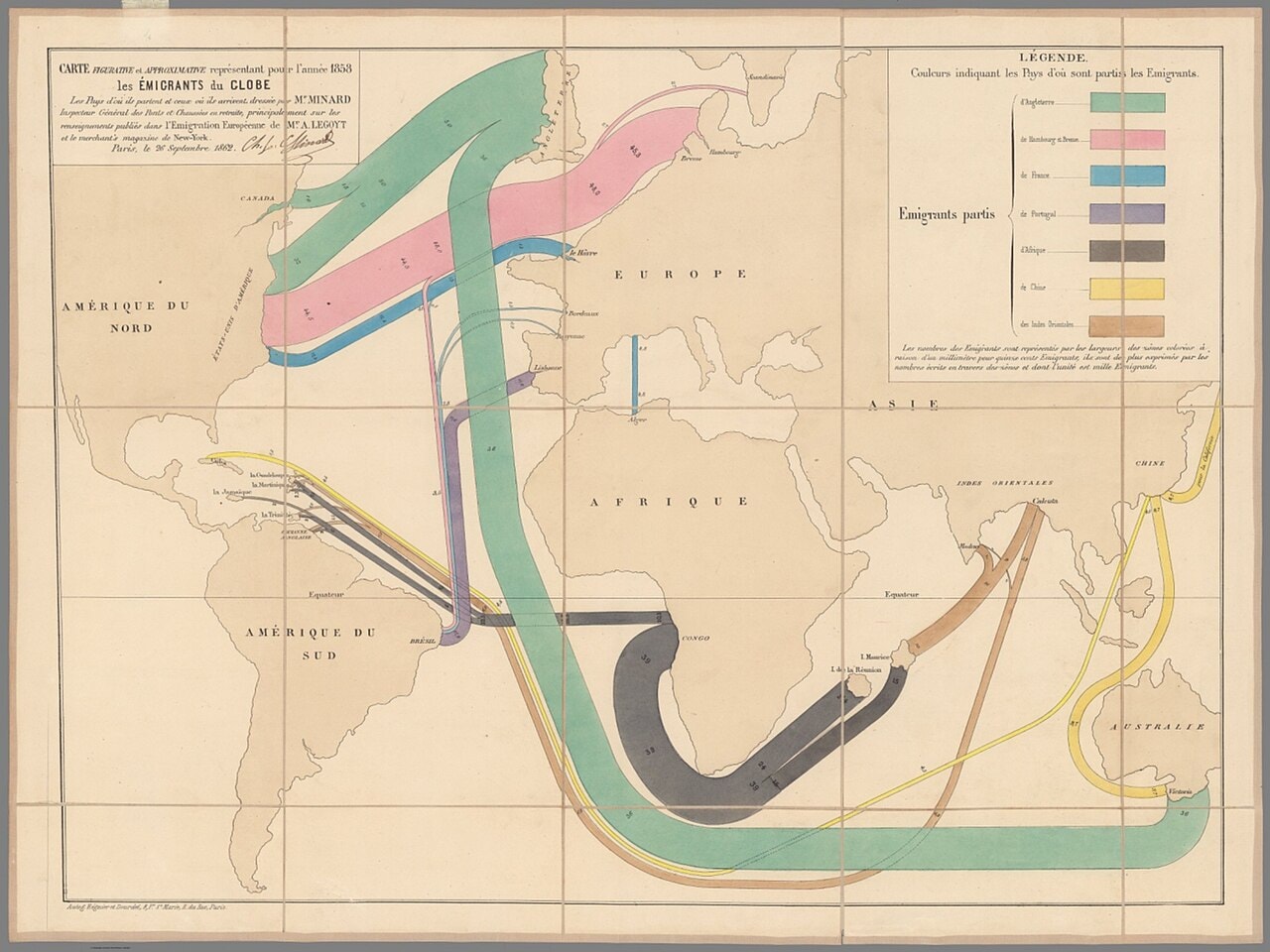
When Britain abolished slavery in 1833, it replaced enslaved labor with indentured servitude, and Indians were among the first indentured servants sent across the British Empire.
Indians in Africa
- Many Indians went to Mauritius (islands off southeast Africa) and Natal (now part of South Africa) as indentured servants on sugar plantations. Others built railways in Natal and British East Africa.
- Nearly 32,000 indentured Indians worked on railroad construction in Kenya between 1886 and 1901, though only about 7,000 stayed. Indians remain a significant part of these regions' populations today.
- Both Hindus and Muslims emigrated to South Africa. Hindus brought the caste system but soon abandoned it, even as many kept Hindu traditions and home altars to honor deities.
- South Africa's Indian population was divided by class, language, and religion, but united by shared discrimination. That injustice became central to the work of Mohandas Gandhi, who arrived in Pretoria in 1893 to practice law, faced repeated racial discrimination, founded the Natal Indian Congress, and exposed anti-Indian discrimination to the world. In 1914 he returned to India and became a leader of the nationalist movement against British rule.
Indians in Southeast Asia
Between 1834 and 1937, India was the major labor source for the British colonies of Ceylon, Burma, and Malaya. Indentured servitude there was eventually replaced by the kangani system, which recruited entire families to work on tea, coffee, and rubber plantations. Kangani workers had less restricted lives than indentured laborers and kept their families with them. About 6 million Indians migrated to Southeast Asia before the system was abolished, and because the region was close to India, workers often kept strong ties home. Indian traders also followed, settling wherever indentured laborers went and seeking business opportunities across the British Empire.
Indians in the Caribbean
So many Indians were sent to Caribbean sugar plantations that they are now the largest ethnic group in Guyana and Trinidad and Tobago, and the second largest in Suriname, Jamaica, Grenada, Saint Vincent and the Grenadines, Saint Lucia, Martinique, and Guadeloupe. Indians blended ethnically with migrants from other parts of the world, shaping national cuisines, film, and music. Many Indians in Trinidad and Tobago practiced Hinduism and contributed to Caribbean musical traditions, and many countries celebrate Indian arrival with annual holidays or festivals.
Irish in North America and Italians in Argentina
Irish enclaves
- Before the American Revolution, most Irish arrivals were Scots-Irish (Protestant descendants of Scots who had migrated to Ireland), and most came as indentured servants.
- By the 1830s, most new Irish immigrants were poorer and Catholic. City dwellers worked in factories, many men helped build the US canal system, and many farmed in both the US and Canada.
- Half of the 3 million Irish who fled the Great Famine came to North America, where they faced anti-immigrant nativist and anti-Catholic hostility. Immigration stayed strong until the 1880s, then slowed.
- Later waves included many single women seeking work and husbands; more than half became domestic servants. Men in this period were mostly unskilled laborers.
- Irish cultural impact: dance music, St. Patrick's Day, the spread of Catholicism, and strong support for labor unions. Second-generation Irish often held white-collar or skilled blue-collar jobs, and some became stars of the new popular culture as boxers, baseball players, and vaudeville performers. Families like the Fitzgeralds and Kennedys became wealthy and powerful.
Italians in Argentina
Only the United States attracted more immigrants than Argentina during the 18th and 19th centuries. The 1853 Argentine Constitution actively encouraged European immigration and guaranteed foreigners the same civil rights as citizens.
Italians made up almost half of European immigrants to Argentina in the late 19th and early 20th centuries, and today more than 55 percent of Argentines have Italian ancestry. The draw was economic: agricultural wages were five to ten times higher than in Italy, fertile land was abundant, and the cost of living (even in Buenos Aires) was lower than in many rural Italian provinces. By 1909, Italian immigrants owned nearly 40 percent of Buenos Aires' commercial establishments. Argentine Spanish absorbed many Italian words, and Italian was widely spoken in Buenos Aires.
Prejudice and Regulation of Immigration
Receiving societies didn't always welcome migrants. In the US and Australia, native-born workers resented Chinese immigrants who would work for lower wages, and governments turned that resentment into law.
Regulation in the United States
California's revised 1879 constitution, pushed by nativists, prohibited the state and public works from hiring Chinese workers, blocked Chinese (and anyone not considered white) from citizenship, and encouraged towns to remove or segregate Chinese residents.
In 1882 Congress passed the Chinese Exclusion Act, the first major US federal law to suspend immigration of a specific ethnic group. Initially a ten-year ban, it was extended repeatedly, made permanent in 1902, and finally repealed in 1943.
After exclusion, some Chinese moved to Mexico, where President Porfirio Díaz promoted immigration and development, especially near the US border. Most worked as truck farmers, shopkeepers, or manufacturers rather than mine or railroad laborers.
White Australia
- The Chinese population in Australia grew to around 50,000 during the gold rushes of the 1850s-60s. Victoria's Chinese Immigration Act (1855) limited how many Chinese could land per ship; many sidestepped it by landing in South Australia.
- White miners in New South Wales attacked Chinese miners starting in December 1860, killing several. One of the worst attacks came on June 30, 1861, when several thousand white miners plundered Chinese dwellings.
- New South Wales responded with the Chinese Immigration Regulation and Restriction Act (November 1861, repealed 1867), then the Influx of Chinese Restriction Act (1881), which used an entrance tax to limit Chinese immigration.
- After the gold rushes, Chinese Australians turned to gardening, trade, furniture making, fishing, and pearl diving. Chinatowns developed in cities, with the biggest economic contributions in the Northern Territory and north Queensland. Anti-Chinese leagues formed as resentment over lower wages grew.
- When six British self-governing colonies united in 1901, the new parliament moved to limit non-British immigration. The attorney general declared the goal of preserving a "white Australia." The White Australia Policy stayed in effect until the mid-1970s.
Key Terms to Know
| Term | Why it matters |
|---|---|
| Ethnic enclaves | Neighborhoods of people from the same home country that preserved language, food, and culture while influencing the new society. |
| Remittances | Money migrants sent home, which shifted women's work and family decision-making and sometimes funded children's schooling. |
| Mohandas Gandhi | Indian lawyer who became an activist against discrimination in South Africa, then led the nationalist movement against British rule in India after 1914. |
| Natal Indian Congress | Organization Gandhi founded to expose and fight discrimination against Indians in South Africa. |
| Kangani system | Replaced indentured servitude in Ceylon, Burma, and Malaya by recruiting entire families to plantations, with less restricted lives. |
| Chinese Exclusion Act | 1882 US law banning Chinese immigration, the first federal law targeting a specific ethnic group; permanent in 1902, repealed in 1943. |
| Chinese Immigration Act | 1855 Victoria (Australia) law limiting Chinese arrivals per ship during the gold rushes. |
| Chinese Immigration Regulation and Restriction Act | 1861 New South Wales law restricting Chinese immigration after violent attacks on Chinese miners; repealed 1867. |
| Influx of Chinese Restriction Act | 1881 New South Wales law using an entrance tax to limit Chinese immigration. |
| White Australia Policy | Post-1901 policy to limit non-British immigration and preserve a "white Australia"; lasted until the mid-1970s. |
| Mauritius | Islands off southeast Africa where Indian indentured servants worked sugar plantations. |
| Natal | South African colony that received Indian indentured laborers and railway workers; site of Gandhi's activism. |
| Trinidad and Tobago | Caribbean nation where Indians became the largest ethnic group, bringing Hinduism and shaping musical traditions. |
| Guyana | Caribbean-region nation where Indians are now the largest ethnic group due to plantation labor migration. |
| Porfirio Díaz | Mexican president who promoted immigration and development, drawing Chinese migrants after US exclusion. |
| Scots-Irish | Protestant descendants of Scots in Ireland who migrated to North America before the American Revolution, mostly as indentured servants. |
| Chinatowns | Chinese enclaves in cities across Australia and the Americas that anchored Chinese economic and cultural life. |
| Gold rush | Mining booms in California and Australia that pulled in Chinese migrants and sparked nativist backlash. |
Practice and Next Steps
Pair these notes with the 6.7 Effects of Migration course study guide, which frames the same content the way the AP exam tests it. Then finish the unit with AMSCO 6.8 Causation in the Imperial Age, the unit's wrap-up review.
To check yourself, run Unit 6 questions in guided practice and quiz vocab with the AP World key terms glossary. All the Unit 6 chapter notes live on the AMSCO notes hub.
Frequently Asked Questions
What is an ethnic enclave in AP World History?
An ethnic enclave is a neighborhood or cluster of migrants from the same home country who keep their language, food, religion, and way of life in a new society. Key examples from 1750-1900 include Chinatowns in the Americas and Australia, Indian communities in the Caribbean and East Africa, Irish enclaves in North America, and Italians in Argentina. Enclaves cut both ways: they preserved home culture and also influenced the receiving society's cuisine, music, and traditions.
What was the Chinese Exclusion Act and why does it matter for AP World?
The Chinese Exclusion Act of 1882 was the first major US federal law to suspend immigration of a specific ethnic group. Originally a ten-year ban, it was made permanent in 1902 and not repealed until 1943. It's the go-to AP World example of how receiving societies used racial prejudice and state regulation to control migration.
How did migration change gender roles in home societies from 1750 to 1900?
Because most migrants were male, women left behind often took on roles formerly filled by men, like managing finances and household decisions. Remittances sent home gave many women real spending power, and in some places correlated with girls staying in school longer. Effects varied: where male relatives took over support, women's roles stayed traditional.
What was the kangani system and how was it different from indentured servitude?
The kangani system recruited entire Indian families to work on tea, coffee, and rubber plantations in Ceylon, Burma, and Malaya, replacing indentured servitude there. Workers had less restricted lives than indentured laborers and kept their families with them. About 6 million Indians migrated to Southeast Asia before it was abolished.
What examples should I use for effects of migration on the AP World exam?
Strong examples include Chinese enclaves in Southeast Asia, Cuba, Peru, and the US; Indian indentured laborers in Mauritius, Natal, Kenya, and the Caribbean; Irish in North America; and Italians in Argentina. For state regulation and prejudice, use the Chinese Exclusion Act and the White Australia Policy. Practice applying them with Fiveable's AP World guided practice.
See Fiveable more often in Google
Mark Fiveable as a preferred source and Google is more likely to show you our guides in Top Stories, with a "preferred" badge in AI Mode and AI Overviews.