AMSCO 8.2 The Cold War Notes

🌍AP World History: Modern Review
AMSCO 8.2 The Cold War Notes
🌍 AP World History: Modern
AMSCO 1.1 Developments in East Asia Notes
AMSCO 1.2 Developments in Dar al-Islam Notes
AMSCO 1.3 Developments in South and Southeast Asia Notes
AMSCO 1.4 Developments in the Americas Notes
AMSCO 1.5 Developments in Africa Notes
AMSCO 1.6 Developments in Europe Notes
AMSCO 1.7 Comparison in the Period from c.1200 to c.1450 Notes
AMSCO 2.1 The Silk Roads Notes
AMSCO 2.2 The Mongol Empire and the Modern World Notes
AMSCO 2.3 Exchange in the Indian Ocean Notes
AMSCO 2.4 Trans-Saharan Trade Routes Notes
AMSCO 2.5 Cultural Consequences of Connectivity Notes
AMSCO 2.6 Environmental Consequences of Connectivity Notes
AMSCO 2.7 Comparison of Economic Exchange Notes
AMSCO 3.1 European, East Asian, and Gunpowder Empires Expand Notes
AMSCO 3.2 Empires: Administrations Notes
AMSCO 3.3 Empires: Belief Systems Notes
AMSCO 3.4 Comparison in Land-Based Empires Notes
AMSCO 4.1 Technological Innovations Notes
AMSCO 4.2 Exploration: Causes and Events Notes
AMSCO 4.3 Columbian Exchange Notes
AMSCO 4.4 Maritime Empires Link Regions Notes
AMSCO 4.5 Maritime Empires Develop Notes
AMSCO 4.6 Internal and External Challenges to State Power Notes
AMSCO 4.7 Changing Social Hierarchies Notes
AMSCO 4.8 Continuity and Change from c.1450 to c.1750 Notes
AMSCO 5.1 The Enlightment Notes
AMSCO 5.2 Nationalism and Revolutions Notes
AMSCO 5.3 Industrial Revolution Begins Notes
AMSCO 5.4 Industrialization Spreads Notes
AMSCO 5.5 Technology in the Industrial Age Notes
AMSCO 5.6 Industrialization: Government's Role Notes
AMSCO 5.7 Economic Developments and Innovations Notes
AMSCO 5.8 Reactions to the Industrial Economy Notes
AMSCO 5.9 Society and the Industrial Age Notes
AMSCO 5.10 Continuity and Change in the Industrial Age Notes
AMSCO 6.1 Rationales for Imperialism Notes
AMSCO 6.2 State Expansion Notes
AMSCO 6.3 Indigenous Responses to State Expansion Notes
AMSCO 6.4 Global Economic Development Notes
AMSCO 6.5 Economic Imperialism Notes
AMSCO 6.6 Causes of Migration in an Interconnected World Notes
AMSCO 6.7 Effects of Migration Notes
AMSCO 6.8 Causation in the Imperial Age Notes
AMSCO 7.1 Shifting Power Notes
AMSCO 7.2 Causes of World War I Notes
AMSCO 7.3 Conducting World War I Notes
AMSCO 7.4 Economy in the Interwar Period Notes
AMSCO 7.5 Unresolved Tensions After World War I Notes
AMSCO 7.6 Causes of World War II Notes
AMSCO 7.7 Conducting World War II Notes
AMSCO 7.8 Mass Atrocities Notes
AMSCO 7.9 Causation in Global Conflict Notes
AMSCO 8.1 Setting the Stage for the Cold War and Decolonization Notes
AMSCO 8.2 The Cold War Notes
AMSCO 8.3 Effects of the Cold War Notes
AMSCO 8.4 Spread of Communism Notes
AMSCO 8.5 Decolonization after 1900 Notes
AMSCO 8.6 Newly Independent States Notes
AMSCO 8.7 Global Resistance to Established Power Structure Notes
AMSCO 8.8 End of the Cold War Notes
AMSCO 8.9 Causation in the Age of the Cold Ward and Decolonization Notes
AMSCO 9.1 Advances in Technology and Exchange Notes
AMSCO 9.2 Technological Advancements and Limitations Notes
AMSCO 9.3 Technology and the Environment Notes
AMSCO 9.4 Economics in the Global Age Notes
AMSCO 9.5 Calls for Reforms and Responses Notes
AMSCO 9.6 Globalized Culture Notes
AMSCO 9.7 Resistance to Globalization Notes
AMSCO 9.8 Institutions Developing in a Globalized World Notes
AMSCO 9.9 Continuity and Change in a Globalized World Notes
Overview
AMSCO Topic 8.2, "The Cold War" (AMSCO p. 554-558), covers how the United States and the Soviet Union emerged from World War II as rival superpowers locked in an ideological struggle between capitalism and communism. The chapter explains the founding of the United Nations, the economic and political differences between the two systems, U.S. policies like containment, the Truman Doctrine, and the Marshall Plan, the Space Race and arms race, and the Non-Aligned Movement of new African and Asian nations. It sits at the start of Unit 8 (1900 to the present), setting up the conflicts that shape the rest of the unit. For background on how WWII created this rivalry, check the AMSCO 8.1 notes on setting the stage for the Cold War.
The chapter opens with a 1947 quote from banker and presidential advisor Bernard Baruch: "we are today in the midst of a cold war." After the Potsdam Conference in Germany in 1945, Truman and Stalin recognized their rivalry for dominance over Europe and Asia. That power struggle between capitalism (led by the U.S.) and communism (led by the USSR) became the central global conflict of the next 40 years.
Key Takeaways
- The United Nations was established in 1945 as a peace organization meant to address the League of Nations' failures.
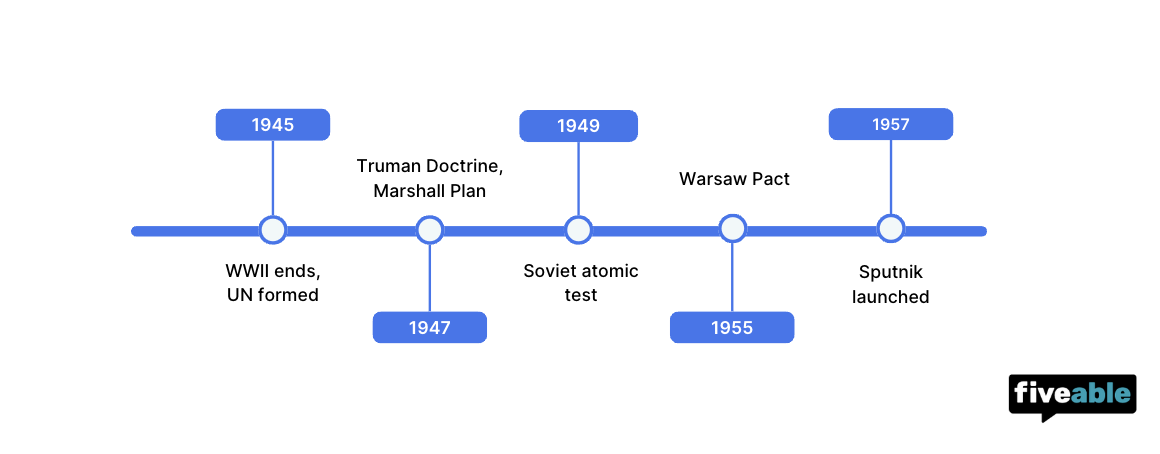
- The Iron Curtain described Europe's split between communist East and capitalist West, while Soviet satellite countries were forced to trade only with the USSR.
- George Kennan urged containment of communism, and the Truman Doctrine promised U.S. economic and military support to Greece and Turkey against communist influence.
- The Marshall Plan offered $12 billion to rebuild Europe; the Soviet Union and its satellites refused the aid and created COMECON for Eastern Europe instead.
- Sputnik's launch began the Space Race, while mutual assured destruction meant neither superpower could win a nuclear war.
- Many newly independent African and Asian countries wanted an alternative to superpower rivalry; Bandung delegates condemned colonialism, and the conference led to the Non-Aligned Movement in 1961.
The United Nations: Cooperation Despite Conflict
Even with their ideological differences, the Allies agreed on one thing: the world needed a new peace organization to replace the failed League of Nations.
The League of Nations failed for two main reasons:
- It lacked the support of all the world's powerful countries, especially the United States.
- It had no mechanism to act quickly and stop small conflicts before they escalated into big ones.
In 1943, leaders of the United States, Great Britain, the Soviet Union, and China discussed the idea of the United Nations (UN). The UN was officially established in 1945.
Rivalry in Economics and Politics
The UN didn't stop U.S.-Soviet tensions from getting worse. In March 1946, Winston Churchill gave the speech that came to symbolize the Cold War, declaring that "an iron curtain has descended across the continent" of Europe. The Iron Curtain metaphor described the split between communist Eastern Europe and capitalist Western Europe.
Capitalism vs. Communism
The first big difference was economic, who owns the stuff.
- In the United States, Western Europe, and other capitalist countries, economic assets like farms and factories were mostly privately owned. Private interests made economic decisions, and people had the freedom to act in their own self-interest.
- In the Soviet Union, Eastern Europe, and other communist countries, the government owned economic assets. The system emphasized equality and fairness.
Democracy vs. Authoritarianism
The second difference was political, who picks the leaders.
- In the United States, people chose leaders through free elections, relied on an independent press for accurate information, and watched multiple political parties compete for votes.
- In the Soviet Union, elections didn't matter much, the government ran the press, and a single party dominated politics.
Criticisms and Surprising Similarities
Each side attacked the other's flaws:
- Americans criticized the Soviet system for restricting free speech, free worship, free elections, and efficient business.
- Soviets accused the U.S. of giving poor people the "freedom to starve" and of discriminating against African Americans and other minorities. The USSR also pointed to its emphasis on women's equality as a contrast with the American system.
Some analysts noticed similarities, though. In both countries, big economic decisions were controlled by groups, either the government or millions of corporate shareholders. And both acted out of fear of the other, which made the military a powerful force in each society.
Conflicts in International Affairs
Each superpower wanted to spread its system worldwide, producing a long-running battle for influence over public opinion and government alliances. This expansion of communism continues in the AMSCO 8.4 notes on the spread of communism.
The USSR and Its Satellite Countries
The Soviets remade Eastern Europe in their own image. They directed Bulgaria, East Germany, Hungary, Poland, and Romania to:
- Adopt five-year economic plans focused on industry and collective agriculture at the expense of consumer products
- Outlaw all political parties other than the Communists
These satellite countries (small states economically or politically dependent on a more powerful state) were forced to import only Soviet goods and export only to the Soviet Union. The arrangement let the USSR exploit Eastern Europe for its own benefit, and the satellite governments were just as dictatorial as the Soviet one.
World Revolution
Since the October Revolution of 1917, the Soviet Union viewed capitalism as a threat. The concept of world revolution, the belief that organized workers would overthrow capitalism in every country, drove Soviet support for revolutions and uprisings in Germany, Bavaria, Hungary, northern Italy, and Bulgaria between 1919 and 1923. This interference raised Western suspicions, and after WWII, growing revolutionary feelings seriously threatened Western powers and governments in Central and Southern Europe.
Containment and the Truman Doctrine
U.S. diplomat George Kennan, who worked in the U.S. Embassy in Moscow in the 1930s and in 1946, believed the Soviet Union would keep expanding wherever it could. He pushed a policy of containment: don't let communism spread any farther. Critics said containment just accepted the status quo and argued for a more aggressive "roll back" policy of overthrowing existing communist regimes.
Kennan's reports influenced President Harry Truman. In a 1947 speech, Truman outlined the Truman Doctrine, a pledge that the U.S. would do whatever it took to stop communist influence, specifically in Greece and Turkey:
- The USSR wanted military bases in Turkey to control the Dardanelles, the strait between the Black Sea and the Mediterranean.
- In Greece, left-wing groups controlled by Communists were close to taking over the government.
Truman promised U.S. economic and military support so both countries could resist communist domination.
The Marshall Plan vs. COMECON
The logic behind the Marshall Plan: communist revolutions happen in economically unstable countries, so make Europe prosperous and stable. Enacted in June 1947, the plan offered $12 billion in aid to all European nations, including Germany, to modernize industry, reduce trade barriers, and rebuild damaged infrastructure.
It worked. Economic output in aided countries was 35 percent higher in 1951 than it had been in 1938.
The Soviet Union and its satellites refused to participate. Instead, in 1949 the Soviets created the Council for Mutual Economic Assistance (COMECON) to rebuild Eastern Europe. COMECON was narrower in scope, limited mostly to trade and credit agreements among its six members, and its impact was modest compared to the Marshall Plan.
The Space Race and the Arms Race
The superpower competition extended into space and weapons technology.
Space Race
In 1957, the Soviet Union launched Sputnik, the first artificial satellite to orbit Earth, kicking off the Space Race. The United States launched its first satellite in January 1958. The two nations then raced to put the first crewed satellite in orbit and, later, the first human on the moon.
Mutual Assured Destruction (MAD)
In 1957, the Soviets tested the first intercontinental ballistic missile (ICBM) capable of delivering a nuclear warhead to U.S. territory. The United States tested a similar missile soon after.
Both sides realized they had reached mutual assured destruction: no matter who started a nuclear war, both countries would be obliterated by the end of it. Since neither side could win, neither had an incentive to start one. As long as both kept improving their technology, this "balance of terror" would keep the peace. Everyone hoped, anyway.
The Non-Aligned Movement
Many newly independent African and Asian countries wanted out of the U.S.-Soviet rivalry entirely. They wanted an alternative international economic, political, and social order not dominated by the two superpowers.
In 1955, Indonesia hosted the Bandung Conference (named for the host city). Delegates from China, India, and 27 other countries, representing more than half the world's population, passed resolutions condemning colonialism. The momentum from Bandung led to the formal organization of the Non-Aligned Movement in 1961.
Non-aligned countries faced two big challenges:
- Balancing international institutions with national interests. India's Jawaharlal Nehru supported a stronger UN but opposed its intervention in the India-Pakistan conflict over Kashmir.
- Drifting toward one superpower anyway. When war broke out between Somalia and Ethiopia in 1977, the Soviet Union aided Ethiopia, prompting the United States to aid Somalia.
Key Non-Aligned Leaders
- Jawaharlal Nehru (India) served as prime minister from 1947 to 1964 and was one of the most important leaders at Bandung.
- Kwame Nkrumah (Ghana) led Ghana to independence from Great Britain in 1957 and advocated African unity through the Organization of African Unity.
- Gamal Abdel Nasser (Egypt) served three terms as president between 1954 and 1970, helped negotiate compromises at Bandung, and supported the Pan-Arab movement.
- Sukarno (Indonesia) became Indonesia's first president in 1945, organized and hosted the Bandung Conference, and criticized both superpowers while accepting large amounts of aid from each.
Key Terms to Know
| Term | Why it matters |
|---|---|
| United Nations (UN) | Peace organization established in 1945 to fix the League of Nations' failures: missing great powers and no fast-action mechanism. |
| Iron Curtain | Churchill's 1946 metaphor for the split between communist Eastern Europe and capitalist Western Europe. |
| Satellite countries | Eastern European states (like Poland and Hungary) economically and politically dependent on the USSR and forced to trade only with it. |
| World revolution | Soviet belief that organized workers would overthrow capitalism in every country, which fueled Western suspicion. |
| Containment | George Kennan's policy of stopping communism from spreading farther rather than rolling it back. |
| Truman Doctrine | Truman's 1947 pledge of U.S. economic and military aid to stop communism, first applied in Greece and Turkey. |
| Marshall Plan | 1947 U.S. program offering $12 billion to rebuild Europe; output in aided countries was 35% higher in 1951 than 1938. |
| Council for Mutual Economic Assistance (COMECON) | The Soviets' 1949 answer to the Marshall Plan for Eastern Europe; mostly trade and credit deals, with modest impact. |
| Sputnik | First artificial satellite, launched by the USSR in 1957, which started the Space Race. |
| Mutual assured destruction (MAD) | The standoff after both sides built ICBMs in the late 1950s: any nuclear war destroys both, so neither starts one. |
| Bandung Conference | 1955 meeting in Indonesia where delegates from 29 countries condemned colonialism; led to the Non-Aligned Movement. |
| Non-Aligned Movement | Formal 1961 organization of nations (led by figures like Nehru, Nkrumah, Nasser, and Sukarno) seeking independence from both superpowers. |
Practice and Next Steps
Pair these notes with the Topic 8.2 The Cold War study guide for the course-aligned version of this material, then continue with the AMSCO 8.3 notes on effects of the Cold War. You can browse every chapter on the AP World AMSCO notes page.
To check yourself, run through AP World guided practice questions on Unit 8, drill definitions in the key terms glossary, or try FRQ practice with instant scoring using Cold War evidence like containment, the Marshall Plan, and the Non-Aligned Movement.
Frequently Asked Questions
What is AMSCO Topic 8.2 in AP World about?
AMSCO Topic 8.2 (p. 554-558) covers the Cold War: the ideological struggle between the capitalist United States and the communist Soviet Union after World War II. It includes the founding of the UN, containment, the Truman Doctrine, the Marshall Plan, the Space Race, mutual assured destruction, and the Non-Aligned Movement.
What was the difference between the Truman Doctrine and the Marshall Plan?
The Truman Doctrine (1947) was a pledge of U.S. economic and military aid to countries resisting communism, applied first to Greece and Turkey. The Marshall Plan (June 1947) was an economic program offering $12 billion to rebuild all of Europe, based on the idea that communist revolutions take hold in economically unstable nations. Both put containment into action, but one was a political commitment and the other was a rebuilding fund.
What was the Non-Aligned Movement and who led it?
The Non-Aligned Movement, formally organized in 1961, was a group of newly independent African and Asian nations that refused to side with either superpower during the Cold War. It grew out of the 1955 Bandung Conference in Indonesia, where 29 countries condemned colonialism. Key leaders included Nehru (India), Nkrumah (Ghana), Nasser (Egypt), and Sukarno (Indonesia).
Were the US and USSR actually that different during the Cold War?
They were ideological opposites (private vs. government ownership, free elections vs. one-party rule), but the AMSCO chapter notes some surprising similarities. In both countries, big economic decisions were controlled by groups, either the government or millions of corporate shareholders, and both built powerful militaries out of fear of the other. The Soviets also pointed to U.S. flaws like poverty and discrimination against minorities as counterattacks.
How does the Cold War show up on the AP World exam?
Topic 8.2 asks you to explain the causes and effects of the Cold War's ideological struggle, so expect questions on how capitalism vs. communism shaped policies like containment and the Marshall Plan, plus alternatives like the Non-Aligned Movement (Sukarno and Nkrumah are go-to examples). Cold War content is strong evidence for Unit 8 essays. Practice applying it with FRQ practice and instant scoring.
See Fiveable more often in Google
Mark Fiveable as a preferred source and Google is more likely to show you our guides in Top Stories, with a "preferred" badge in AI Mode and AI Overviews.