AMSCO 8.1 Setting the Stage for the Cold War and Decolonization Notes

🌍AP World History: Modern Review
AMSCO 8.1 Setting the Stage for the Cold War and Decolonization Notes
🌍 AP World History: Modern
AMSCO 1.1 Developments in East Asia Notes
AMSCO 1.2 Developments in Dar al-Islam Notes
AMSCO 1.3 Developments in South and Southeast Asia Notes
AMSCO 1.4 Developments in the Americas Notes
AMSCO 1.5 Developments in Africa Notes
AMSCO 1.6 Developments in Europe Notes
AMSCO 1.7 Comparison in the Period from c.1200 to c.1450 Notes
AMSCO 2.1 The Silk Roads Notes
AMSCO 2.2 The Mongol Empire and the Modern World Notes
AMSCO 2.3 Exchange in the Indian Ocean Notes
AMSCO 2.4 Trans-Saharan Trade Routes Notes
AMSCO 2.5 Cultural Consequences of Connectivity Notes
AMSCO 2.6 Environmental Consequences of Connectivity Notes
AMSCO 2.7 Comparison of Economic Exchange Notes
AMSCO 3.1 European, East Asian, and Gunpowder Empires Expand Notes
AMSCO 3.2 Empires: Administrations Notes
AMSCO 3.3 Empires: Belief Systems Notes
AMSCO 3.4 Comparison in Land-Based Empires Notes
AMSCO 4.1 Technological Innovations Notes
AMSCO 4.2 Exploration: Causes and Events Notes
AMSCO 4.3 Columbian Exchange Notes
AMSCO 4.4 Maritime Empires Link Regions Notes
AMSCO 4.5 Maritime Empires Develop Notes
AMSCO 4.6 Internal and External Challenges to State Power Notes
AMSCO 4.7 Changing Social Hierarchies Notes
AMSCO 4.8 Continuity and Change from c.1450 to c.1750 Notes
AMSCO 5.1 The Enlightment Notes
AMSCO 5.2 Nationalism and Revolutions Notes
AMSCO 5.3 Industrial Revolution Begins Notes
AMSCO 5.4 Industrialization Spreads Notes
AMSCO 5.5 Technology in the Industrial Age Notes
AMSCO 5.6 Industrialization: Government's Role Notes
AMSCO 5.7 Economic Developments and Innovations Notes
AMSCO 5.8 Reactions to the Industrial Economy Notes
AMSCO 5.9 Society and the Industrial Age Notes
AMSCO 5.10 Continuity and Change in the Industrial Age Notes
AMSCO 6.1 Rationales for Imperialism Notes
AMSCO 6.2 State Expansion Notes
AMSCO 6.3 Indigenous Responses to State Expansion Notes
AMSCO 6.4 Global Economic Development Notes
AMSCO 6.5 Economic Imperialism Notes
AMSCO 6.6 Causes of Migration in an Interconnected World Notes
AMSCO 6.7 Effects of Migration Notes
AMSCO 6.8 Causation in the Imperial Age Notes
AMSCO 7.1 Shifting Power Notes
AMSCO 7.2 Causes of World War I Notes
AMSCO 7.3 Conducting World War I Notes
AMSCO 7.4 Economy in the Interwar Period Notes
AMSCO 7.5 Unresolved Tensions After World War I Notes
AMSCO 7.6 Causes of World War II Notes
AMSCO 7.7 Conducting World War II Notes
AMSCO 7.8 Mass Atrocities Notes
AMSCO 7.9 Causation in Global Conflict Notes
AMSCO 8.1 Setting the Stage for the Cold War and Decolonization Notes
AMSCO 8.2 The Cold War Notes
AMSCO 8.3 Effects of the Cold War Notes
AMSCO 8.4 Spread of Communism Notes
AMSCO 8.5 Decolonization after 1900 Notes
AMSCO 8.6 Newly Independent States Notes
AMSCO 8.7 Global Resistance to Established Power Structure Notes
AMSCO 8.8 End of the Cold War Notes
AMSCO 8.9 Causation in the Age of the Cold Ward and Decolonization Notes
AMSCO 9.1 Advances in Technology and Exchange Notes
AMSCO 9.2 Technological Advancements and Limitations Notes
AMSCO 9.3 Technology and the Environment Notes
AMSCO 9.4 Economics in the Global Age Notes
AMSCO 9.5 Calls for Reforms and Responses Notes
AMSCO 9.6 Globalized Culture Notes
AMSCO 9.7 Resistance to Globalization Notes
AMSCO 9.8 Institutions Developing in a Globalized World Notes
AMSCO 9.9 Continuity and Change in a Globalized World Notes
Overview
AMSCO Topic 8.1, Setting the Stage for the Cold War and Decolonization (AMSCO p. 547-550), explains how World War II's end created two huge developments at once: the Cold War rivalry between the United States and the Soviet Union, and the collapse of European colonial empires. The chapter covers the three Big Three wartime conferences (Tehran, Yalta, Potsdam), the shift in global power toward the two superpowers, the nature of the early Cold War, and why colonial empires were suddenly vulnerable after 1945. It opens Unit 8 (1900 to present) and sets up everything that follows, from the Marshall Plan to independence movements in Asia and Africa.
The chapter starts with a quote from Lal Bahadur Shastri, an Indian independence leader, who called ending colonialism a "moral duty." That anti-imperialist sentiment, mostly frustrated after World War I, finally got traction after 1945.
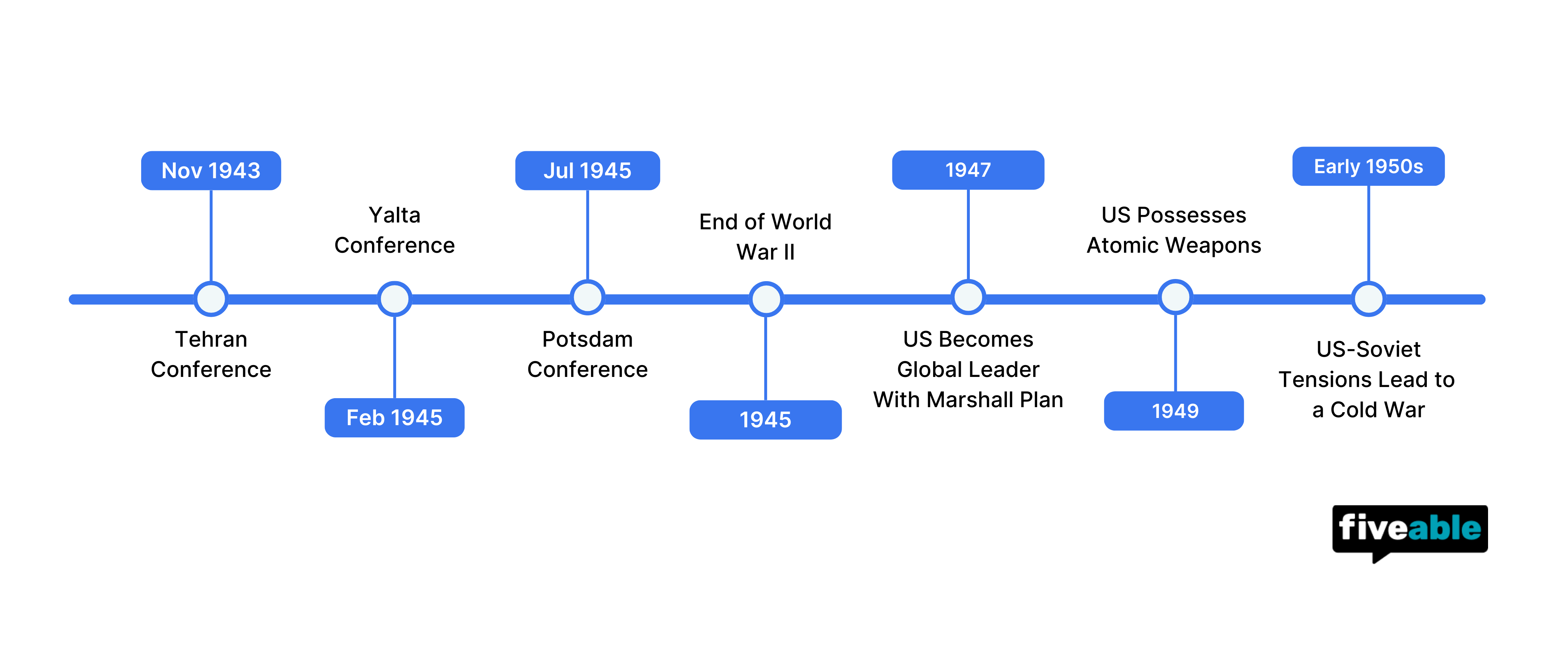
Timeline of events preceding the Cold War and decolonization. Image courtesy of Riya.
Key Takeaways
- At Tehran, the Allies divided Europe's liberation; at Yalta, Soviet assurances about free elections were vague; at Potsdam, Stalin refused Truman's demand for those elections.
- World War II devastated Europe and Asia, and Europe lost global influence as the United States and Soviet Union emerged as the two superpowers.
- The U.S. and USSR avoided direct war, but they armed opposing sides in conflicts elsewhere, making those conflicts larger and bloodier.
- The arms race produced hydrogen bombs in both superpowers, while Eisenhower warned that close ties between the military and defense contractors could give the military-industrial complex too much power.
- Self-determination spread after World War I, but European colonial rule largely continued; after World War II, stronger independence movements, weakened colonial powers, and potential superpower support set the stage for decolonization.
Bringing the War to an End: The Big Three Conferences
The Big Three (the leaders of Great Britain, the United States, and the Soviet Union) met several times during World War II to plan the post-war world. Three conferences matter most, and the pattern across them is rising distrust.
Tehran Conference (November 1943)
- Held in Iran while the war was still going.
- The Allies divided up the job of liberating Europe: the Soviet Union would focus on freeing Eastern Europe, while Britain and the U.S. concentrated on Western Europe. (Remember this; it explains why Soviet troops ended up occupying Eastern Europe.)
- Britain and the U.S. agreed to shift some Polish territory to the Soviet Union, with Poland compensated with land elsewhere, mostly from Germany.
Yalta Conference (February 1945)
- Held at a Black Sea resort with Germany near defeat. The big question: what happens after surrender?
- Roosevelt wanted free, democratic elections in Eastern Europe and Soviet help in the war against Japan.
- Stalin wanted Eastern Europe as a buffer zone. After Napoleon and Hitler both invaded Russia from the west, he wanted friendly territory between the USSR and Western Europe. In exchange for fighting Japan, he also wanted Japanese-claimed islands, Chinese-ruled ports, and part ownership of a Manchurian railroad.
- Result: the Soviets pledged to fight Japan but gave only vague assurances about free elections. Roosevelt figured Americans wouldn't support another war, this time against the Soviets, over democracy in Eastern Europe.
Potsdam Conference (July 1945)
- Held in Germany, with new faces. Harry Truman replaced Roosevelt (who died April 12, 1945), and Clement Atlee replaced Churchill as British prime minister mid-conference.
- Truman insisted on free elections in Eastern Europe. Stalin refused, and by then Soviet troops already occupied the region, so Truman had no real leverage.
- With Soviet backing, communists eventually took control of East Germany, Poland, Czechoslovakia, Hungary, Bulgaria, and Romania.
By 1945, the U.S. and USSR didn't trust each other, and the aggressive rhetoric that would define the next four decades had begun. The conferences failed to settle the big issues, so a cold war followed the hot one.
Shifting Balance of Power
World War II devastated Europe and Asia, and that destruction is exactly why the United States and the Soviet Union emerged as the world's two superpowers.
Destruction in Europe
- The war caused 40 to 60 million deaths and destroyed factories, roads, and bridges needed for industrial production. Millions of people were displaced, many fleeing communism or seeking safety.
- Losses were uneven. East and Central Europe suffered worse than Western Europe. The Soviet Union, Poland, and Germany were hit hardest, each losing 10 to 20 percent of its population.
- Britain and France kept strong democratic traditions, rule of law, good universities, and large innovative corporations, which let Western Europe rebuild into a global economic leader. But Europe as a whole lost influence in the world.
Why the U.S. Came Out on Top
- The U.S. mainland was untouched (heavy fighting on U.S. soil happened only in the Philippines), and American loss of life was far lower than Europe's.
- The U.S. industrial base actually grew stronger during the war thanks to government-funded military contracts.
- That prosperity let the U.S. fund post-war aid to Europe through the Marshall Plan (covered in AMSCO 8.2).
- The U.S. had developed and used atomic weapons. The Soviets tested their own atomic bomb in 1949. By the end of the 1940s, only the USSR could challenge the U.S. in military might and political influence.
Wartime Technological Advances
Government-funded military research at universities and private companies produced technologies later adapted for civilian life: pressurized airplane cabins, food refrigeration, stronger plywood, new plastics, and most importantly the widespread use of penicillin, which saved thousands of wounded soldiers and then millions of civilians. This is the "technological and economic gains shifted the global balance of power" idea the AP exam loves.
The Start of the Cold War
A cold war is a conflict that does not involve direct military confrontation between rival states. Both superpowers had just paid an enormous price for a hot war, so neither wanted to fight the other directly. Instead, the rivalry played out through:
- Propaganda campaigns
- Secret operations
- An arms race
Where the Cold War Actually Got Deadly
The deadliest results of the Cold War happened outside the superpowers' own territory. The U.S. and USSR armed opposing sides in conflicts around the world, turning small civil wars and regional conflicts into much larger, bloodier events. Keep this in mind for the effects of the Cold War in 8.3.
The Arms Race and the Military-Industrial Complex
- In the early 1950s, both superpowers developed the hydrogen bomb, far more powerful than the atomic bombs dropped on Japan.
- The arms race built close ties between the military and weapons manufacturers. Before leaving office in 1961, President Dwight Eisenhower warned against letting the military-industrial complex (the informal alliance between government and large defense contractors) gain too much power.
- In later decades, citizens in many countries echoed his worries and protested nuclear stockpiling.
Breakdown of Empires
After World War II, colonial empires were finally positioned to fall apart. The start of World War I had actually been the high point of colonial empires: Britain, France, and other Europeans controlled almost all of Africa, India, and Southeast Asia, and dominated China.
What Happened After World War I
- Self-determination, the idea that each country should choose its own form of government and leaders, spread after WWI.
- The multiethnic Austro-Hungarian and Ottoman Empires crumbled into multiple new countries. Each had been dominated by one group, leaving others feeling discriminated against.
- But in China, India, and across Africa, Europeans kept their power and even expanded it over former Ottoman territories. Hopes for self-government went largely unfulfilled.
Why Decolonization Took Off After World War II
During WWII, colonial powers were focused on stopping Hitler, so anti-colonial movements grew stronger but independence made little actual progress. After 1945, three factors set the foundation for dismantling empires:
- Movements for self-determination grew in the colonized world, including both advocates of greater self-rule and proponents of full independence.
- World War II so weakened Britain, France, and the other colonial powers that they had fewer resources to resist independence.
- The Cold War gave anti-colonial activists two superpowers to recruit as supporters.
The actual independence movements are covered in AMSCO 8.5 on decolonization and 8.6 on newly independent states.
Key Terms to Know
| Term | Why it matters |
|---|---|
| Big Three | The wartime leaders of Britain, the U.S., and the Soviet Union who met to plan the post-war world. |
| Tehran Conference | November 1943 meeting where the Allies divided Europe's liberation: Soviets in the East, Britain and the U.S. in the West. |
| Yalta Conference | February 1945 meeting where Stalin pledged to fight Japan but gave only vague promises about free elections in Eastern Europe. |
| Potsdam Conference | July 1945 meeting where Stalin rejected Truman's demand for free elections, since Soviet troops already occupied Eastern Europe. |
| Harry Truman | Became U.S. president after Roosevelt's death in April 1945 and represented the U.S. at Potsdam. |
| Cold War | A conflict between rival states that avoids direct military confrontation, fought instead through propaganda, secret operations, and an arms race. |
| Buffer zone | Stalin's goal for Eastern Europe, a layer of friendly territory protecting the USSR from another western invasion. |
| Self-determination | The idea that each country should choose its own form of government and leaders, the driving idea behind decolonization. |
| Hydrogen bomb | Developed by both superpowers in the early 1950s, far more powerful than the atomic bombs dropped on Japan. |
| Military-industrial complex | The informal alliance between government and large defense contractors that Eisenhower warned against in 1961. |
| Dwight Eisenhower | U.S. president who warned in 1961 that the military-industrial complex could gain too much power. |
| Marshall Plan | The U.S. financial aid program for post-war Europe, made possible by American prosperity (detailed in Topic 8.2). |
| Penicillin | The wartime medical advance that saved thousands of soldiers and then improved millions of civilian lives. |
| Anti-imperialism | Opposition to colonial rule, voiced by leaders like Lal Bahadur Shastri, that surged after 1945. |
Practice and Next Steps
Pair these notes with the Fiveable Topic 8.1 course study guide for the College Board framing, then keep moving through the unit with AMSCO 8.2 on the Cold War. All the chapter notes for this unit live on the AP World AMSCO notes page.
To check yourself, run a quick set of AP World practice questions on Unit 8, or try writing about Cold War causation with FRQ practice and instant scoring. Topic 8.1 is heavy on contextualization, so it shows up constantly as the setup for essay prompts about the Cold War and decolonization.
Frequently Asked Questions
What were the three Big Three conferences in AMSCO 8.1?
Tehran (November 1943), Yalta (February 1945), and Potsdam (July 1945). At Tehran the Allies split Europe's liberation between the Soviets in the East and Britain/the U.S. in the West; at Yalta Stalin pledged to fight Japan but gave vague promises on free elections; at Potsdam Stalin refused Truman's demand for free elections in Eastern Europe, since Soviet troops already occupied the region.
What is a cold war, and why didn't the US and USSR fight directly?
A cold war is a conflict between rival states that avoids direct military confrontation. Both superpowers had just paid enormous costs in World War II, so neither wanted another full-scale war. Instead they competed through propaganda, secret operations, and an arms race, and the deadliest fighting happened in smaller conflicts around the world where each side armed opposing groups.
Why did the United States and Soviet Union become superpowers after World War II?
Europe was devastated (40-60 million deaths, with the Soviet Union, Poland, and Germany each losing 10-20% of their populations), while the U.S. mainland was untouched and its industrial base actually grew through wartime military contracts. The U.S. also had atomic weapons, and after the Soviets tested their own bomb in 1949, only the USSR could match American military and political power.
Why did decolonization happen after World War II and not after World War I?
After WWI, self-determination spread but Europeans kept (and even expanded) their colonies in Africa, India, and China, so hopes for self-government went unfulfilled. After WWII, three things changed: independence movements had grown stronger, Britain and France were too weakened to resist, and the Cold War gave anti-colonial activists two superpowers to recruit as supporters. The actual independence movements are covered in AMSCO 8.5.
How does Topic 8.1 show up on the AP World exam?
Topic 8.1 is the context-setting topic for Unit 8, so it most often appears as background for questions about the Cold War and decolonization rather than as standalone facts. Knowing why the conferences failed, why power shifted to the superpowers, and why empires weakened is great material for contextualization points on the DBQ and LEQ. Practice applying it with FRQ practice and instant scoring.
See Fiveable more often in Google
Mark Fiveable as a preferred source and Google is more likely to show you our guides in Top Stories, with a "preferred" badge in AI Mode and AI Overviews.