AMSCO 1.4 Developments in the Americas Notes

🌍AP World History: Modern Review
AMSCO 1.4 Developments in the Americas Notes
🌍 AP World History: Modern
AMSCO 1.1 Developments in East Asia Notes
AMSCO 1.2 Developments in Dar al-Islam Notes
AMSCO 1.3 Developments in South and Southeast Asia Notes
AMSCO 1.4 Developments in the Americas Notes
AMSCO 1.5 Developments in Africa Notes
AMSCO 1.6 Developments in Europe Notes
AMSCO 1.7 Comparison in the Period from c.1200 to c.1450 Notes
AMSCO 2.1 The Silk Roads Notes
AMSCO 2.2 The Mongol Empire and the Modern World Notes
AMSCO 2.3 Exchange in the Indian Ocean Notes
AMSCO 2.4 Trans-Saharan Trade Routes Notes
AMSCO 2.5 Cultural Consequences of Connectivity Notes
AMSCO 2.6 Environmental Consequences of Connectivity Notes
AMSCO 2.7 Comparison of Economic Exchange Notes
AMSCO 3.1 European, East Asian, and Gunpowder Empires Expand Notes
AMSCO 3.2 Empires: Administrations Notes
AMSCO 3.3 Empires: Belief Systems Notes
AMSCO 3.4 Comparison in Land-Based Empires Notes
AMSCO 4.1 Technological Innovations Notes
AMSCO 4.2 Exploration: Causes and Events Notes
AMSCO 4.3 Columbian Exchange Notes
AMSCO 4.4 Maritime Empires Link Regions Notes
AMSCO 4.5 Maritime Empires Develop Notes
AMSCO 4.6 Internal and External Challenges to State Power Notes
AMSCO 4.7 Changing Social Hierarchies Notes
AMSCO 4.8 Continuity and Change from c.1450 to c.1750 Notes
AMSCO 5.1 The Enlightment Notes
AMSCO 5.2 Nationalism and Revolutions Notes
AMSCO 5.3 Industrial Revolution Begins Notes
AMSCO 5.4 Industrialization Spreads Notes
AMSCO 5.5 Technology in the Industrial Age Notes
AMSCO 5.6 Industrialization: Government's Role Notes
AMSCO 5.7 Economic Developments and Innovations Notes
AMSCO 5.8 Reactions to the Industrial Economy Notes
AMSCO 5.9 Society and the Industrial Age Notes
AMSCO 5.10 Continuity and Change in the Industrial Age Notes
AMSCO 6.1 Rationales for Imperialism Notes
AMSCO 6.2 State Expansion Notes
AMSCO 6.3 Indigenous Responses to State Expansion Notes
AMSCO 6.4 Global Economic Development Notes
AMSCO 6.5 Economic Imperialism Notes
AMSCO 6.6 Causes of Migration in an Interconnected World Notes
AMSCO 6.7 Effects of Migration Notes
AMSCO 6.8 Causation in the Imperial Age Notes
AMSCO 7.1 Shifting Power Notes
AMSCO 7.2 Causes of World War I Notes
AMSCO 7.3 Conducting World War I Notes
AMSCO 7.4 Economy in the Interwar Period Notes
AMSCO 7.5 Unresolved Tensions After World War I Notes
AMSCO 7.6 Causes of World War II Notes
AMSCO 7.7 Conducting World War II Notes
AMSCO 7.8 Mass Atrocities Notes
AMSCO 7.9 Causation in Global Conflict Notes
AMSCO 8.1 Setting the Stage for the Cold War and Decolonization Notes
AMSCO 8.2 The Cold War Notes
AMSCO 8.3 Effects of the Cold War Notes
AMSCO 8.4 Spread of Communism Notes
AMSCO 8.5 Decolonization after 1900 Notes
AMSCO 8.6 Newly Independent States Notes
AMSCO 8.7 Global Resistance to Established Power Structure Notes
AMSCO 8.8 End of the Cold War Notes
AMSCO 8.9 Causation in the Age of the Cold Ward and Decolonization Notes
AMSCO 9.1 Advances in Technology and Exchange Notes
AMSCO 9.2 Technological Advancements and Limitations Notes
AMSCO 9.3 Technology and the Environment Notes
AMSCO 9.4 Economics in the Global Age Notes
AMSCO 9.5 Calls for Reforms and Responses Notes
AMSCO 9.6 Globalized Culture Notes
AMSCO 9.7 Resistance to Globalization Notes
AMSCO 9.8 Institutions Developing in a Globalized World Notes
AMSCO 9.9 Continuity and Change in a Globalized World Notes
Overview
AMSCO Topic 1.4, "Developments in the Americas" (AMSCO pages 33-39), covers the major American civilizations of c. 1200-1450: the Mississippian culture in North America, the Maya city-states, the Aztec Empire in Mesoamerica, and the Inca Empire in the Andes. The big takeaway for AP World is that state systems in the Americas, just like in Afro-Eurasia, showed continuity, innovation, and diversity while expanding in scope and reach. These civilizations built strong states, large urban centers, and complex belief systems entirely on their own, with no contact with Europe or Asia.
What we know about them comes from a mix of archaeology, oral traditions, and writings recorded by Europeans after 1492, including poetry by the Aztec writer Nezahualcoyotl.
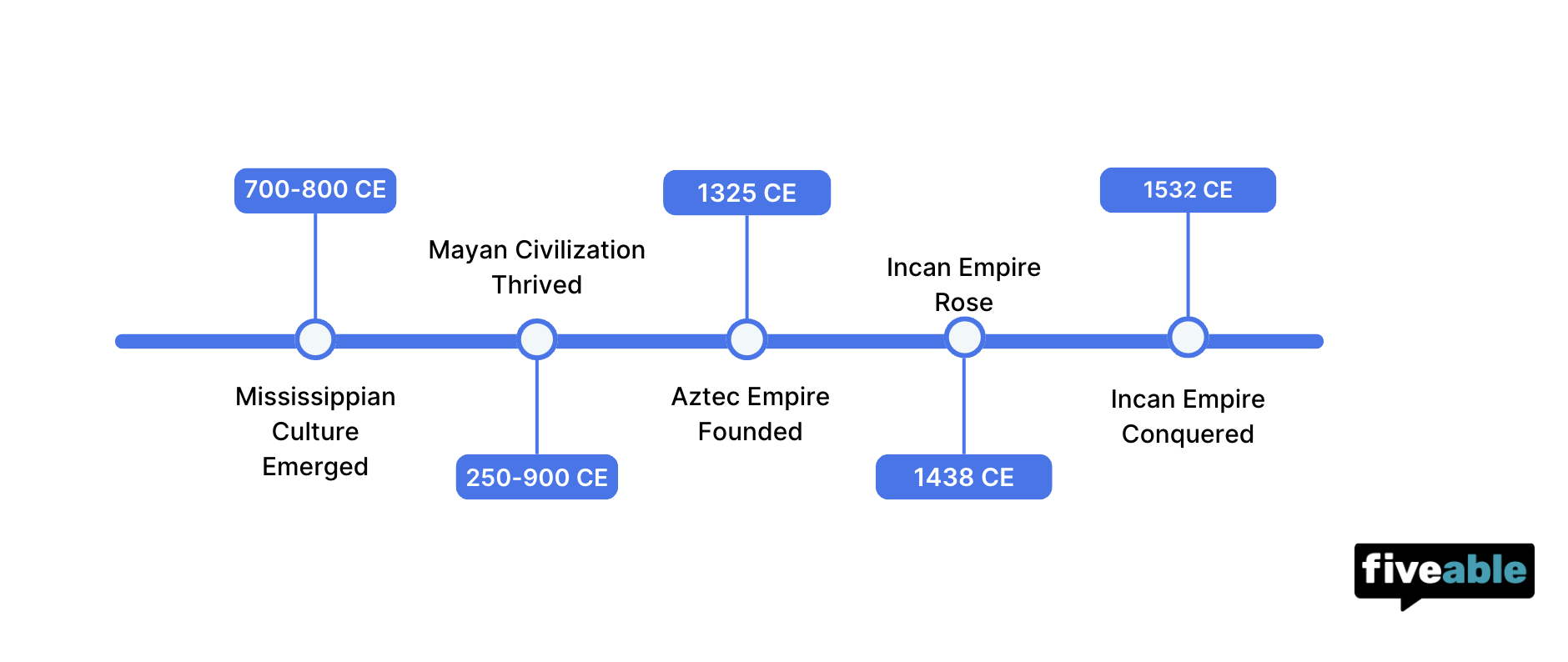
Timeline of Key Events in Ancient American Civilizations. Image Courtesy of Riya Patel
Key Takeaways
- Mississippians built enormous earthen mounds, while the Chaco built stone-and-clay housing and Mesa Verde people built homes into cliffs.
- Mayan city-states had separate kings and fought for tribute and captives, while priests used calendars to guide ceremonies and decisions about war.
- The Aztecs built Tenochtitlan on a lake island, expanded farmland with chinampas, and collected tribute through local rulers who kept their positions.
- Aztec expansion and demands for tribute and sacrifice victims bred resentment, leaving many subject tribes ready to rebel when the Spanish arrived.
- Pachacuti began Incan conquests, and the empire was divided into four provinces; conquered people owed mit'a public labor instead of tribute.
- Many historians argue Mesoamerican cultures built on Olmec traditions, while others argue these civilizations developed complex societies more or less independently.
The Mississippian Culture and the Southwest
The Mississippian culture was the first large-scale civilization in North America, emerging in the 700s or 800s in the Mississippi River Valley. Instead of stone pyramids, Mississippians built enormous earthen mounds, some up to 100 feet tall and covering an area the size of 12 football fields. The largest mound site is Cahokia, in southern Illinois.
Government and society
- A chief called the Great Sun ruled each large town.
- Rigid class structure: priests and nobles on top, then farmers, hunters, merchants, and artisans, with enslaved people (usually prisoners of war) at the bottom.
- Society was matrilineal, meaning social standing passed through the woman's side of the family. When a Great Sun died, the title went to his sister's son, not his own.
- Generally, women farmed and men hunted.
Decline
Cahokia was abandoned around 1450, and other large Mississippian cities by 1600. Historians debate why. One theory points to flooding or weather extremes that wrecked the agricultural economy. Another blames diseases introduced by Europeans.
Chaco and Mesa Verde
In the dry southwestern United States, two cultures became known for adapting to scarce water and wood:
- The Chaco built large housing structures out of stones and clay, some with hundreds of rooms.
- The people of Mesa Verde built multi-story homes into cliff sides using sandstone bricks.
Both declined in the late 13th century as the climate got drier.
The Maya City-States
Mayan civilization peaked between 250 and 900 C.E. across southern Mexico, Belize, Honduras, and Guatemala. Note the dates: the Maya peak comes before the course's 1200 start date, but AMSCO covers them because later Mesoamerican states built on Mayan foundations. At its height, the region held as many as 2 million Mayans living in or near roughly 40 cities of 5,000 to 50,000 people each.
Government
- The basic political unit was the city-state, each ruled by a king (women ruled when no male heir was available). There was no central government over all Mayan lands.
- City-states fought constantly, but rarely for territory. They fought for tribute (payments from the conquered to the conqueror) and for captives to use in human sacrifice ceremonies.
- Each king claimed descent from a god and directed elite scribes and priests who ran the state.
- Commoners paid taxes in crops and provided labor. There were no standing armies; citizens served when war broke out.
Religion, science, and technology
- The Maya developed the concept of zero, a complex writing system, and rubber made from plant sap.
- Science and religion were linked through astronomy. Priests used the calendar to decide when to hold ceremonies and whether to go to war, so they built precise observatories atop pyramids like the one at Chichen Itza. Their calendar was more accurate than any in Europe at the time.
- Priests, who could be male or female, honored deities of the sun, rain, and corn. War captives were sometimes sacrificed as offerings.
- Mayan stepped pyramids resemble Mesopotamian ziggurats, a shape that shows up from Spain to Indonesia.
The Aztec Empire
The Aztecs (also called the Mexica) were originally hunter-gatherers who migrated into central Mexico in the 1200s. In 1325 they founded their capital, Tenochtitlan, on the site of modern Mexico City. Within a century they had built an empire stretching from the Gulf of Mexico to the Pacific Ocean.
Tenochtitlan
- Built on an island in a swampy lake for defense, the city grew to nearly 200,000 people, one of the largest cities in the world.
- Aqueducts supplied water, and a 150-foot Great Pyramid anchored the city center.
- On Lake Texcoco, the Aztecs built chinampas, floating gardens that expanded farmland. They dug ditches to irrigate fields and drain lake water for more land.
Government, economy, and society
Here's the key idea: the Aztecs ruled through tribute, not direct control. Conquered peoples paid tribute (food, cloth, firewood, plus luxury goods like feathers and jewelry), surrendered land, and performed military service. Local rulers kept their positions and served as tribute collectors, which gave the Aztecs political dominance without administrative control.
- City-states were grouped into provinces. Warriors and their families were relocated to each provincial capital, and an Aztec official collected tribute there.
- The government was a theocracy, rule by religious leaders. The emperor, called the Great Speaker, was both political ruler and divine representative of the gods.
- Social hierarchy below him: land-owning nobles (who led the military), then scribes and healers, then craftspeople and traders (including the pochteca, a special merchant class trading luxury goods), then peasants and soldiers. People could be enslaved for unpaid debts or as punishment for crimes.
Religion and the role of women
- The Aztecs worshipped hundreds of deities, many with both male and female aspects.
- Human sacrifice repaid the gods, who Aztecs believed had sacrificed themselves to create the world. Sacrifice also had a political side, dramatically displaying Aztec might. Spanish invaders may have exaggerated its extent to justify conquest.
- Women wove the cloth that local rulers demanded as tribute, so they were central to the tribute economy. Most women worked at home, but some became priestesses, midwives, healers, or merchants, and a few noblewomen worked as literate scribes.
Decline
By the late 15th century the empire was weakening. Low technology (no wheeled vehicles or pack animals) made agriculture inefficient, the empire expanded beyond what it could govern, and the constant demands for tribute and sacrifice victims bred resentment. Many subject tribes were ready to rebel, which is exactly the opportunity the Spanish exploited after arriving in 1519.
The Inca Empire
In 1438, a leader who called himself Pachacuti ("transformer" or "shaker" of the earth) began conquering tribes near Cuzco, Peru. His victories, and his son's, built the Incan Empire, which stretched from present-day Ecuador to Chile. By 1493 his grandson Huayna Capac ruled and focused on consolidating the conquests.
Government, economy, and society
- The empire was split into four provinces, each with its own governor and bureaucracy. Loyal conquered leaders were rewarded.
- Unlike the Aztecs, the Inca did not demand tribute. Instead, conquered people owed the mit'a system: mandatory public service. Men aged 15 to 50 provided agricultural and other labor, including road construction. Tribute vs. mit'a is a classic AP comparison, so know the difference.
Religion
- Inca means "people of the sun," and the sun god Inti was the most important deity. Rulers were considered Inti's earthly representatives. The Temple of the Sun in Cuzco was the core of Incan religion.
- Royal ancestor veneration: dead rulers were mummified and kept "ruling," retaining their servants, possessions, and property. New rulers inherited nothing, which partly motivated constant expansion.
- Priests read the gods' will (coca leaves, spider movements), diagnosed illness, and predicted battles. Human sacrifice happened during serious events like famines and plagues, though scholars think it was less frequent than among the Aztecs.
- Incan religion included animism, the belief that physical objects (called huaca) like mountains, rivers, stones, or bridges could hold supernatural power.
Achievements
- The quipu, a system of knotted strings, recorded numerical information and messages.
- Terrace farming grew potatoes and maize, using waru waru, raised beds with channels that captured rainwater, prevented erosion, and stored water for dry periods.
- The Carpa Nan, a roughly 25,000-mile road system built with captive labor, served the government and military, with bridges crucial in the mountains.
Decline
When Spanish conquistador Francisco Pizarro arrived in 1532, the empire was in a civil war of succession after Huayna Capac's death. Some scholars say the civil war weakened the army; others point to European diseases. The Spanish took the empire's core in 1533, though outposts held out until 1572. Machu Picchu remains one of the world's most visited sites.
Continuities and Diversity
Historians debate how connected Mesoamerican cultures were. Many argue most built on the Olmec civilization, since the Olmecs' feathered snake-god became fundamental to both Mayan and Aztec religion, and Olmec pottery subjects, ritual sacrifices, pyramids, and ball courts continued in later cultures. Other historians argue these civilizations developed complex societies more or less independently. Either way, the pattern matches the rest of Unit 1: states demonstrating continuity with earlier traditions while innovating in their own directions.
Key Terms to Know
| Term | Why it matters |
|---|---|
| Mississippian | First large-scale North American civilization (700s-800s), known for massive earthen mounds. |
| Cahokia | The largest Mississippian mound site, in southern Illinois, abandoned around 1450. |
| Matrilineal society | Social standing passed through the mother's side, so a Great Sun's title went to his sister's son. |
| City-states | The Mayan political unit, a king ruling a city and its surrounding territory with no central Mayan government. |
| Tribute | Payments from conquered to conqueror; the engine of both Mayan warfare and the Aztec economy. |
| Mexica (Aztecs) | Migrants turned empire-builders who ruled Mesoamerica through tribute collected by local rulers. |
| Tenochtitlan | Aztec capital founded in 1325 on a lake island, home to nearly 200,000 people. |
| Chinampas | Floating gardens on Lake Texcoco that expanded Aztec food production. |
| Theocracy | Rule by religious leaders; the Aztec Great Speaker was both emperor and divine representative. |
| Human sacrifice | Ritual offering to the gods, central to Aztec religion and a display of imperial power. |
| Pachacuti | Leader who began Incan conquests in 1438 and built the empire from Cuzco. |
| Incan Empire | Andean empire from Ecuador to Chile, run through four provinces with bureaucracies. |
| Mit'a system | Mandatory public labor service owed by Incan subjects instead of tribute. |
| Temple of the Sun | Cuzco temple to Inti that anchored Incan religion and royal ancestor veneration. |
| Quipu | Incan knotted-string system for recording numbers and messages. |
| Carpa Nan | The Incan road network of some 25,000 miles used by the government and military. |
| Animism | Belief that physical objects (huaca) hold supernatural power, part of Incan religion. |
Practice and Next Steps
Pair these notes with the 1.4 State Building in the Americas study guide for the course-topic version of this material, and browse the full set of AP World AMSCO notes to keep moving through Unit 1. The next chapter, AMSCO 1.5 Developments in Africa, continues the regional tour, and AMSCO 1.7 pulls all the Unit 1 regions together for comparison.
To check yourself, run a quick set of AP World practice questions on state building in the Americas, or look up any fuzzy term in the key terms glossary. The Aztec tribute system vs. the Incan mit'a system is a comparison the exam loves, so make sure you can explain both before moving on.
Frequently Asked Questions
What does AMSCO Topic 1.4 Developments in the Americas cover?
AMSCO Topic 1.4 (pages 33-39) covers the major American civilizations of c. 1200-1450: the Mississippian culture in North America, the Maya city-states, the Aztec Empire in Mesoamerica, and the Inca Empire in the Andes. The core idea is that American state systems showed continuity, innovation, and diversity, just like states in Afro-Eurasia.
What is the difference between the Aztec tribute system and the Incan mit'a system?
The Aztecs forced conquered peoples to pay tribute in goods like food, cloth, and luxury items, with local rulers kept in place as tribute collectors. The Inca did not collect tribute; instead, conquered men aged 15 to 50 owed mandatory public labor through the mit'a system, including farming and road construction. This is one of the most common comparisons on the AP World exam.
What was the Mississippian culture known for?
The Mississippian culture, the first large-scale civilization in North America, emerged in the 700s or 800s in the Mississippi River Valley and built enormous earthen mounds, some 100 feet tall. Its largest site, Cahokia in southern Illinois, was abandoned around 1450. The society was matrilineal, so a ruler's title passed to his sister's son rather than his own.
Why are the Maya in Unit 1 if their civilization peaked before 1200?
Mayan civilization peaked between 250 and 900 C.E., before the AP World course's 1200 start date, but AMSCO covers it because later Mesoamerican states like the Aztecs built on Mayan and Olmec foundations, including pyramids, ritual sacrifice, and the feathered snake-god. The exam focuses on the Aztec and Inca empires for this period, with the Maya as background context.
How does Topic 1.4 show up on the AP World exam?
Topic 1.4 supports the skill of explaining how and why states in the Americas developed and changed over time, with the Aztec Empire, Inca Empire, and Mississippian culture as the go-to examples. Expect comparison questions, like Aztec tribute vs. Incan mit'a, or state-building evidence for essays. You can test yourself with AP World practice questions.
See Fiveable more often in Google
Mark Fiveable as a preferred source and Google is more likely to show you our guides in Top Stories, with a "preferred" badge in AI Mode and AI Overviews.