5.10 Continuity and Change in the Industrial Age

🌍AP World History: Modern Unit 5 Review
5.10 Continuity and Change in the Industrial Age
🌍 AP World History: Modern
5.1
The Enlightenment
5.2
Nationalism and Revolutions from 1750-1900
5.3
Industrialization Begins
5.4
Industrialization Spreads, 1750 to 1900
5.5
Technology in the Industrial Age
5.6
Government's Role in Industrialization from 1750-1900
5.7
Economic Developments and Innovations in the Industrial Age
5.8
Reactions to Industrialization, 1750-1900
5.9
Social Effects of Industrialization
5.10
Continuity and Change in the Industrial Age
This topic focuses on how to weigh how much industrialization actually changed the world from 1750 to 1900. Technology, industrial capitalism, and new political ideologies reshaped economies, governments, and daily life, but older power structures like patriarchy, colonialism, and class and racial hierarchies often stayed in place.
AP World 5.10 Continuity and Change
AP World 5.10 asks you to explain the extent to which industrialization brought change from 1750 to 1900. The strongest answer is not just "everything changed." Industrial capitalism, transportation, communication, nationalism, and new nation-states reshaped the world, but many social and political hierarchies continued.
For the exam, organize evidence into two buckets: changes caused by industrialization and continuities that survived the Industrial Age. Then make a claim about extent, such as change being strongest in technology and economic production while patriarchy, colonialism, and class or racial hierarchy remained powerful.
Why This Matters for the AP World History Exam
This topic is the wrap-up for Unit 5, so it pulls together everything from the Enlightenment and revolutions through factories, labor reactions, and new social classes. That makes it perfect practice for continuity and change over time reasoning, which shows up across multiple-choice questions and in the long essay and document-based question.
When the exam asks you to "explain the extent to which" something changed, it wants both sides. Industrialization is a classic case where you can argue major change (steam power, mass production, nation-states) while also pointing to what held steady (gender roles, empire, inequality). Getting comfortable with this both-and structure here helps you write sharper arguments throughout the rest of the course.
Key Takeaways
- Industrial capitalism raised standards of living for some and made consumer goods cheaper, more varied, and more available, but the gains were uneven and many workers stayed poor.
- Railroads, steamships, and the telegraph shrank distances, opened interior regions, and boosted global trade and migration.
- Enlightenment ideas about natural rights, the social contract, and reason questioned old traditions and often came before revolutions.
- Nationalism became a major force, fueling both independence movements and unification of fragmented regions.
- Real continuities persisted: patriarchy, colonial control, and racial and class hierarchies limited who actually benefited.
- A good answer treats this period as change layered on top of older structures, not a clean break with the past.
Industrial Capitalism and Standards of Living
Industrial capitalism increased the availability, affordability, and variety of consumer goods, especially in industrializing regions. Improved manufacturing methods meant more people could buy things that had once been rare or expensive.
- Factory production lowered costs and expanded what ordinary people could purchase.
- Standards of living rose for some, particularly the growing middle class.
- Gains were not evenly shared. Many working-class families still faced poverty, long hours, and unsafe conditions.
That gap between rising consumption and persistent hardship is exactly the kind of tension the exam wants you to notice. Progress was real, but it did not reach everyone equally.
Transportation and Communication
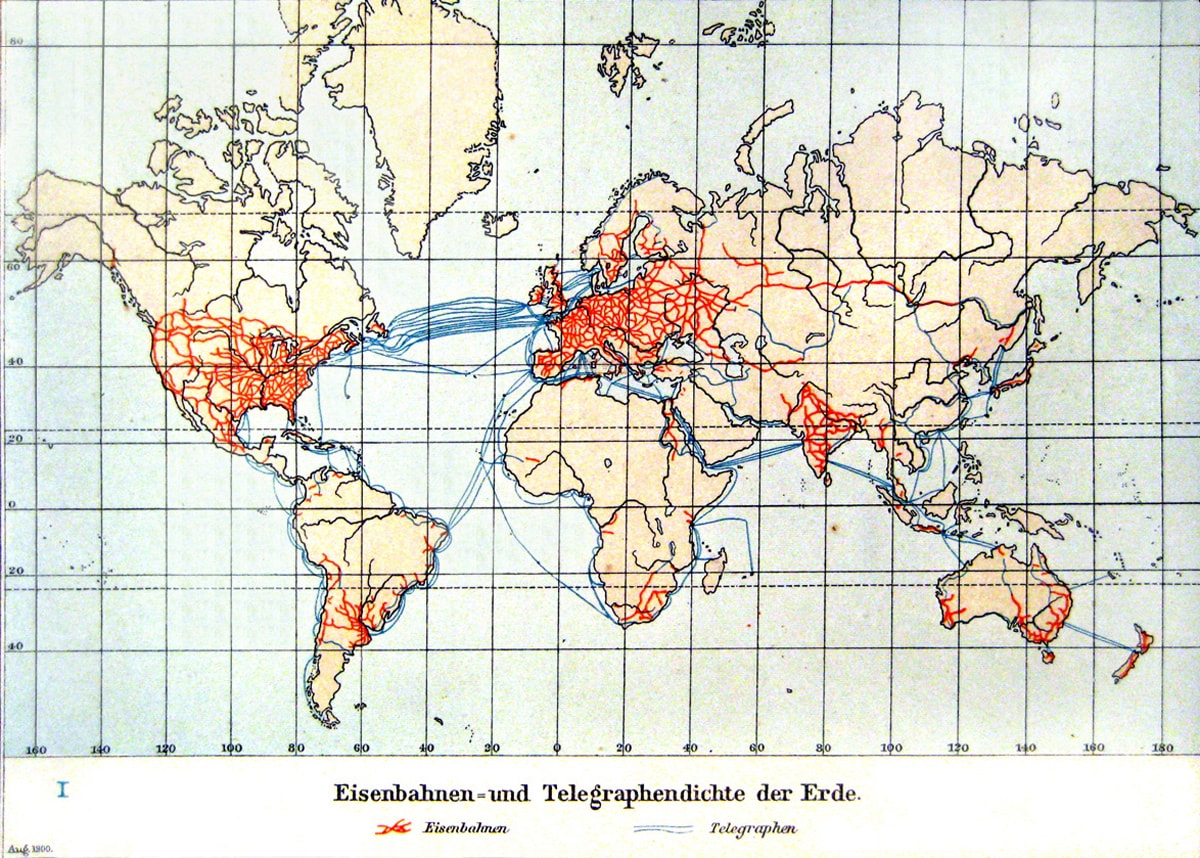
New technologies made exploration, development, and communication possible in interior regions around the world, which led to more trade and migration.
| Technology | Impact |
|---|---|
| Railroads | Opened interior regions to development and migration |
| Steamships | Enabled faster, cheaper movement of goods and people |
| Telegraph | Allowed near-instant communication across long distances |
These tools let businesses coordinate over distance, helped people move in larger numbers, and tied distant regions into wider economic networks. They are strong examples of how technology drove change in this period.
Revolutions and Ideological Shifts
Between 1750 and 1900, the world entered an intense period of revolution and rebellion against existing governments, which led to new nation-states. Two ideas powered much of this.
Enlightenment Thought
Enlightenment philosophies applied reason and empiricist approaches to nature and human relationships, and reexamined the role of religion in public life. Philosophers developed new political ideas about the individual, natural rights, and the social contract.
- Natural rights framed government as something that should protect individuals.
- The social contract argued that legitimate government rests on the consent of the governed.
- An emphasis on reason encouraged people to question inherited traditions.
The spread of this thought, which challenged established traditions in many areas of life, often came right before revolts against existing governments.
Nationalism
Nationalism gave people a new sense of commonality based on language, religion, social customs, and territory. It became a major force shaping states and empires.
- It inspired independence movements and the unification of fragmented regions.
- Governments sometimes used national feeling to build unity.
- New national communities often tied identity to the borders of a state.
German and Italian unification are commonly cited examples of nationalism pushing for the joining of fragmented regions. Treat these as illustrative examples, not the only acceptable evidence.
Continuities Amid Change
The hardest part of "extent of change" questions is remembering what did not change. Even as technology and ideology shifted, older power structures often survived.
| Continuity | Explanation |
|---|---|
| Patriarchy | Many women remained excluded from political and economic power |
| Colonialism | European empires still controlled large parts of the world |
| Racial and class hierarchies | Social mobility stayed limited, especially in colonies |
| Rural and agrarian life | Many regions outside industrial zones kept traditional ways of living |
The pattern is that ideologies and machines changed quickly, but the core structures of gender, race, and class often stayed in place, sometimes justified in new ways.
How to Use This on the AP World History Exam
Continuity and Change Over Time
Build a two-column mental list before you write. One side is change: industrial capitalism, mass production, railroads, steamships, the telegraph, new ideologies, and new nation-states. The other side is continuity: patriarchy, colonialism, and persistent racial and class hierarchies. A response that names both is far stronger than one that only celebrates progress.
Free Response
When a prompt asks you to "explain the extent" of change, take a clear position and support it. You might argue that change outweighed continuity in economics and technology while continuity held in social hierarchy. Back each claim with specific evidence, then explain how that evidence proves your point rather than just listing facts.
MCQ
Source-based multiple-choice questions often pair a document about new technology or reform with the question of what stayed the same. Watch for answer choices that overstate change ("industrialization ended all inequality") versus ones that capture the mixed reality. The balanced option is usually correct.
Common Trap
Avoid treating 1750 to 1900 as a straight line of improvement. The exam rewards the recognition that benefits were uneven and that old structures often persisted underneath new technology and ideas.
Common Misconceptions
- Misconception: Industrialization raised living standards for everyone.Actually: Industrialization did not raise living standards for everyone. It improved life for some, especially the middle class, while many workers stayed in poverty.
- Misconception: Revolutions erased old hierarchies.Actually: Revolutions did not erase old hierarchies. Patriarchy, colonialism, and class and racial divisions often continued even after new governments formed.
- Misconception: Enlightenment ideas and nationalism were the same thing.Actually: Enlightenment ideas and nationalism were not the same thing. Enlightenment thought focused on reason, natural rights, and the social contract, while nationalism centered on shared identity and territory.
- Misconception: Nationalism only broke empires apart.Actually: Nationalism did not only break empires apart. It also pushed fragmented regions to unify, as with German and Italian unification.
- Misconception: New technology spreading globally meant industrialization was evenly distributed.Actually: New technology spreading globally did not mean industrialization was evenly distributed. Many regions stayed agrarian, and benefits clustered in industrializing areas.
- Misconception: Continuity means nothing happened.Actually: Continuity does not mean nothing happened. It means important structures survived alongside genuine, large-scale change.
Related AP World History Guides
Practice Questions for 5.10
1 of 10
In the 1790s, enslaved people in Saint-Domingue (Haiti) organized a rebellion that abolished slavery and established an independent Black republic, drawing on revolutionary rhetoric about natural rights and human equality circulating through print and oral networks. This uprising best illustrates which historical development?
A.
Decline of mercantilism enabling colonies' economic and political independence
B.
Industrial capitalism creating demand for free labor that replaced slavery
C.
Rise of nationalist movements based on shared language and culture
D.
Spread of Enlightenment ideas inspiring resistance to entrenched hierarchies
Vocabulary
The following words are mentioned explicitly in the AP® course framework for this topic.Term | Definition |
|---|---|
consumer goods | Products manufactured for purchase and use by individual consumers rather than for further production or business use. |
Enlightenment | An 18th-century intellectual movement emphasizing reason, empiricism, and new ways of understanding the natural world and human relationships. |
industrial capitalism | An economic system combining industrial production with capitalist principles, where private individuals and companies own and control the means of production for profit. |
Industrial Revolution | The period of rapid industrial growth and social change, roughly from 1750 to 1900, characterized by the shift from agrarian economies to industrial production. |
nation-states | Sovereign political units with defined territories, centralized governments, and populations sharing a common identity or nationality. |
nationalism | A political ideology emphasizing loyalty to one's nation and the desire for national independence and self-determination. |
natural rights | Fundamental rights believed to belong to all individuals by virtue of their humanity, a key concept developed by Enlightenment philosophers. |
railroads | Transportation networks powered by steam engines that enabled exploration, resource development, and increased trade globally. |
rebellion | An organized resistance or uprising against existing governmental authority, common during the 18th century. |
revolution | A fundamental and often violent overthrow of an existing government or social system, occurring frequently in the 18th century. |
social contract | A political theory developed by Enlightenment philosophers describing an agreement between individuals and government to establish legitimate authority. |
steamships | Vessels powered by steam engines that facilitated global exploration, trade, and migration across oceans. |
telegraph | A communication technology that transmitted messages over long distances, enabling rapid communication for trade and coordination. |
Frequently Asked Questions
What is AP World 5.10 about?
AP World 5.10 is about explaining the extent to which industrialization brought change from 1750 to 1900 while also identifying continuities that stayed in place.
What changed during the Industrial Age from 1750 to 1900?
Industrial capitalism, factory production, railroads, steamships, the telegraph, nationalism, and new nation-states changed economies, transportation, communication, and politics.
What stayed the same during the Industrial Age?
Major continuities included patriarchy, colonialism, class hierarchy, racial hierarchy, and rural or agrarian life in many regions outside industrial centers.
How do you write a continuity and change answer for AP World 5.10?
Make a claim about extent, then organize evidence into changes and continuities. Strong answers explain how industrialization changed technology and production while older social and political hierarchies continued.
Why is industrial capitalism important in AP World 5.10?
Industrial capitalism increased consumer goods and standards of living for some people, but it also kept many workers in difficult conditions and intensified debates over reform, socialism, and labor rights.
What evidence works well for AP World 5.10?
Useful evidence includes railroads, steamships, the telegraph, factory production, industrial capitalism, Enlightenment ideas, nationalism, new nation-states, persistent patriarchy, colonialism, and class or racial hierarchy.
See Fiveable more often in Google
Mark Fiveable as a preferred source and Google is more likely to show you our guides in Top Stories, with a "preferred" badge in AI Mode and AI Overviews.