AMSCO 9.6 Globalized Culture Notes

🌍AP World History: Modern Review
AMSCO 9.6 Globalized Culture Notes
🌍 AP World History: Modern
AMSCO 1.1 Developments in East Asia Notes
AMSCO 1.2 Developments in Dar al-Islam Notes
AMSCO 1.3 Developments in South and Southeast Asia Notes
AMSCO 1.4 Developments in the Americas Notes
AMSCO 1.5 Developments in Africa Notes
AMSCO 1.6 Developments in Europe Notes
AMSCO 1.7 Comparison in the Period from c.1200 to c.1450 Notes
AMSCO 2.1 The Silk Roads Notes
AMSCO 2.2 The Mongol Empire and the Modern World Notes
AMSCO 2.3 Exchange in the Indian Ocean Notes
AMSCO 2.4 Trans-Saharan Trade Routes Notes
AMSCO 2.5 Cultural Consequences of Connectivity Notes
AMSCO 2.6 Environmental Consequences of Connectivity Notes
AMSCO 2.7 Comparison of Economic Exchange Notes
AMSCO 3.1 European, East Asian, and Gunpowder Empires Expand Notes
AMSCO 3.2 Empires: Administrations Notes
AMSCO 3.3 Empires: Belief Systems Notes
AMSCO 3.4 Comparison in Land-Based Empires Notes
AMSCO 4.1 Technological Innovations Notes
AMSCO 4.2 Exploration: Causes and Events Notes
AMSCO 4.3 Columbian Exchange Notes
AMSCO 4.4 Maritime Empires Link Regions Notes
AMSCO 4.5 Maritime Empires Develop Notes
AMSCO 4.6 Internal and External Challenges to State Power Notes
AMSCO 4.7 Changing Social Hierarchies Notes
AMSCO 4.8 Continuity and Change from c.1450 to c.1750 Notes
AMSCO 5.1 The Enlightment Notes
AMSCO 5.2 Nationalism and Revolutions Notes
AMSCO 5.3 Industrial Revolution Begins Notes
AMSCO 5.4 Industrialization Spreads Notes
AMSCO 5.5 Technology in the Industrial Age Notes
AMSCO 5.6 Industrialization: Government's Role Notes
AMSCO 5.7 Economic Developments and Innovations Notes
AMSCO 5.8 Reactions to the Industrial Economy Notes
AMSCO 5.9 Society and the Industrial Age Notes
AMSCO 5.10 Continuity and Change in the Industrial Age Notes
AMSCO 6.1 Rationales for Imperialism Notes
AMSCO 6.2 State Expansion Notes
AMSCO 6.3 Indigenous Responses to State Expansion Notes
AMSCO 6.4 Global Economic Development Notes
AMSCO 6.5 Economic Imperialism Notes
AMSCO 6.6 Causes of Migration in an Interconnected World Notes
AMSCO 6.7 Effects of Migration Notes
AMSCO 6.8 Causation in the Imperial Age Notes
AMSCO 7.1 Shifting Power Notes
AMSCO 7.2 Causes of World War I Notes
AMSCO 7.3 Conducting World War I Notes
AMSCO 7.4 Economy in the Interwar Period Notes
AMSCO 7.5 Unresolved Tensions After World War I Notes
AMSCO 7.6 Causes of World War II Notes
AMSCO 7.7 Conducting World War II Notes
AMSCO 7.8 Mass Atrocities Notes
AMSCO 7.9 Causation in Global Conflict Notes
AMSCO 8.1 Setting the Stage for the Cold War and Decolonization Notes
AMSCO 8.2 The Cold War Notes
AMSCO 8.3 Effects of the Cold War Notes
AMSCO 8.4 Spread of Communism Notes
AMSCO 8.5 Decolonization after 1900 Notes
AMSCO 8.6 Newly Independent States Notes
AMSCO 8.7 Global Resistance to Established Power Structure Notes
AMSCO 8.8 End of the Cold War Notes
AMSCO 8.9 Causation in the Age of the Cold Ward and Decolonization Notes
AMSCO 9.1 Advances in Technology and Exchange Notes
AMSCO 9.2 Technological Advancements and Limitations Notes
AMSCO 9.3 Technology and the Environment Notes
AMSCO 9.4 Economics in the Global Age Notes
AMSCO 9.5 Calls for Reforms and Responses Notes
AMSCO 9.6 Globalized Culture Notes
AMSCO 9.7 Resistance to Globalization Notes
AMSCO 9.8 Institutions Developing in a Globalized World Notes
AMSCO 9.9 Continuity and Change in a Globalized World Notes
Overview
AMSCO Topic 9.6, Globalized Culture (AMSCO p. 679-687), explains how and why culture went global after 1900. The chapter traces three big threads: political and social upheaval that reshaped the arts in the early 20th century, the rise of a worldwide consumer and popular culture (movies, music, sports, social media), and new religious developments sparked by global exchange. This is the cultural side of Unit 9 globalization, sitting between the protest movements in AMSCO 9.5 Calls for Reforms and Responses and the pushback covered in AMSCO 9.7 Resistance to Globalization.
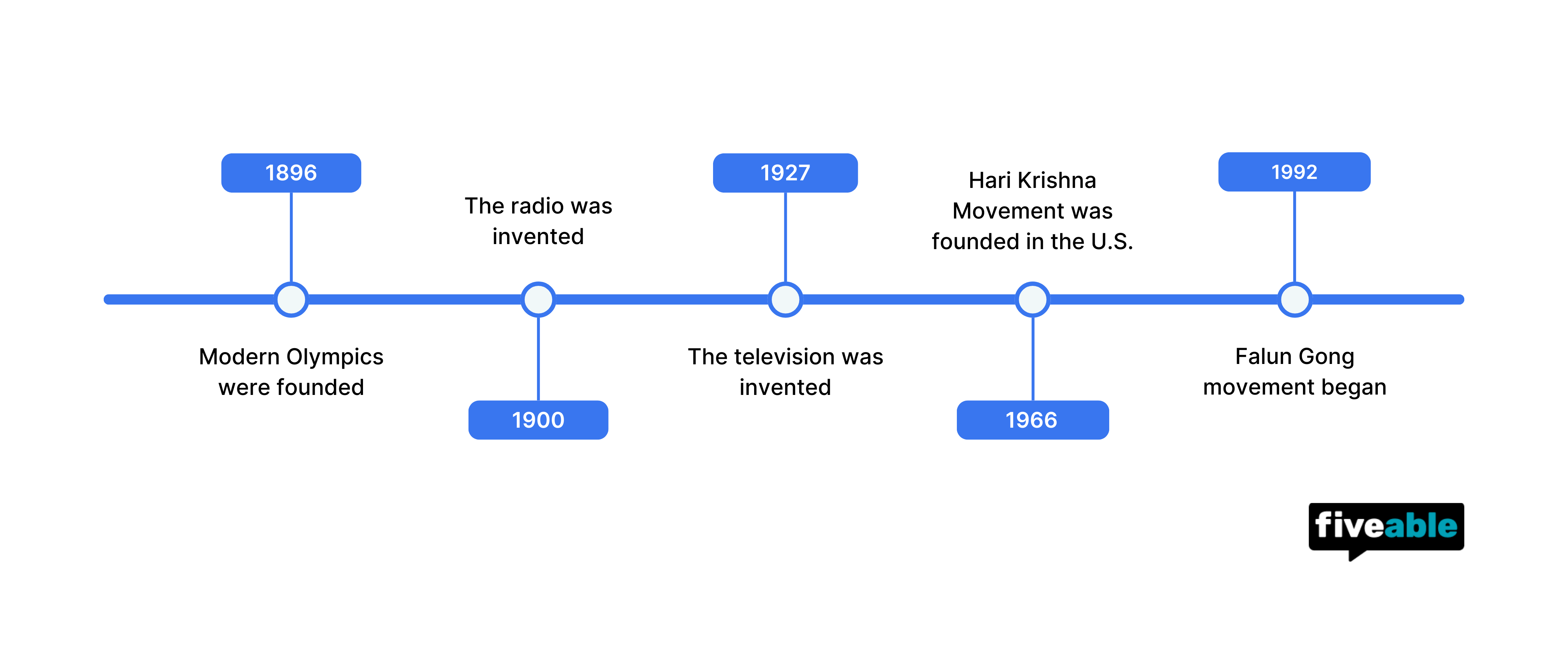
Timeline of global cultural events spanning from 1900 to the present. Image courtesy of Siya.
Key Takeaways
- World wars, the Cold War, and social change reshaped how people thought, while modernist artists broke from traditional forms in painting, writing, and music.
- Radio and movies spread popular culture, postwar TV advertising encouraged consumer culture, and the internet later connected people worldwide.
- Americanization spread U.S. culture and drew criticism for waste and pollution, while English and multinational brands crossed national borders.
- Culture also flowed into the United States and around the world through Bollywood films, Japanese anime, Jamaican reggae, and Korean pop music.
- Social media changed communication but could be censored or used to manipulate, while global sports brought countries together even as athletes represented their home nations.
- Global exchange helped spread religious movements that adapted older traditions, while a growing number of younger people identified as unaffiliated with religious institutions.
Political, Social, and Artistic Changes
The chapter opens with a simple cause-and-effect argument: the political and social shocks of the 20th century changed how people thought, and the arts changed to match.
Political changes
- Early 1900s imperialism fueled fierce competition between nations, which exploded into two world wars.
- The Cold War split the world into rival camps, but after it ended, economic and cultural barriers fell.
- Competition gradually gave way to collaboration through regional organizations (the European Union, NAFTA) and global ones (the United Nations for conflict resolution, the World Trade Organization to regulate international trade).
Social changes
- International organizations and collaboration put people of different cultures in closer contact, much like earlier exchange networks had.
- Rights movements, especially civil rights and women's rights, brought formerly marginalized voices into the mainstream.
- Thinkers shook long-held beliefs: Albert Einstein (1879-1955) upended understandings of physical reality, Sigmund Freud (1856-1939) probed the human psyche, and Jean-Paul Sartre (1905-1980) philosophized that nothing had meaning.
- Technology kept piling on change: horses to cars, telegraph to radio, antibiotics and vaccines.
Artistic changes
Artists responded to a mechanized, urbanized world by breaking the old rules.
- Cubism, the style Picasso used in Guernica, challenged traditional perspective in painting.
- Stream-of-consciousness writers like Marcel Proust (1871-1922) and James Joyce (1882-1941) rebelled against traditional narrative.
- Arnold Schoenberg (1874-1951) composed atonal music outside familiar tonalities.
- The Harlem Renaissance was a "rebirth" of African American culture that rejected stereotyped portrayals of Black Americans in literature and onstage. Writers, poets, musicians, and activists made Harlem a center of Black artistic expression, and jazz emerged from this era to become an international language.
Together these movements make up modernism, the rejection of tradition in favor of new forms. That's the early-1900s setup; the rest of the chapter shows culture going truly global.
Global Consumer and Popular Culture
After World War II, popular culture (the culture of everyday people rather than the educated elite) and consumer culture spread across national borders. This is the heart of Topic 9.6 for the AP exam.
Mass media builds shared culture
- In the 1920s, radio and motion pictures gave popular culture its first mass platforms. Radio offered comedies and big band music, and during World War II it played a vital role in national defense in most industrialized nations.
- Movies offered relief from the Great Depression while reflecting it. Charlie Chaplin's "Little Tramp" epitomized the down and out.
- Radio and TV ushered in postwar consumer culture: "free" programming carried commercials into millions of homes, and industry pivoted from wartime production to consumer goods.
- In the 1990s, the internet connected people around the globe.
Americanization and its critics
The United States remained the world's most influential culture in the early 21st century. Through Americanization, people worldwide learned more about the U.S. than Americans learned about the rest of the world. That dominance bred resentment among people who felt American pop culture diluted their cultural identity. Critics also labeled American consumer culture a throwaway culture, objecting to the waste and pollution tied to ever newer, cheaper, more disposable products.
English spreads and changes
- Through the British Empire and then American movies, corporations, and scientific research, English became a second language across much of the world. In the early 21st century, about 300 million people in China were learning English, roughly the population of the United States.
- English-speaking corporations moved call centers to India and the Philippines, where fluent English speakers worked for relatively low wages.
- New speakers reshaped the language. Indian English added "prepone," the opposite of postpone.
Global brands and online commerce
- Multinational advertising created global brands like Apple, Nike, and Rolex. Interbrand's 2018 top global companies included Toyota (which sells more cars than any other brand), tech giants Apple, Google, Amazon, Microsoft, and Facebook, plus Coca-Cola, famous for its 1971 multicultural "buy the world a Coke" commercial.
- Online commerce made shopping global: Amazon operates in more than 17 countries, Alibaba mostly in Asia, and eBay in 30 countries. These retailers still pay sales taxes under the laws of each country or state where they sell.
Culture flows both ways
The U.S. exports culture, but it imports plenty too. These are go-to examples for any "globalized culture" question.
- Bollywood, the film industry in Bombay (Mumbai), produces musicals popular worldwide and blends multiple film styles. India makes more films than any other country.
- Anime, Japanese hand-drawn animation, reached America in the 1980s through the movie Akira; late-1990s shows like Pokemon and Dragon Ball brought it mainstream. By 2016, 60 percent of the world's animated TV shows were based on anime.
- Reggae emerged in 1960s Jamaica, blending New Orleans jazz and rhythm and blues with mento (itself a fusion of African rhythms and European elements). It's tied to the Rastafari religion and Pan-Africanism, and Bob Marley's music made it global in the 1970s.
- K-pop artists, singing in a mix of Korean and English, became global stars in the early 21st century. The South Korean government invested in K-pop concerts and tours because the genre boosts other Korean exports. Streaming sites like YouTube and Vimeo spread it worldwide.
Social media and censorship
Facebook, Twitter, Snapchat, and other platforms changed communication. They can inspire but also manipulate, a tension noted by Malala Yousafzai, the Pakistani activist and youngest Nobel Prize laureate. China banned outside social media but allowed homegrown platforms like WeChat, Weibo, and YuKu, censoring any criticism of the Communist Party on them.
Global culture in sports
- The modern Olympic Games, established in 1896, reflected an early internationalism. The 2016 Rio de Janeiro Olympics drew about 3.6 billion viewers. The Games show both nationalism (athletes represent home countries) and internationalism (nearly every country participates). That tension is a classic AP-style point.
- Soccer became the world's most popular sport partly because it requires so little equipment, and the World Cup rivals the Olympics as a global event.
- Basketball went global too. In 2014 the NBA included players from 30 countries or territories, and reporters from 35 countries covered the 2017 NBA Finals. In 2018, 27 percent of major league baseball players were foreign-born, from 21 countries.
- Sports also opened up to women. Some Muslim female athletes competed wearing hijab with adapted athletic wear. Afghan soccer player Hajar Abulfazi said she wore it to "show the next generation and their parents how Afghan women and girls can maintain respect for religion and culture while pursuing sports achievements."
Global Culture and Religion
Globalization also produced new religious movements, often blending traditions across borders.
- In the 1970s, former Beatle George Harrison released a song containing a Hindu mantra, launching the popularity of the Hari Krishna movement (based on traditional Hindu scriptures) in the United States and Europe.
- New Age religions revived and adapted forms of Buddhism, shamanism, Sufism, and other traditions for a largely Western audience.
- In 1990s China, Falun Gong, a movement based on Buddhist and Daoist traditions, gained popularity. The communist government tolerated it at first, then began restricting it in 1999. The suppression sparked international protests against China for human rights abuses.
- Most people worldwide still identified with some religion in the early 21st century, but a growing number of younger people identified as nonbelievers. Most weren't atheists (no belief in any god) or agnostics (believing we may not be able to know if God exists); they simply weren't affiliated with any religious institution.
Key Terms to Know
| Term | Why it matters |
|---|---|
| Modernism | The early-1900s cultural movement that rejected tradition in art, literature, and music in response to a mechanized, urbanized society. |
| Popular culture | The culture of everyday people rather than the educated elite, spread by radio, movies, TV, and the internet. |
| Consumer culture | A culture built around buying mass-produced goods, supercharged after WWII by commercials on radio and TV. |
| Americanization | The one-way flow where the world learns more about U.S. culture than Americans learn about everyone else's. |
| Throwaway culture | The global criticism of American consumerism's waste and pollution from disposable products. |
| Global brands | Companies like Toyota, Coca-Cola, and Apple whose products and advertising cross national borders. |
| Online commerce | Buying and selling over the internet through platforms like Amazon, Alibaba, and eBay. |
| Bollywood | The Mumbai-based film industry whose musicals are popular worldwide; India makes more films than any other country. |
| Anime | Japanese hand-drawn animation that went global, accounting for 60 percent of the world's animated TV shows by 2016. |
| Reggae | Jamaican music blending African and European traditions, tied to Rastafari and Pan-Africanism, spread globally by Bob Marley. |
| K-pop | Korean pop music sung in mixed Korean and English that became a global, government-supported export. |
| Social media | Platforms like Facebook and Twitter that can inspire or manipulate, and that some governments (like China) ban or censor. |
| Olympic Games | Modern games founded in 1896; they showcase both nationalism and internationalism at once. |
| World Cup | The global soccer competition that rivals the Olympics as a worldwide event. |
| Hari Krishna | A Hindu-based movement popularized in the West after George Harrison's 1970s song featuring a Hindu mantra. |
| New Age | Western adaptations of Buddhism, shamanism, Sufism, and other traditions revived through global exchange. |
| Falun Gong | A Buddhist- and Daoist-based Chinese movement restricted by the government starting in 1999, sparking international human rights protests. |
| Nonbelievers | A growing group of (mostly younger) people unaffiliated with religious institutions, not necessarily atheist or agnostic. |
Practice and Next Steps
Pair these notes with the 9.6 Globalized Culture after 1900 study guide, which frames the same material the way the AP exam tests it. Then continue through Unit 9 with the rest of the AMSCO notes collection, starting with AMSCO 9.7 Resistance to Globalization.
To check yourself, run through guided MCQ practice on Unit 9, drill definitions in the key terms glossary, or try FRQ practice with instant scoring since globalized culture makes a great body paragraph example for continuity-and-change essays.
Frequently Asked Questions
What does AMSCO Topic 9.6 Globalized Culture cover?
AMSCO 9.6 (p. 679-687) covers how culture globalized after 1900: early-20th-century modernism in the arts, the spread of consumer and popular culture through radio, movies, TV, and the internet, Americanization, global media like Bollywood, anime, reggae, and K-pop, global sports like the Olympics and World Cup, and new religious developments like New Age movements and Falun Gong.
What is Americanization in AP World History?
Americanization is the global spread of U.S. culture, where people around the world learn more about the United States than Americans learn about other countries. It bred resentment among people who felt American pop culture diluted their own identities, and critics labeled American consumerism a 'throwaway culture' because of its waste and pollution.
Is globalized culture only American culture spreading to other countries?
No, cultural flows went both ways. Bollywood musicals from India, Japanese anime (60 percent of the world's animated TV shows by 2016), Jamaican reggae, and Korean K-pop all gained huge audiences in the U.S. and worldwide. The AP exam loves examples showing globalization as exchange, not just one-way American influence.
How are the Olympics both nationalist and internationalist?
Olympic athletes represent their home nations, so the Games showcase nationalism, but they also bring together people from nearly every country, making them a symbol of internationalism. The modern Games began in 1896, and the 2016 Rio Olympics drew about 3.6 billion viewers worldwide. That dual nature makes the Olympics a strong example for essays on globalization.
How does Topic 9.6 show up on the AP World exam?
Topic 9.6 asks you to explain how and why globalization changed culture over time, so expect questions using examples like K-pop, Bollywood, global brands such as Coca-Cola and Toyota, social media, and the World Cup. It works well as evidence in continuity-and-change essays about the period after 1900. Try FRQ practice with instant scoring to apply these examples.
See Fiveable more often in Google
Mark Fiveable as a preferred source and Google is more likely to show you our guides in Top Stories, with a "preferred" badge in AI Mode and AI Overviews.