AMSCO 9.2 Technological Advancements and Limitations Notes

🌍AP World History: Modern Review
AMSCO 9.2 Technological Advancements and Limitations Notes
🌍 AP World History: Modern
AMSCO 1.1 Developments in East Asia Notes
AMSCO 1.2 Developments in Dar al-Islam Notes
AMSCO 1.3 Developments in South and Southeast Asia Notes
AMSCO 1.4 Developments in the Americas Notes
AMSCO 1.5 Developments in Africa Notes
AMSCO 1.6 Developments in Europe Notes
AMSCO 1.7 Comparison in the Period from c.1200 to c.1450 Notes
AMSCO 2.1 The Silk Roads Notes
AMSCO 2.2 The Mongol Empire and the Modern World Notes
AMSCO 2.3 Exchange in the Indian Ocean Notes
AMSCO 2.4 Trans-Saharan Trade Routes Notes
AMSCO 2.5 Cultural Consequences of Connectivity Notes
AMSCO 2.6 Environmental Consequences of Connectivity Notes
AMSCO 2.7 Comparison of Economic Exchange Notes
AMSCO 3.1 European, East Asian, and Gunpowder Empires Expand Notes
AMSCO 3.2 Empires: Administrations Notes
AMSCO 3.3 Empires: Belief Systems Notes
AMSCO 3.4 Comparison in Land-Based Empires Notes
AMSCO 4.1 Technological Innovations Notes
AMSCO 4.2 Exploration: Causes and Events Notes
AMSCO 4.3 Columbian Exchange Notes
AMSCO 4.4 Maritime Empires Link Regions Notes
AMSCO 4.5 Maritime Empires Develop Notes
AMSCO 4.6 Internal and External Challenges to State Power Notes
AMSCO 4.7 Changing Social Hierarchies Notes
AMSCO 4.8 Continuity and Change from c.1450 to c.1750 Notes
AMSCO 5.1 The Enlightment Notes
AMSCO 5.2 Nationalism and Revolutions Notes
AMSCO 5.3 Industrial Revolution Begins Notes
AMSCO 5.4 Industrialization Spreads Notes
AMSCO 5.5 Technology in the Industrial Age Notes
AMSCO 5.6 Industrialization: Government's Role Notes
AMSCO 5.7 Economic Developments and Innovations Notes
AMSCO 5.8 Reactions to the Industrial Economy Notes
AMSCO 5.9 Society and the Industrial Age Notes
AMSCO 5.10 Continuity and Change in the Industrial Age Notes
AMSCO 6.1 Rationales for Imperialism Notes
AMSCO 6.2 State Expansion Notes
AMSCO 6.3 Indigenous Responses to State Expansion Notes
AMSCO 6.4 Global Economic Development Notes
AMSCO 6.5 Economic Imperialism Notes
AMSCO 6.6 Causes of Migration in an Interconnected World Notes
AMSCO 6.7 Effects of Migration Notes
AMSCO 6.8 Causation in the Imperial Age Notes
AMSCO 7.1 Shifting Power Notes
AMSCO 7.2 Causes of World War I Notes
AMSCO 7.3 Conducting World War I Notes
AMSCO 7.4 Economy in the Interwar Period Notes
AMSCO 7.5 Unresolved Tensions After World War I Notes
AMSCO 7.6 Causes of World War II Notes
AMSCO 7.7 Conducting World War II Notes
AMSCO 7.8 Mass Atrocities Notes
AMSCO 7.9 Causation in Global Conflict Notes
AMSCO 8.1 Setting the Stage for the Cold War and Decolonization Notes
AMSCO 8.2 The Cold War Notes
AMSCO 8.3 Effects of the Cold War Notes
AMSCO 8.4 Spread of Communism Notes
AMSCO 8.5 Decolonization after 1900 Notes
AMSCO 8.6 Newly Independent States Notes
AMSCO 8.7 Global Resistance to Established Power Structure Notes
AMSCO 8.8 End of the Cold War Notes
AMSCO 8.9 Causation in the Age of the Cold Ward and Decolonization Notes
AMSCO 9.1 Advances in Technology and Exchange Notes
AMSCO 9.2 Technological Advancements and Limitations Notes
AMSCO 9.3 Technology and the Environment Notes
AMSCO 9.4 Economics in the Global Age Notes
AMSCO 9.5 Calls for Reforms and Responses Notes
AMSCO 9.6 Globalized Culture Notes
AMSCO 9.7 Resistance to Globalization Notes
AMSCO 9.8 Institutions Developing in a Globalized World Notes
AMSCO 9.9 Continuity and Change in a Globalized World Notes
Overview
AMSCO Topic 9.2, Technological Advancements and Limitations: Disease (AMSCO p.641-645), covers how diseases and medical breakthroughs shaped human populations after 1900. The chapter sorts disease into three buckets: diseases tied to poverty (malaria, tuberculosis, cholera, polio), new emerging epidemics (the 1918 flu, HIV/AIDS, Ebola), and diseases that show up more because people live longer (heart disease, Alzheimer's). The big takeaway for Unit 9 of AP World: science and public health campaigns wiped out or contained some diseases, but poverty, war, and aging populations kept others alive, and every outbreak pushed new medical technology forward.
The chapter opens with the biggest success story. Smallpox killed millions per year as recently as the 1960s, but a global vaccination campaign run by the World Health Organization (WHO) eliminated it. In 1979, scientists declared smallpox gone from the planet, except for a culture preserved at the Centers for Disease Control in the United States. This proved that coordinated global action could solve global problems, a theme that runs through the whole chapter.
This topic builds directly on the medical and scientific advances in AMSCO 9.1 Advances in Technology and Exchange.
Key Timeline
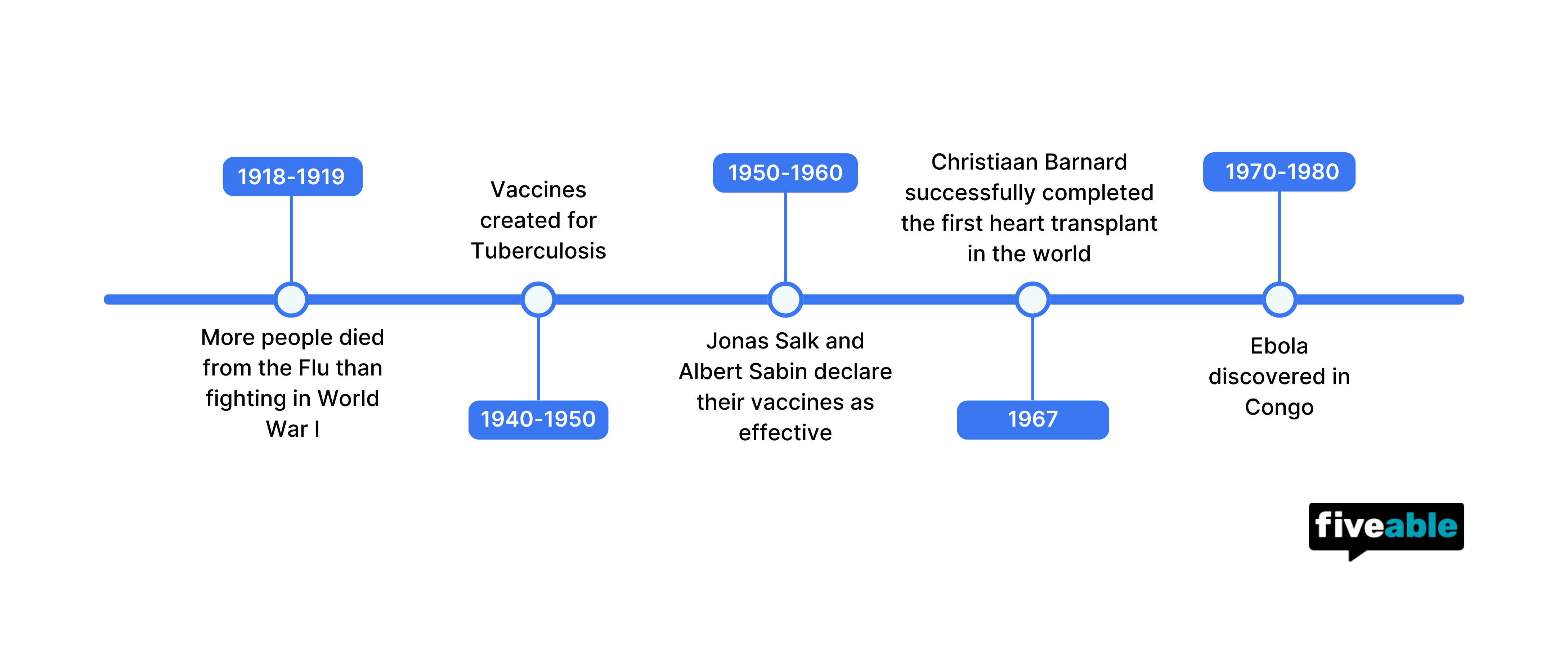
Timeline of diseases as they appear from 1900 to the present. Image courtesy of Vibhi.
Key Takeaways
- A WHO vaccination campaign eliminated smallpox by 1979, showing what coordinated global action could achieve.
- Poverty keeps diseases circulating: malaria still kills hundreds of thousands, drug-resistant TB has increased infections, and cholera spreads through contaminated water.
- A global campaign beginning in 1988 nearly eliminated polio, but war and distrust of outsiders have made vaccination difficult in Pakistan and Afghanistan.
- The 1918 flu infected one-fifth of the world's population and killed 20 million people, spreading along trade routes and with military troops.
- Antiretroviral drugs let people live with HIV, but their cost limited access in poor countries. A coordinated public health response contained the 2014 Ebola outbreak in West Africa.
- As people lived longer, heart disease and Alzheimer's became more common; treatments helped heart disease patients live longer, while researchers continued searching for an Alzheimer's cure.
Diseases Associated with Poverty
Some diseases persist even when cures exist, because poverty itself spreads them. Poor housing, unsafe working conditions, contaminated water, and lack of access to health care all keep these diseases circulating among low-income populations.
Malaria
- A parasitic disease spread by mosquitoes in tropical areas. In the early 21st century, malaria killed more than 600,000 people per year, most of them young African children.
- Doctors Without Borders, an international non-governmental organization (NGO), treated about 1.7 million malaria patients annually.
- Prevention has focused on insecticide-treated mosquito nets used while sleeping, but people can still be bitten during waking hours. An effective vaccine has been in development for years but remained in trials.
- Progress is real: in 2019, the WHO certified Algeria and Argentina as malaria-free. The catch is that some mosquitoes are becoming resistant to insecticides.
Tuberculosis (TB)
- An airborne infection of the lungs that spreads through coughs and sneezes.
- Before 1946, there was no effective drug treatment. Then a cure was developed using antibiotics plus a long rest period. In countries where TB is common, children receive vaccines.
- In the early 21st century, a drug-resistant strain appeared and infections rose, especially in prisons where people live in close quarters. The WHO launched a worldwide anti-TB campaign in the 2010s.
Cholera
- A bacterial disease spread through contaminated water, causing about 95,000 deaths per year, mainly among poor people in developing countries.
- A severe infection can kill within hours, but quick rehydration can effectively eliminate the risk of death.
- Prevention means boiling or chlorinating drinking water and washing hands. Vaccines exist but don't replace those basic measures.
Polio
- Spread by water contaminated with a virus from fecal matter. Polio once infected 100,000 new people per year and could cause paralysis or death.
- On April 12, 1955, American researcher Jonas Salk announced an effective injectable polio vaccine. Six years later, Albert Sabin's oral vaccine became available.
- A global campaign by governments, private organizations, and United Nations agencies began in 1988. In under 30 years, polio was eliminated almost everywhere.
- It survives in a few places like Pakistan and Afghanistan, where war makes vaccination difficult and political unrest and religious fundamentalism make people distrust programs pushed by outsiders.
- Like the smallpox campaign, polio eradication showed that coordinated global efforts can tackle global problems. That's a great piece of evidence for essays about international cooperation after 1900.
Emerging Epidemics
New diseases emerged after 1900 that caused major social disruption, and each one spurred new medical and public health responses. A quick vocab check: epidemics are widespread disease outbreaks, and pandemics are epidemics that spread across national borders.
The 1918 Influenza Pandemic
- In fall 1918, as World War I ended, a virulent flu strain swept the world. More soldiers died from the flu than from battle.
- One quarter of all Americans and one-fifth of the world's population became infected. The flu killed 20 million people worldwide, and its victims tended to be ages 20 to 40.
- It was so deadly that life expectancy in the United States dropped by 10 years, and more people died in 1918-1919 than in four years of the Bubonic Plague (1347-1351).
- Like the plague, the flu spread along trade routes and with military troops. That's a continuity worth remembering: disease still travels the same paths people do.
HIV/AIDS
- Acquired immunodeficiency syndrome (AIDS) is caused by the human immunodeficiency virus (HIV), which weakens the immune system so patients more easily succumb to other illnesses. It spreads through bodily fluids: unprotected sex, blood transfusions, and shared intravenous needles.
- Between 1981 and 2014, AIDS killed more than 25 million people worldwide. Because the disease was associated early on with homosexual men and drug addicts, research funding was hard to secure, and a high percentage of the first victims died.
- By the mid-1990s, antiretroviral drugs could stop HIV from weakening the immune system, letting patients live with the virus for years. There's a treatment, not a cure.
- The drugs were expensive, so poor countries struggled to access them. Brazil is the standout exception: in 1996 it began providing free antiretroviral drugs to anyone who needed them. Deaths dropped dramatically, and the program actually saved the government money by reducing hospitalizations, medical leaves, and early retirements.
- After 2000, the WHO, the US government, and private groups increased funding for prevention and treatment, but in 2018 about 40 million people were living with HIV, mostly in developing countries or low-income areas of developed countries. More than 600 young women ages 15-24 become infected each week.
Ebola
- Discovered in the Congo in 1976, Ebola is a deadly virus that infects the African fruit bat, humans, and other primates. Humans catch it from the fluids of infected people or animals.
- It causes extensive bleeding and organ failure, and kills the majority of infected people.
- A massive 2014 outbreak in West Africa caused worldwide fear, but a coordinated, intensive public health effort contained and then ended it. The WHO led the response, issuing emergency warnings and implementing a "road map" for handling outbreaks. Like the polio campaign, this showed countries could work together against a shared danger.
Diseases Associated with Longevity
As people live longer, diseases that develop later in life become more common. These diseases appear most in countries with higher incomes, basically the flip side of the poverty diseases above.
Heart Disease
- The most common cause of death in developed countries, linked to lifestyle, genetics, and increased longevity.
- South African surgeon Christiaan Barnard performed the first heart transplant in 1967.
- Robert Jarvik led the team that designed an artificial heart, used as a temporary device while a patient waited for a compatible human heart.
- Less invasive fixes followed: valve replacements, stents in arteries, vessel replacements, and medications targeting the blood conditions behind heart disease. By the 2000s, heart disease patients lived longer than similar patients had in the 1970s.
Alzheimer's Disease
- A form of dementia affecting mostly elderly people (and some middle-aged people) that became a growing concern as longevity increased.
- Patients progressively lose their memory, eventually failing to recognize loved ones. Because the disease undermines bodily functions, it leads to death. Researchers are still searching for a cure.
Key Terms to Know
| Term | Why it matters |
|---|---|
| Pandemics | Epidemic diseases that spread across national borders, like the 1918 flu and HIV/AIDS. |
| Smallpox | Ancient killer eliminated worldwide by 1979 through a WHO vaccination campaign, the chapter's biggest success story. |
| Malaria | Mosquito-borne parasitic disease of tropical areas that killed 600,000+ people a year, mostly young African children. |
| Doctors Without Borders | International NGO that treated about 1.7 million malaria patients annually, showing the role of non-state actors in global health. |
| Tuberculosis (TB) | Airborne lung disease of poverty; curable with antibiotics after 1946, but a drug-resistant strain emerged in the early 2000s. |
| Cholera | Bacterial disease spread by contaminated water that can kill within hours but is survivable with quick rehydration. |
| Polio | Waterborne virus causing paralysis; a global vaccination campaign starting in 1988 nearly eliminated it. |
| Jonas Salk | American researcher who announced the effective injectable polio vaccine on April 12, 1955. |
| Albert Sabin | Developed the oral polio vaccine, available six years after Salk's. |
| HIV | Virus that weakens the immune system and causes AIDS; spread through bodily fluids. |
| AIDS | Disease that killed 25+ million people between 1981 and 2014; treatable but not curable. |
| Antiretroviral drugs | Stop HIV from weakening the immune system; expensive, but Brazil provided them free starting in 1996. |
| Ebola | Virus discovered in the Congo in 1976; a 2014 West African outbreak was contained by a WHO-led global response. |
| Heart disease | The leading cause of death in developed countries, tied to lifestyle, genetics, and longer lifespans. |
| Christiaan Barnard | South African surgeon who performed the first heart transplant in 1967. |
| Robert Jarvik | Led the team that designed the artificial heart, a temporary device for transplant patients. |
| Alzheimer's disease | Form of dementia that grew more common as longevity increased; patients progressively lose memory, and there is no cure. |
Practice and Next Steps
Pair these notes with Fiveable's Topic 9.2 course study guide on disease after 1900 for the College Board framing of the same content, then move on to AMSCO 9.3 Technology and the Environment. You can find the full set of chapter summaries on the AP World AMSCO notes page.
To check yourself:
- Run through guided multiple-choice practice on Unit 9 to test whether you can match diseases to their categories (poverty, emerging epidemic, longevity).
- Try FRQ practice with instant scoring using this chapter's evidence. The smallpox, polio, and Ebola campaigns are strong examples for prompts about global cooperation after 1900.
- Look up unfamiliar vocab in the AP World key terms glossary.
Frequently Asked Questions
What does AMSCO Topic 9.2 cover in AP World?
AMSCO Topic 9.2 (p.641-645) covers how diseases and medical advances affected populations after 1900. It groups disease into three categories: diseases of poverty (malaria, tuberculosis, cholera, polio), emerging epidemics (the 1918 flu, HIV/AIDS, Ebola), and diseases linked to longer lifespans (heart disease, Alzheimer's).
What is the difference between an epidemic and a pandemic in AP World?
An epidemic is a widespread disease outbreak, while a pandemic is an epidemic that spreads across national borders. The 1918 influenza is the classic pandemic example: it infected one-fifth of the world's population and killed 20 million people, spreading along trade routes and with military troops just like the Bubonic Plague had.
Which diseases are associated with poverty in AP World Unit 9?
Malaria, tuberculosis, and cholera are the main poverty-related diseases, with polio also tied to contaminated water. They persist even when treatments exist because poor housing, contaminated water, and lack of health care access keep them spreading among low-income populations.
Was smallpox actually eliminated, and when?
Yes. After a global WHO vaccination campaign, scientists declared smallpox eliminated from the planet in 1979, except for a culture kept at the Centers for Disease Control in the United States. It's the strongest example in Topic 9.2 of coordinated global action solving a global problem.
How does Topic 9.2 show up on the AP World exam?
Topic 9.2 connects to the Unit 9 theme of how environmental factors affect human populations, so expect questions linking disease to poverty, globalization, and medical technology. Examples like the polio and Ebola responses also work as essay evidence for global cooperation after 1900. Practice applying them with FRQ practice and instant scoring.
See Fiveable more often in Google
Mark Fiveable as a preferred source and Google is more likely to show you our guides in Top Stories, with a "preferred" badge in AI Mode and AI Overviews.