AMSCO 9.7 Resistance to Globalization Notes

🌍AP World History: Modern Review
AMSCO 9.7 Resistance to Globalization Notes
🌍 AP World History: Modern
AMSCO 1.1 Developments in East Asia Notes
AMSCO 1.2 Developments in Dar al-Islam Notes
AMSCO 1.3 Developments in South and Southeast Asia Notes
AMSCO 1.4 Developments in the Americas Notes
AMSCO 1.5 Developments in Africa Notes
AMSCO 1.6 Developments in Europe Notes
AMSCO 1.7 Comparison in the Period from c.1200 to c.1450 Notes
AMSCO 2.1 The Silk Roads Notes
AMSCO 2.2 The Mongol Empire and the Modern World Notes
AMSCO 2.3 Exchange in the Indian Ocean Notes
AMSCO 2.4 Trans-Saharan Trade Routes Notes
AMSCO 2.5 Cultural Consequences of Connectivity Notes
AMSCO 2.6 Environmental Consequences of Connectivity Notes
AMSCO 2.7 Comparison of Economic Exchange Notes
AMSCO 3.1 European, East Asian, and Gunpowder Empires Expand Notes
AMSCO 3.2 Empires: Administrations Notes
AMSCO 3.3 Empires: Belief Systems Notes
AMSCO 3.4 Comparison in Land-Based Empires Notes
AMSCO 4.1 Technological Innovations Notes
AMSCO 4.2 Exploration: Causes and Events Notes
AMSCO 4.3 Columbian Exchange Notes
AMSCO 4.4 Maritime Empires Link Regions Notes
AMSCO 4.5 Maritime Empires Develop Notes
AMSCO 4.6 Internal and External Challenges to State Power Notes
AMSCO 4.7 Changing Social Hierarchies Notes
AMSCO 4.8 Continuity and Change from c.1450 to c.1750 Notes
AMSCO 5.1 The Enlightment Notes
AMSCO 5.2 Nationalism and Revolutions Notes
AMSCO 5.3 Industrial Revolution Begins Notes
AMSCO 5.4 Industrialization Spreads Notes
AMSCO 5.5 Technology in the Industrial Age Notes
AMSCO 5.6 Industrialization: Government's Role Notes
AMSCO 5.7 Economic Developments and Innovations Notes
AMSCO 5.8 Reactions to the Industrial Economy Notes
AMSCO 5.9 Society and the Industrial Age Notes
AMSCO 5.10 Continuity and Change in the Industrial Age Notes
AMSCO 6.1 Rationales for Imperialism Notes
AMSCO 6.2 State Expansion Notes
AMSCO 6.3 Indigenous Responses to State Expansion Notes
AMSCO 6.4 Global Economic Development Notes
AMSCO 6.5 Economic Imperialism Notes
AMSCO 6.6 Causes of Migration in an Interconnected World Notes
AMSCO 6.7 Effects of Migration Notes
AMSCO 6.8 Causation in the Imperial Age Notes
AMSCO 7.1 Shifting Power Notes
AMSCO 7.2 Causes of World War I Notes
AMSCO 7.3 Conducting World War I Notes
AMSCO 7.4 Economy in the Interwar Period Notes
AMSCO 7.5 Unresolved Tensions After World War I Notes
AMSCO 7.6 Causes of World War II Notes
AMSCO 7.7 Conducting World War II Notes
AMSCO 7.8 Mass Atrocities Notes
AMSCO 7.9 Causation in Global Conflict Notes
AMSCO 8.1 Setting the Stage for the Cold War and Decolonization Notes
AMSCO 8.2 The Cold War Notes
AMSCO 8.3 Effects of the Cold War Notes
AMSCO 8.4 Spread of Communism Notes
AMSCO 8.5 Decolonization after 1900 Notes
AMSCO 8.6 Newly Independent States Notes
AMSCO 8.7 Global Resistance to Established Power Structure Notes
AMSCO 8.8 End of the Cold War Notes
AMSCO 8.9 Causation in the Age of the Cold Ward and Decolonization Notes
AMSCO 9.1 Advances in Technology and Exchange Notes
AMSCO 9.2 Technological Advancements and Limitations Notes
AMSCO 9.3 Technology and the Environment Notes
AMSCO 9.4 Economics in the Global Age Notes
AMSCO 9.5 Calls for Reforms and Responses Notes
AMSCO 9.6 Globalized Culture Notes
AMSCO 9.7 Resistance to Globalization Notes
AMSCO 9.8 Institutions Developing in a Globalized World Notes
AMSCO 9.9 Continuity and Change in a Globalized World Notes
Overview
AMSCO Topic 9.7, Resistance to Globalization (p. 688-695), covers the variety of ways people and governments pushed back against economic and cultural globalization from 1900 to the present. This is Unit 9 material (1900 to present), and the big question is simple: globalization made goods, money, and ideas move faster than ever, so why did so many people resist it? The chapter's answer comes in several flavors: anti-WTO and anti-IMF protests, exposés of dangerous working conditions like the Rana Plaza collapse, environmental criticism, sovereignty movements like Brexit, and government control of social media in countries like China and Saudi Arabia.
The throughline to remember for the AP exam: responses to globalization took many forms, from grassroots protest movements demanding fair trade and human rights to states building their own walled-off versions of the internet.
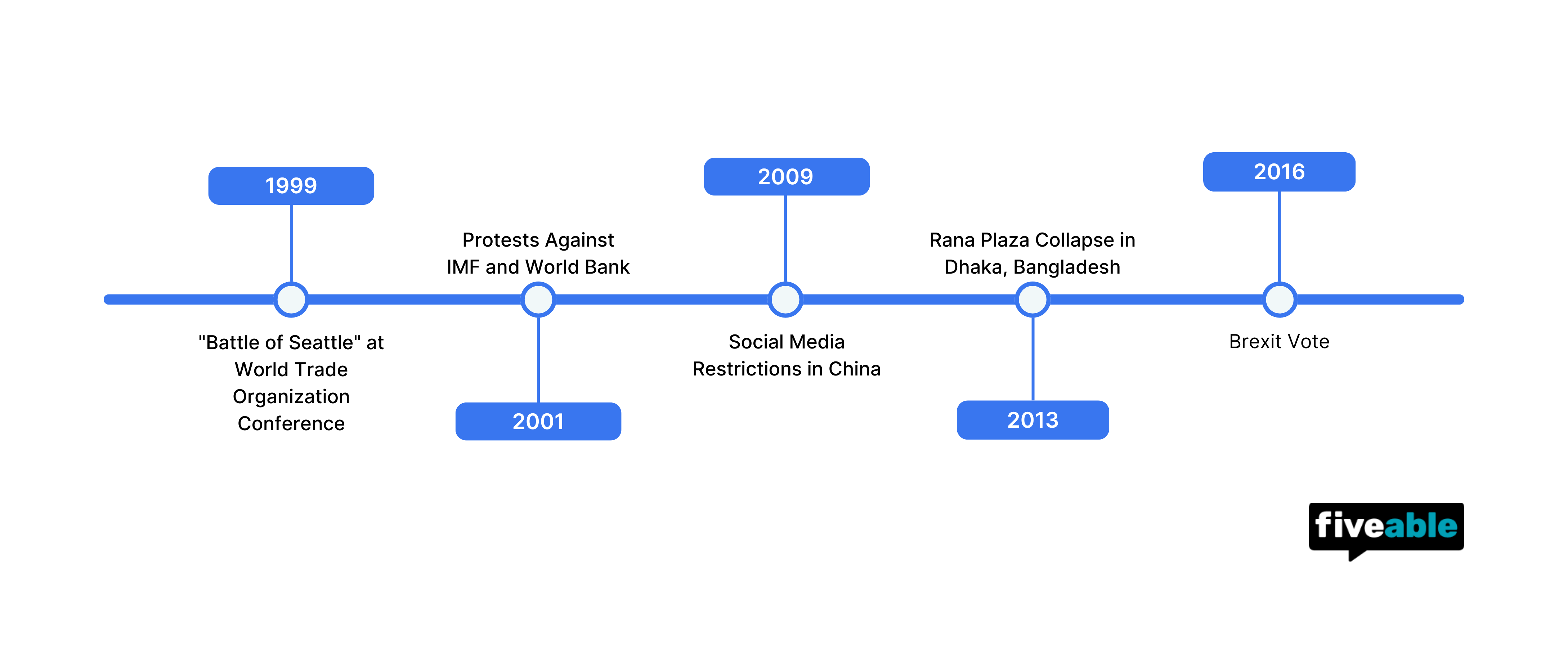
Timeline of key events in the resistance to globalization. Image courtesy of Samhitha.
Key Takeaways
- As trade barriers fell and the WTO expanded global trade rules, protesters in Seattle challenged the organization over concerns about whose interests it served.
- Child labor in cocoa production and the Rana Plaza collapse exposed hidden costs for workers, while long-distance shipping and rainforest clearing raised environmental concerns.
- Brexit reflected a different objection to globalization: some British voters and politicians believed the European Union threatened Britain's ability to govern itself.
- Economic critics said institutions such as the IMF and World Bank favored wealthy nations and large corporations, while anti-globalists called for fair trade and debt relief.
- Activists spread anti-globalization ideas online, but China banned Twitter and Facebook and introduced Weibo, while critics accused Saudi officials of using social media to intimidate citizens.
The Roots of Globalization and Anti-Globalization
After World War II, a wave of international organizations built the modern global economy, and the anti-globalization movement grew up in reaction to them.
- Between 1947 and the early 1990s, the General Agreement on Tariffs and Trade (GATT), the European Economic Union, Mercosur in South America, and ASEAN (Association of Southeast Asian Nations) all formed to strengthen economies and expand prosperity.
- Falling tariff rates made it easier for goods to cross national borders, accelerating global trade.
- In 1995, the World Trade Organization (WTO) took over GATT's operations. The WTO makes rules covering more than 90 percent of international trade.
- The WTO's closed board meetings fed a perception that it cared about profit, not people's welfare.
The "Battle of Seattle" (1999)
When the WTO met in Seattle in 1999 to plan trade negotiations for the new millennium, more than 40,000 protesters showed up and shut the meeting down.
- The crowd was a coalition of special interest groups: labor unions, family farmers, student groups, and environmentalists.
- Anti-WTO demonstrations spread to dozens of other countries.
- Many people consider Seattle the beginning of the anti-globalization movement, and it was one of the first social movements coordinated through the internet.
- The protests did not weaken the WTO much. China joined in 2001, expanding the organization's territorial and economic reach.
Why Resist Globalization?
The core complaint was a knowledge gap. Consumers buying products with a few clicks often had no idea who made those products or what the real short-term and long-term costs were. A string of scandals exposed those hidden costs.
Harsh Working Conditions
- Much of the chocolate sold in the early 21st century traced back to child labor in West Africa. The biggest chocolate companies missed deadlines in 2005, 2008, and 2010 to certify their suppliers were child-labor free. In 2015, the U.S. Department of Labor estimated more than 2 million children were doing dangerous labor in cocoa-growing regions.
- Conditions in Western nations could be harsh too. In 2019, Amazon warehouse employees described pressure so intense that workers risked being fired for taking a bathroom break. Amazon employed more than 600,000 people at the time, plus another 100,000 during the holidays.
- In 2013, the Rana Plaza factory, an eight-story building in Dhaka, Bangladesh, collapsed. More than 1,000 people died and another 2,500 were injured, most of them female garment workers making clothing for Western companies. Muhammad Yunus, the Bangladeshi Nobel Peace Prize winner, called it "a symbol of our failure as a nation" and proposed an international minimum wage.
Environmental Damage
- Shipping products vast distances burns fuel, increasing greenhouse gases and worsening the climate emergency.
- In the early 21st century, Brazil cleared thousands of square miles of rainforest each year for cattle farms. The meat became one of Brazil's most valuable exports.
- Globalization's defenders push back with examples like Costa Rica, where ecotourism turns natural wonders into profit without destroying them. For more on the environmental side of this period, see the AMSCO 9.3 Technology and the Environment notes.
Threats to National Sovereignty
Resistance didn't come only from the left. Many conservative groups distrusted globalization because it seemed to override national self-rule.
- The clearest example is Brexit. In 2016, 52 percent of British voters chose to leave the European Union, then a 28-country political and economic organization that Britain had helped found in 1993.
- Conservative British politicians argued the EU interfered with Britain's right to govern itself, and many Brexit supporters said the EU forced Britain to accept too many immigrants.
- Prime Minister Theresa May couldn't craft an exit deal acceptable to her own party, let alone the other 27 EU nations. She resigned in 2019.
- Brexit critics warned that leaving would be economically disastrous for an island nation dependent on imports.
A useful pattern to notice: liberal critics worried globalization harmed workers, children, and the environment; conservative critics worried it harmed national sovereignty. Same target, different reasons.
Economic Resistance
Critics argued that international institutions stacked the deck in favor of large corporations and rich nations.
- Big corporations and transnational businesses could work through the International Monetary Fund (IMF) and WTO; small local businesses could not. Small businesses couldn't cross national borders, extract the natural resources they needed, or tap the wide variety of labor sources big firms used.
- In response, some businesses, especially restaurants, committed to selling locally grown or locally made products.
- The World Bank, a UN-affiliated organization whose mission is improving member states' economic development, drew similar distrust. In 1988, about 20,000 people protested IMF and World Bank meetings in West Berlin, arguing the agencies favored richer nations over poorer ones.
- In 2001 and 2002, anti-IMF and anti-World Bank protests hit 23 countries, including many of the world's poorest.
- The World Bank reformed its structure and governance in 2014, but critics maintained the richest nations still controlled it. The AMSCO 9.8 notes on global institutions cover the World Bank and similar organizations in more depth.
What Anti-Globalists Want
The movement grew into a broader social movement focused on four goals:
- Human rights, the basic freedoms every person has, like freedom from slavery and freedom to express opinions
- Fair trade, a system ensuring the person who provided a good or service receives reasonable payment for it
- Sustainable development, business that makes a profit without preventing future generations from meeting their own needs
- Debt relief or debt restructuring, so countries that owe huge sums to the IMF don't risk economic breakdown
Anti-Globalization and Social Media
Activists used the internet to spread anti-globalization ideas to nearly every country on Earth, but some governments fought back by controlling social media itself.
China: Banning and Replacing
- In 2009, more than 1,000 rioters clashed with police in Urumqi, China, amid tensions between the Han ethnic majority and the mostly Muslim Uighur minority.
- Chinese authorities blamed Twitter and Facebook for fueling the unrest and banned both platforms.
- The government introduced Weibo as a substitute. It streams posts while tracking and blocking "sensitive" content, and it has become a vehicle of negotiation between the Chinese government and its citizens. Weibo is the textbook example of a locally developed social media platform created as a response to globalization, so it's worth knowing cold.
Saudi Arabia: Allowing but Controlling
- Some governments permit social media but shape its content. Critics contend Saudi officials use Twitter and Facebook to harass and intimidate citizens.
- Women's rights activist Manal al-Sharif put it bluntly: "If the same tools we joined for our liberation are being used to oppress us and undermine us, and used to spread fake news and hate, I'm out of these platforms."
The chapter's closing point: economic and cultural interconnection threatens some people's and governments' sense of autonomy and identity, and that tension drives resistance. This is the flip side of the cultural spread covered in the AMSCO 9.6 Globalized Culture notes.
Key Terms to Know
| Term | Why it matters |
|---|---|
| Brexit | Britain's 2016 vote (52 percent) to leave the EU, the chapter's main example of resisting globalization to protect national sovereignty. |
| Theresa May | British prime minister who failed to negotiate an acceptable Brexit deal and resigned in 2019. |
| Rana Plaza factory | Eight-story building in Dhaka, Bangladesh that collapsed in 2013, killing over 1,000 mostly female garment workers and exposing globalization's labor costs. |
| Muhammad Yunus | Bangladeshi Nobel Peace Prize winner who called Rana Plaza "a symbol of our failure as a nation" and proposed an international minimum wage. |
| Child labor | Over 2 million children worked in dangerous cocoa-region labor as of 2015, showing the hidden human cost of cheap global goods. |
| Amazon | U.S. company whose warehouse workers reported intense pressure in 2019, proof that harsh conditions exist in Western nations too. |
| Ecotourism | Tourism that profits by showing off a country's natural wonders (Costa Rica is the go-to example) and a pro-globalization counterargument on the environment. |
| Human rights | Basic freedoms every person has, such as freedom from slavery and freedom of expression, and a core anti-globalist goal. |
| Fair trade | A system ensuring the person who provided a good or service receives reasonable payment for it. |
| Sustainable development | Profit-making that doesn't prevent future generations from meeting their own needs. |
| Debt relief / debt restructuring | Easing or rewriting the loan terms of countries that owe huge sums to the IMF so they avoid economic breakdown. |
| China's substitute social media platform after the 2009 Twitter and Facebook ban, designed to track and block "sensitive" content. | |
| Uighur | Mostly Muslim ethnic group whose tensions with the Han in Urumqi in 2009 triggered China's social media crackdown. |
| Manal al-Sharif | Saudi women's rights activist who quit social media platforms after governments turned them into tools of oppression. |
Practice and Next Steps
Pair these chapter notes with the 9.7 Resistance to Globalization After 1900 course study guide, which frames the same content the way the exam tests it. You can browse every chapter summary on the AMSCO Notes hub, and the next chapter, AMSCO 9.8 on global institutions, picks up with the World Bank and the UN.
To check yourself, run some AP World multiple choice practice on Unit 9, then try writing about responses to globalization with FRQ practice and instant scoring. The key terms glossary is handy for quick definition lookups while you review.
Frequently Asked Questions
What does AMSCO Topic 9.7 Resistance to Globalization cover?
AMSCO 9.7 (p. 688-695) covers responses to globalization from 1900 to the present: the 1999 Battle of Seattle WTO protests, labor scandals like child labor in cocoa farming and the Rana Plaza collapse, environmental criticism, Brexit, anti-IMF and anti-World Bank activism, and government control of social media in China and Saudi Arabia. The big takeaway is that resistance came from both liberal and conservative groups for different reasons.
What was the Battle of Seattle in 1999?
The Battle of Seattle was a 1999 protest where more than 40,000 people, including labor unions, family farmers, student groups, and environmentalists, shut down a WTO conference in Seattle. Many consider it the start of the anti-globalization movement, and it was one of the first social movements coordinated through the internet. The WTO stayed powerful, though, and China joined in 2001.
Why is Weibo important for AP World Unit 9?
Weibo is the go-to example of a locally developed social media platform created in response to globalization. After 2009 riots in Urumqi between Han and Uighur groups, China banned Twitter and Facebook and introduced Weibo, which streams posts while tracking and blocking 'sensitive' content. It shows how some governments accept economic globalization while resisting cultural globalization.
Did only liberal groups resist globalization?
No, resistance came from across the political spectrum. Liberal critics focused on harm to workers, children, and the environment (think Rana Plaza and rainforest clearing in Brazil), while conservative groups distrusted globalization as a threat to national sovereignty. Brexit, where 52 percent of British voters chose to leave the EU in 2016 over self-governance and immigration concerns, is the chapter's main conservative example.
How does Topic 9.7 show up on the AP World exam?
Topic 9.7 asks you to explain the various responses to increasing globalization from 1900 to the present, so expect questions comparing different forms of resistance: anti-IMF and anti-World Bank activism, locally developed platforms like Weibo, and sovereignty movements like Brexit. It pairs well with continuity-and-change questions across Unit 9. Try some AP World practice questions to test yourself on this material.
See Fiveable more often in Google
Mark Fiveable as a preferred source and Google is more likely to show you our guides in Top Stories, with a "preferred" badge in AI Mode and AI Overviews.