AMSCO 4.7 Changing Social Hierarchies Notes

🌍AP World History: Modern Review
AMSCO 4.7 Changing Social Hierarchies Notes
🌍 AP World History: Modern
AMSCO 1.1 Developments in East Asia Notes
AMSCO 1.2 Developments in Dar al-Islam Notes
AMSCO 1.3 Developments in South and Southeast Asia Notes
AMSCO 1.4 Developments in the Americas Notes
AMSCO 1.5 Developments in Africa Notes
AMSCO 1.6 Developments in Europe Notes
AMSCO 1.7 Comparison in the Period from c.1200 to c.1450 Notes
AMSCO 2.1 The Silk Roads Notes
AMSCO 2.2 The Mongol Empire and the Modern World Notes
AMSCO 2.3 Exchange in the Indian Ocean Notes
AMSCO 2.4 Trans-Saharan Trade Routes Notes
AMSCO 2.5 Cultural Consequences of Connectivity Notes
AMSCO 2.6 Environmental Consequences of Connectivity Notes
AMSCO 2.7 Comparison of Economic Exchange Notes
AMSCO 3.1 European, East Asian, and Gunpowder Empires Expand Notes
AMSCO 3.2 Empires: Administrations Notes
AMSCO 3.3 Empires: Belief Systems Notes
AMSCO 3.4 Comparison in Land-Based Empires Notes
AMSCO 4.1 Technological Innovations Notes
AMSCO 4.2 Exploration: Causes and Events Notes
AMSCO 4.3 Columbian Exchange Notes
AMSCO 4.4 Maritime Empires Link Regions Notes
AMSCO 4.5 Maritime Empires Develop Notes
AMSCO 4.6 Internal and External Challenges to State Power Notes
AMSCO 4.7 Changing Social Hierarchies Notes
AMSCO 4.8 Continuity and Change from c.1450 to c.1750 Notes
AMSCO 5.1 The Enlightment Notes
AMSCO 5.2 Nationalism and Revolutions Notes
AMSCO 5.3 Industrial Revolution Begins Notes
AMSCO 5.4 Industrialization Spreads Notes
AMSCO 5.5 Technology in the Industrial Age Notes
AMSCO 5.6 Industrialization: Government's Role Notes
AMSCO 5.7 Economic Developments and Innovations Notes
AMSCO 5.8 Reactions to the Industrial Economy Notes
AMSCO 5.9 Society and the Industrial Age Notes
AMSCO 5.10 Continuity and Change in the Industrial Age Notes
AMSCO 6.1 Rationales for Imperialism Notes
AMSCO 6.2 State Expansion Notes
AMSCO 6.3 Indigenous Responses to State Expansion Notes
AMSCO 6.4 Global Economic Development Notes
AMSCO 6.5 Economic Imperialism Notes
AMSCO 6.6 Causes of Migration in an Interconnected World Notes
AMSCO 6.7 Effects of Migration Notes
AMSCO 6.8 Causation in the Imperial Age Notes
AMSCO 7.1 Shifting Power Notes
AMSCO 7.2 Causes of World War I Notes
AMSCO 7.3 Conducting World War I Notes
AMSCO 7.4 Economy in the Interwar Period Notes
AMSCO 7.5 Unresolved Tensions After World War I Notes
AMSCO 7.6 Causes of World War II Notes
AMSCO 7.7 Conducting World War II Notes
AMSCO 7.8 Mass Atrocities Notes
AMSCO 7.9 Causation in Global Conflict Notes
AMSCO 8.1 Setting the Stage for the Cold War and Decolonization Notes
AMSCO 8.2 The Cold War Notes
AMSCO 8.3 Effects of the Cold War Notes
AMSCO 8.4 Spread of Communism Notes
AMSCO 8.5 Decolonization after 1900 Notes
AMSCO 8.6 Newly Independent States Notes
AMSCO 8.7 Global Resistance to Established Power Structure Notes
AMSCO 8.8 End of the Cold War Notes
AMSCO 8.9 Causation in the Age of the Cold Ward and Decolonization Notes
AMSCO 9.1 Advances in Technology and Exchange Notes
AMSCO 9.2 Technological Advancements and Limitations Notes
AMSCO 9.3 Technology and the Environment Notes
AMSCO 9.4 Economics in the Global Age Notes
AMSCO 9.5 Calls for Reforms and Responses Notes
AMSCO 9.6 Globalized Culture Notes
AMSCO 9.7 Resistance to Globalization Notes
AMSCO 9.8 Institutions Developing in a Globalized World Notes
AMSCO 9.9 Continuity and Change in a Globalized World Notes
Overview
AMSCO Topic 4.7, Changing Social Hierarchies (AMSCO p. 251-260), covers how societies between 1450 and 1750 organized people into classes and how those rankings shifted under new rulers, new wealth, and new conquests. The big pattern: some states accommodated diversity to keep their empires running (the Ottomans welcoming Jews, Akbar ending the jizya), while others suppressed it (Spain expelling Jews in 1492, the Qing forcing Han men to wear queues). Meanwhile, conquest created brand-new elites, like the Manchu in China and the peninsulares atop the Casta system in the Americas, and old elites like Russian boyars and European nobles fought to hold their ground against increasingly powerful monarchs.
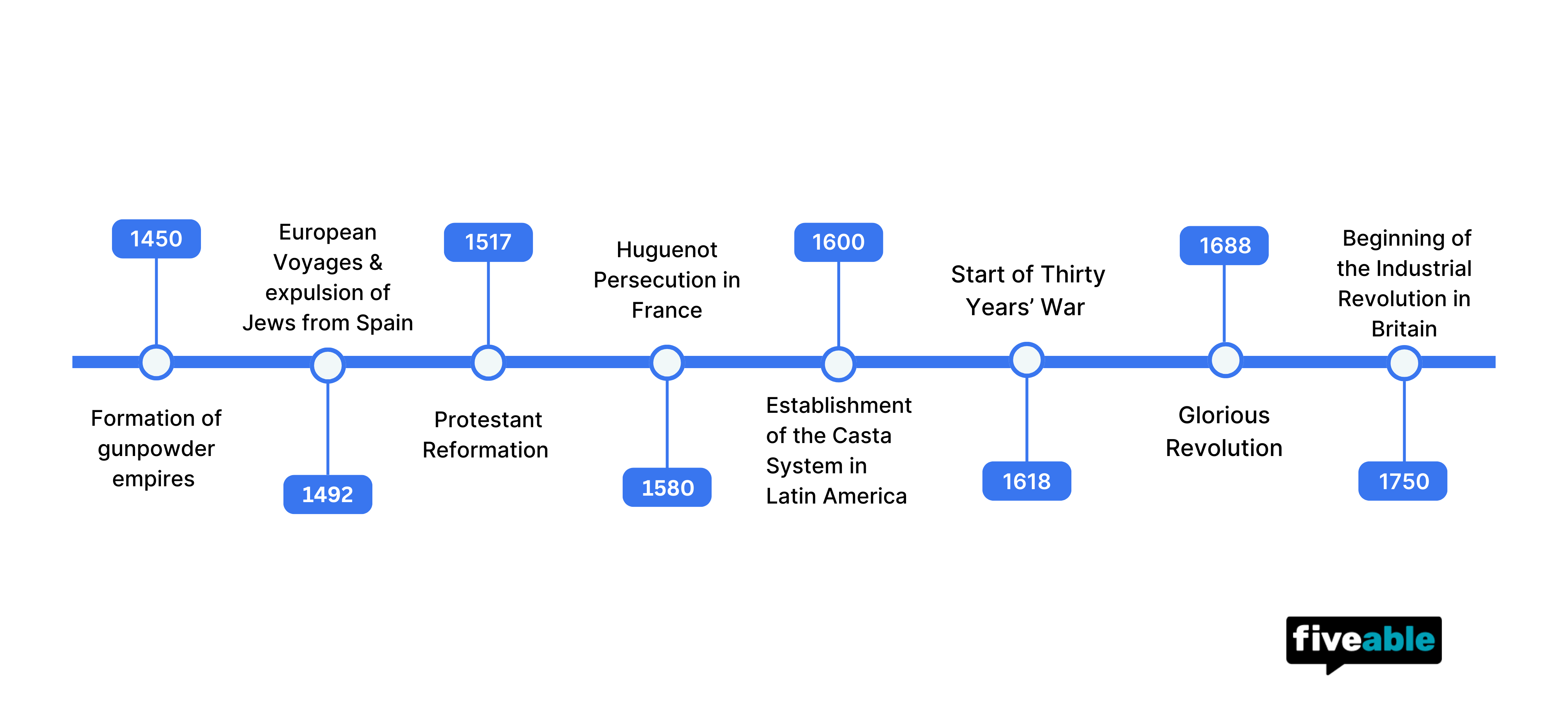
Timeline of social hierarchies development. Image Courtesy of Tien.
The chapter opens with the Edict of the Expulsion of the Jews (1492), in which Ferdinand and Isabella ordered Jews out of Spain. Jews had already been expelled from England (1290) and France (1394). Huguenots (French Protestants in Catholic France) faced similar persecution and fled to other countries or colonies. States also propped up elite classes, like the boyars in Russia and the nobility in Western Europe, who both supported and challenged royal power.
Key Takeaways
- Ottoman Janissaries tried to overthrow sultans, who used timar grants to reward loyal soldiers; Sultan Bayezid II also welcomed Jews expelled from Spain.
- Akbar promoted religious toleration by ending the jizya and supporting several faiths, while Roxelana's rise from enslavement to public works commissioner showed that social mobility was possible but rare.
- The Qing gave Manchus top government positions while keeping Chinese institutions, but required Han men to wear queues as a loyalty test.
- Landowning elites held political power in England and the Netherlands, but in France Louis XIV kept power from both nobles and commoners after a failed uprising.
- In Russia, Ivan IV defeated boyars who opposed his expansion, while serfs remained bound to nobles' land and transferred with it when it was sold.
- The Casta system ranked people in the Americas by race and ancestry, with peninsulares at the top; those at the bottom paid higher taxes and tributes.
Social Classes and Minorities in the Gunpowder Empires
The Ottoman, Safavid, and Mughal empires are called gunpowder empires because they succeeded militarily by adopting guns and cannons when those weapons first became widely available. All three dealt with tension between military elites and absolutist rulers.
Ottoman Society
The Ottoman system was built around a warrior aristocracy that competed for bureaucratic positions with the ulama, scholars and experts in Islamic law. Within the military, the Janissaries gained so much power and prestige that they eventually tried to mount coups against the sultans.
As sultans grew weaker, viziers (powerful advisors) increasingly spoke for them in government. But the sultan kept real leverage through timar, a system of granting land or tax revenues to people he favored. Timar grants rewarded soldiers and kept them loyal.
Treatment of Religious Minorities
Relative tolerance toward Jews and Christians was one reason the Ottoman Empire succeeded. After Spain expelled its Jews in 1492, Sultan Bayezid II invited them to settle in the Ottoman Empire. Some became court physicians and diplomats, and Jewish settlers may have brought the printing press to the empire. Tolerance had limits, though:
- Jews could live only in specified areas of cities
- All non-Muslims paid the jizya tax
- Top positions in the empire were reserved for Muslims
Religious Toleration in the Mughal Empire
The Mughal Empire began in 1526, and its greatest emperor was probably Akbar the Great (ruled 1556-1605). To hold his huge, fractious empire together, Akbar practiced religious toleration. He ended the jizya tax, gave land and money grants to both Hindus and Muslims, funded a Catholic church, and supported Sikhism.
Women in the Ottoman Empire
Wives and concubines of the sultan promoted their own sons as heirs to the throne, a practice called harem politics (the harem was the residence where a powerful man's wives and concubines lived).
Roxelana is the standout example. Kidnapped from Eastern Europe by Crimean raiders and sold into slavery, she was forced to convert to Islam and entered the harem of Suleiman the Magnificent. Suleiman then married her, which was highly unusual. She went from enslaved person to commissioner of major public works projects, and her son succeeded Suleiman. Viziers grumbled about a "sultanate of the women," complaining the harem had too much political influence. Roxelana's rise shows social mobility was possible in this era, but rare.
Other Ottoman Social Classes
Merchants and artisans formed a small middle class. Below them were peasants, kept poor partly by tribute payments that supported the Ottoman armies. At the bottom were the enslaved, including prisoners of war captured in Ukraine and elsewhere in Central and Eastern Europe. Barbary pirates operating off the North African coast (named for the Berbers who lived there) captured Europeans in the Mediterranean and sold them to the sultan or other officials. Some captives were impressed, meaning forced into service, as galley workers in the navy. As many as one million people were impressed between the 16th and 19th centuries.
Manchu Power and the Qing Dynasty
The Qing Dynasty (1644-1912) put an ethnic minority, the Manchu from Manchuria, in charge of the majority Han Chinese. Like the Mongols 400 years earlier, the Manchu were ethnically and culturally distinct from the people they ruled. Unlike the Mongols, they were determined to make their own culture dominant.
The Qing balanced two strategies. They placed Manchus in top government positions, but they also kept traditional Chinese institutions like the civil service exams and the bureaucracy, recruiting Han Chinese to work under or alongside Manchus. Over time, some (not all) Chinese accepted the Qing as legitimate rulers.
Conflicts with the Han
The Han felt Qing intolerance most severely. Non-official Han civilians could still wear Hanfu (traditional Han clothing), but every man had to wear his hair in a queue, the braided Manchu pigtail. The queue was a loyalty test and a humiliating challenge to traditional Confucian values. Refusing could mean execution.
The Qing also used Han Chinese defectors to massacre Han who refused to assimilate. General Li Chengdong orchestrated three separate massacres in Jiading within a single month, leaving hardly anyone alive in the city. Liu Liangzuo massacred the entire population of Jiangyin, killing between 74,000 and 100,000 people. These defectors played a massive role in the Qing conquest of China.
European Hierarchies
Europe's hierarchy ran royalty, then nobility, then everyone else. Nobles were usually wealthy landowners, and nearly every European state had laws granting them special privileges. Though a small minority of the population, nobles owned most of the land and passed it down through inheritance.
Nobility Gains and Losses
In the Netherlands, Dutch landowners anchored local provincial government. In England, large landowners controlled Parliament, though they had to contend with radical religious sects and a growing middle class.
Elsewhere, nobles lost ground. A failed uprising in France in the mid-1600s convinced Louis XIV to keep power away from both commoners and nobles ("I am the state"). Gunpowder and cannons let monarchs destroy nobles' fortresses and seize their lands. Frederick of Prussia framed absolutism differently: "I am the first servant of the state." Writers piled on too; Thomas More accused nobles of "living in idleness and luxury without doing society any good."
Growing Acceptance of Jews
Jews gained a larger role in many countries starting in the 17th century. Jews who traced their heritage to Spain became known as Sephardic Jews (Sepharad is the Hebrew word for Spain), and many resettled around the Mediterranean, in northern Africa, or the Middle East. Jews from central and eastern Europe became known as Ashkenazi Jews. Under the influence of the Scientific Revolution and the Enlightenment, prejudice declined somewhat. Jews became especially important in banking and commerce, and the Netherlands, tolerant of religious dissent generally, offered Jews less discrimination than most of Europe.
Russian Social Classes
Moscow's hierarchy continued the structure of 11th-century Kievan Rus: boyars (noble landowners) at the top, merchants in the middle, and peasants, the most numerous group, at the bottom. Serfs were the lowest peasants. Bound to a noble's land in exchange for a plot and protection, serfs transferred with the land when it was sold. They were not technically enslaved, but their lives were brutally hard.
Boyars clashed with rulers much like Western European nobles did. When the boyars of Novgorod opposed the expansionist policies of Ivan IV ("Ivan the Terrible," who murdered his own son), Ivan defeated Novgorod, confiscated his opponents' lands, and forced their families to move to Moscow where he could watch them.
The Casta System in the Americas
European arrival, imported African slave labor, and diseases that killed tens of millions drastically reshaped social structures in the Americas (covered in AMSCO 4.3 on the Columbian Exchange). The result was a new hierarchy based on race and ancestry, where skin color signified power and status. In the Spanish and Portuguese empires, this was formalized for centuries.
The Latin American pyramid, top to bottom:
- Peninsulares, born on the Iberian peninsula
- Criollos, of European ancestry but born in the Americas
- Castas, people of mixed-race ancestry, ranked internally as mestizos (European + indigenous), mulattoes (European + African), and zambos (indigenous + African)
- Indigenous peoples and enslaved Africans at the bottom
People were assigned their level at baptism and could only move up through intermarriage. Those at the bottom paid higher taxes and tributes, even though they could least afford them.
Key Terms to Know
| Term | Why it matters |
|---|---|
| Timar | The Ottoman sultan's system of granting land or tax revenues to favorites and soldiers, keeping the military loyal. |
| Bayezid II | Ottoman sultan who invited Jews expelled from Spain in 1492 to settle in the Ottoman Empire. |
| Akbar the Great | Mughal emperor (ruled 1556-1605) who ended the jizya and funded Hindu, Muslim, Catholic, and Sikh institutions. |
| Roxelana | Enslaved woman who married Suleiman the Magnificent, proof that social mobility was possible but rare. |
| Harem | Residence of a powerful man's wives and concubines; "harem politics" meant their influence over succession. |
| Barbary pirates | North African pirates who captured Europeans in the Mediterranean and sold them into Ottoman slavery. |
| Impressed | Forced into service; up to one million people became enslaved galley workers in the Ottoman navy. |
| Manchu | Ethnic minority from Manchuria that ruled Han Chinese as the Qing Dynasty (1644-1912). |
| Queues | Braided Manchu pigtail required of all men under the Qing as a loyalty test; refusal could mean execution. |
| Li Chengdong / Liu Liangzuo | Han Chinese defectors who carried out Qing massacres at Jiading and Jiangyin (74,000-100,000 killed at Jiangyin). |
| Nobility | Europe's landowning elite, which held power in England and the Netherlands but lost ground to absolutist monarchs. |
| Boyar | Russian noble landowner; Ivan IV crushed the Novgorod boyars and confiscated their lands. |
| Serf | Russian peasant bound to a noble's land, not technically enslaved but with little personal freedom. |
| Sephardic / Ashkenazi Jews | Jews tracing heritage to Spain vs. central and eastern Europe; both terms emerged from migration after expulsions. |
| Peninsulares | Top of the Casta system: people born on the Iberian peninsula. |
| Criollo | People of European ancestry born in the Americas, ranked just below peninsulares. |
| Castas | Mixed-race groups in Latin America, ranked as mestizos, mulattoes, and zambos. |
Practice and Next Steps
Go deeper on this topic with the 4.7 Changing Social Hierarchies course study guide, which frames class and race from 1450-1750 the way the exam tests it. This chapter connects directly to AMSCO 4.6 on challenges to state power, since elite resistance and rebellion drove many of these hierarchy shifts, and it sets up AMSCO 4.8 on continuity and change from 1450 to 1750. Find the rest of the unit on the AMSCO notes page.
To check your understanding, drill stimulus-based questions with AP World guided practice, look up unfamiliar vocab in the key terms glossary, and try a comparison or continuity prompt with FRQ practice and instant scoring.
Frequently Asked Questions
What does AMSCO Topic 4.7 Changing Social Hierarchies cover?
AMSCO 4.7 (p. 251-260) covers how social hierarchies shifted from 1450 to 1750: Ottoman tolerance of religious minorities, Akbar's policies in the Mughal Empire, Manchu rule over the Han in Qing China, European nobles losing ground to absolutist kings, Russian boyars and serfs, and the race-based Casta system in the Americas. The core theme is that some states accommodated diversity while others suppressed it.
What was the Casta system in Latin America?
The Casta system was a formal social hierarchy in Spanish and Portuguese colonies based on race and ancestry. Peninsulares (born in Iberia) ranked highest, then criollos (Europeans born in the Americas), then mixed-race castas (mestizos, mulattoes, zambos), with indigenous peoples and enslaved Africans at the bottom. People were assigned a level at baptism and could only move up through intermarriage, and lower groups paid higher taxes.
Why did the Ottoman Empire welcome Jews when Spain expelled them?
After Ferdinand and Isabella expelled Jews from Spain in 1492, Sultan Mehmed II invited them to settle in Istanbul, where some became court physicians and diplomats. Ottoman tolerance was practical: religious minorities contributed economically and politically. But it wasn't equality. Jews lived in designated areas, paid the jizya tax required of all non-Muslims, and were barred from top positions reserved for Muslims.
Were the Qing like the Mongols in how they ruled China?
Partly, but with a key difference. Like the Mongols, the Manchu were an ethnic minority who put their own people in top government posts while keeping Chinese institutions like the civil service exam. Unlike the Mongols, the Qing were less tolerant and tried to make Manchu culture dominant, forcing all men to wear queues on pain of execution and using Han defectors like Li Chengdong to massacre cities that resisted.
How does Topic 4.7 show up on the AP World exam?
Topic 4.7 is great material for comparison and continuity-and-change questions, like comparing how the Ottomans and Qing treated minorities, or how elites (timars, boyars, European nobles) lost power to absolutist rulers. Roxelana, the Casta system, and the queue requirement are common evidence in short-answer and essay responses. Practice applying them with FRQ practice and instant scoring.
See Fiveable more often in Google
Mark Fiveable as a preferred source and Google is more likely to show you our guides in Top Stories, with a "preferred" badge in AI Mode and AI Overviews.