AMSCO 7.7 Conducting World War II Notes

🌍AP World History: Modern Review
AMSCO 7.7 Conducting World War II Notes
🌍 AP World History: Modern
AMSCO 1.1 Developments in East Asia Notes
AMSCO 1.2 Developments in Dar al-Islam Notes
AMSCO 1.3 Developments in South and Southeast Asia Notes
AMSCO 1.4 Developments in the Americas Notes
AMSCO 1.5 Developments in Africa Notes
AMSCO 1.6 Developments in Europe Notes
AMSCO 1.7 Comparison in the Period from c.1200 to c.1450 Notes
AMSCO 2.1 The Silk Roads Notes
AMSCO 2.2 The Mongol Empire and the Modern World Notes
AMSCO 2.3 Exchange in the Indian Ocean Notes
AMSCO 2.4 Trans-Saharan Trade Routes Notes
AMSCO 2.5 Cultural Consequences of Connectivity Notes
AMSCO 2.6 Environmental Consequences of Connectivity Notes
AMSCO 2.7 Comparison of Economic Exchange Notes
AMSCO 3.1 European, East Asian, and Gunpowder Empires Expand Notes
AMSCO 3.2 Empires: Administrations Notes
AMSCO 3.3 Empires: Belief Systems Notes
AMSCO 3.4 Comparison in Land-Based Empires Notes
AMSCO 4.1 Technological Innovations Notes
AMSCO 4.2 Exploration: Causes and Events Notes
AMSCO 4.3 Columbian Exchange Notes
AMSCO 4.4 Maritime Empires Link Regions Notes
AMSCO 4.5 Maritime Empires Develop Notes
AMSCO 4.6 Internal and External Challenges to State Power Notes
AMSCO 4.7 Changing Social Hierarchies Notes
AMSCO 4.8 Continuity and Change from c.1450 to c.1750 Notes
AMSCO 5.1 The Enlightment Notes
AMSCO 5.2 Nationalism and Revolutions Notes
AMSCO 5.3 Industrial Revolution Begins Notes
AMSCO 5.4 Industrialization Spreads Notes
AMSCO 5.5 Technology in the Industrial Age Notes
AMSCO 5.6 Industrialization: Government's Role Notes
AMSCO 5.7 Economic Developments and Innovations Notes
AMSCO 5.8 Reactions to the Industrial Economy Notes
AMSCO 5.9 Society and the Industrial Age Notes
AMSCO 5.10 Continuity and Change in the Industrial Age Notes
AMSCO 6.1 Rationales for Imperialism Notes
AMSCO 6.2 State Expansion Notes
AMSCO 6.3 Indigenous Responses to State Expansion Notes
AMSCO 6.4 Global Economic Development Notes
AMSCO 6.5 Economic Imperialism Notes
AMSCO 6.6 Causes of Migration in an Interconnected World Notes
AMSCO 6.7 Effects of Migration Notes
AMSCO 6.8 Causation in the Imperial Age Notes
AMSCO 7.1 Shifting Power Notes
AMSCO 7.2 Causes of World War I Notes
AMSCO 7.3 Conducting World War I Notes
AMSCO 7.4 Economy in the Interwar Period Notes
AMSCO 7.5 Unresolved Tensions After World War I Notes
AMSCO 7.6 Causes of World War II Notes
AMSCO 7.7 Conducting World War II Notes
AMSCO 7.8 Mass Atrocities Notes
AMSCO 7.9 Causation in Global Conflict Notes
AMSCO 8.1 Setting the Stage for the Cold War and Decolonization Notes
AMSCO 8.2 The Cold War Notes
AMSCO 8.3 Effects of the Cold War Notes
AMSCO 8.4 Spread of Communism Notes
AMSCO 8.5 Decolonization after 1900 Notes
AMSCO 8.6 Newly Independent States Notes
AMSCO 8.7 Global Resistance to Established Power Structure Notes
AMSCO 8.8 End of the Cold War Notes
AMSCO 8.9 Causation in the Age of the Cold Ward and Decolonization Notes
AMSCO 9.1 Advances in Technology and Exchange Notes
AMSCO 9.2 Technological Advancements and Limitations Notes
AMSCO 9.3 Technology and the Environment Notes
AMSCO 9.4 Economics in the Global Age Notes
AMSCO 9.5 Calls for Reforms and Responses Notes
AMSCO 9.6 Globalized Culture Notes
AMSCO 9.7 Resistance to Globalization Notes
AMSCO 9.8 Institutions Developing in a Globalized World Notes
AMSCO 9.9 Continuity and Change in a Globalized World Notes
Overview
AMSCO Topic 7.7, Conducting World War II (AMSCO p. 511-517), covers how governments fought the deadliest war in human history, from Germany's blitzkrieg and Japan's Pacific expansion to total war on the home fronts and the atomic bombs that ended the conflict in 1945. The chapter's big question, and the one the AP World exam cares about, is how governments used similar and different methods to wage war: propaganda, intense nationalism, ideology (fascism and communism), new technology, and total mobilization of civilians. World War II killed around 75 million people, two-thirds of them civilians, and set up the Cold War rivalry that shaped the next five decades.
This chapter picks up where AMSCO 7.6 Causes of World War II leaves off and leads into the mass atrocities of 7.8.
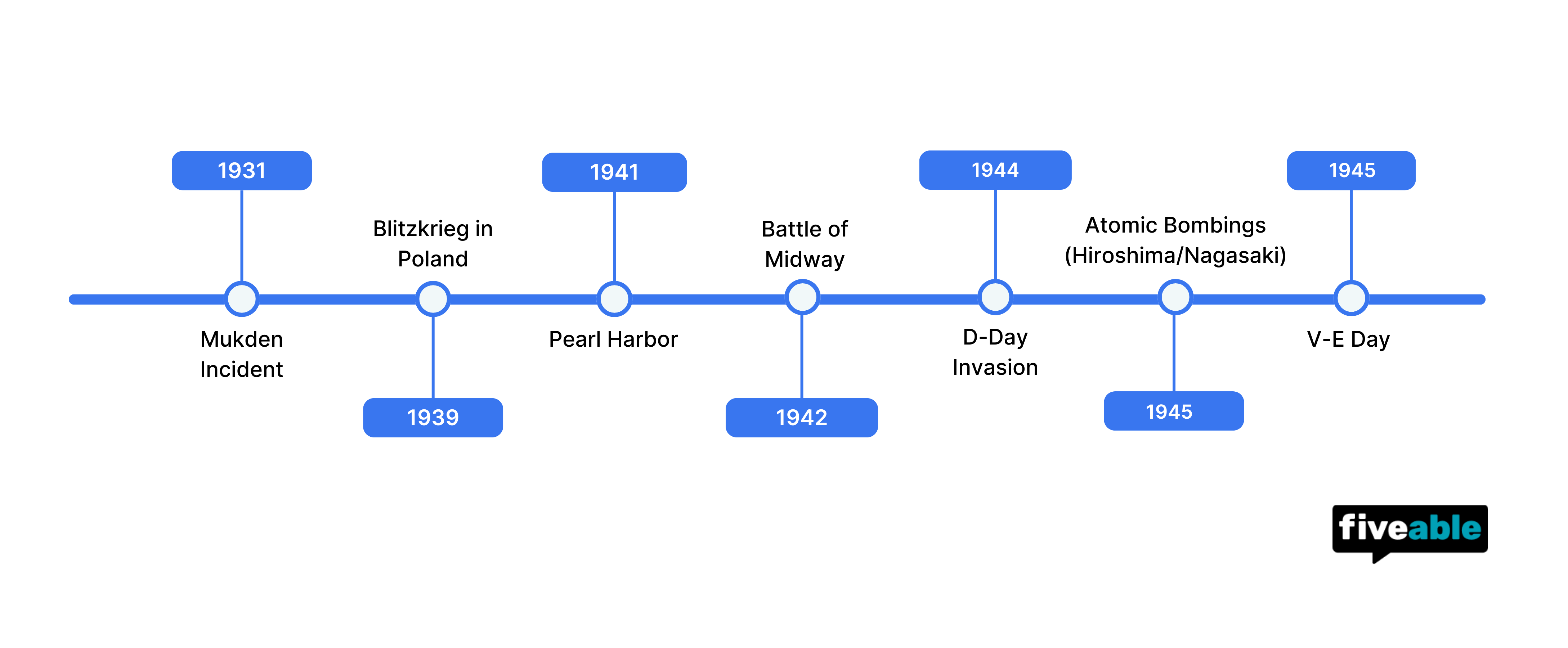
Timeline of key events during World War II. Image courtesy of Riya.
Key Takeaways
- Japan pivoted toward Southeast Asia after the German-Soviet Nonaggression Pact and faced U.S. sanctions over China, while Germany's blitzkrieg conquered Poland and much of Western Europe.
- British planes and radar helped stop Germany's air campaign, Lend-Lease supplied Britain, and Hitler invaded the USSR to wipe out Bolshevism and seize Lebensraum.
- Japan's attack on Pearl Harbor brought the U.S. into the war, and Allied mobilization reached colonies, including India's volunteer army of more than 2.5 million.
- Total war drew U.S. women into factory and office jobs, while Germany relied on forced labor and Japan did not draft women or fully mobilize its resources.
- Stalingrad shifted momentum against Germany, while Midway damaged Japan's fleet and island-hopping moved Allied forces toward Japan.
- D-Day opened the way to liberating Paris, and atomic bombs struck Hiroshima and Nagasaki before Japan surrendered; World War II killed around 75 million people, two-thirds of them civilians.
Japan's Imperialist Push in the Pacific
Japan's military-controlled government wanted a "New Order in East Asia," and that ambition is what turned the war global. The Mukden Incident and the takeover of Manchuria (renamed Manchukuo) were the early moves.
- Japan originally eyed Soviet Siberia for expansion, but the German-Soviet Nonaggression Pact of 1939 closed that option. So Japan pivoted to Southeast Asia, which was controlled by Western European powers and the United States.
- The problem: Japan's occupation of China triggered U.S. economic sanctions. Japan's economy depended on American oil and scrap iron, so sanctions threatened to strangle its economy and stall its military.
- Japan's gamble was to strike the United States militarily, hoping the Western powers would back off and accept Japanese imperial ambitions. That gamble became Pearl Harbor.
Germany's Early Victories in Europe
Hitler's blitzkrieg ("lightning war") strategy used fast-moving tank divisions backed by air power, and it worked terrifyingly well at first. Poland fell in a four-week campaign in September 1939, then Germany and the Soviets split the country as planned under their Nonaggression Pact.
- April 1940: Germany conquered Denmark and Norway. May 1940: the Netherlands, Belgium, and France fell.
- Germany took direct control of northern France. A pro-Nazi puppet government was set up in Vichy under Marshal Henri-Philippe Pétain, an aged World War I hero.
Britain Holds Out (and the U.S. Helps)
Fearing it was next, Britain turned to the United States, and Roosevelt moved past American isolationism step by step.
- The 1940 Destroyers-for-Bases Agreement traded 50 U.S. destroyers for eight British air and naval bases in the Western Hemisphere.
- The 1941 Lend-Lease Act dropped any pretense of neutrality by lending war materials to Britain.
- The 1941 Atlantic Charter laid out post-war goals: restoring self-government to peoples deprived of it, abandoning the use of force, and disarming aggressor nations.
In the Battle of Britain (starting July 1940), Hitler sent the Luftwaffe to bomb Britain into submission before an invasion. Germany first hit military bases, then switched to bombing cities after the Royal Air Force raided Berlin. That switch backfired. It gave the British military time to rebuild its bases, and Britain's superior planes and radar destroyed German planes faster than Germany could replace them. Churchill called the civilian endurance of months of bombing Britain's "finest hour." By May 1941, Hitler postponed the invasion indefinitely.
Germany Invades the Soviet Union
In June 1941, Hitler attacked the USSR to wipe out Bolshevism and seize Lebensraum, "living space" for German settlement. The invasion started fast, capturing huge territory and two million Soviet troops, but the harsh Russian winter ground it down. The Siege of Leningrad lasted three years and killed a million Soviet men, women, and children.
Pearl Harbor and a Truly Global War
On December 7, 1941, Japan launched a surprise air attack on the U.S. naval base at Pearl Harbor, Hawaii, destroying much of the U.S. Pacific Fleet. Japan then rapidly seized the Philippines, the Dutch East Indies, British Malaya, Burma, and many Pacific islands.
- Japan expected the attack to force the U.S. into a quick, favorable settlement. Instead, isolationism disappeared overnight and American public opinion demanded retaliation.
- Britain and China joined the U.S. against Japan, and within days Hitler declared war on the United States. The war was now genuinely global.
Colonial Armies
Western colonies joined the Allied effort in huge numbers. The Indian Army grew from 200,000 men at the war's start to more than 2.5 million, the largest volunteer army in history. It sent troops to North Africa, but most fought the Japanese in Southeast Asia. This is your go-to example for how mobilization extended to colonies, not just home countries.
Home Fronts and Total War
World War II was a total war, meaning governments mobilized everything, including civilians, to win. The comparisons here are exactly what the topic's essential question is about.
- United States: Already the world's strongest industrial power, the U.S. added strict government planning and ramped up production of ships, tanks, planes, landing craft, radar, guns, and ammunition. Unlike anywhere in Europe, American factories faced no threat of military attack. With men enlisting, women filled factory and office jobs, encouraged by government "Rosie the Riveter" art.
- Germany: Instead of mobilizing all citizens, Germany relied on forced labor, some of it in concentration camps. At its peak, 20 percent of the wartime workforce was forced labor, including 600,000 French citizens in German war plants and 1.5 million French soldiers in POW camps. It was counterproductive: workers were treated so badly that productivity stayed low.
- Japan: Home-front efforts were confused. The government pushed an optimistic picture of the war rather than fully mobilizing resources, and it took pride in not drafting women, citing "consideration for the family system." It did successfully ration food and evacuate children from cities when bombing began late in the war.
The Tide Turns, 1942-1943
The second half of 1942 was the turning point in both theaters. The U.S. joined Britain and the USSR as the major Allied powers, and despite political differences they agreed Axis surrender had to be unconditional.
European Theater
- In early 1942, General Erwin Rommel (the "Desert Fox") led German troops in Egypt and threatened Alexandria. The British defeated him at the Battle of El Alamein.
- After months of fighting, a Soviet counteroffensive defeated the German Sixth Army at the Battle of Stalingrad. Germany still held most of Western Europe, but momentum had shifted against the Nazis.
Pacific Theater
- May 1942: the Battle of the Coral Sea, the first Allied victory, stopped a Japanese fleet headed for New Guinea and the Solomon Islands and helped prevent an invasion of Australia.
- June 1942: the Battle of Midway Island destroyed four Japanese aircraft carriers and proved Allied naval superiority in the Pacific.
- The first major Allied offensive, on Guadalcanal, ended in Allied victory in early 1943.
Under General Douglas MacArthur, the Allies used island-hopping: attack islands where Japan was weak, skip the ones where it was strong, and move steadily (at great human cost) toward Japan itself. Technology mattered enormously. Aircraft carriers let planes take off and land at sea, extending naval range and flexibility, and submarines sank about 55 percent of the Japanese merchant fleet, wrecking Japan's supply lines.
The Last Years of the War
From 1943 on, the Axis powers were on the defensive everywhere.
Defeating Germany
- The Allies hit Italy first as the weakest Axis point, taking Sicily in July 1943 (which led to Mussolini's fall), invading southern Italy in September, and recapturing Rome on June 4, 1944. Italy turned against Germany.
- D-Day, June 6, 1944: about 150,000 Allied troops under General Dwight Eisenhower launched an amphibious invasion from England onto the beaches of Normandy. Casualties were high, but the Allies established a base and liberated Paris in August.
- The Battle of the Bulge (winter 1944, in the Ardennes Forest across France, Belgium, and Luxembourg) was Germany's last big push. The Allied victory left Germany with no realistic chance of winning. Allied troops crossed the Rhine in March 1945.
- On the Eastern Front, the Soviets won the Battle of Kursk (July 1943), the largest tank battle of the war, by holding a defensive position against German blitzkrieg and then counterattacking. They swept through Ukraine, the Baltic States, Warsaw (January 1945), Hungary, Romania, and Bulgaria, and advanced on Berlin in April 1945.
- Hitler committed suicide in his Berlin bunker on April 30, 1945, two days after Italian resistance fighters killed Mussolini. Germany surrendered in early May. May 8, 1945 is V-E Day (Victory in Europe Day).
Defeating Japan
- In 1945, U.S. forces captured Iwo Jima (February-March) and Okinawa (April-June). In March 1945, the fire-bombing of Tokyo killed about 100,000 people and left about a million homeless. Japan's emperor still wouldn't surrender.
- Fearing enormous casualties from invading the Japanese mainland, President Truman ordered the atomic bomb dropped on Hiroshima on August 6, 1945. A second bomb hit Nagasaki three days later. The two bombings caused an estimated 140,000 Japanese civilian deaths and opened the nuclear age.
- Japan surrendered unconditionally on August 14. Truman designated September 2, the day of the formal surrender ceremony, as V-J Day.
Consequences of World War II
World War II killed around 75 million people, two-thirds of them civilians, making it the bloodiest war in human history. It transformed how people thought about racism, colonial empires, and international relations, themes that drive the rest of Unit 7 and Units 8-9. It also set up the ideological struggle between the United States and the Soviet Union that shaped global affairs for the next five decades.
Key Terms to Know
| Term | Why it matters |
|---|---|
| Blitzkrieg | Germany's "lightning war" of fast tanks plus air support, which conquered Poland in four weeks and most of Western Europe by mid-1940. |
| Vichy | Pro-Nazi French regime under Marshal Pétain that governed after France fell in 1940. |
| Destroyers-for-Bases Agreement | 1940 deal trading 50 U.S. destroyers for eight British bases, an early crack in U.S. isolationism. |
| Lend-Lease Act | 1941 U.S. law lending war materials to Britain, ending any pretense of American neutrality. |
| Atlantic Charter | 1941 U.S.-British statement of post-war goals, including self-government and disarming aggressors. |
| Battle of Britain | German air campaign against Britain in 1940-41 that failed thanks to British planes and radar. |
| Siege of Leningrad | Three-year German siege of a Soviet city that killed a million Soviet civilians and soldiers. |
| Pearl Harbor | Japan's December 7, 1941 surprise attack on the U.S. Pacific Fleet that brought the U.S. into the war. |
| Battle of El Alamein | British victory over Rommel in North Africa that helped turn the tide in 1942. |
| Battle of Stalingrad | Soviet counteroffensive that destroyed the German Sixth Army and shifted momentum in Europe. |
| Battle of Midway Island | June 1942 destruction of four Japanese aircraft carriers; the Pacific turning point. |
| Island-hopping | MacArthur's strategy of attacking weakly held islands and skipping strong ones to approach Japan. |
| D-Day | June 6, 1944 Allied invasion of Normandy under Eisenhower that opened the road to liberating Paris. |
| Battle of the Bulge | Germany's failed final offensive in the Ardennes, winter 1944. |
| Battle of Kursk | July 1943, the largest tank battle of the war; the Soviets beat German blitzkrieg with defense plus counterattack. |
| Hiroshima and Nagasaki | Japanese cities hit by atomic bombs in August 1945, causing about 140,000 civilian deaths and forcing surrender. |
| V-E Day / V-J Day | May 8, 1945 (victory in Europe) and September 2, 1945 (formal Japanese surrender), the war's official end points. |
Practice and Next Steps
Pair these notes with the Fiveable course study guide for Topic 7.7 Conducting World War II, which frames the same material the way exam questions ask it. Then move to AMSCO 7.8 Mass Atrocities for the Holocaust and other wartime atrocities, and AMSCO 7.9 Causation in Global Conflict to tie Unit 7 together.
To check yourself, run some AP World multiple-choice practice on Unit 7, or try FRQ practice with instant scoring. Comparing how the U.S., Germany, Japan, Britain, and the USSR mobilized for total war is classic comparison-essay material. The full set of Unit 7 chapter summaries lives on the AMSCO notes page.
Frequently Asked Questions
What does AMSCO Topic 7.7 Conducting World War II cover?
AMSCO 7.7 (p. 511-517) covers how governments fought World War II: Japan's Pacific expansion, Germany's blitzkrieg, the Battle of Britain, Pearl Harbor, home-front mobilization, the turning points at Stalingrad and Midway, D-Day, and the atomic bombings of Hiroshima and Nagasaki. The big theme is total war, meaning governments mobilized all resources, including civilians, to win.
What does total war mean in World War II?
Total war means governments mobilized all of their resources, including the civilian population, to achieve victory. In WWII this looked different by country: the U.S. used government planning and brought women into factories (Rosie the Riveter), Germany relied on forced labor that made up 20 percent of its wartime workforce at its peak, and Japan refused to draft women and pushed an optimistic picture of the war instead of fully mobilizing.
What were the turning points of World War II?
The second half of 1942 turned the war in both theaters. In Europe, the British beat Rommel at El Alamein and the Soviets destroyed the German Sixth Army at Stalingrad. In the Pacific, the Battle of the Coral Sea stopped Japan's advance and the Battle of Midway destroyed four Japanese aircraft carriers, putting the Allies on the offensive.
Why did Japan attack Pearl Harbor?
U.S. economic sanctions over Japan's occupation of China threatened to strangle Japan's economy, which depended on American oil and scrap iron. Japan gambled that a surprise attack would push the United States into a quick settlement favorable to Japanese imperial ambitions. It backfired: U.S. isolationism disappeared overnight, and within days Hitler's declaration of war against the U.S. made the conflict fully global.
How does Topic 7.7 show up on the AP World exam?
The exam asks you to compare how governments conducted war, so build fluency with contrasts: democracies like Britain under Churchill and the U.S. under Roosevelt versus totalitarian states like Hitler's Germany and Stalin's USSR. Know how propaganda, nationalism, ideology, and new technology (atomic bomb, fire-bombing, aircraft carriers) drove total war and raised casualties. Try a comparison prompt with FRQ practice and instant scoring.
See Fiveable more often in Google
Mark Fiveable as a preferred source and Google is more likely to show you our guides in Top Stories, with a "preferred" badge in AI Mode and AI Overviews.