AMSCO 9.9 Continuity and Change in a Globalized World Notes

🌍AP World History: Modern Review
AMSCO 9.9 Continuity and Change in a Globalized World Notes
🌍 AP World History: Modern
AMSCO 1.1 Developments in East Asia Notes
AMSCO 1.2 Developments in Dar al-Islam Notes
AMSCO 1.3 Developments in South and Southeast Asia Notes
AMSCO 1.4 Developments in the Americas Notes
AMSCO 1.5 Developments in Africa Notes
AMSCO 1.6 Developments in Europe Notes
AMSCO 1.7 Comparison in the Period from c.1200 to c.1450 Notes
AMSCO 2.1 The Silk Roads Notes
AMSCO 2.2 The Mongol Empire and the Modern World Notes
AMSCO 2.3 Exchange in the Indian Ocean Notes
AMSCO 2.4 Trans-Saharan Trade Routes Notes
AMSCO 2.5 Cultural Consequences of Connectivity Notes
AMSCO 2.6 Environmental Consequences of Connectivity Notes
AMSCO 2.7 Comparison of Economic Exchange Notes
AMSCO 3.1 European, East Asian, and Gunpowder Empires Expand Notes
AMSCO 3.2 Empires: Administrations Notes
AMSCO 3.3 Empires: Belief Systems Notes
AMSCO 3.4 Comparison in Land-Based Empires Notes
AMSCO 4.1 Technological Innovations Notes
AMSCO 4.2 Exploration: Causes and Events Notes
AMSCO 4.3 Columbian Exchange Notes
AMSCO 4.4 Maritime Empires Link Regions Notes
AMSCO 4.5 Maritime Empires Develop Notes
AMSCO 4.6 Internal and External Challenges to State Power Notes
AMSCO 4.7 Changing Social Hierarchies Notes
AMSCO 4.8 Continuity and Change from c.1450 to c.1750 Notes
AMSCO 5.1 The Enlightment Notes
AMSCO 5.2 Nationalism and Revolutions Notes
AMSCO 5.3 Industrial Revolution Begins Notes
AMSCO 5.4 Industrialization Spreads Notes
AMSCO 5.5 Technology in the Industrial Age Notes
AMSCO 5.6 Industrialization: Government's Role Notes
AMSCO 5.7 Economic Developments and Innovations Notes
AMSCO 5.8 Reactions to the Industrial Economy Notes
AMSCO 5.9 Society and the Industrial Age Notes
AMSCO 5.10 Continuity and Change in the Industrial Age Notes
AMSCO 6.1 Rationales for Imperialism Notes
AMSCO 6.2 State Expansion Notes
AMSCO 6.3 Indigenous Responses to State Expansion Notes
AMSCO 6.4 Global Economic Development Notes
AMSCO 6.5 Economic Imperialism Notes
AMSCO 6.6 Causes of Migration in an Interconnected World Notes
AMSCO 6.7 Effects of Migration Notes
AMSCO 6.8 Causation in the Imperial Age Notes
AMSCO 7.1 Shifting Power Notes
AMSCO 7.2 Causes of World War I Notes
AMSCO 7.3 Conducting World War I Notes
AMSCO 7.4 Economy in the Interwar Period Notes
AMSCO 7.5 Unresolved Tensions After World War I Notes
AMSCO 7.6 Causes of World War II Notes
AMSCO 7.7 Conducting World War II Notes
AMSCO 7.8 Mass Atrocities Notes
AMSCO 7.9 Causation in Global Conflict Notes
AMSCO 8.1 Setting the Stage for the Cold War and Decolonization Notes
AMSCO 8.2 The Cold War Notes
AMSCO 8.3 Effects of the Cold War Notes
AMSCO 8.4 Spread of Communism Notes
AMSCO 8.5 Decolonization after 1900 Notes
AMSCO 8.6 Newly Independent States Notes
AMSCO 8.7 Global Resistance to Established Power Structure Notes
AMSCO 8.8 End of the Cold War Notes
AMSCO 8.9 Causation in the Age of the Cold Ward and Decolonization Notes
AMSCO 9.1 Advances in Technology and Exchange Notes
AMSCO 9.2 Technological Advancements and Limitations Notes
AMSCO 9.3 Technology and the Environment Notes
AMSCO 9.4 Economics in the Global Age Notes
AMSCO 9.5 Calls for Reforms and Responses Notes
AMSCO 9.6 Globalized Culture Notes
AMSCO 9.7 Resistance to Globalization Notes
AMSCO 9.8 Institutions Developing in a Globalized World Notes
AMSCO 9.9 Continuity and Change in a Globalized World Notes
Overview
AMSCO Topic 9.9, Continuity and Change in a Globalized World, is the final chapter of Unit 9 and pulls the whole period from 1900 to the present together. The chapter answers one essential question: how did science, technology, politics, justice, transportation, communication, and the environment change and stay the same after 1900? The big takeaway is that rapid scientific and technological advances drove sweeping social, economic, political, cultural, and environmental changes, but many of those changes came with unintended consequences, and scholars still disagree about where it all leads.
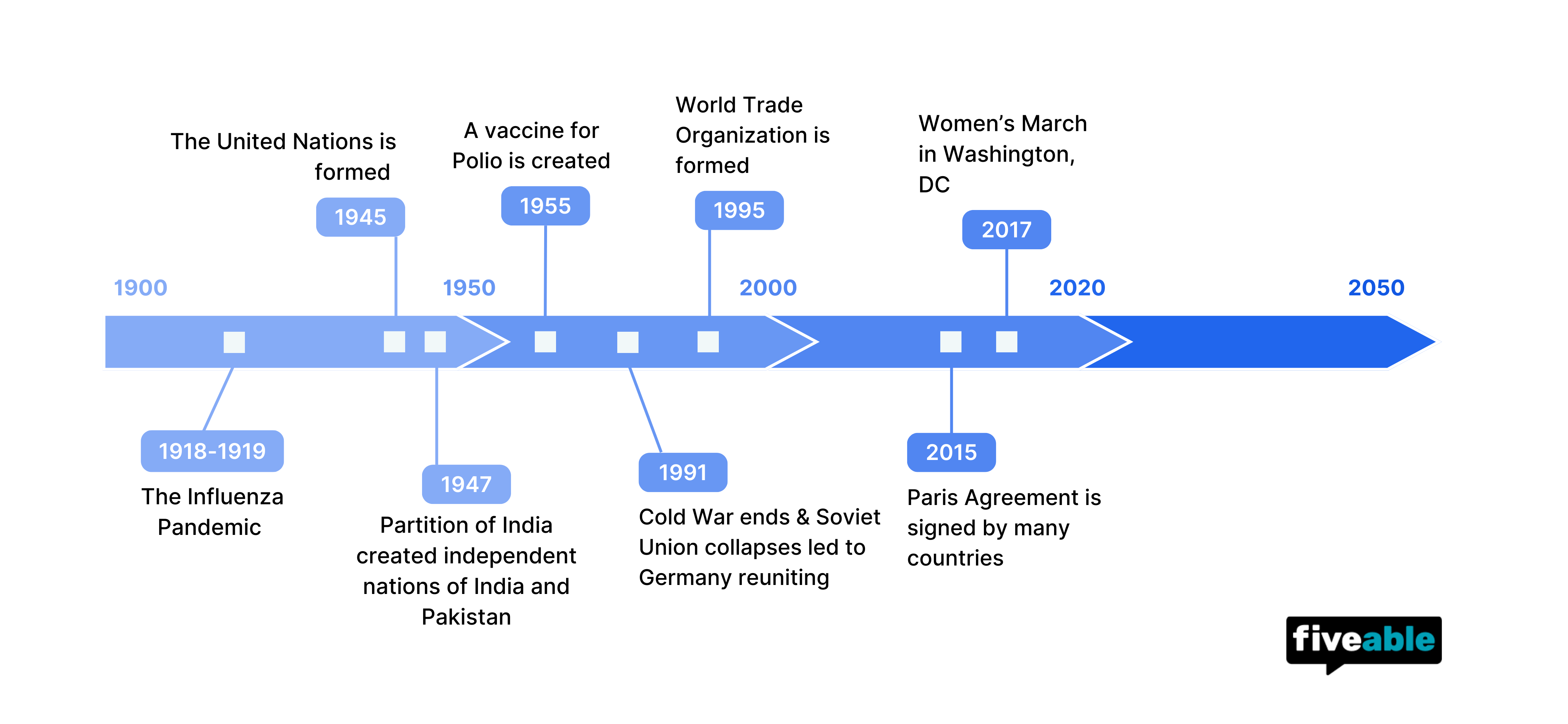
Timeline of events showing the continuing change in the modern world. Image courtesy of Rashmi.
For the College Board version of this material, pair these notes with the 9.9 course topic study guide.
Key Takeaways
- Medical advances helped people live longer, shipping containers expanded global trade, and Green Revolution crops raised yields but reduced biodiversity.
- Rapid population growth strained social orders, migration caused a brain drain in less developed countries, and birth control contributed to declining fertility in developed countries.
- Developed nations continued exploiting less developed regions, while East Asian manufacturing economies and a modernizing China challenged Western economic dominance.
- Mass protests drove political change, including the end of apartheid in South Africa, while governments took a larger role in managing economies.
- Faster movement of people and information intensified two-way cultural exchange, while burning carbon-based fuels and dumping waste increased air and water pollution.
- Fukuyama expected democracy and capitalism to spread, Huntington predicted conflict along religious and cultural lines, and Sen challenged Huntington by pointing to peaceful diversity and multiple identities.
Advances in Science and Technology
Science and technology after 1900 transformed how people understood the universe and how they lived in it. AMSCO organizes the breakthroughs into seven areas:
- Origin of the universe. The Big Bang theory, the idea that the universe began with a single cosmic event, improved understanding of the universe and of atomic and subatomic science.
- Wave science. Discoveries about radio, light, sound, and microwaves improved radio and cellular communications and made internet service faster.
- Medical science. Vaccines and cures arrived for polio, tuberculosis, and tetanus. Antibiotics like penicillin let people survive infections. New treatments helped with chronic diseases like cancer and arthritis. Reliable birth control let women control family size. Together, these advances meant longer, healthier lives.
- Energy technologies. Oil extraction improved, nuclear power became a major energy source, and renewables (wind, solar, thermal) got dramatically cheaper. In 2018, the International Renewable Energy Agency predicted renewables would be consistently cheaper than fossil fuels by 2020. More energy meant more productivity, more material goods, and faster transportation.
- Communication technologies. Radio and television spread, telephones reached most homes, and then the internet and cell phones replaced older systems. Mass communication and global information transfer exploded.
- Transportation technologies. Airplanes appeared in the early 1900s, and jets later shrank distances between world regions. Larger, faster ships carrying prefabricated shipping containers expanded global trade and cultural interaction.
- Agricultural technologies. Genetically modified crops resisted drought and disease and produced higher yields. This Green Revolution fueled higher population growth, especially in developing countries, but also reduced biodiversity as modified crops replaced local varieties.
These advances build directly on the technology story in AMSCO 9.1, so review them together.
Changes in a Globalized World
Science and technology set off ripple effects across every part of society. AMSCO traces five categories of change.
Social Changes
World population grew faster than at any earlier time in history, straining existing social orders. Growth was fastest in developing countries (especially among lower socioeconomic classes), while developed countries saw population growth slow. Better communication and transportation made migration easier, producing a "brain drain" as educated, skilled workers left less developed countries for jobs elsewhere.
Women's socioeconomic status rose, especially in developed countries. Women entered careers traditionally reserved for men, won the right to vote, and in some nations held the highest political offices. Birth control gave women real choices, so fertility declined in developed countries as some women delayed or skipped having children. In some countries, though, women saw little improvement as societies resisted change. AMSCO connects this thread back to the reform movements in Topic 9.5.
Economic Changes
Economic globalization that began in the 1800s intensified. Developed nations kept exploiting less developed regions for raw materials and as markets for finished goods. But the world economic order shifted:
- The West, especially the United States, remained dominant but faced new challengers.
- Japan, Hong Kong, South Korea, Taiwan, and Singapore adopted growth policies built on inexpensive labor and high-quality manufacturing, competing with Western economies in consumer goods and high-tech products.
- China's modernization policies after Mao Zedong's death relaxed government control, and China became the world's second-largest economy and a major exporter.
- India became an economic powerhouse with a labor force specializing in software development and engineering.
Political Changes
Mass protest movements drove political and social change. Demonstrations in India showed how nonviolent resistance could win results. Civil rights activists organized in the United States, Northern Ireland, Canada, and elsewhere. Anti-war protests erupted in the US and Western Europe. Women's rights movements spread from Western democracies across the globe. Protests against apartheid ended racial segregation in South Africa, and democracy movements in North Africa and the Middle East produced the Arab Spring. Governments were sometimes slow to respond, and some persecuted, imprisoned, or attacked protesters.
One more continuity-and-change point worth memorizing: governments began playing a larger role in managing or regulating their economies, a shift away from the free-market, laissez-faire economics of the previous era.
Cultural Changes
Once information and people could move quickly worldwide, cultural exchange intensified. Western culture, especially American movies, TV, and music, was consumed globally, and a consumer culture spread. The big change from earlier eras is that exchange became a two-way street. Global audiences watched Hollywood films, but Chinese, Japanese, Indian, and Latin American cuisine landed on American and European plates, and East Asian music and art found loyal US fans. The internet and cellular technology pushed these exchanges into even the most remote places. This pairs with AMSCO 9.6 on globalized culture.
Environmental Changes
Humans overcame environmental limits in new ways. Jet travel turned global trips from months into hours, new petroleum extraction made energy cheap and abundant, and the Space Age made space exploration possible. But the damage piled up too. Airborne pollution rose as factories, cars, and homes burned carbon-based fuels, and water pollution increased as waste was dumped into rivers, lakes, and oceans. Debates over the causes of climate change grew as global temperatures rose, polar ice caps melted, and weather events became more intense and catastrophic.
Perspectives on the Future
AMSCO closes the chapter with four scholars who disagree about where globalization is heading. These make great evidence for continuity-and-change or argumentation prompts.
- Francis Fukuyama, The End of History and the Last Man (1992). Inspired by the fall of the Soviet Union, Fukuyama argued democracy was the ideal government and capitalism the best economic system, both spreading worldwide. Once every country adopted them, the conflicts that drove past wars would vanish. Critics compared him to Karl Marx, who had also wrongly claimed humanity was entering history's final phase.
- Samuel Huntington, The Clash of Civilizations and the Remaking of World Order (1996). Fukuyama's former teacher rejected the end-of-history argument. Huntington predicted that religion and culture would draw the fault lines of post-Cold War conflict, citing Hindu-Muslim tensions in India and the rise of Islamic fundamentalism hostile to Western culture.
- Amartya Sen, Identities and Violence: The Illusion of Destiny (2006). The Nobel prize-winning economist called Huntington's generalizations oversimplified and pro-Western. Sen pointed to peaceful diverse societies worldwide and argued that globalization gave people many ways to identify themselves beyond religion and ethnicity.
- Michio Kaku, Physics of the Future (2011). Writing once the internet and smartphones connected the globe, the physicist was optimistic that technology and trade could break down cultural barriers and bring material abundance and greater peace.
Unit 9 Essay Prep
These prompts (from the College Board and the AMSCO textbook) are the kind of LEQ this topic feeds into:
- Evaluate the extent to which the spread of free-market ideas led to economic change in the late twentieth century. (College Board, 2022 AP World History Exam, LEQ #4)
- Evaluate the extent to which the effects of the 1918-1919 influenza pandemic were similar to or different from the HIV/AIDS epidemic that began in the 1980s. (AMSCO)
- Evaluate the extent to which the partition of India in 1947 and the partition of Palestine in 1948 were similar or different. (AMSCO)
- Evaluate the extent to which the partition of Germany and the partition of Korea were similar or different from 1945 to the present. (AMSCO)
Quick evidence banks for two of the most common comparisons:
| Aspect | Influenza Pandemic (1918-1919) | HIV/AIDS Epidemic (1980s-present) |
|---|---|---|
| Nature of disease | Highly contagious influenza virus, rapid spread | HIV transmitted via bodily fluids |
| Societal response | Limited medical knowledge, no vaccine, public health strain | Stigma, initial lack of understanding, global health crisis |
| Globalization link | Limited global connectivity, slower spread | Increased global travel sped transmission, harder containment |
| Aspect | Partition of India (1947) | Partition of Palestine (1948) |
| --- | --- | --- |
| Religious/ideological divide | Hindu-Muslim tensions; creation of India and Pakistan | Arab-Jewish conflict; creation of Israel |
| Colonial role | British withdrawal and decolonization | British withdrawal, creation of the State of Israel |
| Human cost | Massive population movements, refugee crisis | Population displacement, Palestinian refugee crisis |
For Germany vs. Korea: both were divided by capitalist and communist powers after WWII (Berlin Wall 1961-1989, Korea's 38th parallel and DMZ), but Germany reunified in 1990 while Korea remains divided with no formal peace treaty after the 1950-1953 Korean War armistice.
Key Terms to Know
| Term | Why it matters |
|---|---|
| Big Bang theory | The best-supported theory that the universe began with a single cosmic event, advancing atomic and subatomic science. |
| Penicillin | The breakthrough antibiotic that let people survive and prevent infections, helping extend lifespans. |
| Birth control | Reliable contraception gave women control over fertility and contributed to declining birth rates in developed countries. |
| Green Revolution | Genetically modified, high-yield crops that drove population growth in developing countries but reduced biodiversity. |
| Shipping containers | Prefabricated containers on larger, faster ships expanded the global trade network. |
| Brain drain | The loss of educated, skilled workers from less developed countries as they migrated for better jobs. |
| Laissez-faire | Free-market economics of the previous era, replaced by greater government management of national economies. |
| Asian economies | Japan, Hong Kong, South Korea, Taiwan, and Singapore used cheap labor and quality manufacturing to challenge the West. |
| Nonviolent resistance | Protest strategy demonstrated in India that won social and political change worldwide. |
| Apartheid | South Africa's racial segregation system, ended by mass protest movements. |
| Arab Spring | Democracy protests and revolutions across North Africa and the Middle East. |
| Consumer culture | Globalized buying habits and entertainment that spread across national borders, often from the US outward. |
| Climate change | Rising global temperatures, melting polar ice, and catastrophic weather linked to carbon-based fuel use. |
| Francis Fukuyama | Argued in The End of History (1992) that democracy and capitalism would spread everywhere and end major conflict. |
| Samuel Huntington | Countered in The Clash of Civilizations (1996) that religion and culture would drive post-Cold War conflict. |
| Amartya Sen | Nobel-winning economist who rejected Huntington, pointing to peaceful diverse societies and multiple identities. |
| Michio Kaku | Physicist whose Physics of the Future (2011) expressed hope that technology and trade would break down cultural barriers. |
Look up any of these in the AP World key terms glossary for fuller definitions.
Practice and Next Steps
- Review the College Board framing of this material in the 9.9 Continuity and Change in a Globalized World study guide.
- Since 9.9 synthesizes the whole unit, skim the rest of the Unit 9 AMSCO notes, especially 9.4 on global economics and 9.7 on resistance to globalization.
- Quiz yourself with guided multiple-choice practice, then take one of the LEQ prompts above to FRQ practice with instant scoring.
Frequently Asked Questions
What is AMSCO Topic 9.9 about in AP World?
Topic 9.9, Continuity and Change in a Globalized World, is the final chapter of Unit 9. It reviews how science, technology, politics, transportation, communication, and the environment changed and stayed the same after 1900, covering everything from the Green Revolution and antibiotics to the Arab Spring and climate change.
What is the difference between Fukuyama and Huntington's views on the post-Cold War world?
Francis Fukuyama argued in The End of History and the Last Man (1992) that democracy and capitalism would spread worldwide and end the conflicts that drove past wars. Samuel Huntington rejected that in The Clash of Civilizations (1996), predicting that religion and culture would draw the fault lines of future conflict, citing Hindu-Muslim tensions in India and Islamic fundamentalism's hostility toward Western culture.
What was the Green Revolution and what were its effects?
The Green Revolution refers to genetically modified crops that resisted drought and disease and produced higher yields. Its biggest effect was higher population growth, especially in developing countries, but it also reduced biodiversity as modified crops replaced local crop varieties. Both the positive and negative effects show up often in continuity-and-change essay prompts.
Did globalization only spread Western culture to the rest of the world?
No, and that's a key change AMSCO highlights. While global audiences consumed American movies, TV, and music, cultural exchange became a two-way street: Chinese, Japanese, Indian, and Latin American cuisine spread to America and Europe, and East Asian music and art built fan bases in the US. The internet and cell phones pushed these exchanges into even remote regions.
How does Topic 9.9 show up on the AP World exam?
Topic 9.9 synthesizes all of Unit 9, so it feeds directly into LEQ and DBQ prompts about change after 1900. A real example: the 2022 AP World exam asked test takers to evaluate how the spread of free-market ideas led to economic change in the late twentieth century. You can practice prompts like that with FRQ practice and instant scoring.
See Fiveable more often in Google
Mark Fiveable as a preferred source and Google is more likely to show you our guides in Top Stories, with a "preferred" badge in AI Mode and AI Overviews.