AMSCO 8.5 Decolonization after 1900 Notes

🌍AP World History: Modern Review
AMSCO 8.5 Decolonization after 1900 Notes
🌍 AP World History: Modern
AMSCO 1.1 Developments in East Asia Notes
AMSCO 1.2 Developments in Dar al-Islam Notes
AMSCO 1.3 Developments in South and Southeast Asia Notes
AMSCO 1.4 Developments in the Americas Notes
AMSCO 1.5 Developments in Africa Notes
AMSCO 1.6 Developments in Europe Notes
AMSCO 1.7 Comparison in the Period from c.1200 to c.1450 Notes
AMSCO 2.1 The Silk Roads Notes
AMSCO 2.2 The Mongol Empire and the Modern World Notes
AMSCO 2.3 Exchange in the Indian Ocean Notes
AMSCO 2.4 Trans-Saharan Trade Routes Notes
AMSCO 2.5 Cultural Consequences of Connectivity Notes
AMSCO 2.6 Environmental Consequences of Connectivity Notes
AMSCO 2.7 Comparison of Economic Exchange Notes
AMSCO 3.1 European, East Asian, and Gunpowder Empires Expand Notes
AMSCO 3.2 Empires: Administrations Notes
AMSCO 3.3 Empires: Belief Systems Notes
AMSCO 3.4 Comparison in Land-Based Empires Notes
AMSCO 4.1 Technological Innovations Notes
AMSCO 4.2 Exploration: Causes and Events Notes
AMSCO 4.3 Columbian Exchange Notes
AMSCO 4.4 Maritime Empires Link Regions Notes
AMSCO 4.5 Maritime Empires Develop Notes
AMSCO 4.6 Internal and External Challenges to State Power Notes
AMSCO 4.7 Changing Social Hierarchies Notes
AMSCO 4.8 Continuity and Change from c.1450 to c.1750 Notes
AMSCO 5.1 The Enlightment Notes
AMSCO 5.2 Nationalism and Revolutions Notes
AMSCO 5.3 Industrial Revolution Begins Notes
AMSCO 5.4 Industrialization Spreads Notes
AMSCO 5.5 Technology in the Industrial Age Notes
AMSCO 5.6 Industrialization: Government's Role Notes
AMSCO 5.7 Economic Developments and Innovations Notes
AMSCO 5.8 Reactions to the Industrial Economy Notes
AMSCO 5.9 Society and the Industrial Age Notes
AMSCO 5.10 Continuity and Change in the Industrial Age Notes
AMSCO 6.1 Rationales for Imperialism Notes
AMSCO 6.2 State Expansion Notes
AMSCO 6.3 Indigenous Responses to State Expansion Notes
AMSCO 6.4 Global Economic Development Notes
AMSCO 6.5 Economic Imperialism Notes
AMSCO 6.6 Causes of Migration in an Interconnected World Notes
AMSCO 6.7 Effects of Migration Notes
AMSCO 6.8 Causation in the Imperial Age Notes
AMSCO 7.1 Shifting Power Notes
AMSCO 7.2 Causes of World War I Notes
AMSCO 7.3 Conducting World War I Notes
AMSCO 7.4 Economy in the Interwar Period Notes
AMSCO 7.5 Unresolved Tensions After World War I Notes
AMSCO 7.6 Causes of World War II Notes
AMSCO 7.7 Conducting World War II Notes
AMSCO 7.8 Mass Atrocities Notes
AMSCO 7.9 Causation in Global Conflict Notes
AMSCO 8.1 Setting the Stage for the Cold War and Decolonization Notes
AMSCO 8.2 The Cold War Notes
AMSCO 8.3 Effects of the Cold War Notes
AMSCO 8.4 Spread of Communism Notes
AMSCO 8.5 Decolonization after 1900 Notes
AMSCO 8.6 Newly Independent States Notes
AMSCO 8.7 Global Resistance to Established Power Structure Notes
AMSCO 8.8 End of the Cold War Notes
AMSCO 8.9 Causation in the Age of the Cold Ward and Decolonization Notes
AMSCO 9.1 Advances in Technology and Exchange Notes
AMSCO 9.2 Technological Advancements and Limitations Notes
AMSCO 9.3 Technology and the Environment Notes
AMSCO 9.4 Economics in the Global Age Notes
AMSCO 9.5 Calls for Reforms and Responses Notes
AMSCO 9.6 Globalized Culture Notes
AMSCO 9.7 Resistance to Globalization Notes
AMSCO 9.8 Institutions Developing in a Globalized World Notes
AMSCO 9.9 Continuity and Change in a Globalized World Notes
Overview
AMSCO Topic 8.5, "Decolonization after 1900" (AMSCO p.579-585), covers how colonized peoples in Asia, Africa, and even North America pursued independence after World War II, the heart of Unit 8 (1900-present). The chapter's big organizing idea is that decolonization happened through two main routes: negotiated independence (India, Ghana, French West Africa) and armed struggle (Algeria, Vietnam), while regional, religious, and ethnic movements (the Muslim League, Biafra, Quebecois separatism) challenged both colonial rule and the borders empires left behind. World War II weakened European powers and made empire politically unacceptable, and all of this unfolded against the backdrop of the Cold War and the new United Nations. If you can compare these case studies, you've got the topic.
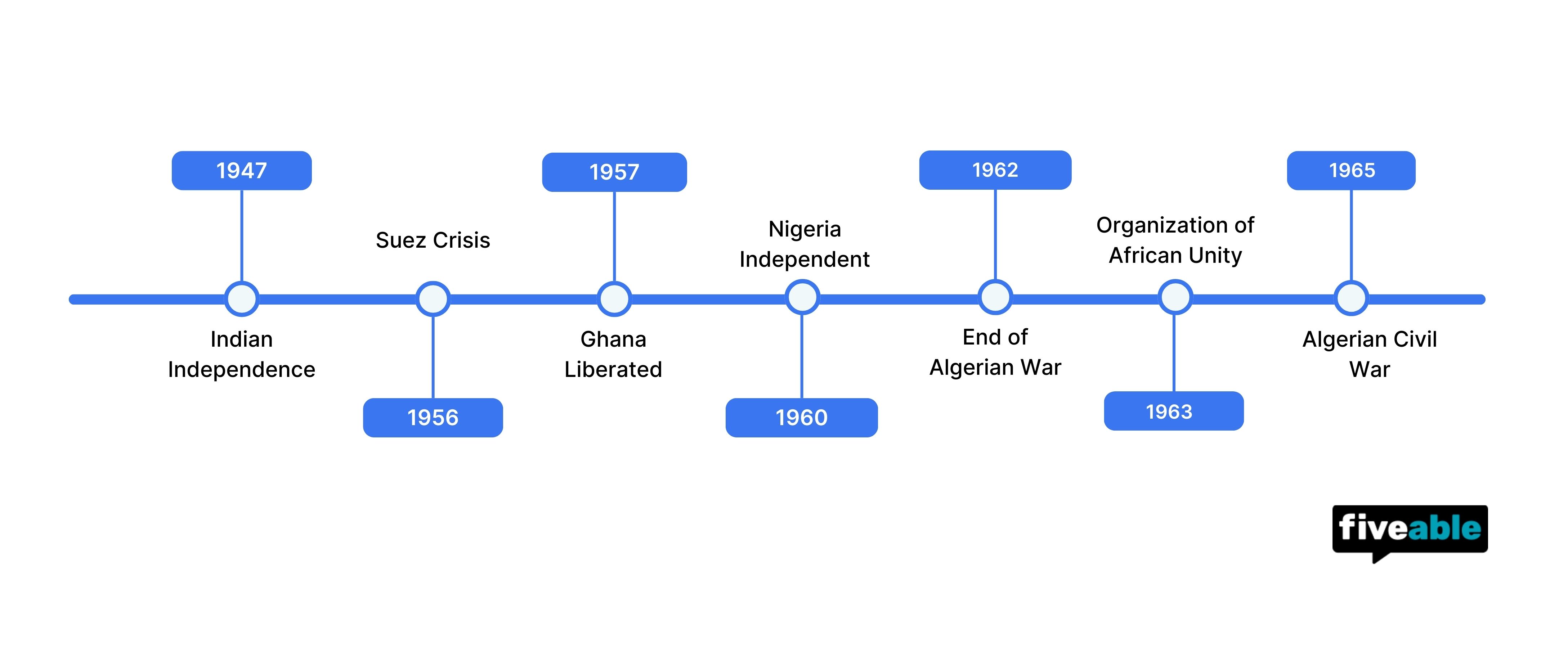
Timeline of Decolonization after 1900. Image Courtesy of Riya Patel
Key Takeaways
- Gandhi pushed civil disobedience against British rule, while the Muslim League sought a separate Muslim state; independence in 1947 brought the violent partition of India and Pakistan.
- Ghana negotiated independence in 1957, but Nkrumah later gained dictatorial powers; Algeria's FLN fought France with guerrilla tactics for independence.
- Political parties pushed for self-government in French West Africa, where most colonies gained independence through negotiation in 1960.
- Ho Chi Minh used nationalism to fight French rule, and after Vietnam split in 1954, U.S. troops backed the South against communist guerrillas.
- Nasser promoted Pan-Arabism and seized the Suez Canal in 1956; the U.S. and USSR opposed the ensuing invasion and used the UN to broker a resolution.
- Nigeria's Igbo secession as Biafra failed, while Quebec's Quiet Revolution fed separatism and a 1995 independence referendum narrowly failed.
India and Pakistan: Negotiation and Partition
India won independence from Britain in 1947 through political pressure and negotiation, but independence came with a violent split into two countries: Hindu-majority India and Muslim-majority Pakistan.
- The Indian National Congress, founded in the 19th century, led the drive for self-rule. Mohandas Gandhi became its leader in 1920 and pushed mass civil disobedience and noncooperation.
- The Muslim League, founded in 1906, advocated a separate nation for Indian Muslims. Muslims feared being a permanent minority in a Hindu-dominated independent India.
- Hindu and Muslim groups set aside their differences during the independence fight, united by the goal of removing the British. Not everyone agreed with Gandhi's nonviolence or his call for Hindu-Muslim unity, but disagreements waited until after World War II.
- After the war, Britain was economically exhausted while Indian resistance grew. The Royal Indian Navy Revolt of 1946 convinced Britain it could no longer hold India.
- In 1947, both India and Pakistan gained independence. The Muslim League's campaign for a separate state succeeded, but the partition reflected centuries of Hindu-Muslim distrust dating back to Muslim invasions of northern India in the 8th century.
Ghana and Algeria: Two Very Different Paths
Ghana negotiated its way to independence peacefully in 1957. Algeria fought a brutal eight-year war against France. The contrast between them is one of the most testable comparisons in this chapter.
Ghana: Negotiated Independence
- The British Gold Coast combined with former British Togoland to become Ghana, the first sub-Saharan African country to gain independence in the 20th century (1957). UN-led negotiations helped make it happen.
- Kwame Nkrumah became Ghana's first president in 1960. He built a national identity the way modern nation-states do: a national narrative of past glory, founding fathers, a flag, an anthem, a currency, museums, and monuments. He also launched public works like hydroelectric plants.
- Critics accused Nkrumah of running up debt and tolerating corruption. In 1964, voters approved a one-party state with Nkrumah as party leader, giving him dictatorial powers.
- Nkrumah championed Pan-Africanism, the idea of African unity and rejection of intervention by former colonial powers, and founded the Organization of African Unity (OAU) in 1963.
- A military coup overthrew him in 1966. Ghana didn't see a peaceful transfer of power between elected presidents until 2000.
Algeria: Armed Struggle
- France considered Algeria part of France itself because so many French settlers lived there, so it refused to let go. The Algerian War for Independence began in 1954.
- The FLN (National Liberation Front) led the fight using guerrilla tactics against half a million French troops. Hundreds of thousands of Algerians died, and the French military committed widespread torture, in the words of French historian Pierre Vidal-Naquet, "hundreds of thousands of instances of torture."
- The war divided France itself. In 1958, Charles de Gaulle gained expanded presidential power under the new Fifth Republic and arranged Algerian independence through a referendum, bypassing the French National Assembly.
- Independence came in 1962, followed by more violence. Pro-French Algerians fled to France, fueling housing shortages and anti-immigration sentiment there. The FLN ran Algeria as a single-party socialist state that suppressed dissent.
- The Algerian Civil War (1991-2002) erupted after the government canceled an election the Islamic Salvation Front was winning. An Islamist assassinated Algeria's president in 1992, and in 1997 Algeria banned religion-based political parties.
Comparing the Two
Both countries struggled under military rule, torn between multiparty democracy and single-party socialism. Ghana stabilized with a new constitution in 1992 (and Ghanaian Kofi Annan became UN Secretary General in 1997). Algeria's religious tensions worsened, with the military repressing Islamic fundamentalists much like Egypt and Turkey did.
Negotiated Independence in French West Africa
France negotiated independence with its West African colonies, including Senegal, the Ivory Coast, Niger, and Upper Volta, with most achieving it in 1960.
- France had controlled these territories since the late 1800s using indirect rule, governing through local chiefs and existing African leaders with only small military forces.
- France invested in railroads and agriculture and profited from growing trade revenue.
- By the mid-1950s, African political parties of all stripes (democratic, socialist, communist) had emerged, pushing for self-governance. Independence came through negotiation, not war, which is why French West Africa pairs with India and Ghana as a "negotiated" example.
Vietnam: Independence Through Armed Struggle
Vietnam fought France for independence (1946-1954), then fought a second war that pulled in the United States as part of the Cold War.
- After World War II, France reoccupied southern Vietnam and tried to reestablish colonial rule. Ho Chi Minh, the communist leader of North Vietnam, appealed to nationalism to unite the country under communism. The war of independence lasted until 1954.
- The 1954 peace treaty split the country into North and South Vietnam, with reunification elections planned for 1956. The U.S. and many South Vietnamese feared Ho would win, so the election never happened. This is exactly how decolonization and the Cold War overlap; review the Cold War's effects in Topic 8.3 and the spread of communism in 8.4 for the bigger picture.
- War broke out between North and South. U.S. troops backed the South against the Viet Cong, communist South Vietnamese guerrillas. President Nixon began withdrawing troops in 1971; the last left in 1975, and North Vietnam quickly took the South.
- The war killed an estimated one to two million people, including about 58,000 Americans, and destabilized Southeast Asia. Communists won Laos and Cambodia, but communism's spread stopped there.
- Starting in the 1980s, Vietnam adopted market-based economic reforms and later restored trade and diplomatic relations with the U.S.
Egypt, Nasser, and the Suez Crisis
Egypt's path was about throwing off lingering British influence, not formal colonial rule. The 1956 Suez Crisis became a landmark moment showing European colonial power was finished.
- Egypt became a nominally independent kingdom in 1922, but Britain kept treaty rights and stationed soldiers there to protect the Suez Canal under a 1936 Anglo-Egyptian treaty.
- After World War II, Egypt was a founding member of the Arab League (which grew to 22 states). In 1952, Gamal Abdel Nasser and Muhammad Naguib overthrew the king and founded the Republic of Egypt. Naguib was the first president; Nasser the second.
- Nasser promoted Pan-Arabism, the cultural and political unity of Arab nations (a transnational movement parallel to Pan-Africanism and communism). His domestic policies blended Islam and socialism: land reform turning private farms into cooperatives, plus nationalizing industries and foreign-owned banks.
- The Suez Crisis: the canal, built 1859-1869 by Egyptian laborers with French money, was under a 99-year French lease that Egyptians saw as colonial exploitation. When Nasser seized the canal in 1956, Israel invaded at Britain and France's urging, and the two European powers occupied the canal zone.
- Both the U.S. and the USSR opposed the invasion and used the UN to broker a resolution. The canal became an international waterway under Egyptian sovereignty, with UN peacekeepers in the Sinai. The crisis also showed Egypt holding a nonaligned position between the two Cold War superpowers.
Nigeria and the Biafran Civil War
Nigeria, Africa's most populous country, gained independence from Britain in 1960, then faced a secession crisis that tested its inherited colonial borders.
- The Biafran Civil War began in 1967 when the Igbos, a Westernized, mostly Christian group in the oil-rich southeastern Niger River Delta, declared the independent nation of Biafra after targeted attacks by the Hausa-Fulani Islamic group in the north.
- The secession failed; Biafra ceased to exist when the war ended in 1970. Nigeria granted amnesty to most Igbo generals, but military coups continued until the 1999 election of Olusegun Obasanjo and the democratic Fourth Republic.
- To fight tribalism, Nigeria created a federation of 36 states with borders cutting across ethnic and religious lines, and the constitution even encouraged intermarriage. Eleven states voted to adopt a dual legal system of secular law and shariah.
- Friction persisted: Christian Yoruba and Igbo groups in the south versus Islamic groups in the north, plus protests in the Niger Delta, where citizens accused the government and oil companies of extracting wealth and polluting the land. Militants set fire to oil wells and pipelines.
Quebec and the Quiet Revolution
Not every autonomy movement targeted a European empire. The Quebecois separatist movement in Canada shows that regional and cultural movements challenged existing states too.
- Quebec, Canada's largest province, is rooted in French Catholic culture, while English-speaking Canada was mainly Protestant. That divide dates to the late 1700s, when England took control of New France.
- The Quiet Revolution of the 1960s brought major political and social change as the Liberal Party gained power and reformed economic policies, feeding desires for separation from the rest of Canada.
- French Canadian nationalism expanded, and splinter groups turned to extreme tactics, including terrorist bombings starting in 1963. Prime Minister Pierre Trudeau, himself from Quebec, preserved national unity.
- A 1995 referendum on Quebec independence failed by a narrow margin.
Key Terms to Know
| Term | Why it matters |
|---|---|
| Muslim League | Founded 1906, it campaigned for a separate Muslim state, leading to Pakistan's creation at India's 1947 independence. |
| Kwame Nkrumah | Ghana's first president, a Pan-Africanist who built a national identity but later took dictatorial powers in a one-party state. |
| One-party state | A system where only one political party is allowed; both Ghana under Nkrumah and Algeria under the FLN adopted it. |
| Pan-Africanism | A movement for unity of culture and ideas across Africa that rejected intervention by former colonial powers. |
| Organization of African Unity (OAU) | Continental body Nkrumah founded in 1963 to promote African unity and tackle decolonization issues. |
| Algerian War for Independence | The 1954-1962 armed struggle against France, marked by FLN guerrilla warfare, French torture, and hundreds of thousands of Algerian deaths. |
| Charles de Gaulle | French president who used the Fifth Republic's expanded powers and a referendum to grant Algeria independence. |
| Algerian Civil War | The 1991-2002 conflict triggered by the cancellation of an election the Islamic Salvation Front was winning. |
| Ho Chi Minh | Communist leader of North Vietnam who used nationalism to fight French rule and later the U.S.-backed South. |
| Viet Cong | Communist South Vietnamese guerrillas who fought U.S. troops and the South Vietnamese government during the Vietnam War. |
| Gamal Abdel Nasser | Egypt's second president, a Pan-Arabist who nationalized industries and seized the Suez Canal in 1956. |
| Suez Crisis | The 1956 showdown where the U.S. and USSR forced Britain, France, and Israel out of Egypt, signaling the end of European colonial dominance. |
| Pan-Arabism | Nasser's movement promoting the cultural and political unity of Arab nations. |
| Biafran Civil War | Nigeria's 1967-1970 conflict in which the Igbo attempt to secede as Biafra failed, a key example of ethnic movements challenging inherited borders. |
| Quiet Revolution | 1960s political and social transformation in Quebec that fueled French Canadian nationalism and the separatist movement. |
| Indian National Congress | The party, led by Gandhi from 1920, that drove India's negotiated independence through mass civil disobedience. |
Practice and Next Steps
Get comfortable with the core comparison this topic demands: negotiated independence (India, Ghana, French West Africa) versus armed struggle (Algeria, Vietnam), plus the movements that challenged inherited borders (Muslim League, Biafra, Quebec). The Topic 8.5 Decolonization After 1900 study guide reviews the same material framed around exam skills, and the full set of AP World AMSCO notes covers every chapter in Unit 8. Continue to AMSCO 8.6 Newly Independent States to see what happened after independence was won.
To check yourself, run through guided practice questions on Unit 8, then try a comparison-style essay with FRQ practice and instant scoring. Closer to exam day, a full-length practice exam will show you how decolonization questions appear alongside Cold War content.
Frequently Asked Questions
What is AMSCO Topic 8.5 Decolonization after 1900 about?
AMSCO Topic 8.5 (p.579-585) covers how peoples in Asia, Africa, and Canada pursued independence or autonomy after 1900. It contrasts negotiated independence (India, Ghana, French West Africa) with armed struggle (Algeria, Vietnam), and covers regional and ethnic movements like the Muslim League, Biafra, and Quebecois separatism.
Which countries negotiated independence and which fought for it after 1900?
India (1947), Ghana (1957), and French West Africa (by 1959) negotiated independence from Britain and France. Algeria (1954-1962) and Vietnam (war ending 1954) won independence from France through armed struggle. This negotiated-vs-armed comparison is the central framework of Topic 8.5 and a common AP World comparison prompt.
Why was the Suez Crisis of 1956 so important?
When Nasser nationalized the Suez Canal in 1956, Israel invaded Egypt at the urging of Britain and France, who then occupied the canal zone. Both the United States and the Soviet Union opposed the invasion and used the UN to broker a resolution, leaving the canal under Egyptian sovereignty. The crisis showed European colonial power was finished and that Egypt could stay nonaligned between the Cold War superpowers.
Was the Biafran Civil War a decolonization movement?
Not exactly. Nigeria had already gained independence from Britain in 1960; the Biafran Civil War (1967-1970) was a secession attempt by the Igbo people against Nigeria's northern-dominated government after attacks by the Hausa-Fulani. It's in Topic 8.5 as an example of ethnic movements challenging the borders empires left behind, not a fight against a European colonizer.
How does decolonization show up on the AP World exam?
Decolonization is core Unit 8 content and frequently appears in comparison questions, like comparing how Ghana and Algeria achieved independence or how the Cold War shaped conflicts in Vietnam and Egypt. Knowing leaders (Nkrumah, Nasser, Ho Chi Minh, Gandhi) and the negotiated-vs-armed-struggle framework sets you up for MCQs and essays. Try a comparison essay with FRQ practice and instant scoring.
See Fiveable more often in Google
Mark Fiveable as a preferred source and Google is more likely to show you our guides in Top Stories, with a "preferred" badge in AI Mode and AI Overviews.