AMSCO 2.1 The Silk Roads Notes

🌍AP World History: Modern Review
AMSCO 2.1 The Silk Roads Notes
🌍 AP World History: Modern
AMSCO 1.1 Developments in East Asia Notes
AMSCO 1.2 Developments in Dar al-Islam Notes
AMSCO 1.3 Developments in South and Southeast Asia Notes
AMSCO 1.4 Developments in the Americas Notes
AMSCO 1.5 Developments in Africa Notes
AMSCO 1.6 Developments in Europe Notes
AMSCO 1.7 Comparison in the Period from c.1200 to c.1450 Notes
AMSCO 2.1 The Silk Roads Notes
AMSCO 2.2 The Mongol Empire and the Modern World Notes
AMSCO 2.3 Exchange in the Indian Ocean Notes
AMSCO 2.4 Trans-Saharan Trade Routes Notes
AMSCO 2.5 Cultural Consequences of Connectivity Notes
AMSCO 2.6 Environmental Consequences of Connectivity Notes
AMSCO 2.7 Comparison of Economic Exchange Notes
AMSCO 3.1 European, East Asian, and Gunpowder Empires Expand Notes
AMSCO 3.2 Empires: Administrations Notes
AMSCO 3.3 Empires: Belief Systems Notes
AMSCO 3.4 Comparison in Land-Based Empires Notes
AMSCO 4.1 Technological Innovations Notes
AMSCO 4.2 Exploration: Causes and Events Notes
AMSCO 4.3 Columbian Exchange Notes
AMSCO 4.4 Maritime Empires Link Regions Notes
AMSCO 4.5 Maritime Empires Develop Notes
AMSCO 4.6 Internal and External Challenges to State Power Notes
AMSCO 4.7 Changing Social Hierarchies Notes
AMSCO 4.8 Continuity and Change from c.1450 to c.1750 Notes
AMSCO 5.1 The Enlightment Notes
AMSCO 5.2 Nationalism and Revolutions Notes
AMSCO 5.3 Industrial Revolution Begins Notes
AMSCO 5.4 Industrialization Spreads Notes
AMSCO 5.5 Technology in the Industrial Age Notes
AMSCO 5.6 Industrialization: Government's Role Notes
AMSCO 5.7 Economic Developments and Innovations Notes
AMSCO 5.8 Reactions to the Industrial Economy Notes
AMSCO 5.9 Society and the Industrial Age Notes
AMSCO 5.10 Continuity and Change in the Industrial Age Notes
AMSCO 6.1 Rationales for Imperialism Notes
AMSCO 6.2 State Expansion Notes
AMSCO 6.3 Indigenous Responses to State Expansion Notes
AMSCO 6.4 Global Economic Development Notes
AMSCO 6.5 Economic Imperialism Notes
AMSCO 6.6 Causes of Migration in an Interconnected World Notes
AMSCO 6.7 Effects of Migration Notes
AMSCO 6.8 Causation in the Imperial Age Notes
AMSCO 7.1 Shifting Power Notes
AMSCO 7.2 Causes of World War I Notes
AMSCO 7.3 Conducting World War I Notes
AMSCO 7.4 Economy in the Interwar Period Notes
AMSCO 7.5 Unresolved Tensions After World War I Notes
AMSCO 7.6 Causes of World War II Notes
AMSCO 7.7 Conducting World War II Notes
AMSCO 7.8 Mass Atrocities Notes
AMSCO 7.9 Causation in Global Conflict Notes
AMSCO 8.1 Setting the Stage for the Cold War and Decolonization Notes
AMSCO 8.2 The Cold War Notes
AMSCO 8.3 Effects of the Cold War Notes
AMSCO 8.4 Spread of Communism Notes
AMSCO 8.5 Decolonization after 1900 Notes
AMSCO 8.6 Newly Independent States Notes
AMSCO 8.7 Global Resistance to Established Power Structure Notes
AMSCO 8.8 End of the Cold War Notes
AMSCO 8.9 Causation in the Age of the Cold Ward and Decolonization Notes
AMSCO 9.1 Advances in Technology and Exchange Notes
AMSCO 9.2 Technological Advancements and Limitations Notes
AMSCO 9.3 Technology and the Environment Notes
AMSCO 9.4 Economics in the Global Age Notes
AMSCO 9.5 Calls for Reforms and Responses Notes
AMSCO 9.6 Globalized Culture Notes
AMSCO 9.7 Resistance to Globalization Notes
AMSCO 9.8 Institutions Developing in a Globalized World Notes
AMSCO 9.9 Continuity and Change in a Globalized World Notes
Overview
AMSCO Topic 2.1, The Silk Roads (AMSCO p. 77-84), covers the revival and expansion of the overland Silk Roads between c. 1200 and c. 1450, the opening topic of Unit 2: Networks of Exchange. The chapter explains the causes of growing exchange networks (new empires like the Mongols, better transportation technology, rising demand for luxury goods) and the effects (booming trading cities like Kashgar and Samarkand, caravanserai, and commercial innovations like paper money and bills of exchange). The big idea: the Silk Roads had a second golden age in this era because trade got safer, easier, and more profitable than ever before.
The exam loves cause-and-effect questions on this topic. As you review, keep sorting every detail into one of two buckets: did it cause more trade, or did more trade cause it?
Key Takeaways
- The Crusades raised European demand for fabrics and spices from the East, while Abbasid merchants revived land and Indian Ocean trade routes.
- The Mongol Empire expanded Silk Roads trade by unifying routes under one authority, improving roads, and punishing bandits.
- Redesigned camel saddles increased overland carrying capacity, while Chinese compasses, rudders, and large junks supported sea trade.
- Trade helped oasis cities like Kashgar and Samarkand thrive, while caravanserai gave travelers places to rest and exchange ideas.
- China's flying cash let merchants move money without hauling coins, and European banking houses used bills of exchange to handle payments.
- The Hanseatic League controlled North Sea and Baltic Sea trade, while rising demand expanded textile and porcelain exports and China's iron and steel production.
Why Silk Roads Trade Grew After 1200
Three forces revived and expanded the Silk Roads: new empires that protected trade, improved transportation technology, and surging demand for luxury goods across Afro-Eurasia.
The Crusades and Rising Demand
The Crusades introduced European lords and knights to fabrics and spices from the East, and Europe wanted more. Demand for luxury goods rose in both Europe and Africa.
- Europe craved Chinese silk, tea, and rhubarb. China wanted Europe's gold and silver.
- Even with the Ottoman Turks pressing into the Byzantine Empire, the land routes stayed open, along with sea routes across the Mediterranean and Indian Ocean.
- Europeans hadn't yet sailed around the Cape of Good Hope, so overland routes carried the weight of East-West trade.
Rise of New Empires
After the Roman and Han empires collapsed, the first golden age of the Silk Roads ended and traffic dropped off dramatically. Revival came in two waves.
First, in the 8th and 9th centuries, Arab merchants from the Abbasid Empire revived the land routes and the Indian Ocean sea routes. Tang China fed this network with major exports and inventions:
- China contributed the compass, paper, and gunpowder to the trade network
- Exports: porcelain, tea, silk
- Imports: cotton, precious stones, pomegranates, dates, horses, and grapes, luxury goods prized by China's upper class
Second, and most important: the Mongol Empire. No other cause had a bigger impact on expanding trade. The Mongols conquered the Abbasid Caliphate in 1258, and China came fully under their control by 1279. For the first time, stretches of the Silk Roads that had been ruled by different governments were unified under one authority that respected merchants and enforced laws. The Mongols improved roads and punished bandits, making travel far safer, and new trade channels linked Asia, the Middle East, Africa, and Europe. The Mongols get their own chapter next, in the AMSCO 2.2 Mongol Empire notes.
Improvements in Transportation Technology
Better tech made bigger loads and longer trips possible, on land and at sea.
- Overland travelers learned that moving in caravans was safer than traveling alone.
- Redesigned camel saddles greatly increased how much weight each camel could carry.
- During the Han Dynasty, Chinese scientists developed the magnetic compass and improved the rudder, both critical for navigation and ship control.
- The Chinese junk (also a Han-era development) was similar to the Southwest Asian dhow but huge: multiple sails, up to 400 feet long, at least triple the size of a typical Western European ship of the time. Its hull was divided into walled compartments that strengthened the ship and made sinking less likely.
These maritime advances let China control sea trade in the South China Sea, a thread that continues in AMSCO 2.3 on Indian Ocean exchange.
Trading Cities and Oases Along the Routes
More trade produced thriving cities at oases along the routes, plus a network of roadside inns called caravanserai. Long stretches of the Silk Roads crossed hot, arid land where water was scarce, so any city with a reliable river became a magnet for merchants.
Kashgar
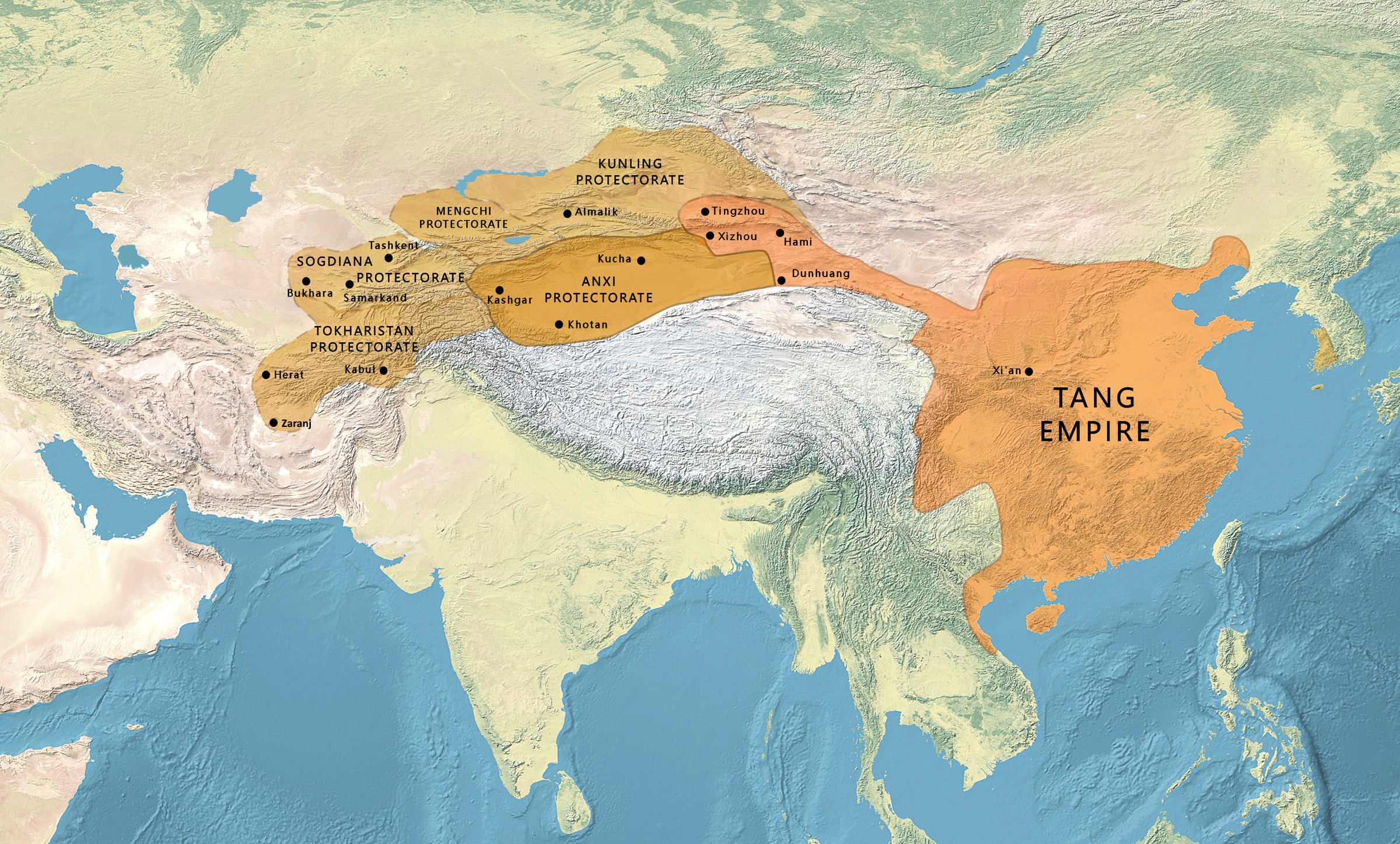
Kashgar sits at the western edge of China, where the northern and southern Silk Road routes crossed on their way to Central Asia, India, Pakistan, and Persia.
- Located where the Taklamakan Desert meets the Tian Shan Mountains, watered by the Kashgar River
- Fertile land grew wheat, rice, fruits, and cotton, so travelers depended on it for food and water
- Artisans produced textiles, rugs, leather goods, and pottery sold in a bustling market
- Cultural crossroads: once primarily Buddhist, it became a center of Islamic scholarship
Samarkand
Samarkand, in present-day Uzbekistan in the Zeravshan River valley, was a stopping point between China and the Mediterranean.
- A center of cultural exchange as much as commercial exchange
- Archaeological remains show Christianity, Buddhism, Zoroastrianism, and Islam all coexisting there
- Like Kashgar, known for artisans, centers of Islamic learning, and magnificently decorated mosques
These two cities are the go-to examples for "powerful new trading cities" on the exam. If a question asks for evidence that trade routes promoted urban growth or cultural diffusion, Kashgar and Samarkand are your answer.
Caravanserai
Once the routes stabilized, inns called caravanserai sprang up roughly 100 miles apart. That spacing wasn't random: 100 miles is about how far camels could travel before needing water. Travelers could rest, water their animals, and sometimes swap tired animals for fresh ones. The word comes from the Persian words for caravan and palace. Because merchants from many regions mixed at these inns, caravanserai also became sites of cultural exchange, not just rest stops.
Commercial Innovations That Managed the Boom
More trade demanded better money systems, and China led the way. China had long been a money economy, meaning it used currency rather than bartering with commodities like cowrie shells or salt. But copper coins became too heavy and unwieldy for everyday long-distance transactions, so new tools emerged.
- Flying cash was a Chinese government system of credit. A merchant deposited paper money under his name in one location and withdrew the same amount in another, so he didn't have to haul coins across deserts.
- Flying cash exchange locations became the model for the banking houses established in European cities in the 1300s.
- At a banking house, a person could present a bill of exchange, a document legally promising the holder payment of a set amount on a set date, and receive that money.
Think of it this way: flying cash worked like an early version of wiring money, and a bill of exchange worked like a check. Each innovation made trade more convenient and gave merchants stable institutions to rely on.
The Hanseatic League
Europe built its own commercial machinery. In the 13th century, cities in northern Germany and Scandinavia formed the Hanseatic League, a commercial alliance controlling trade in the North Sea and Baltic Sea.
- Member cities included Lubeck, Hamburg, and Riga
- The league drove out pirates and monopolized trade in timber, grain, leather, and salted fish
- League ships left the Baltic and North Seas, rounded the Atlantic coast of Western Europe, and reached Mediterranean ports, where they could pick up goods from Arab caravans
- It lasted until the mid-17th century, when national governments grew strong enough to protect their own merchants
Demand Drove Production
Growing demand for luxury goods across Afro-Eurasia pushed supply up too. Chinese, Persian, and Indian artisans and merchants expanded production of silk, other textiles, and porcelain for export. Iron and steel manufacturing expanded in China, motivating its proto-industrialization. That term matters: it means China was producing goods on a large scale for distant markets before true industrialization existed.
Key Terms to Know
| Term | Why it matters |
|---|---|
| Mongol Empire | Unified the Silk Roads under one authority after 1258, improving roads and punishing bandits; the single biggest cause of expanded trade. |
| Kashgar | Oasis trading city at the crossroads of Silk Road routes in western China; became a center of Islamic scholarship. |
| Samarkand | Silk Road city in present-day Uzbekistan known for cultural exchange among Christians, Buddhists, Zoroastrians, and Muslims. |
| Caravanserai | Inns spaced about 100 miles apart (a camel's range without water) where travelers rested and exchanged goods and ideas. |
| Magnetic compass | Han-era Chinese invention that made sea navigation far more reliable. |
| Rudder | Improved by Han Dynasty China; gave sailors better control of large ships. |
| Junk | Massive Chinese ship (up to 400 feet) with multiple sails and compartmentalized hulls that resisted sinking. |
| Money economy | An economy using currency instead of bartering goods like cowrie shells or salt; China had one long before this era. |
| Flying cash | Chinese credit system letting merchants deposit money in one city and withdraw it in another. |
| Paper money | Chinese innovation that replaced heavy copper coins and made large transactions practical. |
| Banking houses | European financial institutions of the 1300s, modeled on flying cash exchange locations. |
| Bill of exchange | A document promising the holder payment of a set amount on a set date; an early check. |
| Hanseatic League | 13th-century alliance of northern German and Scandinavian cities (Lubeck, Hamburg, Riga) that monopolized Baltic and North Sea trade until the mid-17th century. |
| Proto-industrialization | Large-scale production for export before industrial machinery; China's expanding iron and steel manufacturing is the key example. |
Practice and Next Steps
Pair these notes with the Topic 2.1 The Silk Roads study guide for the College Board framing of the same content, then continue through Unit 2 with the AMSCO 2.4 Trans-Saharan Trade Routes notes to compare how all three major routes work. You can find the full set of chapters on the AMSCO notes hub.
To check yourself, run through AP World guided practice questions on networks of exchange, and look up any shaky vocabulary in the AP World key terms glossary. When you're ready to write, try a comparison or causation prompt in FRQ practice with instant scoring.
Frequently Asked Questions
What does AMSCO Topic 2.1 The Silk Roads cover?
AMSCO 2.1 (p. 77-84) covers the causes and effects of growing exchange networks on the Silk Roads from c. 1200 to c. 1450. Causes include the rise of the Mongol Empire, improved transportation like camel saddles and the Chinese junk, and rising demand for luxury goods. Effects include trading cities like Kashgar and Samarkand, caravanserai, and credit innovations like flying cash and bills of exchange.
Why did Silk Roads trade increase after 1200?
The biggest cause was the Mongol Empire, which unified the routes under one authority after conquering the Abbasid Caliphate in 1258, improved roads, and punished bandits. Other causes were rising Afro-Eurasian demand for luxury goods like silk and porcelain, plus transportation improvements such as caravans, redesigned camel saddles, the magnetic compass, and the rudder.
What is the difference between flying cash and a bill of exchange?
Flying cash was a Chinese credit system: a merchant deposited paper money in one location and withdrew the same amount in another, like wiring money. A bill of exchange was a document promising the holder payment of a set amount on a set date, like an early check, redeemable at European banking houses in the 1300s. Flying cash exchange locations were actually the model for those European banking houses.
Why are Kashgar and Samarkand important in AP World?
They're the standard examples of trading cities that grew because of Silk Roads commerce. Kashgar sat where northern and southern routes crossed in western China and became a center of Islamic scholarship; Samarkand, in present-day Uzbekistan, hosted Christianity, Buddhism, Zoroastrianism, and Islam. Use them as evidence whenever a question asks how trade routes promoted urban growth or cultural diffusion.
How does Topic 2.1 show up on the AP World exam?
Mostly as causation and continuity questions: what caused trade to grow after 1200, and what effects followed. Be ready to connect specific evidence (Mongol protection of merchants, caravanserai, flying cash, paper money, the Hanseatic League) to broader patterns of economic exchange. You can practice applying this with AP World guided practice questions.
What is a caravanserai and why were they 100 miles apart?
A caravanserai was an inn along the Silk Roads where travelers and their animals could rest, get water, and sometimes trade for fresh animals. They sprang up roughly 100 miles apart because that's about how far a camel could travel before needing water. The name comes from the Persian words for caravan and palace.
See Fiveable more often in Google
Mark Fiveable as a preferred source and Google is more likely to show you our guides in Top Stories, with a "preferred" badge in AI Mode and AI Overviews.