AMSCO 6.8 Causation in the Imperial Age Notes

🌍AP World History: Modern Review
AMSCO 6.8 Causation in the Imperial Age Notes
🌍 AP World History: Modern
AMSCO 1.1 Developments in East Asia Notes
AMSCO 1.2 Developments in Dar al-Islam Notes
AMSCO 1.3 Developments in South and Southeast Asia Notes
AMSCO 1.4 Developments in the Americas Notes
AMSCO 1.5 Developments in Africa Notes
AMSCO 1.6 Developments in Europe Notes
AMSCO 1.7 Comparison in the Period from c.1200 to c.1450 Notes
AMSCO 2.1 The Silk Roads Notes
AMSCO 2.2 The Mongol Empire and the Modern World Notes
AMSCO 2.3 Exchange in the Indian Ocean Notes
AMSCO 2.4 Trans-Saharan Trade Routes Notes
AMSCO 2.5 Cultural Consequences of Connectivity Notes
AMSCO 2.6 Environmental Consequences of Connectivity Notes
AMSCO 2.7 Comparison of Economic Exchange Notes
AMSCO 3.1 European, East Asian, and Gunpowder Empires Expand Notes
AMSCO 3.2 Empires: Administrations Notes
AMSCO 3.3 Empires: Belief Systems Notes
AMSCO 3.4 Comparison in Land-Based Empires Notes
AMSCO 4.1 Technological Innovations Notes
AMSCO 4.2 Exploration: Causes and Events Notes
AMSCO 4.3 Columbian Exchange Notes
AMSCO 4.4 Maritime Empires Link Regions Notes
AMSCO 4.5 Maritime Empires Develop Notes
AMSCO 4.6 Internal and External Challenges to State Power Notes
AMSCO 4.7 Changing Social Hierarchies Notes
AMSCO 4.8 Continuity and Change from c.1450 to c.1750 Notes
AMSCO 5.1 The Enlightment Notes
AMSCO 5.2 Nationalism and Revolutions Notes
AMSCO 5.3 Industrial Revolution Begins Notes
AMSCO 5.4 Industrialization Spreads Notes
AMSCO 5.5 Technology in the Industrial Age Notes
AMSCO 5.6 Industrialization: Government's Role Notes
AMSCO 5.7 Economic Developments and Innovations Notes
AMSCO 5.8 Reactions to the Industrial Economy Notes
AMSCO 5.9 Society and the Industrial Age Notes
AMSCO 5.10 Continuity and Change in the Industrial Age Notes
AMSCO 6.1 Rationales for Imperialism Notes
AMSCO 6.2 State Expansion Notes
AMSCO 6.3 Indigenous Responses to State Expansion Notes
AMSCO 6.4 Global Economic Development Notes
AMSCO 6.5 Economic Imperialism Notes
AMSCO 6.6 Causes of Migration in an Interconnected World Notes
AMSCO 6.7 Effects of Migration Notes
AMSCO 6.8 Causation in the Imperial Age Notes
AMSCO 7.1 Shifting Power Notes
AMSCO 7.2 Causes of World War I Notes
AMSCO 7.3 Conducting World War I Notes
AMSCO 7.4 Economy in the Interwar Period Notes
AMSCO 7.5 Unresolved Tensions After World War I Notes
AMSCO 7.6 Causes of World War II Notes
AMSCO 7.7 Conducting World War II Notes
AMSCO 7.8 Mass Atrocities Notes
AMSCO 7.9 Causation in Global Conflict Notes
AMSCO 8.1 Setting the Stage for the Cold War and Decolonization Notes
AMSCO 8.2 The Cold War Notes
AMSCO 8.3 Effects of the Cold War Notes
AMSCO 8.4 Spread of Communism Notes
AMSCO 8.5 Decolonization after 1900 Notes
AMSCO 8.6 Newly Independent States Notes
AMSCO 8.7 Global Resistance to Established Power Structure Notes
AMSCO 8.8 End of the Cold War Notes
AMSCO 8.9 Causation in the Age of the Cold Ward and Decolonization Notes
AMSCO 9.1 Advances in Technology and Exchange Notes
AMSCO 9.2 Technological Advancements and Limitations Notes
AMSCO 9.3 Technology and the Environment Notes
AMSCO 9.4 Economics in the Global Age Notes
AMSCO 9.5 Calls for Reforms and Responses Notes
AMSCO 9.6 Globalized Culture Notes
AMSCO 9.7 Resistance to Globalization Notes
AMSCO 9.8 Institutions Developing in a Globalized World Notes
AMSCO 9.9 Continuity and Change in a Globalized World Notes
Overview
AMSCO Topic 6.8, Causation in the Imperial Age (p. 439-450), wraps up Unit 6 by asking one big question: what was the relative significance of the effects of imperialism from 1750 to 1900? This chapter doesn't introduce much new content. Instead, it pulls together everything from Unit 6 into cause-and-effect chains: industrial capitalism drove overseas expansion, expansion sparked resistance and rebellion, and the whole system reshaped migration, living standards, and global power. The chapter also includes seven primary source documents and a tour of how historians (Hobson, Lenin, Wallerstein) have judged imperialism, which makes it perfect prep for DBQ and LEQ writing on this period.
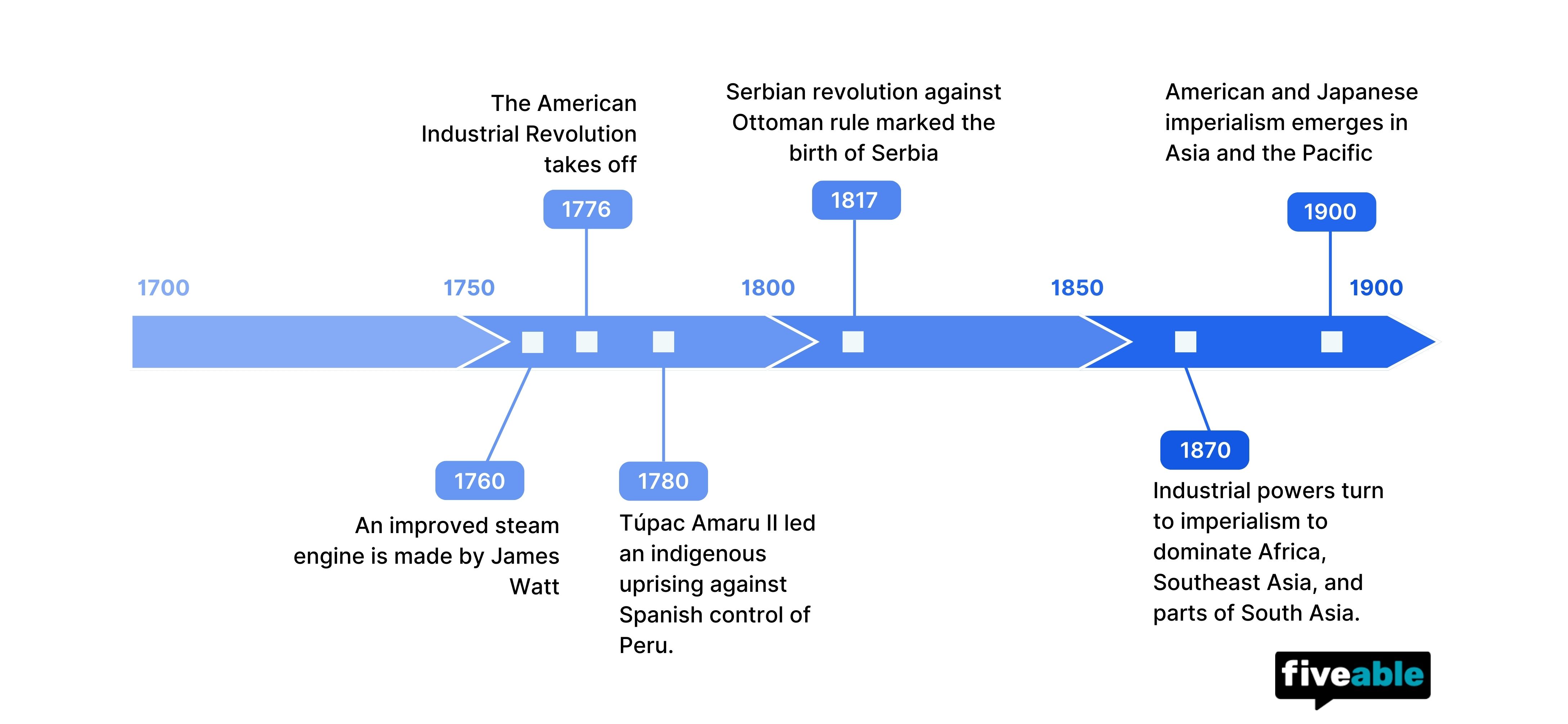
The core causal chain to remember: industrialization increased manufacturing capacity, which created demand for raw materials and new markets, which pushed industrialized nations toward empire-building, which produced migration, independence movements, and the European rivalries that exploded into war in the early 20th century.
Key Takeaways
- Industrial production lowered consumer prices, and real wages doubled between 1819 and 1852, but pollution, crowded cities, and war costs complicate claims that living standards rose for everyone.
- Overproduction and demand for raw materials fueled overseas expansion, while advances in military technology, shipbuilding, and medicine helped Western Europeans control regions that had resisted colonization.
- The 1857 sepoy rebellion led to direct British rule in India, while China's Boxers fought Western influence; these early resistance movements mostly failed but helped seed later nationalism.
- Imperialism spurred migration toward industrial economies; indentured laborers worked under contracts to repay transport costs, and immigrants faced discrimination based on race and religion.
- Hobson saw imperialist competition as a flaw in capitalism, Lenin predicted imperialist conflict would bring communism, and Wallerstein divided the global economy into core and periphery regions.
- The Treaty of Nanking ceded Hong Kong to Britain, Firoz Shah called for resistance during the sepoy revolt, and the Treaty of Shimonoseki forced China to cede Formosa and recognize Korea's independence.
Changes in Standards of Living
Industrial efficiency raised living standards for some people, but the picture is complicated. Automation, interchangeable parts, division and specialization of labor, and the assembly line boosted output of consumer goods like textiles, clothing, home furnishings, and porcelain. More supply meant lower prices and more variety.
Economists track this through real wages, meaning wages adjusted for inflation, which show how much stuff your paycheck can actually buy. Real wages grew slowly in the early Industrial Revolution, then accelerated after 1819 and doubled between 1819 and 1852. By that measure, standards of living rose across income groups.
But there's a counterargument, and the AP exam loves this kind of nuance:
- The wealth gap (distribution of income) became more pronounced
- Pollution, crowded cities, and the costs of wars offset wage gains
- Factoring those in, standards of living may not have risen for many people
This "improved for some, not for all" framing is exactly the kind of qualified argument that earns complexity points on an LEQ.
Overseas Expansion
Overproduction is the hinge between industrialization and imperialism. As more countries industrialized, domestic markets got saturated. They couldn't absorb everything factories produced. International trade transformed industrial economies from mercantilist to capitalist systems, and businesses pushed their governments to pry open closed or inaccessible foreign markets. That created economic and political rivalry among industrialized countries.
Industry also needed raw materials it couldn't get at home: coal, iron, tin, bauxite, rubber, and copper imported from Africa, Southeast Asia, and Latin America. So a key effect of industrial capitalism was the expansion of imperialism in the 19th century, continuing the empire-building Europeans had started in earlier eras. The motivations behind this push are covered in AMSCO 6.1 Rationales for Imperialism.
What changed in this era is who got colonized:
- Regions that had previously resisted European colonization fell under Western control
- Most of Africa came under direct European rule
- Britain colonized much of South Asia; France took much of Southeast Asia
- Even China, the most dynamic civilization of earlier eras, succumbed to Western and Japanese domination
Why could the West suddenly do this? Industrial Revolution technology. Advances in military technology, shipbuilding, and medicine let Western European nations assert control over regions that had held them off before.
Meanwhile, the dependent colonial economies supplying raw materials saw little economic development. Reliance on cash crops introduced by imperial powers left them vulnerable to natural disasters and volatile world markets. That dependency dynamic connects directly to AMSCO 6.5 Economic Imperialism.
Seeds of Revolution and Rebellion
Imperialism planted resistance movements that would eventually grow into new nation-states. The pattern started early: Britain's North American colonies became the independent United States in the late 1700s, France overthrew its monarchy, and Spanish and Portuguese colonies in South America won independence in the early 1800s.
As Western imperialism spread, colonized peoples resisted westernization (the assimilation of Western culture):
- In South Asia, Indian soldiers called sepoys rose up against the British East India Company in 1857. Britain brutally suppressed the rebellion, but the result was the disbandment of the East India Company and direct rule of India by the British government, the period known as the British Raj.
- In China, the Boxers tried to rid the country of Western influence, especially Christian missionaries.
These early movements mostly failed in the short term, but they were the seeds of the widespread, successful nationalism of the post-World War II period. For more resistance examples, see AMSCO 6.3 Indigenous Responses to State Expansion.
Migration and Discrimination
One of the most significant effects of modern imperialism was migration from less industrialized regions toward dominant industrial economies. People moved from rural to urban areas within countries, from less developed to more developed parts of Europe, and from Europe to the United States and Canada, where immigrants often made up a large share of the industrial workforce.
Indentured laborers signed contracts to work for a set period and pay back their transport costs. They came from China, Japan, South Asia, and Europe, and ended up working in the Americas, Southeast Asia, Africa, and Australia. Those who settled often formed enclaves, communities of people from the same homeland.
Migration came with friction. Immigrants faced discrimination based on race, religion, and other factors, and working-class laborers in industrial economies, already squeezed by the profit motive, now competed for jobs with immigrants from nonindustrial countries while the middle and upper classes accumulated capitalism's wealth. The AMSCO guides on the causes of migration and the effects of migration go deeper on both sides.
How Historians Judge Imperialism
The chapter closes with three influential interpretations. Knowing these gives you ready-made historical arguments for essays.
Hobson: imperialism is a flaw in capitalism
British writer J. A. Hobson argued in Imperialism: A Study (1904) that competition for new resources and markets was a flaw in capitalism. Capital piled up in the hands of a few profit-seekers, who pressured governments to take over underdeveloped nations and protect access to them, ignoring the political and economic costs. Hobson thought the system could be fixed through greater global cooperation and planning.
Lenin: imperialism is capitalism's final stage
Russian revolutionary Vladimir Lenin went further in Imperialism, The Highest Stage of Capital Development (1917). He predicted imperialist conflicts would cause capitalist states to destroy each other and usher in the era of communism.
Wallerstein: world-systems theory
In the late 20th century, American social scientist Immanuel Wallerstein popularized world-systems theory, dividing the global economy into two main regions:
- The core: highly developed nations that accumulated capital and demanded resources and markets
- The periphery: regions that supplied the resources, markets, and labor the core needed
Wallerstein traced this system to the mid-16th century, with colonialism as the mechanism that pulled peripheral states into the world economy. The system is dynamic: nations can be semi-peripheral and move toward the core or slide the other way (he cited Spain as an example). The inequalities were real, but the system's flexibility made it durable.
Documents to Know
The chapter's seven sources are DBQ practice gold. Each one illustrates a Unit 6 theme:
- Andrew Jackson's 1835 removal proposal justifies relocating the Cherokee and other Native American nations to Indian Territory (the Trail of Tears), framed as a "moral duty" of a "civilized community"
- The Treaty of Nanking (1842), which the Qing emperor was forced to sign after the Opium War, ceded Hong Kong to Britain "in perpetuity"
- Firoz Shah's 1857 proclamation, from the grandson of the last Mughal emperor, calls Hindus and Muslims to unite against "the tyranny and oppression of the infidel and the treacherous English" during the sepoy revolt
- Moshweshewe, Chief of the Basutos, wrote to the Cape Colony governor in 1858 protesting Boer land seizures and broken British treaty promises
- "The Dogs of War," an 1876 Punch cartoon, shows John Bull (Britain) warning the Russian tsar before the 1877-1878 Russo-Turkish War
- Fukuzawa Yukichi's "Good-bye Asia" (1885) argues Japan had to discard old conventions and adopt Western civilization or lose its national independence
- The Treaty of Shimonoseki (1895) ended the First Sino-Japanese War, forcing China to recognize Korea's independence and cede Formosa (Taiwan) and other territory to Japan
Notice the range: imperialism by the US, Britain, and Japan, plus resistance voices from India and southern Africa. That's the kind of sourcing variety a DBQ throws at you.
Key Terms to Know
| Term | Why it matters |
|---|---|
| Industrial capitalism | The economic system whose hunger for raw materials and markets drove 19th-century imperialism. |
| Real wages | Wages adjusted for inflation; they doubled between 1819 and 1852, a key measure of rising living standards. |
| Overproduction | Factories made more than home markets could buy, pushing nations to seek foreign markets. |
| Westernization | The assimilation of Western culture, often resisted in colonized regions. |
| Sepoys | Indian soldiers employed by the British East India Company who rebelled in 1857. |
| British Raj | Direct rule of India by the British government after the sepoy rebellion ended Company rule. |
| Boxers | Chinese movement that tried to expel Western influence, especially Christian missionaries. |
| Indentured laborers | Migrants from China, Japan, South Asia, and Europe who worked under contract to repay transport costs. |
| Enclaves | Communities immigrants formed with others from their home country. |
| J. A. Hobson | Argued in 1904 that imperialist competition was a flaw in capitalism, fixable through global cooperation. |
| Vladimir Lenin | Predicted in 1917 that imperialist conflicts would destroy capitalist states and bring communism. |
| World-systems theory | Wallerstein's model of a global economy split into core and periphery regions. |
| Core | Highly developed nations that accumulated capital and demanded resources and markets. |
| Periphery | Regions supplying the resources, markets, and labor the core needed. |
| Treaty of Nanking (1842) | Forced Qing treaty ceding Hong Kong to Britain after the Opium War. |
| Treaty of Shimonoseki (1895) | Ended the First Sino-Japanese War; China ceded Formosa and recognized Korean independence. |
| Trail of Tears | Forced removal of the Cherokee and other Native nations west of the Mississippi under Jackson's policy. |
Practice and Next Steps
Since 6.8 is a causation review topic, the best practice is essay writing. Pick one effect of imperialism (migration, resistance movements, or European rivalry) and argue its relative significance against the others. That's exactly what the chapter's essential question asks.
- Review the matching course topic guide for 6.8 Causation in the Imperial Age
- Browse all the AP World AMSCO notes to fill gaps elsewhere in Unit 6
- Drill multiple choice with guided practice questions
- Write a DBQ or LEQ and get instant scoring with FRQ practice, or pull prompts from past exam questions
Frequently Asked Questions
What is AMSCO Topic 6.8 Causation in the Imperial Age about?
Topic 6.8 (AMSCO p. 439-450) is the Unit 6 review chapter asking the relative significance of the effects of imperialism from 1750 to 1900. It connects industrial capitalism to overseas expansion, then traces effects like migration, independence movements, and the European rivalries that led to 20th-century wars. It also includes seven primary source documents for DBQ-style practice.
What is the difference between Hobson's and Lenin's views on imperialism?
J. A. Hobson argued in Imperialism: A Study (1904) that imperialist competition for resources and markets was a flaw in capitalism that could be fixed through greater global cooperation and planning. Vladimir Lenin, writing in 1917, argued imperialism was capitalism's highest stage and that imperialist conflicts would cause capitalist states to destroy each other and usher in communism. Hobson wanted reform; Lenin predicted collapse.
What is world-systems theory in AP World History?
World-systems theory, popularized by Immanuel Wallerstein, divides the global economy into a core (highly developed nations that accumulate capital and demand resources and markets) and a periphery (regions that supply resources, markets, and labor). Wallerstein traced the system to the mid-16th century, with colonialism pulling peripheral states into the world economy. Nations can move between zones; he cited Spain as an example.
Did industrialization actually raise standards of living from 1750 to 1900?
For some people, yes. Real wages doubled between 1819 and 1852, and consumer goods became cheaper and more varied. But the wealth gap grew, and pollution, crowded cities, and the costs of wars offset gains, so standards of living may not have risen for many. That qualified, both-sides answer is exactly the kind of complexity AP World essays reward.
How does Topic 6.8 show up on the AP World exam?
As a causation topic, 6.8 is essay fuel rather than a standalone fact set. LEQ and DBQ prompts on imperialism's effects from 1750 to 1900 draw directly on this material, and the chapter's seven documents (like the Treaty of Nanking and Firoz Shah's proclamation) mirror real DBQ sources. Practice building arguments about relative significance with Fiveable's FRQ practice.
See Fiveable more often in Google
Mark Fiveable as a preferred source and Google is more likely to show you our guides in Top Stories, with a "preferred" badge in AI Mode and AI Overviews.