8.3 Effects of the Cold War

🌍AP World History: Modern Unit 8 Review
8.3 Effects of the Cold War
🌍 AP World History: Modern
8.1
Setting the Stage for the Cold War and Decolonization
8.2
The Cold War
8.3
Effects of the Cold War
8.4
Spread of Communism After 1900
8.5
Decolonization After 1900
8.6
Newly Independent States After 1900
8.7
Global Resistance to Established Power Structures After 1900
8.8
End of the Cold War
8.9
Causation in the Age of the Cold War and Decolonization
TLDR
The Cold War split the world into rival blocs led by the United States and the Soviet Union, who competed through new military alliances like NATO and the Warsaw Pact, a nuclear arms race, and proxy wars in Latin America, Africa, and Asia. For AP World History, the key skill is comparing how each superpower tried to maintain influence without fighting each other directly.
Why This Matters for the AP World History Exam
This topic centers on a comparison skill: how the United States and the Soviet Union each worked to keep and expand influence during the Cold War. That makes it useful for any question that asks you to compare strategies, motives, or outcomes between the two superpowers.
The most testable through-line here is that the Cold War created new military alliances (NATO and the Warsaw Pact), drove nuclear proliferation, and produced proxy wars in postcolonial states across Latin America, Africa, and Asia. If you can connect those effects to superpower competition, you can support comparison and causation arguments in both multiple-choice and free-response settings.
Key Takeaways
- The Cold War produced rival military alliances: NATO (Western bloc) and the Warsaw Pact (Soviet bloc).
- Both superpowers expanded their influence partly through nuclear proliferation and an arms race.
- Proxy wars let the United States and the Soviet Union fight indirectly by backing opposing sides, often in postcolonial states.
- Korea, Angola, and Nicaragua are clear examples of Cold War proxy conflicts.
- The core exam skill is comparison: how each superpower sought to maintain influence, not just what happened.
Cold War Alliances
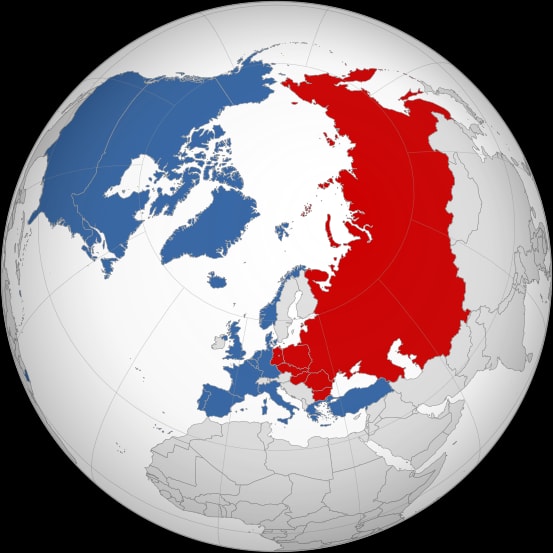
After World War II, the world split into two competing ideological blocs, and both superpowers formed military alliances to lock in their influence.
- NATO (North Atlantic Treaty Organization) was created in 1949 by the United States and its Western European allies. It was built around collective security against the Soviet Union and aligned with capitalism and democracy.
- The Warsaw Pact, formed in 1955, was the Eastern bloc's answer. Led by the Soviet Union, it tied together Eastern European states and aimed to defend socialism and keep Soviet influence over the region.
These alliances sharpened the East-West divide and gave each side a framework for military coordination throughout the Cold War. They are the clearest required examples of how the superpowers organized their influence.
Proxy Wars
Instead of fighting each other directly, the United States and the Soviet Union backed opposing sides in conflicts around the world. Many of these wars took place in postcolonial states in Latin America, Africa, and Asia, which turned local struggles into battlegrounds for Cold War ideology.
The Korean War (1950-1953)
- North Korea, supported by the Soviet Union and China, invaded South Korea, which was backed by the United States and United Nations forces.
- The war ended in a stalemate with an armistice in 1953 and the creation of the Demilitarized Zone (DMZ).
- It was one of the first major military conflicts of the Cold War and set a pattern for future proxy wars.
The Angolan Civil War (1975-2002)
- After independence from Portugal, civil war broke out between:
- MPLA (communist, backed by the USSR and Cuba)
- UNITA (anti-communist, backed by the U.S. and South Africa)
- The war dragged on for decades, ending in 2002.
- This is a strong African example of how decolonization and Cold War rivalry overlapped.
The Sandinista-Contras Conflict in Nicaragua (1979-1990)
- In Nicaragua, the Sandinistas, a socialist group, overthrew the Somoza dictatorship.
- The Contras, an anti-communist rebel group, were covertly supported by the United States.
- The conflict wound down in 1990 with elections in which the Sandinistas lost power peacefully.
Related context: Vietnam
The Vietnam War is another well-known Cold War conflict, with communist North Vietnam (backed by the USSR and China) fighting U.S.-backed South Vietnam until the country was unified under communist rule in 1975. Treat it as useful cross-topic context for Cold War proxy conflicts rather than the central example for this topic.
Nuclear Proliferation and the Arms Race
A major effect of the Cold War was the spread of nuclear weapons and an escalating arms race between the superpowers.
- Both the U.S. and the USSR built increasingly powerful weapons, far beyond those used in World War II.
- The idea of Mutually Assured Destruction (MAD) held that any full nuclear exchange would devastate both sides, which discouraged direct war.
- Arms control talks like SALT (Strategic Arms Limitation Talks) tried to limit stockpiles, but deep mistrust remained.
For the exam, the key point is that nuclear proliferation was one of the main ways the superpower rivalry shaped global security.
Other Cold War Flashpoints
Not every confrontation became a shooting war. Some played out as symbolic, political, or technological competition.
The Space Race
- The Soviet Union launched the first artificial satellite, Sputnik, in 1957, which pushed the U.S. to invest heavily in science and education.
- The United States landed astronauts on the moon with Apollo 11 in 1969.
- Space competition was tied to military power, since rockets that could reach space could also deliver intercontinental ballistic missiles (ICBMs). These are useful examples of indirect competition, not required content for this topic.
Berlin
- In 1948, the Soviet Union blockaded West Berlin, and the Western Allies responded with the Berlin Airlift, flying in supplies until the blockade ended.
- In 1961, East Germany built the Berlin Wall to stop people from fleeing west. It became a powerful symbol of the divide between communism and capitalism until it fell in 1989.
Comparison of Cold War Influence Strategies
| Method | United States | Soviet Union |
|---|---|---|
| Military Alliances | NATO | Warsaw Pact |
| Economic Aid | Marshall Plan | Comecon |
| Ideological Messaging | Containment of communism | Promotion of socialism |
| Proxy Conflicts | Korea, Angola, Nicaragua | Korea, Angola, Nicaragua |
| Nuclear Strategy | MAD, arms buildup, arms control talks | MAD, arms buildup, arms control talks |
Use this kind of side-by-side thinking to answer comparison questions. The superpowers often used similar tools (alliances, aid, proxy wars, nuclear strategy) but aimed them at opposite ideological goals.
How to Use This on the AP World History Exam
Comparison
This topic is built around comparison, so practice stating both a similarity and a difference. Example: both superpowers built military alliances and fought proxy wars (similarity), but the U.S. promoted capitalism and containment while the USSR promoted socialism and protected its bloc (difference).
Free Response
If a prompt asks how the U.S. and USSR maintained influence, organize your answer by method (alliances, economic aid, proxy wars, nuclear strategy) instead of just telling a story. Back each claim with a specific example like NATO, the Warsaw Pact, or the Korean War.
MCQ
Documents and maps about NATO, the Warsaw Pact, divided Germany, or a proxy conflict are common. Ask yourself which superpower benefited, what ideology was at stake, and whether the source shows direct or indirect competition.
Common Trap
A frequent mistake is treating every Cold War event as direct U.S. versus USSR combat. The defining feature is that the superpowers usually competed indirectly, especially through proxy wars in postcolonial regions.
Common Misconceptions
- Misconception: The superpowers fought each other directly.Actually: They did not. The Cold War stayed "cold" between the U.S. and USSR; the actual fighting happened in proxy wars where each side backed local forces.
- Misconception: Proxy wars were only about local issues.Actually: Local politics mattered, but these conflicts were also tied to the larger struggle between capitalism and communism, which is why outside powers got involved.
- Misconception: NATO and the Warsaw Pact were equal mirror images.Actually: They served similar functions but reflected opposite ideologies and power structures, with the Soviet Union exercising tighter control over its bloc.
- Misconception: Nuclear weapons were just for fighting.Actually: The arms race and MAD were as much about deterrence and influence as about actual war, since the threat itself shaped global politics.
- Misconception: The Cold War was only a U.S.-Soviet story.Actually: Its effects reached Latin America, Africa, and Asia, especially in postcolonial states where superpower rivalry overlapped with decolonization.
Related AP World History Guides
Practice Questions for 8.3
1 of 10
The Soviet Union's support for the MPLA in Angola and the United States' backing of UNITA during the Angolan Civil War best illustrates the relationship between Cold War ideological competition and which of the following?
A.
The economic superiority of capitalist nations in providing military resources to allied forces
B.
The failure of the United Nations to prevent regional conflicts in newly independent nations
C.
The Soviet Union's geographic proximity to African nations, which gave it natural advantages in regional conflicts
D.
The extension of superpower rivalry into postcolonial regions where direct confrontation could be avoided
Vocabulary
The following words are mentioned explicitly in the AP® course framework for this topic.Term | Definition |
|---|---|
Angolan Civil War | A proxy conflict in Angola where the Soviet Union and Cuba supported one faction while the United States supported another during the Cold War. |
Cold War | The ideological and geopolitical conflict between the Soviet Union and the United States and their respective allies that lasted from the end of World War II until the early 1990s. |
Korean War | A proxy conflict (1950-1953) between communist North Korea supported by the Soviet Union and China, and non-communist South Korea supported by the United States. |
military alliances | Formal agreements between nations to provide mutual defense and security cooperation, such as those formed during the Cold War. |
North Atlantic Treaty Organization | The North Atlantic Treaty Organization, a military alliance formed in 1949 by Western nations led by the United States to counter Soviet expansion in Europe. |
nuclear proliferation | The spread of nuclear weapons and nuclear weapons technology to additional countries during the Cold War. |
postcolonial states | Nations that gained independence from colonial rule, particularly in Latin America, Africa, and Asia, and became sites of Cold War competition. |
proxy wars | Indirect military conflicts between superpowers fought through allied nations or client states rather than direct confrontation between the superpowers themselves. |
Sandinista-Contras conflict | A proxy war in Nicaragua where the Soviet Union and Cuba supported the Sandinista government while the United States supported the Contra rebels. |
Warsaw Pact | A military alliance formed in 1955 by the Soviet Union and its Eastern European satellite states as a counterweight to NATO. |
Frequently Asked Questions
What were the main effects of the Cold War in AP World History?
The Cold War produced military alliances, nuclear proliferation, and proxy wars as the United States and Soviet Union competed for global influence.
What military alliances formed during the Cold War?
NATO formed around the United States and Western allies, while the Warsaw Pact formed around the Soviet Union and Eastern European states.
What is a proxy war?
A proxy war is a conflict where major powers support opposing sides instead of fighting each other directly.
What are examples of Cold War proxy wars for AP World?
CED examples include the Korean War, the Angolan Civil War, and the Sandinista-Contras conflict in Nicaragua.
How did nuclear proliferation affect the Cold War?
Nuclear proliferation increased the stakes of the rivalry and made direct war dangerous because both superpowers could cause massive destruction.
How should you write about Topic 8.3 on the AP World exam?
Organize by methods of influence, such as alliances, proxy wars, and nuclear strategy, then compare how the U.S. and Soviet Union used those methods.
See Fiveable more often in Google
Mark Fiveable as a preferred source and Google is more likely to show you our guides in Top Stories, with a "preferred" badge in AI Mode and AI Overviews.