AMSCO 6.2 State Expansion Notes

🌍AP World History: Modern Review
AMSCO 6.2 State Expansion Notes
🌍 AP World History: Modern
AMSCO 1.1 Developments in East Asia Notes
AMSCO 1.2 Developments in Dar al-Islam Notes
AMSCO 1.3 Developments in South and Southeast Asia Notes
AMSCO 1.4 Developments in the Americas Notes
AMSCO 1.5 Developments in Africa Notes
AMSCO 1.6 Developments in Europe Notes
AMSCO 1.7 Comparison in the Period from c.1200 to c.1450 Notes
AMSCO 2.1 The Silk Roads Notes
AMSCO 2.2 The Mongol Empire and the Modern World Notes
AMSCO 2.3 Exchange in the Indian Ocean Notes
AMSCO 2.4 Trans-Saharan Trade Routes Notes
AMSCO 2.5 Cultural Consequences of Connectivity Notes
AMSCO 2.6 Environmental Consequences of Connectivity Notes
AMSCO 2.7 Comparison of Economic Exchange Notes
AMSCO 3.1 European, East Asian, and Gunpowder Empires Expand Notes
AMSCO 3.2 Empires: Administrations Notes
AMSCO 3.3 Empires: Belief Systems Notes
AMSCO 3.4 Comparison in Land-Based Empires Notes
AMSCO 4.1 Technological Innovations Notes
AMSCO 4.2 Exploration: Causes and Events Notes
AMSCO 4.3 Columbian Exchange Notes
AMSCO 4.4 Maritime Empires Link Regions Notes
AMSCO 4.5 Maritime Empires Develop Notes
AMSCO 4.6 Internal and External Challenges to State Power Notes
AMSCO 4.7 Changing Social Hierarchies Notes
AMSCO 4.8 Continuity and Change from c.1450 to c.1750 Notes
AMSCO 5.1 The Enlightment Notes
AMSCO 5.2 Nationalism and Revolutions Notes
AMSCO 5.3 Industrial Revolution Begins Notes
AMSCO 5.4 Industrialization Spreads Notes
AMSCO 5.5 Technology in the Industrial Age Notes
AMSCO 5.6 Industrialization: Government's Role Notes
AMSCO 5.7 Economic Developments and Innovations Notes
AMSCO 5.8 Reactions to the Industrial Economy Notes
AMSCO 5.9 Society and the Industrial Age Notes
AMSCO 5.10 Continuity and Change in the Industrial Age Notes
AMSCO 6.1 Rationales for Imperialism Notes
AMSCO 6.2 State Expansion Notes
AMSCO 6.3 Indigenous Responses to State Expansion Notes
AMSCO 6.4 Global Economic Development Notes
AMSCO 6.5 Economic Imperialism Notes
AMSCO 6.6 Causes of Migration in an Interconnected World Notes
AMSCO 6.7 Effects of Migration Notes
AMSCO 6.8 Causation in the Imperial Age Notes
AMSCO 7.1 Shifting Power Notes
AMSCO 7.2 Causes of World War I Notes
AMSCO 7.3 Conducting World War I Notes
AMSCO 7.4 Economy in the Interwar Period Notes
AMSCO 7.5 Unresolved Tensions After World War I Notes
AMSCO 7.6 Causes of World War II Notes
AMSCO 7.7 Conducting World War II Notes
AMSCO 7.8 Mass Atrocities Notes
AMSCO 7.9 Causation in Global Conflict Notes
AMSCO 8.1 Setting the Stage for the Cold War and Decolonization Notes
AMSCO 8.2 The Cold War Notes
AMSCO 8.3 Effects of the Cold War Notes
AMSCO 8.4 Spread of Communism Notes
AMSCO 8.5 Decolonization after 1900 Notes
AMSCO 8.6 Newly Independent States Notes
AMSCO 8.7 Global Resistance to Established Power Structure Notes
AMSCO 8.8 End of the Cold War Notes
AMSCO 8.9 Causation in the Age of the Cold Ward and Decolonization Notes
AMSCO 9.1 Advances in Technology and Exchange Notes
AMSCO 9.2 Technological Advancements and Limitations Notes
AMSCO 9.3 Technology and the Environment Notes
AMSCO 9.4 Economics in the Global Age Notes
AMSCO 9.5 Calls for Reforms and Responses Notes
AMSCO 9.6 Globalized Culture Notes
AMSCO 9.7 Resistance to Globalization Notes
AMSCO 9.8 Institutions Developing in a Globalized World Notes
AMSCO 9.9 Continuity and Change in a Globalized World Notes
Overview
AMSCO Topic 6.2, State Expansion (p. 375-387), covers how European powers, the United States, Russia, and Japan expanded their empires between 1750 and 1900 through conquest, settlement, diplomacy, and economic pressure. The chapter's big question: by what processes did state power shift around the world during this period? The answer varies by region. Africa got carved up at the Berlin Conference, Britain absorbed all of South Asia, China kept its government but lost economic control, and the U.S. and Japan went from regional players to imperial powers. The chapter also gives you a comparison of three imperialism types (state-run colonies, settler colonies, and economic domination) that shows up constantly on the AP exam.
One pattern to watch: in two famous cases, control shifted from private hands to actual governments. Belgium took the Congo away from King Leopold II in 1908, and the Dutch government took over Indonesia after the Dutch East India Company went bankrupt. That non-state-to-state shift is exactly the kind of comparison the exam loves.
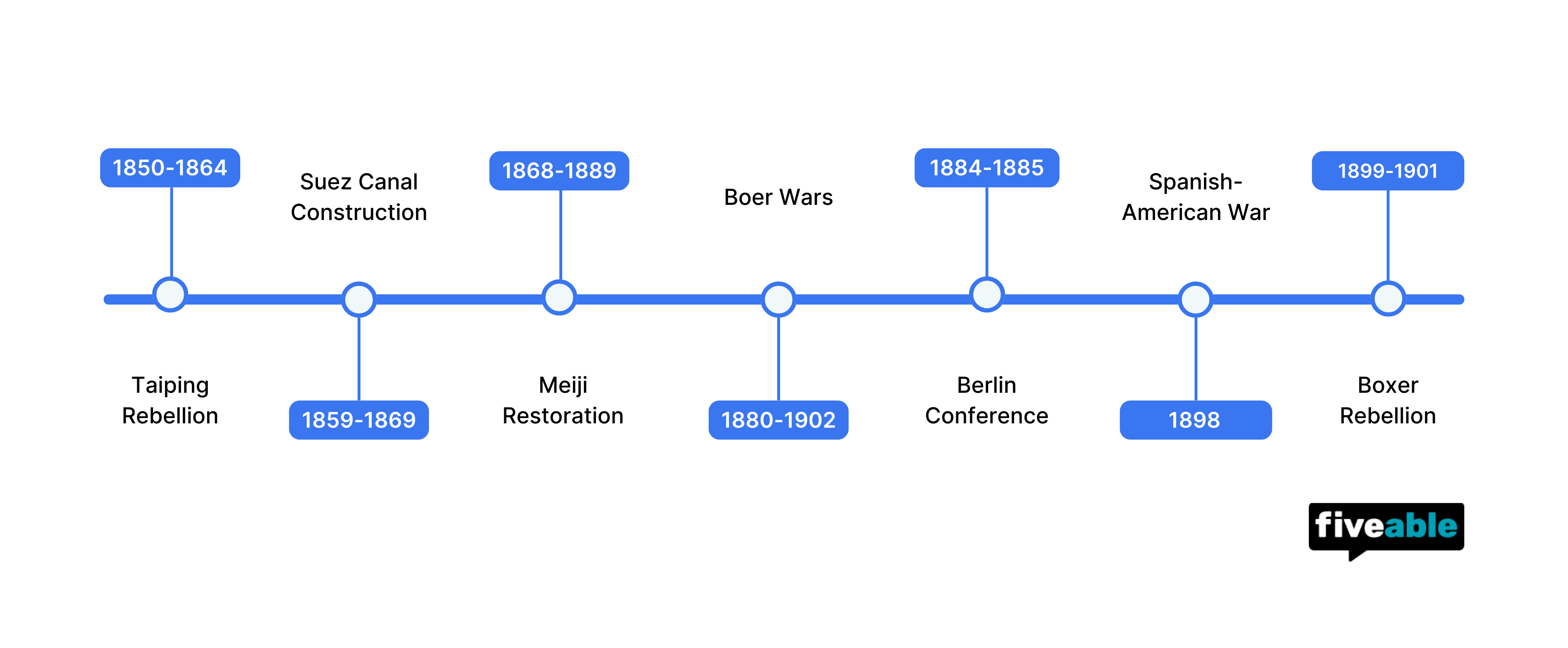
Timeline of state expansion spanning from 1750-1900. Image Courtesy of Siya
Key Takeaways
- Quinine and steamships helped Europeans move into Africa's interior, while the Berlin Conference divided the continent among European powers without African participation.
- Britain seized Egypt when unrest threatened the Suez Canal, while Leopold II's forced-labor regime in the Congo ended with a Belgian government takeover in 1908.
- The East India Company took land across India, European powers gained exclusive trading rights in China without ruling it, and Japan built an East Asian empire.
- The Dutch government took over the Dutch East Indies after the VOC went bankrupt, Siam avoided colonization through diplomacy and reforms, and Britain took control of Australia.
- The U.S. forced Native peoples from their lands and gained overseas territory, while Russia competed with Britain over Afghanistan in the Great Game.
- State-run colonies replaced local culture with Western institutions, settler colonies focused on controlling land, and economic domination extracted resources while leaving weakened local governments in place.
Imperialism in Africa and the Scramble for Africa
Europeans had traded with Africa for centuries, but for most of the 1800s their presence was limited to coastal trading posts. Even after most European countries banned importing enslaved Africans by the early 1800s, demand for palm oil (which kept British textile machinery from rusting), gold, ivory, and diamonds kept Europeans engaged. Two technologies changed everything in the second half of the century: quinine, a medicine that treats malaria and made the tropical interior survivable, and the steamship.
British Egypt and West Africa
- The Suez Canal, completed in 1869, cut 100 miles between the Red Sea and Mediterranean and saved ships the entire trip around Africa. A French company ran the project, but up to 1.5 million Egyptians did the labor, many as corvée laborers (unpaid forced workers, a form of taxation). Thousands died over ten years.
- When unrest threatened the canal in 1882, Britain seized Egypt from the Ottoman Empire.
- In West Africa, Britain established Sierra Leone (1787) as a home for freed enslaved people, plus Gambia (1816); both served as bases to stop the slave trade from the region. Lagos became a crown colony in 1861, the Gold Coast in 1874, and the Asante Empire fell under British control in 1901.
- Britain used diplomacy first, then warfare. The 1873 treaty with King Jaja of Opobo (in palm-oil-rich present-day Nigeria) recognized him as ruler with favorable trade terms. But as European competition heated up, treaties like this became meaningless and Africans who resisted met overpowering military force.
- France drove the Ottomans out of Algeria in 1830 and turned it into a settler colony by 1870, drawing French, Spanish, Italian, and Maltese immigrants. France also set up trading posts in Guinea, the Ivory Coast, and Niger.
The Berlin Conference
Otto von Bismarck hosted the Berlin Conference in 1884-1885 so European powers could divide Africa without going to war with each other. No Africans were invited. The powers agreed on colonial boundaries and free movement of goods on rivers like the Niger and Congo. The borders were artificial lines that split unified societies apart and forced rival groups together, which made national unity nearly impossible when these colonies became independent in the 20th century.
South Africa and the Boer Wars
Britain replaced the Dutch in the Cape Colony during the Napoleonic Wars. Dutch-speaking Afrikaners (descendants of 17th-century Dutch settlers) moved east, fighting wars with the Zulus and other indigenous groups along the way. British-Afrikaner conflict over land exploded into the Boer Wars (1880-1881 and 1899-1902). The British forced Afrikaners and Africans into racially segregated concentration camps with terrible sanitation and starvation rations. Of roughly 100,000 Black Africans interned, nearly 15,000 died, and conditions in Black camps stayed terrible even after British activists improved the white camps. By the end, Britain had absorbed southern Africa into its empire and displaced millions of farmers onto poor land.
Leopold's Congo
King Leopold II of Belgium personally owned the Congo Free State; the Belgian government originally wanted nothing to do with it. His regime forced laborers to harvest ivory and rubber, severed workers' hands to terrorize others, held spouses captive so workers couldn't flee, and killed those who missed quotas. As many as 8 million people died, while Leopold pocketed about 220 million francs (roughly $1.1 billion today). In 1908, the Belgian Parliament took the Congo away from him and ran it as a regular colony, and conditions improved.
Who stayed independent?
By 1900, only Abyssinia (modern Ethiopia) and Liberia were unclaimed by Europeans. Abyssinia defeated an Italian invasion attempt in 1895. Liberia, founded by formerly enslaved people from the United States, was technically independent but economically dependent on the U.S.
Imperialism in South and East Asia
Britain ended up controlling all of South Asia, while China kept its government but lost economic sovereignty. Those are two very different processes of state power shifting, and the chapter wants you to see the contrast.
British India
Portugal held only the coastal port of Goa and France was driven out of India after losing the Seven Years' War (1756-1763). That left England's East India Company (EIC) to steadily take land from the weakening Mughal Empire until Britain controlled the entire subcontinent, from Pakistan to Kashmir to Bengal to Ceylon (Sri Lanka). The EIC recruited native Indian soldiers called sepoys for its colonial army; their 1857 rebellion is covered in the next topic on indigenous responses.
China: spheres of influence, not colonies
China kept its own government, but European nations used superior military strength to carve out spheres of influence, zones with exclusive trading rights and access to natural resources. Internal crises made foreign domination easier:
- The Taiping Rebellion (1850-1864): failed civil service applicant Hong Xiuquan led starving peasants, workers, and miners against the Qing Dynasty. The Qing won with help from warlords plus French and British intervention, but more than 20 million people died, over half of them civilians.
- Mid-rebellion, the Yellow River changed course, causing floods, drought, famine, and a bubonic plague outbreak.
- The Boxer Rebellion (1899-1901): the anti-imperialist Boxers (named for practicing Chinese martial arts) attacked Chinese Christians and Western missionaries. Empress Dowager Cixi encouraged them and in 1900 ordered all foreigners killed. Of the roughly 100,000 people killed, most were Chinese Christians; only about 200-250 foreigners died. The humiliating Qing defeat further eroded the dynasty's legitimacy.
Japan: from isolated to imperial
Japan had limited foreign contact since the early 1600s until U.S. Commodore Matthew Perry arrived with warships in 1853 and secured a treaty opening Japanese ports. The Meiji Restoration overthrew the traditional government, and Japan rapidly industrialized to protect its culture. Short on resources and arable land, Japan looked outward: it encouraged contract labor in Hawaii and Guam, founded a Colonization Society in 1893 to plan colonies in Mexico and Latin America, and built an East Asian empire (parts of China, Korea, Southeast Asia, and Pacific islands) that lasted until the end of World War II.
Imperialism in Southeast Asia, Australia, and New Zealand
After 1600, the Dutch and English supplanted Portugal and Spain in Southeast Asian trade.
- The Dutch: the Dutch East India Company (VOC) seized the Spice Islands in 1641 and ran the spice trade until corruption bankrupted it by 1800. The Dutch government then took direct control of the Dutch East Indies. Plantations growing tea, rubber, and sugar for export squeezed out rice farming, creating severe hardship for Indonesian farmers; humanitarian reforms came but fell short.
- The French: after winning the Sino-French War (1883-1885), France took northern Vietnam, then pressured Siam into ceding Laos. By the 1890s France controlled Cambodia, Laos, and all of Vietnam as French Indochina, planting rubber across the region.
- The British: starting with Penang (1786) and Singapore (founded 1824, made the region's top seaport by Chinese immigrants), Britain came to control the Malay Peninsula, Burma, and northern Borneo. Tin and gold drew investors first; by the end of the 19th century, Malaya was the world's greatest producer of natural rubber.
- Siam (modern Thailand) was the only Southeast Asian nation to escape colonization. Its monarchs handled diplomacy with neighboring British and French colonies skillfully and pushed Meiji-style modernizing reforms: railroads, industrialization, and Western-style schools to staff an efficient bureaucracy.
Australia and New Zealand
Britain founded Australia as a penal colony in 1788 (New South Wales), then took the whole continent in the 1820s. Wool production, then copper (1842) and gold (1851) discoveries, brought waves of free settlers. Britain annexed New Zealand in 1839; the 1840 Treaty of Waitangi promised the crown would protect Maori rights, and New Zealand became a separate colony in 1841. War broke out anyway as settlers encroached on Maori land. Both are textbook settler colonies.
U.S. and Russian Expansion
The United States and Russia expanded mainly by conquering and settling neighboring territory, then (in the U.S. case) reaching overseas.
The United States
- The Trail of Tears: forced relocation of Eastern Woodlands peoples to Indian Territory (now Oklahoma), killing many through exposure, malnutrition, disease, and exhaustion.
- The 1823 Monroe Doctrine warned Europe out of the Western Hemisphere, implying the U.S. wanted that sphere for itself. The U.S.-Mexico war (1845-1848) delivered vast Southwest territory.
- Manifest Destiny, the belief that expansion to the Pacific was natural and inevitable, drove westward settlement. The U.S. bought Alaska from Russia in 1867, finished the transcontinental railroad in 1869, forced Native Americans onto reservations, and by 1893 the Census Bureau declared the frontier closed.
- Overseas: American planters overthrew Hawaii's monarchy in 1893 (annexed in 1898, a territory in 1900). Victory in the Spanish-American War (1898) brought Guam, Cuba, Puerto Rico, and the Philippines under U.S. control. Theodore Roosevelt's 1904 Roosevelt Corollary declared the U.S. would intervene in "unstable" Latin American countries, and it did, including occupying the Dominican Republic in 1904 until it repaid foreign debts.
Russia
Catherine the Great (ruled 1762-1796) annexed about half of Poland plus Ottoman territory; Alexander I added Finland, Moldova, Georgia, Azerbaijan, and part of Armenia. The Russian-American Company (modeled on the British and Dutch East India companies) ran Alaska from Novoarkhangelsk (Sitka) and even built Fort Ross in California, abandoned in 1839. Russia sold Alaska to the U.S. in 1867. Pushing into Central Asia instead, Russia entered the Great Game, an intense rivalry with Britain over Afghanistan that neither won. Russia also annexed a large portion of Manchuria from China.
Three Types of Imperialism Compared
This comparison chart is the chapter's payoff, and it maps directly onto the comparison skill in the 6.2 Expansion of Imperialism course guide.
| Type | Examples | Features | Outcomes |
|---|---|---|---|
| State-run colony | British West Africa, Belgian Congo | Western institutions slowly replace local culture; often defended as "helping" indigenous people | Labor exploitation, loss of indigenous culture, creation of non-native elite and mixed middle class |
| Settler colony | British South Africa, Australia, New Zealand, French Algeria | Focus on controlling land; settlers remove or dominate indigenous populations; most common in sparsely populated areas | Loss of culture, genocide, disease, forced conversion to Western systems, extreme poverty |
| Economic domination | British and French in China, U.S. in Latin America | Exploits raw materials and low-wage labor; local government stays in place but weakens | Social destabilization, monoculture, soil depletion, environmental damage |
Key Terms to Know
| Term | Why it matters |
|---|---|
| Berlin Conference | The 1884-1885 meeting where European powers divided Africa among themselves, with no Africans invited. |
| Scramble for Africa | The competing European rush to colonize Africa in the late 1800s that the Berlin Conference tried to manage. |
| King Leopold II | The Belgian king who personally owned the Congo Free State and ran a brutal forced-labor regime that killed up to 8 million people. |
| Congo Free State | Leopold's privately owned colony, transferred to Belgian government control in 1908, a key example of non-state-to-state power shift. |
| Boer Wars | British-Afrikaner conflicts (1880-1881, 1899-1902) that ended with Britain controlling southern Africa and tens of thousands dying in concentration camps. |
| Afrikaners | Descendants of 17th-century Dutch settlers in South Africa who fought the British and indigenous groups over land. |
| Corvée laborer | An unpaid forced worker (a form of taxation); up to 1.5 million Egyptians built the Suez Canal this way. |
| Suez Canal | The 1869 canal linking the Red Sea and Mediterranean; protecting it was Britain's reason for seizing Egypt in 1882. |
| Quinine | The malaria medicine that made it possible for Europeans to live in Africa's tropical interior. |
| East India Company (EIC) | The British company that gradually took the Indian subcontinent from the weakening Mughal Empire. |
| Dutch East India Company (VOC) | The company that ran the Spice Islands trade until bankruptcy in 1800, when the Dutch government took direct control. |
| Spheres of influence | Zones in China where individual European powers held exclusive trading rights without formally ruling. |
| Taiping Rebellion | The 1850-1864 uprising against the Qing led by Hong Xiuquan that killed over 20 million people and weakened China against foreign domination. |
| Boxer Rebellion | The 1899-1901 anti-foreign uprising encouraged by Empress Dowager Cixi; its defeat further undermined Qing legitimacy. |
| Settler colony | A colony focused on land, where settlers remove or dominate indigenous people (Australia, New Zealand, Algeria, South Africa). |
| Treaty of Waitangi | The 1840 agreement promising British protection of Maori rights in New Zealand, which settlers' land-grabbing soon undermined. |
| Manifest Destiny | The American belief in a natural, inevitable right to expand to the Pacific. |
| Roosevelt Corollary | Theodore Roosevelt's 1904 addition to the Monroe Doctrine claiming a U.S. right to intervene in "unstable" Latin American countries. |
Practice and Next Steps
Pair these notes with the 6.2 Expansion of Imperialism study guide for the course-topic angle, and review the AMSCO 6.1 Rationales for Imperialism notes to connect the "why" behind expansion to the "how" covered here. Then move ahead to 6.3 Indigenous Responses to State Expansion to see how colonized peoples fought back, including the Sepoy Rebellion this chapter sets up.
To check your understanding, run through AP World guided practice questions on Unit 6, or try a comparison-style prompt with FRQ practice and instant scoring. The three-types-of-imperialism chart above is built for exactly that kind of question.
Frequently Asked Questions
What is AMSCO Topic 6.2 State Expansion about?
AMSCO Topic 6.2 (p. 375-387) covers how European powers, the United States, Russia, and Japan expanded their empires from 1750 to 1900 through conquest, settlement, diplomacy, and economic pressure. Major content includes the Scramble for Africa, the Berlin Conference, the Boer Wars, Leopold's Congo, British control of India, spheres of influence in China, and U.S. overseas expansion after the Spanish-American War.
What happened at the Berlin Conference of 1884-1885?
Otto von Bismarck hosted European powers to agree peacefully on colonial boundaries in Africa and free movement of goods on major rivers like the Niger and Congo. No Africans were invited. The artificial borders split unified societies apart and merged rival groups together, which caused extensive conflict when these colonies became independent in the 20th century.
Why didn't China get colonized like Africa or India?
China kept its own government throughout the period, so it was never formally colonized. Instead, European powers used military superiority to carve out spheres of influence, zones with exclusive trading rights and resource access. Internal crises like the Taiping Rebellion (over 20 million dead) and the Boxer Rebellion's defeat weakened the Qing so much that foreigners dominated China's economy anyway. AMSCO calls this 'economic domination,' a distinct type of imperialism.
What are the three types of imperialism in AP World Unit 6?
State-run colonies (like British West Africa and the Belgian Congo), settler colonies (like Australia, New Zealand, French Algeria, and British South Africa), and economic domination (like the British in China and the U.S. in Latin America). Settler colonies focused on controlling land and displacing indigenous people, while economic domination left local governments in place but weak. This comparison shows up often in AP World comparison FRQs, so it's worth practicing with FRQ practice and instant scoring.
Which African countries stayed independent during the Scramble for Africa?
Only Abyssinia (modern Ethiopia) and Liberia were unclaimed by European powers by 1900. Abyssinia defeated an Italian invasion attempt in 1895. Liberia, founded by formerly enslaved people from the United States, was technically independent but had a dependent relationship with the U.S., so AMSCO notes it wasn't fully independent.
See Fiveable more often in Google
Mark Fiveable as a preferred source and Google is more likely to show you our guides in Top Stories, with a "preferred" badge in AI Mode and AI Overviews.