AMSCO 1.2 Developments in Dar al-Islam Notes

🌍AP World History: Modern Review
AMSCO 1.2 Developments in Dar al-Islam Notes
🌍 AP World History: Modern
AMSCO 1.1 Developments in East Asia Notes
AMSCO 1.2 Developments in Dar al-Islam Notes
AMSCO 1.3 Developments in South and Southeast Asia Notes
AMSCO 1.4 Developments in the Americas Notes
AMSCO 1.5 Developments in Africa Notes
AMSCO 1.6 Developments in Europe Notes
AMSCO 1.7 Comparison in the Period from c.1200 to c.1450 Notes
AMSCO 2.1 The Silk Roads Notes
AMSCO 2.2 The Mongol Empire and the Modern World Notes
AMSCO 2.3 Exchange in the Indian Ocean Notes
AMSCO 2.4 Trans-Saharan Trade Routes Notes
AMSCO 2.5 Cultural Consequences of Connectivity Notes
AMSCO 2.6 Environmental Consequences of Connectivity Notes
AMSCO 2.7 Comparison of Economic Exchange Notes
AMSCO 3.1 European, East Asian, and Gunpowder Empires Expand Notes
AMSCO 3.2 Empires: Administrations Notes
AMSCO 3.3 Empires: Belief Systems Notes
AMSCO 3.4 Comparison in Land-Based Empires Notes
AMSCO 4.1 Technological Innovations Notes
AMSCO 4.2 Exploration: Causes and Events Notes
AMSCO 4.3 Columbian Exchange Notes
AMSCO 4.4 Maritime Empires Link Regions Notes
AMSCO 4.5 Maritime Empires Develop Notes
AMSCO 4.6 Internal and External Challenges to State Power Notes
AMSCO 4.7 Changing Social Hierarchies Notes
AMSCO 4.8 Continuity and Change from c.1450 to c.1750 Notes
AMSCO 5.1 The Enlightment Notes
AMSCO 5.2 Nationalism and Revolutions Notes
AMSCO 5.3 Industrial Revolution Begins Notes
AMSCO 5.4 Industrialization Spreads Notes
AMSCO 5.5 Technology in the Industrial Age Notes
AMSCO 5.6 Industrialization: Government's Role Notes
AMSCO 5.7 Economic Developments and Innovations Notes
AMSCO 5.8 Reactions to the Industrial Economy Notes
AMSCO 5.9 Society and the Industrial Age Notes
AMSCO 5.10 Continuity and Change in the Industrial Age Notes
AMSCO 6.1 Rationales for Imperialism Notes
AMSCO 6.2 State Expansion Notes
AMSCO 6.3 Indigenous Responses to State Expansion Notes
AMSCO 6.4 Global Economic Development Notes
AMSCO 6.5 Economic Imperialism Notes
AMSCO 6.6 Causes of Migration in an Interconnected World Notes
AMSCO 6.7 Effects of Migration Notes
AMSCO 6.8 Causation in the Imperial Age Notes
AMSCO 7.1 Shifting Power Notes
AMSCO 7.2 Causes of World War I Notes
AMSCO 7.3 Conducting World War I Notes
AMSCO 7.4 Economy in the Interwar Period Notes
AMSCO 7.5 Unresolved Tensions After World War I Notes
AMSCO 7.6 Causes of World War II Notes
AMSCO 7.7 Conducting World War II Notes
AMSCO 7.8 Mass Atrocities Notes
AMSCO 7.9 Causation in Global Conflict Notes
AMSCO 8.1 Setting the Stage for the Cold War and Decolonization Notes
AMSCO 8.2 The Cold War Notes
AMSCO 8.3 Effects of the Cold War Notes
AMSCO 8.4 Spread of Communism Notes
AMSCO 8.5 Decolonization after 1900 Notes
AMSCO 8.6 Newly Independent States Notes
AMSCO 8.7 Global Resistance to Established Power Structure Notes
AMSCO 8.8 End of the Cold War Notes
AMSCO 8.9 Causation in the Age of the Cold Ward and Decolonization Notes
AMSCO 9.1 Advances in Technology and Exchange Notes
AMSCO 9.2 Technological Advancements and Limitations Notes
AMSCO 9.3 Technology and the Environment Notes
AMSCO 9.4 Economics in the Global Age Notes
AMSCO 9.5 Calls for Reforms and Responses Notes
AMSCO 9.6 Globalized Culture Notes
AMSCO 9.7 Resistance to Globalization Notes
AMSCO 9.8 Institutions Developing in a Globalized World Notes
AMSCO 9.9 Continuity and Change in a Globalized World Notes
Overview
AMSCO Topic 1.2, "Developments in Dar al-Islam," covers how the Islamic world changed between c. 1200 and c. 1450 as the Abbasid Caliphate weakened and new Turkic-led Muslim states took its place. The chapter (AMSCO p. 15 - p. 19) traces four big threads: the invasions and trade shifts that broke down Abbasid power, the intellectual golden age centered on Baghdad's House of Wisdom, the status of women in Islamic society, and Muslim rule in Spain (al-Andalus). The core takeaway for AP World Unit 1 is that even as Dar al-Islam fragmented politically, it stayed unified culturally through shariah law, trade networks, and shared centers of learning, and Islam kept spreading through merchants, missionaries, and Sufis.
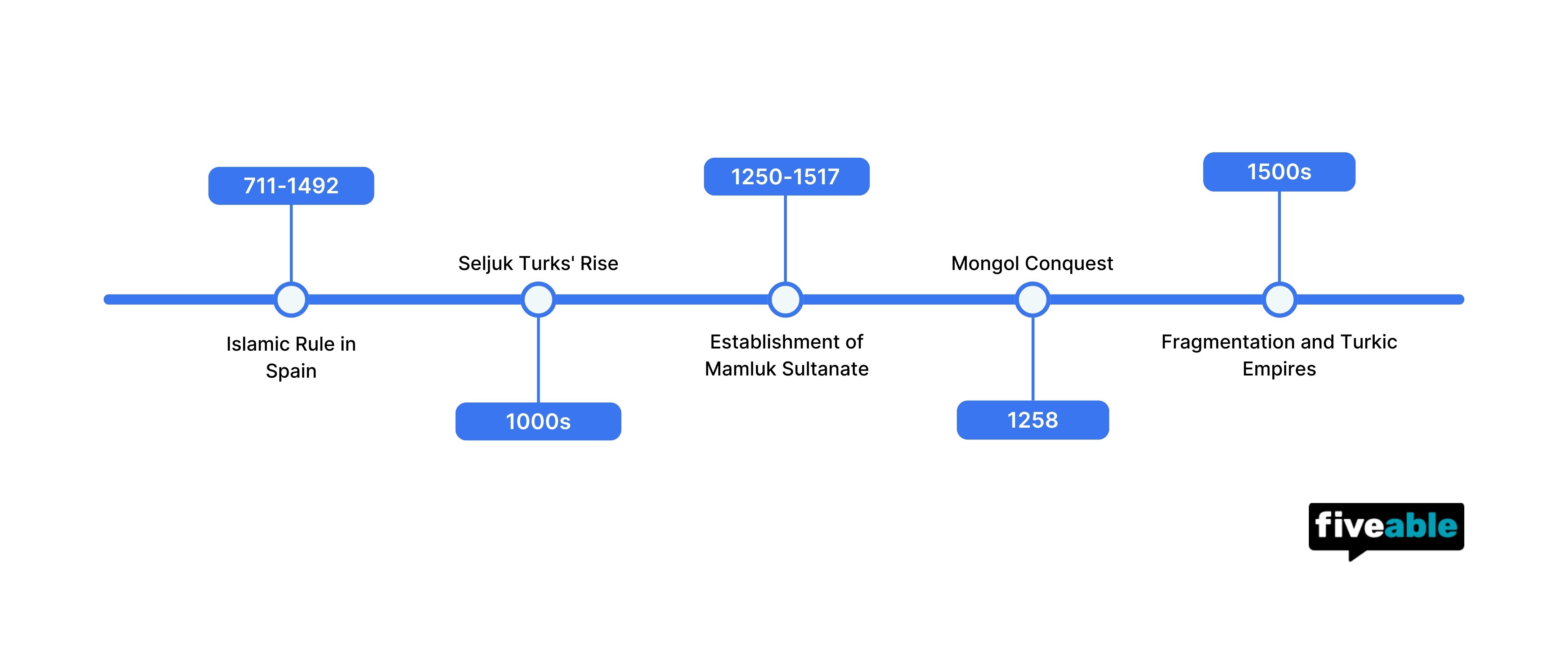
Timeline of Developments in Dar al-Islam (Image Courtesy of Samhitha)
Key Takeaways
- Seljuk sultans took political power from Abbasid caliphs; Mongols conquered what remained of the Abbasid Empire in 1258, but Mamluks stopped their westward advance in Egypt.
- As trade routes shifted north, Baghdad lost wealth and population, leaving it unable to repair canals needed to support the city.
- Trade, shariah law, and universities linked separate Muslim states, while scholars translated Greek classics and passed mathematics from India to Europeans.
- Sufi missionaries adapted to local cultures to spread Islam, while merchants earned respect through fair dealing and charity.
- Islamic women could inherit property, remarry, and sometimes initiate divorce, but their testimony counted less than men's, and growing cities brought new restrictions on their rights.
- Tours limited rapid Islamic expansion into Western Europe, while Umayyad Córdoba fostered religious coexistence; Ibn Rushd's commentaries influenced Maimonides, who influenced Christian thinkers.
Invasions and Shifts in Trade Routes
By the 1100s and 1200s, the Abbasid Empire was getting squeezed from every direction. Like China, it faced nomadic groups from Central Asia. Unlike China, it also faced European invaders. Four groups matter here.
Egyptian Mamluks
- Arabs frequently purchased enslaved people called Mamluks, often ethnic Turks from Central Asia, to serve as soldiers and later bureaucrats. Because of these roles, Mamluks had more chances to rise in society than most enslaved people.
- In Egypt, Mamluks seized control of the government and established the Mamluk Sultanate (1250-1517).
- They prospered by facilitating the cotton and sugar trade between the Islamic world and Europe. When the Portuguese and other Europeans developed new sea routes, Mamluk power declined.
Seljuk Turks
- The Seljuk Turks were Muslims from Central Asia who began taking parts of the Middle East in the 11th century, eventually extending their power almost as far east as Western China.
- The Seljuk leader took the title sultan. That move reduced the highest-ranking Abbasid from caliph (political and religious leader) to merely the chief Sunni religious authority. The Abbasids kept the title but lost the real power.
Crusaders
- The Abbasids had let Christians travel freely to holy sites in and around Jerusalem. The Seljuk Turks restricted that travel.
- In response, European Christians organized armies of Crusaders to reopen access. This is one of the rare cases in this period where the Islamic world faced European invaders, not just Central Asian ones.
Mongols
- The Mongols, also from Central Asia, conquered what remained of the Abbasid Empire in 1258 and ended Seljuk rule.
- They kept pushing westward until the Mamluks stopped them in Egypt. Remember that matchup: Mamluks halt the Mongols.
Economic decline of Baghdad
Since the 8th century, the Abbasids had linked Asia, Europe, and North Africa, with much of that trade flowing through Baghdad. Then trade patterns slowly shifted to routes farther north. The chain reaction is a classic AP World cause-and-effect: Baghdad loses its place at the center of trade, so it loses wealth and population, so it can't afford to repair its canals, so farmers can't feed the city, and the infrastructure of a once-great city decays.
Cultural and Social Life
Here's the paradox the chapter wants you to see: political fragmentation, cultural unity. The Islamic world split into separate states, but those states still formed one cultural region.
Turkic states replace Arab-Persian leadership
- The Abbasid Caliphate was led by Arabs and Persians. The newer Islamic states were shaped by Turkic peoples from Central Asia: the Mamluks in North Africa, the Seljuks in the Middle East, and the Delhi Sultanate in South Asia.
- By the 16th century, three huge Islamic empires had Turkic roots: the Ottoman Empire (Turkey), the Safavid Empire (Persia), and the Mughal Empire (India). You'll see these again in Units 3 and 4.
- What held the region together: trade spreading goods and ideas, the common use of shariah creating similar legal systems, and great universities in Baghdad, Córdoba, Cairo, and Bukhara.
Cultural continuities (transfers)
Islamic scholars followed Muhammad's advice to "Go in quest of knowledge even unto China," and they preserved and passed along knowledge from other cultures:
- Translated Greek classics into Arabic, saving Aristotle and other Greek thinkers from being lost
- Studied mathematics texts from India and transferred that knowledge to Europeans
- Adopted paper-making techniques from China, then taught Europeans to make paper
Cultural innovations (golden age scholarship)
- Nasir al-Din al-Tusi (1201-1274) contributed to astronomy, law, logic, ethics, mathematics, philosophy, and medicine. His observatory was the most advanced in the world and produced the most accurate astronomical charts of the era. His work on triangles laid the groundwork for trigonometry as a separate subject.
- Medicine advanced too: hospital care improved in cities like Cairo, and doctors and pharmacists took licensing exams to practice.
- Ibn Khaldun (1332-1406) is widely recognized as a founder of historiography (the study of how historians work) and sociology.
- 'A'ishah al-Ba'uniyyah (1460-1507), a Sufi poet and mystic, may be the most prolific female Muslim writer before the 20th century. Her best-known work is a long poem praising Muhammad, "Clear Inspiration, on Praise of the Trusted One."
Sufis and the spread of Islam
Sufis emphasized introspection and mystical experience over purely intellectual study of the Quran. Sufism may have begun as a mystical reaction to the perceived luxury-loving lifestyle of the early Umayyad Caliphate. Sufi missionaries were huge for the spread of Islam because they adapted to local cultures, sometimes weaving local religious elements into Islamic practice, which won many converts.
Commerce, class, and slavery
- Merchants held more prestige in Islamic society than in most European or Asian societies at the time. Muhammad himself had been a merchant, and so had his first wife. Merchants stayed respected as long as they dealt fairly and gave to charity, and some were even sent out as missionaries.
- Islamic expansion initially brought discrimination against non-Arabs in conquered areas (though rarely open persecution). That discrimination gradually faded in the 9th century.
- Islam prohibited enslaving Muslims and monotheists (Jews, Christians, Zoroastrians) but permitted enslaving others. Enslaved people were imported from Africa, Kievan Rus, and Central Asia, but hereditary slavery had not developed. Many enslaved people converted to Islam, after which their owners freed them.
- Enslaved women serving as concubines actually had more freedom of movement than legal wives, and only enslaved women could dance or perform music before unrelated men. Some used those earnings to buy their freedom.
Free Women in Islam
Islamic women generally held higher status than Christian or Jewish women of the same era, though that status came with real limits.
- Some practices now associated with Islam, like women covering their heads and faces, were common cultural customs in Central Asia and the Byzantine Empire before Muhammad. Under Islam, the practice solidified as hijab, a term meaning either dressing modestly in general or a specific type of covering.
- Muhammad raised women's status in several ways. He insisted that dowries be paid to the bride herself, not her father. He forbade female infanticide. His first wife was educated and ran her own business, setting a precedent for recognizing women's abilities.
- Rights Islamic women held: inheriting property and keeping it after marriage, remarrying if widowed, receiving a cash settlement if divorced, initiating divorce under some conditions, and practicing birth control.
- Limits: a woman's court testimony under shariah was worth half a man's (though she was protected from retaliation for testifying), and women could not study or read in the company of unrelated men.
- One gap historians face: almost all records before 1450 were written by men, so we have little written evidence of how women viewed their own position.
- As towns and cities grew in Islamic-ruled areas, women's rights faced new restrictions, the same pattern seen in other urbanizing cultures. The veil and the harem (a separate dwelling for wives, concubines, and their children) symbolize this shift.
Islamic Rule in Spain
The Umayyads lost power quickly in the Middle East but ruled Spain for centuries. In 711, after defeating Byzantine armies across North Africa, Muslim forces invaded Spain from the south and made Córdoba their capital there.
Battle of Tours and the limit of expansion
In 732, Islamic forces lost the Battle of Tours to Frankish armies, a rare defeat for Muslim militaries in the 700s. Tours marked the limit of rapid Islamic expansion into Western Europe. Most of the continent stayed Christian, but Muslims ruled Spain for the next seven centuries.
Prosperity and tolerance in al-Andalus
- Like the Abbasids in Baghdad, the Umayyads in Córdoba fostered toleration, with Muslims, Christians, and Jews coexisting peacefully. Muslims considered all three groups "people of the book."
- Trade flourished. Chinese and Southeast Asian products entered Spain (and from there, the rest of Europe), often carried on dhows, ships first developed in India or China with long, thin hulls great for cargo but poor for warfare.
Scholarly transfers that shaped Europe
- Al-Andalus became a major center of learning, and Córdoba held the largest library in the world at the time.
- Ibn Rushd (known in Europe as Averroes, 12th century) wrote influential works on law, secular philosophy, and the natural sciences.
- Watch the chain of influence here: Ibn Rushd's commentaries on Aristotle influenced the Jewish philosopher Maimonides (c. 1135-c. 1204), who blended Aristotle's reasoning with biblical interpretation, and Maimonides in turn influenced Christian thinkers like St. Thomas Aquinas (1225-1274).
- Islamic scholarship, plus knowledge transferred from India and China (like paper-making), laid the groundwork for the European Renaissance and Scientific Revolution. That's a connection AP World loves to test across units.
Key Terms to Know
| Term | Why it matters |
|---|---|
| Abbasid Caliphate | The Arab-Persian Islamic empire whose fragmentation opened the door for new Turkic-led Muslim states. |
| Mamluks | Enslaved people, often ethnic Turks from Central Asia, who served as soldiers and bureaucrats and could rise to real power. |
| Mamluk Sultanate | The state (1250-1517) Mamluks established after seizing Egypt's government; it stopped the Mongols and ran the cotton-sugar trade with Europe. |
| Seljuk Turks | Central Asian Muslims who took much of the Middle East starting in the 11th century and reduced the caliph to a religious figurehead. |
| Sultan | The title the Seljuk leader took, signaling that real political power had shifted away from the Abbasid caliph. |
| Crusaders | European Christian soldiers organized to reopen access to Jerusalem's holy sites after the Seljuks restricted travel. |
| Mongols | Central Asian conquerors who ended the Abbasid Empire in 1258 and were stopped in Egypt by the Mamluks. |
| Baghdad | The Abbasid capital and trade hub whose decline followed trade routes shifting north. |
| House of Wisdom | Baghdad's renowned center of learning that drew scholars from across Afro-Eurasia and powered knowledge transfer. |
| Shariah | Islamic law; its common use gave politically fragmented Muslim states similar legal systems. |
| Sufis | Mystical Muslims who emphasized introspection over book learning; their adaptable missionaries won many converts to Islam. |
| Nasir al-Din al-Tusi | Golden-age scholar whose observatory produced the world's most accurate astronomical charts and whose work laid the groundwork for trigonometry. |
| 'A'ishah al-Ba'uniyyah | Sufi poet, possibly the most prolific female Muslim writer before the 20th century. |
| Ibn Khaldun | A founder of historiography and sociology, known for his historical accounts. |
| Hijab | The practice of dressing modestly, or a specific covering; an example of a pre-Islamic custom that solidified under Islam. |
| Battle of Tours | The 732 Frankish victory that marked the limit of rapid Islamic expansion into Western Europe. |
| Al-Andalus | Muslim-ruled Spain, a tolerant, prosperous center of learning where Córdoba housed the world's largest library. |
| Ibn Rushd (Averroes) | Andalusian scholar whose Aristotle commentaries influenced Maimonides and, through him, Christian philosophy. |
Practice and Next Steps
These notes pair with Fiveable's Topic 1.2 Developments in Dar al-Islam study guide, which approaches the same material from the course-topic angle. To keep moving through the chapter sequence, back up to AMSCO 1.1 Developments in East Asia or continue to AMSCO 1.3 Developments in South and Southeast Asia, where the Delhi Sultanate gets full coverage. The complete chapter list lives on the AMSCO notes hub.
To check your understanding, run through guided multiple-choice practice on this topic, or look up any term you're shaky on in the AP World key terms glossary. When you're ready to write, try FRQ practice with instant scoring.
Frequently Asked Questions
What does AMSCO Topic 1.2 Developments in Dar al-Islam cover?
AMSCO 1.2 (p. 15-19) covers the decline of the Abbasid Caliphate and the rise of new Turkic-led Islamic states like the Mamluk Sultanate and Seljuk Turks between c. 1200 and c. 1450. It also covers the intellectual golden age (House of Wisdom, al-Tusi, Ibn Khaldun), the status of women in Islam, and Muslim rule in Spain (al-Andalus).
Why did the Abbasid Caliphate decline?
The Abbasids faced four major outside pressures: Egyptian Mamluks, Seljuk Turks (who reduced the caliph to a religious figurehead), European Crusaders, and the Mongols, who conquered the remaining empire in 1258. At the same time, trade routes shifted north away from Baghdad, draining the city's wealth, population, and infrastructure.
What's the difference between the Mamluks and the Seljuk Turks?
Both were Turkic peoples from Central Asia, but they played different roles. Mamluks were enslaved soldiers and bureaucrats who seized power in Egypt and founded the Mamluk Sultanate (1250-1517), famously stopping the Mongols there. The Seljuk Turks were free Muslim conquerors who took much of the Middle East starting in the 11th century, and their leader's title of sultan stripped real political power from the Abbasid caliph.
How did Islam spread in the period 1200-1450?
Muslim rule expanded through military conquest, but Islam itself spread mostly through merchants, missionaries, and Sufis. Sufi missionaries were especially effective because they adapted to local cultures and sometimes blended local religious elements into Islamic practice, winning many converts.
How is Dar al-Islam tested on the AP World exam?
Topic 1.2 shows up in multiple-choice and short-answer questions about why Islamic states rose as the Abbasids fragmented, how Islam spread through trade, missionaries, and Sufis, and the effects of intellectual innovation like the House of Wisdom and the Greek translation movement. It's also strong evidence for continuity-and-change essays, since the Islamic world stayed culturally unified even as it fragmented politically. You can drill these ideas with guided practice questions.
See Fiveable more often in Google
Mark Fiveable as a preferred source and Google is more likely to show you our guides in Top Stories, with a "preferred" badge in AI Mode and AI Overviews.