AMSCO 7.5 Unresolved Tensions After World War I Notes

🌍AP World History: Modern Review
AMSCO 7.5 Unresolved Tensions After World War I Notes
🌍 AP World History: Modern
AMSCO 1.1 Developments in East Asia Notes
AMSCO 1.2 Developments in Dar al-Islam Notes
AMSCO 1.3 Developments in South and Southeast Asia Notes
AMSCO 1.4 Developments in the Americas Notes
AMSCO 1.5 Developments in Africa Notes
AMSCO 1.6 Developments in Europe Notes
AMSCO 1.7 Comparison in the Period from c.1200 to c.1450 Notes
AMSCO 2.1 The Silk Roads Notes
AMSCO 2.2 The Mongol Empire and the Modern World Notes
AMSCO 2.3 Exchange in the Indian Ocean Notes
AMSCO 2.4 Trans-Saharan Trade Routes Notes
AMSCO 2.5 Cultural Consequences of Connectivity Notes
AMSCO 2.6 Environmental Consequences of Connectivity Notes
AMSCO 2.7 Comparison of Economic Exchange Notes
AMSCO 3.1 European, East Asian, and Gunpowder Empires Expand Notes
AMSCO 3.2 Empires: Administrations Notes
AMSCO 3.3 Empires: Belief Systems Notes
AMSCO 3.4 Comparison in Land-Based Empires Notes
AMSCO 4.1 Technological Innovations Notes
AMSCO 4.2 Exploration: Causes and Events Notes
AMSCO 4.3 Columbian Exchange Notes
AMSCO 4.4 Maritime Empires Link Regions Notes
AMSCO 4.5 Maritime Empires Develop Notes
AMSCO 4.6 Internal and External Challenges to State Power Notes
AMSCO 4.7 Changing Social Hierarchies Notes
AMSCO 4.8 Continuity and Change from c.1450 to c.1750 Notes
AMSCO 5.1 The Enlightment Notes
AMSCO 5.2 Nationalism and Revolutions Notes
AMSCO 5.3 Industrial Revolution Begins Notes
AMSCO 5.4 Industrialization Spreads Notes
AMSCO 5.5 Technology in the Industrial Age Notes
AMSCO 5.6 Industrialization: Government's Role Notes
AMSCO 5.7 Economic Developments and Innovations Notes
AMSCO 5.8 Reactions to the Industrial Economy Notes
AMSCO 5.9 Society and the Industrial Age Notes
AMSCO 5.10 Continuity and Change in the Industrial Age Notes
AMSCO 6.1 Rationales for Imperialism Notes
AMSCO 6.2 State Expansion Notes
AMSCO 6.3 Indigenous Responses to State Expansion Notes
AMSCO 6.4 Global Economic Development Notes
AMSCO 6.5 Economic Imperialism Notes
AMSCO 6.6 Causes of Migration in an Interconnected World Notes
AMSCO 6.7 Effects of Migration Notes
AMSCO 6.8 Causation in the Imperial Age Notes
AMSCO 7.1 Shifting Power Notes
AMSCO 7.2 Causes of World War I Notes
AMSCO 7.3 Conducting World War I Notes
AMSCO 7.4 Economy in the Interwar Period Notes
AMSCO 7.5 Unresolved Tensions After World War I Notes
AMSCO 7.6 Causes of World War II Notes
AMSCO 7.7 Conducting World War II Notes
AMSCO 7.8 Mass Atrocities Notes
AMSCO 7.9 Causation in Global Conflict Notes
AMSCO 8.1 Setting the Stage for the Cold War and Decolonization Notes
AMSCO 8.2 The Cold War Notes
AMSCO 8.3 Effects of the Cold War Notes
AMSCO 8.4 Spread of Communism Notes
AMSCO 8.5 Decolonization after 1900 Notes
AMSCO 8.6 Newly Independent States Notes
AMSCO 8.7 Global Resistance to Established Power Structure Notes
AMSCO 8.8 End of the Cold War Notes
AMSCO 8.9 Causation in the Age of the Cold Ward and Decolonization Notes
AMSCO 9.1 Advances in Technology and Exchange Notes
AMSCO 9.2 Technological Advancements and Limitations Notes
AMSCO 9.3 Technology and the Environment Notes
AMSCO 9.4 Economics in the Global Age Notes
AMSCO 9.5 Calls for Reforms and Responses Notes
AMSCO 9.6 Globalized Culture Notes
AMSCO 9.7 Resistance to Globalization Notes
AMSCO 9.8 Institutions Developing in a Globalized World Notes
AMSCO 9.9 Continuity and Change in a Globalized World Notes
Overview
AMSCO Topic 7.5, Unresolved Tensions After World War I (AMSCO p.493-499), covers how the war's end failed to deliver self-determination to colonized peoples, and how that failure fueled nationalist movements across Asia, the Middle East, and Africa. The winners of World War I (European powers and Japan) kept or even expanded their colonial holdings through the League of Nations mandate system, while anti-imperial resistance grew through the Indian National Congress, the May Fourth Movement in China, the March First Movement in Korea, and strikes in French West Africa. This topic sits in the middle of Unit 7 (1900 to the present) and explains why the interwar years planted the seeds of decolonization, even though independence mostly arrived after World War II.
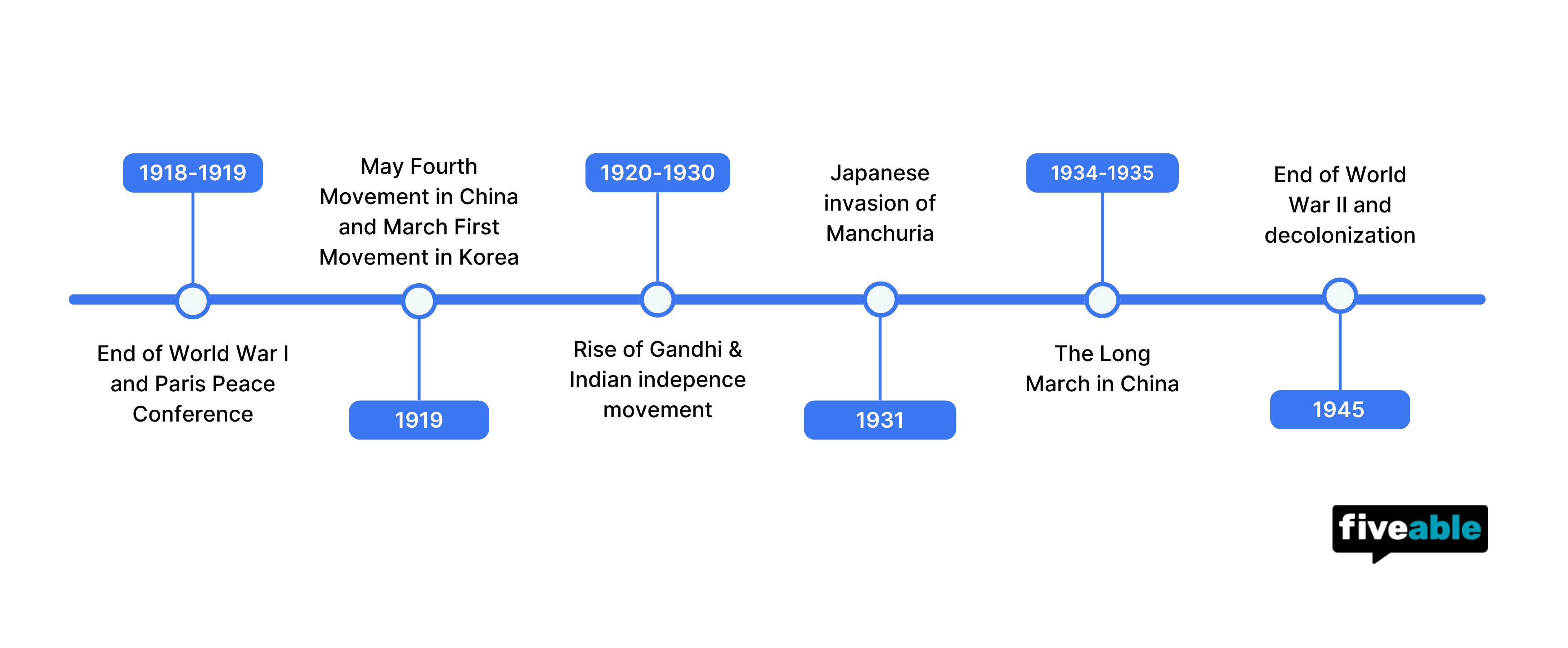
Timeline of unresolved events after World War I. Image courtesy of Riya.
Key Takeaways
- Colonial soldiers' wartime service and Wilson's call for self-determination raised hopes for independence, but the Paris Peace Conference left India, nearly all of Africa, and most of the Middle East under European control.
- The League of Nations mandate system gave former Central Powers' territories to the Allies instead of making them independent, while broken promises to Arab rebels fueled Pan-Arabism.
- The Amritsar Massacre pushed many Indians toward full independence; Gandhi organized civil disobedience against British rule, while Jinnah proposed a separate Muslim state.
- Koreans protested Japanese rule in the March First Movement, while the Allies' decision to give Shandong to Japan sparked China's May Fourth Movement and pushed many Chinese toward Marxism.
- Chiang Kaishek's forces nearly annihilated Mao's in 1927, starting the Chinese Civil War; Japan later invaded Manchuria and expanded its empire under the Greater East Asia Co-Prosperity Sphere.
- In Africa, European-educated intellectuals supported independence movements, while workers in French West Africa struck against discriminatory wages and benefits.
Effects of the War on Colonial Lands
World War I raised colonial peoples' hopes for independence, then the Paris Peace Conference crushed those hopes. That gap between expectation and reality is the engine driving everything in this chapter.
Here's why expectations rose:
- African and Asian colonies sent thousands of soldiers to fight for the Allies. Nationalists hoped this sacrifice would earn respect and start a decolonization process.
- The war's devastation showed colonized peoples that imperial powers like Britain and France were not invincible.
- Wilson's Fourteen Points promoted self-determination, and colonized peoples assumed that principle applied to them too.
It didn't. The Big Three at the peace conference (David Lloyd George of Britain, Woodrow Wilson of the US, and Georges Clemenceau of France) had no interest in freeing colonies. Self-determination was granted only to white countries in Eastern Europe. India, nearly all of Africa, and most of the Middle East stayed under European control. Wilson even refused to meet a group of Vietnamese nationalists that included a young Ho Chi Minh. That rejection strengthened nationalist movements across southern Asia and parts of Africa.
One important wartime example: between November 1915 and September 1916, villages in French West Africa (in what later became Burkina Faso) united to try to drive out the French. France crushed the revolt at great cost, but the rebellion forced the French to acknowledge obligations to the people they colonized.
The economic picture varied too. The United States prospered from selling war materials and farm products to the Allies, while the European countries that took the worst damage were economically devastated. For more on the interwar economic crisis, see the AMSCO 7.4 Economy in the Interwar Period notes.
The Mandate System
The mandate system was colonialism with a new label. Through the League of Nations, the Allies took control of the colonies and territories of the defeated Central Powers instead of granting them independence. Article 22 of the League charter claimed colonized peoples in Africa and Asia needed "tutelage" from more "advanced" nations.
What that looked like on the map:
- Former Ottoman lands (Palestine, Transjordan, Lebanon, Syria, and Iraq) became League of Nations mandates, virtual colonies of Britain and France.
- Former German colonies in Africa went to the Allies. Cameroon, for example, was divided into separate French and British mandates.
- Japan seized the German-held islands of the Western Pacific.
Arab rebels were especially furious. They had been promised self-rule for fighting alongside the Allies against the Ottomans, and the Allies broke that promise. The betrayal fueled Pan-Arabism, an ideology calling for the unification of all lands in North Africa and the Middle East.
A second source of conflict came from the Balfour Declaration (1917), in which the British government stated that Palestine should become a permanent home for the Jews of Europe. Supporters of a Jewish homeland were called Zionists, and after the war European Jews moved to British-controlled Palestine in large numbers, setting up tensions that would last for decades.
Anti-Colonialism in South Asia
The disappointment of the Paris Peace Conference pushed Indian anticolonial activists to redouble their efforts. The Indian National Congress, formed in the late 19th century to air grievances against colonial rule, had become a strong voice for independence by 1918.
The Amritsar Massacre
In spring 1919, Indian nationalists gathered peacefully in a public garden in Amritsar, Punjab, during a Sikh festival, protesting the arrest of two freedom fighters. The British had recently outlawed such gatherings. Colonial forces fired hundreds of shots into the unarmed crowd, killing an estimated 379 people and wounding 1,200 more. The massacre radicalized many Indians and convinced moderate Congress members that full independence was the only way forward.
Gandhi and Satyagraha
By the 1920s, Mohandas Gandhi (called Mahatma, "the great soul") had brought the Congress's cause to the Indian masses. His satyagraha ("devotion-to-truth") movement used civil disobedience: deliberately breaking unjust laws and accepting jail time to expose the injustice of British rule to the world. He led a boycott of British goods and wore the homespun cotton dhoti instead of Western suits, protesting British fabrics made from Indian cotton and sold back to Indians at inflated prices.
His most famous campaign was the Salt March of 1930. Britain had made it illegal for Indians to produce their own sea salt because it wanted a salt monopoly. Gandhi led thousands of Indians to the Arabian Sea and simply picked up grains of salt in open defiance.
Jinnah and the Two-State Idea
Independence leaders disagreed about India's national identity. Muhammad Ali Jinnah, a Muslim leader in the mostly Hindu Indian National Congress, originally favored Hindu-Muslim unity but later proposed a separate Muslim state, Pakistan, covering the heavily Muslim western and eastern parts of South Asia. He feared Muslim interests would be overwhelmed in a Hindu-majority India. The proposal worried Gandhi and Jawaharlal Nehru (who would become independent India's first prime minister). Independence for India and Pakistan didn't come until after World War II, but the interwar years built the foundation.
Nationalism in East Asia
Korea, China, and Japan were never formally colonized by Europe, but they still experienced foreign domination, and the desire for self-determination spread there too.
The March First Movement in Korea
Japan took control of Korea in 1910. After the war, Japanese influence looked likely to grow, and the mysterious death of the Korean emperor pushed resentment over the edge. Starting March 1, 1919, as many as 2 million Koreans (out of a population of 17 million) joined protests against Japanese rule. Japan cracked down harshly, killing several thousand Koreans, but the movement showed the power of Korean nationalism.
The May Fourth Movement in China
China supported the Allies in World War I, with nearly 150,000 Chinese hired by Britain and France for factory work, trench digging, and other labor. China expected the Allies to return German-controlled land on the Shandong Peninsula. Instead, at the Paris Peace Conference in 1919, Britain and France gave it to Japan. Furious Chinese intellectuals and workers launched anti-Japanese demonstrations on May 4, 1919. The May Fourth Movement symbolized rising Chinese nationalism, and the betrayal pushed many Chinese away from Western-style government and toward the Marxist model of the Soviet Union.
Communists vs. Nationalists
Two groups then fought for control of China:
- The Chinese Communist Party (CCP), founded in 1921 and eventually led by Mao Zedong, who believed China's revolution would come from peasants (the vast majority of the population) rather than urban workers.
- The Kuomintang (Chinese Nationalist Party), led by Sun Yatsen, who wanted full independence and industrialization and allied with the Communists to fight warlords and foreign domination. After Sun died in 1925, Chiang Kaishek took over. Chiang deeply distrusted communism, and in 1927 his forces attacked and nearly annihilated Mao's, starting the Chinese Civil War.
In 1934, Chiang attacked Mao's army in rural Jiangxi, triggering the Long March, a year-long, 6,000-mile retreat across mountains, marshes, and deserts. Of the 80,000 or more who started, only about 10,000 reached northern China in 1935. The CCP was weakened, but peasants admired the marchers' stamina and commitment, and that support later proved decisive. Meanwhile Chiang's Nationalists ruled much of China in the 1930s but alienated many by promoting Confucianism, suppressing free speech, and tolerating corruption.
Japan, Manchukuo, and the Co-Prosperity Sphere
Seeking natural resources, Japan invaded Manchuria in September 1931. When the League of Nations condemned the invasion, Japan quit the League and seized more land. In 1932 it set up the puppet state of Manchukuo, placing the last Chinese emperor on its throne to fake independence. The Japanese threat was serious enough that in 1935 the Nationalists and Communists suspended their civil war to unite against it. Japan kept expanding until 1945, seizing the Philippines, the Dutch East Indies, British Malaya, Burma, and Pacific islands, calling the whole project the Greater East Asia Co-Prosperity Sphere. Japan claimed it was liberating Asia from Western imperialism; the people in those territories experienced Japan as a conqueror. This expansion feeds directly into the causes of World War II.
Resistance to French Rule in West Africa
African pro-independence movements began with European-educated intellectuals who saw their homelands' racial discrimination more clearly from abroad. Jomo Kenyatta, future leader of Kenya, studied in London. Léopold Senghor, future leader of Senegal, studied in Paris. Most of the educated elite worked for colonial governments or as attorneys and doctors.
Workers resisted too. Black workers in French West Africa staged strikes, including a railway workers' strike in 1917 and a general strike in 1946, spreading across Senegal, Benin, Ivory Coast, and Guinea. Strikers protested discriminatory wage and benefit policies, and in some cases won demands through compromise settlements.
Key Terms to Know
| Term | Why it matters |
|---|---|
| Mandate system | League of Nations arrangement that handed Central Powers' colonies to the Allies, extending imperialism under a new name. |
| Big Three | Lloyd George (Britain), Wilson (US), and Clemenceau (France), the peace conference leaders who refused to free the colonies. |
| Balfour Declaration | 1917 British statement that Palestine should be a permanent home for Europe's Jews, sparking long-term conflict. |
| Zionists | Supporters of a Jewish homeland in Palestine. |
| Pan-Arabism | Ideology calling for unification of North Africa and the Middle East, fueled by Allied broken promises. |
| Indian National Congress | Late-19th-century organization that became the leading voice for Indian independence by 1918. |
| Amritsar | Site of the 1919 massacre where British forces killed about 379 unarmed Indians, radicalizing the independence movement. |
| Mohandas Gandhi | "Mahatma" who led the satyagraha movement of nonviolent civil disobedience against British rule. |
| Salt March | Gandhi's 1930 protest against Britain's salt monopoly, the model of civil disobedience. |
| Muhammad Ali Jinnah | Muslim League leader who proposed a separate state, Pakistan, fearing Muslim interests would be overwhelmed. |
| Jawaharlal Nehru | Congress leader who became independent India's first prime minister. |
| March First Movement | 1919 Korean protests against Japanese rule involving as many as 2 million people. |
| May Fourth Movement | 1919 Chinese protests after the Allies gave Shandong to Japan; pushed many Chinese toward Marxism. |
| Chinese Communist Party (CCP) | Founded 1921, led by Mao Zedong, who based revolution on the peasantry. |
| Kuomintang | Chinese Nationalist Party of Sun Yatsen, then Chiang Kaishek, who attacked the Communists in 1927. |
| Long March | The 1934-35 6,000-mile Communist retreat; only about 10,000 of 80,000+ survived, but it won peasant admiration. |
| Manchukuo | Japan's 1932 puppet state in Manchuria, fronted by the last Chinese emperor. |
| Greater East Asia Co-Prosperity Sphere | Japan's label for its expanding empire, framed as liberation but experienced as conquest. |
Practice and Next Steps
Pair these notes with the Topic 7.5 Unresolved Tensions After World War I study guide, which approaches the same material from the course framework side. The big skill here is continuity and change: imperial powers kept or expanded territory between the wars (mandates, Manchukuo) while anti-imperial resistance grew (Indian National Congress, West African strikes). That's the comparison the AP exam wants you to make.
Test yourself with AP World guided practice questions, drill writing with FRQ practice and instant scoring, and browse the full set of AMSCO Unit 7 notes to keep moving through the unit. Up next: AMSCO 7.6 Causes of World War II.
Frequently Asked Questions
What was the mandate system after World War I?
The mandate system was the League of Nations arrangement that transferred the colonies and territories of the defeated Central Powers to the Allied victors, mainly Britain and France. Article 22 of the League charter claimed colonized peoples needed "tutelage" from more "advanced" nations. Former Ottoman lands like Palestine, Syria, and Iraq became mandates that were colonies in everything but name, which fueled Pan-Arabism.
Why didn't colonies gain independence after World War I?
The Big Three at the Paris Peace Conference (Lloyd George, Wilson, and Clemenceau) granted self-determination only to white countries in Eastern Europe. Despite colonial troops fighting for the Allies and Wilson's Fourteen Points promoting self-determination, India, nearly all of Africa, and most of the Middle East stayed under European control, and the mandate system actually expanded imperial holdings. That betrayal is what energized interwar nationalist movements.
What's the difference between the March First Movement and the May Fourth Movement?
The March First Movement (1919) was Korean: up to 2 million Koreans protested Japanese rule, and Japan killed several thousand in the crackdown. The May Fourth Movement (1919) was Chinese: protests erupted after the Paris Peace Conference gave German-held Shandong to Japan instead of returning it to China, pushing many Chinese toward Marxism and the future CCP. Both show self-determination spreading in East Asia, but they targeted different grievances.
What was the Long March in China?
The Long March (1934-1935) was a year-long, roughly 6,000-mile retreat by Mao Zedong's Communist forces after Chiang Kaishek's Nationalists attacked them in Jiangxi. Of the 80,000 or more who started, only about 10,000 reached northern China. The CCP was militarily weakened, but peasants admired the marchers' stamina, and that peasant support later helped the Communists win control of China.
How does Topic 7.5 show up on the AP World exam?
Topic 7.5 tests continuity and change in territorial holdings from 1900 on: imperial powers mostly kept or expanded territory between the wars (League of Nations mandates, Manchukuo, the Greater East Asia Co-Prosperity Sphere) while anti-imperial resistance grew (Indian National Congress, West African strikes). Be ready to use specific examples like the mandate system or the Salt March as evidence. Practice applying them with AP World FRQ practice.
See Fiveable more often in Google
Mark Fiveable as a preferred source and Google is more likely to show you our guides in Top Stories, with a "preferred" badge in AI Mode and AI Overviews.