AMSCO 1.1 Developments in East Asia Notes

🌍AP World History: Modern Review
AMSCO 1.1 Developments in East Asia Notes
🌍 AP World History: Modern
AMSCO 1.1 Developments in East Asia Notes
AMSCO 1.2 Developments in Dar al-Islam Notes
AMSCO 1.3 Developments in South and Southeast Asia Notes
AMSCO 1.4 Developments in the Americas Notes
AMSCO 1.5 Developments in Africa Notes
AMSCO 1.6 Developments in Europe Notes
AMSCO 1.7 Comparison in the Period from c.1200 to c.1450 Notes
AMSCO 2.1 The Silk Roads Notes
AMSCO 2.2 The Mongol Empire and the Modern World Notes
AMSCO 2.3 Exchange in the Indian Ocean Notes
AMSCO 2.4 Trans-Saharan Trade Routes Notes
AMSCO 2.5 Cultural Consequences of Connectivity Notes
AMSCO 2.6 Environmental Consequences of Connectivity Notes
AMSCO 2.7 Comparison of Economic Exchange Notes
AMSCO 3.1 European, East Asian, and Gunpowder Empires Expand Notes
AMSCO 3.2 Empires: Administrations Notes
AMSCO 3.3 Empires: Belief Systems Notes
AMSCO 3.4 Comparison in Land-Based Empires Notes
AMSCO 4.1 Technological Innovations Notes
AMSCO 4.2 Exploration: Causes and Events Notes
AMSCO 4.3 Columbian Exchange Notes
AMSCO 4.4 Maritime Empires Link Regions Notes
AMSCO 4.5 Maritime Empires Develop Notes
AMSCO 4.6 Internal and External Challenges to State Power Notes
AMSCO 4.7 Changing Social Hierarchies Notes
AMSCO 4.8 Continuity and Change from c.1450 to c.1750 Notes
AMSCO 5.1 The Enlightment Notes
AMSCO 5.2 Nationalism and Revolutions Notes
AMSCO 5.3 Industrial Revolution Begins Notes
AMSCO 5.4 Industrialization Spreads Notes
AMSCO 5.5 Technology in the Industrial Age Notes
AMSCO 5.6 Industrialization: Government's Role Notes
AMSCO 5.7 Economic Developments and Innovations Notes
AMSCO 5.8 Reactions to the Industrial Economy Notes
AMSCO 5.9 Society and the Industrial Age Notes
AMSCO 5.10 Continuity and Change in the Industrial Age Notes
AMSCO 6.1 Rationales for Imperialism Notes
AMSCO 6.2 State Expansion Notes
AMSCO 6.3 Indigenous Responses to State Expansion Notes
AMSCO 6.4 Global Economic Development Notes
AMSCO 6.5 Economic Imperialism Notes
AMSCO 6.6 Causes of Migration in an Interconnected World Notes
AMSCO 6.7 Effects of Migration Notes
AMSCO 6.8 Causation in the Imperial Age Notes
AMSCO 7.1 Shifting Power Notes
AMSCO 7.2 Causes of World War I Notes
AMSCO 7.3 Conducting World War I Notes
AMSCO 7.4 Economy in the Interwar Period Notes
AMSCO 7.5 Unresolved Tensions After World War I Notes
AMSCO 7.6 Causes of World War II Notes
AMSCO 7.7 Conducting World War II Notes
AMSCO 7.8 Mass Atrocities Notes
AMSCO 7.9 Causation in Global Conflict Notes
AMSCO 8.1 Setting the Stage for the Cold War and Decolonization Notes
AMSCO 8.2 The Cold War Notes
AMSCO 8.3 Effects of the Cold War Notes
AMSCO 8.4 Spread of Communism Notes
AMSCO 8.5 Decolonization after 1900 Notes
AMSCO 8.6 Newly Independent States Notes
AMSCO 8.7 Global Resistance to Established Power Structure Notes
AMSCO 8.8 End of the Cold War Notes
AMSCO 8.9 Causation in the Age of the Cold Ward and Decolonization Notes
AMSCO 9.1 Advances in Technology and Exchange Notes
AMSCO 9.2 Technological Advancements and Limitations Notes
AMSCO 9.3 Technology and the Environment Notes
AMSCO 9.4 Economics in the Global Age Notes
AMSCO 9.5 Calls for Reforms and Responses Notes
AMSCO 9.6 Globalized Culture Notes
AMSCO 9.7 Resistance to Globalization Notes
AMSCO 9.8 Institutions Developing in a Globalized World Notes
AMSCO 9.9 Continuity and Change in a Globalized World Notes
Overview
AMSCO Topic 1.1, "Developments in East Asia" (AMSCO p. 3-14), covers China under the Song Dynasty (960-1279) and how Chinese culture shaped Japan, Korea, and Vietnam from c. 1200 to c. 1450. The chapter's big idea: Song China was the wealthiest, most innovative, most commercialized society in the world at the start of this period, and it held power through two old tools, Confucianism and the imperial bureaucracy. Three threads run through the chapter, and through everything the exam asks about this topic: how China governed, how its economy boomed, and how its culture spread to its neighbors.
The chapter's essential question asks how developments in East Asia reflected continuity, innovation, and diversity. Keep that lens as you review. The bureaucracy and Confucianism are continuities. Champa rice, steel, and proto-industrialization are innovations. Japan, Korea, and Vietnam responding differently to Chinese influence is the diversity.
Key Takeaways
- The Song expanded China's longstanding bureaucracy and used Confucian civil service exams to hire officials, but its growing cost later drained surplus wealth.
- Champa rice and new farming techniques increased food production and population, while coal-powered iron production and home-based manufacturing expanded Song China's output.
- The Grand Canal supported internal trade, while improved ships and navigation helped China trade across open waters.
- Confucian-educated scholar gentry became China's most influential class, while foot binding among aristocratic families restricted women's mobility and public participation.
- Chan Buddhism blended Buddhist and Daoist ideas, Neo-Confucianism combined Confucian, Daoist, and Buddhist thought, and printing expanded access to texts.
- Japan selectively borrowed Chinese traditions, Korea closely followed Chinese models but limited its civil service exams, and Vietnam adopted some Chinese practices while resisting Chinese rule.
Song Dynasty Government: Bureaucracy and Meritocracy
The Song maintained rule through an imperial bureaucracy, a vast organization of appointed officials who carried out the empire's policies. This wasn't new. The bureaucracy dated back to the Qin Dynasty (221-207 BCE), making it a major continuity across Chinese history. The Song expanded it.
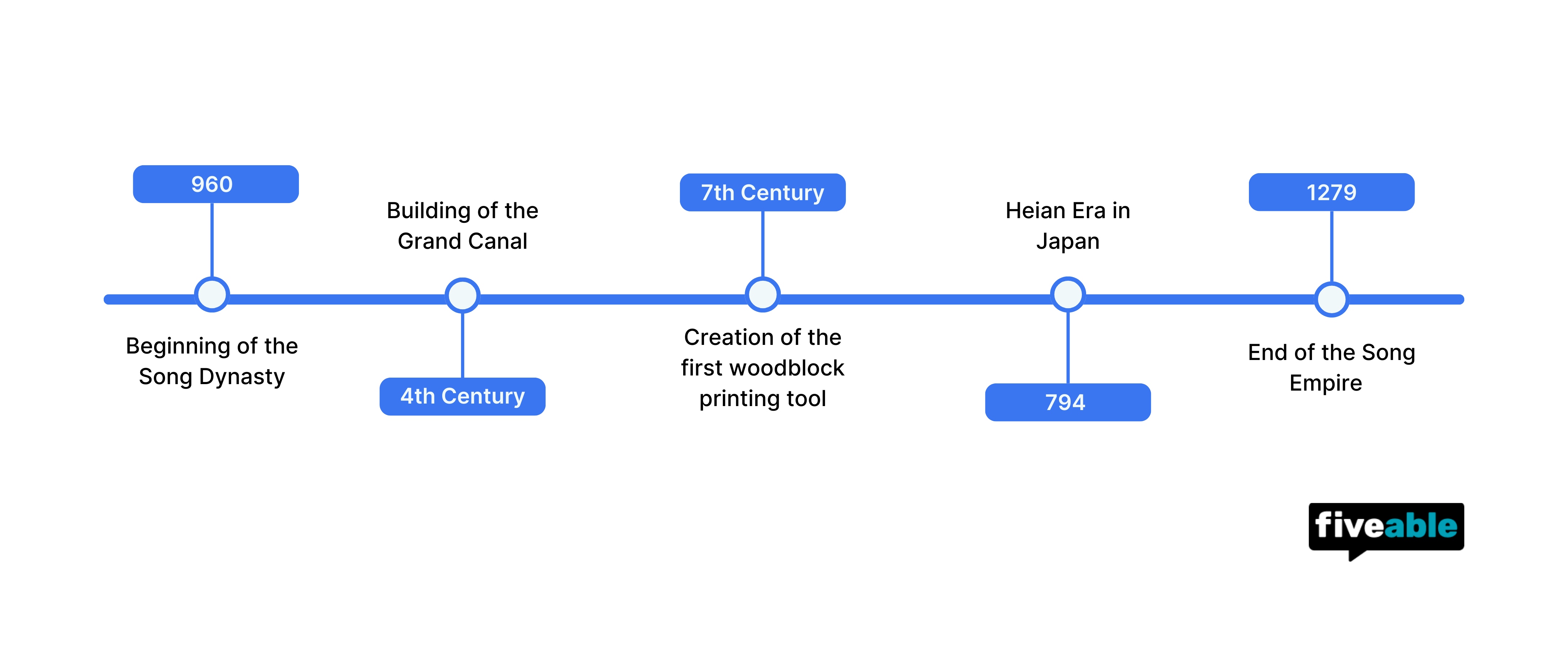
The Song replaced the Tang in 960 and ruled for over three centuries, even though they lost northern lands to pastoralist invaders from Manchuria who set up the Jin Empire. A smaller empire, but a prosperous one.
The civil service exam and meritocracy
Officials earned bureaucratic jobs by scoring well on civil service exams based on Confucian texts. Because positions came from demonstrated merit rather than birth, the system was a meritocracy. Emperor Song Taizu expanded educational opportunities so young men from lower economic classes could compete. The poor were still vastly underrepresented, but China allowed more upward mobility than any other hiring system of its time.
The catch: by the end of the dynasty, the bureaucracy had grown so large and its officials were paid so well that government costs started draining China's surplus wealth. The same institution that strengthened the Song early on weakened it later. That's a classic continuity-and-change point for essays.
Economic Developments in Song China
Song China's economy flourished because of increased productive capacity, expanding trade networks, and innovations in agriculture and manufacturing. The Tang had already improved roads and canals, promoted agriculture, and encouraged foreign trade; the Song built on all of it.
Agriculture: Champa rice and new techniques
Champa rice, a fast-ripening, drought-resistant strain from the Champa Kingdom in present-day Vietnam, arrived in China before the 11th century. It let farmers grow rice in places that couldn't support it before (lowlands, riverbanks, hills) and harvest two crops per year in some regions.
Farmers also boosted output with:
- Manure (human and animal) to enrich soil
- Irrigation systems using ditches, water wheels, pumps, and terraces
- New heavy plows pulled by water buffalo or oxen, opening previously unusable land
The result was an abundance of food, and population exploded. Over three centuries of Song rule, China went from about 25 percent to nearly 40 percent of the world's population.
Manufacturing: iron, steel, and proto-industrialization
China had the greatest manufacturing capability in the world. Coal ("black earth," discovered back in the 4th century BCE) powered massive cast iron production. The Chinese then learned to remove carbon from cast iron to make steel, which reinforced bridges, gates, ship anchors, farm tools, and religious items like pagodas and Buddhist figurines.
Song China experienced proto-industrialization earlier than Western Europe: rural people produced more goods than they could sell, using home-based or community-based production with simple equipment rather than factories. Artisans (skilled craftworkers) made steel in dispersed smelting facilities under imperial supervision, plus porcelain and silk that flowed into expanding trade networks. Porcelain sold well because it was lightweight, strong, and easy to paint with elaborate designs.
Trade, transportation, and money
China became the world's most commercialized society. Its economy shifted from local consumption to market production, with porcelain, textiles, and tea as chief exports. Key pieces:
- The Grand Canal, an inexpensive internal waterway system extending over 30,000 miles, made Song China the most populous trading area in the world.
- The compass, redesigned cargo ships, and printed paper navigation charts let sailors travel open waters out of sight of land. China controlled trade in the South China Sea.
- Instead of forcing people to labor on public projects, the Song paid workers, putting more money in circulation and fueling growth.
- The tributary system required states like Japan, Korea, and Southeast Asian kingdoms to pay money or goods to honor the Chinese emperor, complete with the kowtow ritual (bowing until your head touched the floor). It cemented Chinese power but also created stability and stimulated trade for everyone involved.
Gunpowder had been invented in earlier dynasties, but Song innovators made the first guns. The technology spread across Eurasia via the Silk Roads.
Chinese Society and Social Structure
Song China was the most urbanized place in the world, with several cities over 100,000 people. Chang'an, Hangzhou, and the port of Guangzhou were cosmopolitan commercial centers. Still, most people lived in rural areas.
The class hierarchy
Bureaucratic expansion created a new class, the scholar gentry, educated in Confucian philosophy. They soon outnumbered the aristocracy (landowners with inherited wealth) and became China's most influential class. Below them ranked farmers, artisans, and merchants. Merchants sat low because Confucian values prized hard work and creating value; merchants just exchanged goods without making anything. At the bottom were peasants working off debts to landowners and the urban poor. The Song government provided aid to the poor and ran public hospitals with free care.
Women in Song China
Confucian tradition included both respect for women and the expectation that they defer to men, and this patriarchal pattern strengthened under the Tang and Song. The most distinctive constraint was foot binding, which became common among aristocratic families during the Song. Girls' feet were wrapped so tightly the bones couldn't grow naturally. Bound feet signaled high status and desirability to suitors, but they restricted women's mobility and public participation. The practice wasn't banned until 1912.
Religion and Intellectual Life: Buddhism, Neo-Confucianism, Printing
Buddhism came to China from India via the Silk Roads and became widespread during the Tang Dynasty, helped by the 7th-century monk Xuanzang. Know the three branches:
- Theravada Buddhism: personal spiritual growth through silent meditation and self-discipline; strongest in Southeast Asia
- Mahayana Buddhism: spiritual growth for all beings and service; strongest in China and Korea
- Tibetan Buddhism: emphasis on chanting; strongest in Tibet
All three share the Four Noble Truths (suffering can be eased by eliminating cravings) and the Eight-Fold Path (precepts like right speech and right mindfulness leading to enlightenment, or nirvana).
Syncretism: Chan Buddhism and Neo-Confucianism
Monks sold Buddhism to Chinese audiences by linking it to Daoism, translating dharma as dao ("the way"). The fusion produced Chan (Zen) Buddhism, a syncretic faith emphasizing direct experience and meditation over scriptural study. Tang leaders, seeing China as the "Middle Kingdom," resented a foreign religion's prominence and closed monasteries, but Chan Buddhism stayed popular with ordinary people.
The Song preferred native traditions. Neo-Confucianism, which evolved between 770 and 840, combined rational Confucian thought with abstract Daoist and Buddhist ideas, emphasizing ethics over the mysteries of God and nature. It spread to Japan, Korea, and Vietnam. The Song also leaned on filial piety, the duty to subordinate your desires to the male head of the family and to the ruler. Respect for elders translated into respect for the emperor, which helped the Song hold power.
Paper, printing, and literature
China invented paper as early as the 2nd century CE and developed printing in the 7th century, the first culture to use woodblock printing (a 7th-century Buddhist scripture is thought to be the world's first woodblock printed work). Printing made multiple copies possible without hand-copying, spread farming booklets through rice regions, made Buddhist scriptures available to the scholar gentry, and expanded book access for the privileged classes. Confucian scholars were both the biggest consumers and producers of literature.
Japan, Korea, and Vietnam: Responding to Chinese Influence
Each of China's neighbors faced sinification, the assimilation of Chinese traditions and practices, and each responded differently. This comparison is the heart of the chapter's "diversity" theme.
Japan: selective borrowing and feudalism
Separated from China by sea, Japan controlled its interactions more than Korea or Vietnam could. Prince Shotoku Taishi (574-622) promoted Buddhism and Confucianism alongside Japan's traditional Shinto religion, and Japan learned woodblock printing from China. During the Heian period (794-1185), Japan emulated Chinese politics, art, and literature, but also innovated: an 11th-century Japanese writer composed the world's first novel, The Tale of Genji.
Japan was a feudal society without a centralized government. Landowning daimyo battled for territory, samurai served as warriors bound by the bushido code (frugality, loyalty, martial arts, honor unto death), and peasant serfs farmed rice. It resembled European feudalism (serfs, knights, nobles; hereditary hierarchy; little social mobility), with one key difference: daimyo held more power than European nobles, who sat below their monarch. In Japan, daimyo were in reality more powerful than the emperor or the shogun. In 1192, the Minamoto clan installed a shogun, a military ruler, leaving the emperor as a figurehead. Regional rivalries plagued Japan for the next four centuries until shoguns built a strong central government in the 17th century. The European side of this comparison shows up in AMSCO 1.6 Developments in Europe.
Korea: closest to the Chinese model
Korea shares a land boundary with China and had a tributary relationship, so it emulated China heavily: a centralized government in the Chinese style, Confucian and Buddhist beliefs (Confucian classics for the elite, Buddhism for the peasant masses), and the Chinese writing system, until Korea developed its own in the 15th century.
The key difference: Korea's landed aristocracy was more powerful than China's, so the elite blocked reforms. Korea had a civil service exam, but it wasn't open to peasants, so there was no truly merit-based path into the bureaucracy.
Vietnam: borrowing plus resistance
Vietnam adapted Chinese writing and architecture but had an adversarial relationship with China, sometimes launching violent rebellions. Cultural differences fueled the resistance:
- Vietnamese women had more independence in marriage and rejected foot binding and polygyny (having more than one wife at once)
- Vietnamese preferred nuclear families (wife, husband, children) over Chinese extended families
- Villages operated independently; political centralization was nonexistent
- Vietnamese scholar-officials owed allegiance to village peasants rather than the emperor, and often led revolts against oppressive governments
As the Tang crumbled in the 8th century, Vietnamese rebels pushed out China's occupying army using effective guerrilla warfare. Even so, sinification still occurred.
Key Terms to Know
| Term | Why it matters |
|---|---|
| Song Dynasty | Ruled China 960-1279; the era's model of wealth, innovation, and Confucian government. |
| Imperial bureaucracy | Appointed officials carrying out the emperor's policies; a continuity since the Qin Dynasty that the Song expanded. |
| Meritocracy | Officials earned jobs by passing Confucian civil service exams, allowing unusual upward mobility for the era. |
| Grand Canal | 30,000+ mile internal waterway that made Song China the world's most populous trading area. |
| Champa rice | Fast-ripening, drought-resistant rice from Vietnam that enabled two harvests a year and fueled population growth. |
| Proto-industrialization | Rural, home-based production of more goods than people could sell, reached in China before Western Europe. |
| Artisans | Skilled craftworkers who produced steel, porcelain, and silk for expanding trade networks. |
| Scholar gentry | New Confucian-educated class that outnumbered the aristocracy and became China's most influential class. |
| Filial piety | Duty to defer to the male family head and the ruler; respect for elders helped the Song keep power. |
| Foot binding | Status symbol among Song aristocratic families that restricted women's mobility; banned in 1912. |
| Woodblock printing | Chinese invention enabling mass copies of texts, spreading farming manuals and Buddhist scriptures. |
| Theravada Buddhism | Branch focused on personal growth through meditation and self-discipline; strongest in Southeast Asia. |
| Mahayana Buddhism | Branch focused on spiritual growth for all beings and service; strongest in China and Korea. |
| Tibetan Buddhism | Branch focused on chanting; strongest in Tibet. |
| Syncretic | Describes a fused belief system; the chapter's examples are Chan Buddhism and Neo-Confucianism. |
| Chan (Zen) Buddhism | Fusion of Buddhism and Daoism emphasizing direct experience and meditation over scripture. |
| Neo-Confucianism | Blend of Confucian rational thought with Daoist and Buddhist ideas, emphasizing ethics; spread to Japan, Korea, and Vietnam. |
| Heian period | Era (794-1185) when Japan emulated Chinese traditions and produced The Tale of Genji, the world's first novel. |
Practice and Next Steps
Pair these notes with the Fiveable Topic 1.1 Developments in East Asia study guide, which frames the same content the way the course tests it. Then check your recall with guided MCQ practice and look up any fuzzy vocabulary in the AP World key terms glossary.
The next chapter shifts west: AMSCO 1.2 Developments in Dar al-Islam covers the Islamic world in the same period. Since China-versus-neighbors comparisons feed directly into AMSCO 1.7 Comparison in the Period from c. 1200 to c. 1450, keep a running list of Song China's continuities and innovations as you work through the unit. The full set of chapter notes lives on the AMSCO Notes hub.
Frequently Asked Questions
What does AMSCO Topic 1.1 Developments in East Asia cover?
AMSCO 1.1 (p. 3-14) covers China under the Song Dynasty (960-1279): its imperial bureaucracy and civil service exam, economic innovations like Champa rice and proto-industrialization, social classes, Buddhism and Neo-Confucianism, plus how Japan, Korea, and Vietnam responded to Chinese influence from c. 1200 to c. 1450. It pairs with the Topic 1.1 course study guide.
Why was the Song Dynasty's civil service exam a meritocracy?
Officials earned bureaucratic jobs by scoring well on exams based on Confucian texts, so positions came from demonstrated merit rather than birth. Emperor Song Taizu expanded education to lower-class men, and although the poor stayed underrepresented, China allowed more upward mobility than any other hiring system of its time.
What is proto-industrialization in Song China?
Proto-industrialization means rural people produced more goods than they could sell, using home-based or community-based production with simple equipment instead of factories. Song China reached this stage earlier than Western Europe, with artisans making steel, porcelain, and silk for expanding trade networks. Don't confuse it with later industrialization, which used large factories and complex machinery.
How were Japan, Korea, and Vietnam's relationships with China different?
Japan, separated by sea, borrowed selectively (Buddhism, Confucianism, woodblock printing) while keeping a feudal system with daimyo and samurai. Korea, a tributary sharing a land border, copied China most closely but its powerful aristocracy kept the civil service exam closed to peasants. Vietnam borrowed writing and architecture but rebelled violently, and its women rejected foot binding and polygyny.
How does Topic 1.1 show up on the AP World exam?
Topic 1.1 feeds multiple-choice and short-answer questions on Song China's government, economy, and cultural influence, and it's a common source of comparison and continuity-and-change essay evidence (bureaucracy as continuity, Champa rice and proto-industrialization as innovation). Test yourself with guided practice questions after reviewing.
See Fiveable more often in Google
Mark Fiveable as a preferred source and Google is more likely to show you our guides in Top Stories, with a "preferred" badge in AI Mode and AI Overviews.