AMSCO 6.4 Global Economic Development Notes

🌍AP World History: Modern Review
AMSCO 6.4 Global Economic Development Notes
🌍 AP World History: Modern
AMSCO 1.1 Developments in East Asia Notes
AMSCO 1.2 Developments in Dar al-Islam Notes
AMSCO 1.3 Developments in South and Southeast Asia Notes
AMSCO 1.4 Developments in the Americas Notes
AMSCO 1.5 Developments in Africa Notes
AMSCO 1.6 Developments in Europe Notes
AMSCO 1.7 Comparison in the Period from c.1200 to c.1450 Notes
AMSCO 2.1 The Silk Roads Notes
AMSCO 2.2 The Mongol Empire and the Modern World Notes
AMSCO 2.3 Exchange in the Indian Ocean Notes
AMSCO 2.4 Trans-Saharan Trade Routes Notes
AMSCO 2.5 Cultural Consequences of Connectivity Notes
AMSCO 2.6 Environmental Consequences of Connectivity Notes
AMSCO 2.7 Comparison of Economic Exchange Notes
AMSCO 3.1 European, East Asian, and Gunpowder Empires Expand Notes
AMSCO 3.2 Empires: Administrations Notes
AMSCO 3.3 Empires: Belief Systems Notes
AMSCO 3.4 Comparison in Land-Based Empires Notes
AMSCO 4.1 Technological Innovations Notes
AMSCO 4.2 Exploration: Causes and Events Notes
AMSCO 4.3 Columbian Exchange Notes
AMSCO 4.4 Maritime Empires Link Regions Notes
AMSCO 4.5 Maritime Empires Develop Notes
AMSCO 4.6 Internal and External Challenges to State Power Notes
AMSCO 4.7 Changing Social Hierarchies Notes
AMSCO 4.8 Continuity and Change from c.1450 to c.1750 Notes
AMSCO 5.1 The Enlightment Notes
AMSCO 5.2 Nationalism and Revolutions Notes
AMSCO 5.3 Industrial Revolution Begins Notes
AMSCO 5.4 Industrialization Spreads Notes
AMSCO 5.5 Technology in the Industrial Age Notes
AMSCO 5.6 Industrialization: Government's Role Notes
AMSCO 5.7 Economic Developments and Innovations Notes
AMSCO 5.8 Reactions to the Industrial Economy Notes
AMSCO 5.9 Society and the Industrial Age Notes
AMSCO 5.10 Continuity and Change in the Industrial Age Notes
AMSCO 6.1 Rationales for Imperialism Notes
AMSCO 6.2 State Expansion Notes
AMSCO 6.3 Indigenous Responses to State Expansion Notes
AMSCO 6.4 Global Economic Development Notes
AMSCO 6.5 Economic Imperialism Notes
AMSCO 6.6 Causes of Migration in an Interconnected World Notes
AMSCO 6.7 Effects of Migration Notes
AMSCO 6.8 Causation in the Imperial Age Notes
AMSCO 7.1 Shifting Power Notes
AMSCO 7.2 Causes of World War I Notes
AMSCO 7.3 Conducting World War I Notes
AMSCO 7.4 Economy in the Interwar Period Notes
AMSCO 7.5 Unresolved Tensions After World War I Notes
AMSCO 7.6 Causes of World War II Notes
AMSCO 7.7 Conducting World War II Notes
AMSCO 7.8 Mass Atrocities Notes
AMSCO 7.9 Causation in Global Conflict Notes
AMSCO 8.1 Setting the Stage for the Cold War and Decolonization Notes
AMSCO 8.2 The Cold War Notes
AMSCO 8.3 Effects of the Cold War Notes
AMSCO 8.4 Spread of Communism Notes
AMSCO 8.5 Decolonization after 1900 Notes
AMSCO 8.6 Newly Independent States Notes
AMSCO 8.7 Global Resistance to Established Power Structure Notes
AMSCO 8.8 End of the Cold War Notes
AMSCO 8.9 Causation in the Age of the Cold Ward and Decolonization Notes
AMSCO 9.1 Advances in Technology and Exchange Notes
AMSCO 9.2 Technological Advancements and Limitations Notes
AMSCO 9.3 Technology and the Environment Notes
AMSCO 9.4 Economics in the Global Age Notes
AMSCO 9.5 Calls for Reforms and Responses Notes
AMSCO 9.6 Globalized Culture Notes
AMSCO 9.7 Resistance to Globalization Notes
AMSCO 9.8 Institutions Developing in a Globalized World Notes
AMSCO 9.9 Continuity and Change in a Globalized World Notes
Overview
Topic 6.4, Global Economic Development (AMSCO p. 398-406), explains how environmental factors and industrial demand reshaped the world economy between 1750 and 1900. As Europe and the United States industrialized, they turned colonies in Asia, Africa, and Latin America into export economies that supplied raw materials like cotton, rubber, palm oil, and guano, then bought back finished goods. This chapter sits at the heart of Unit 6 (Consequences of Industrialization) and connects the rationales for imperialism in 6.1 to the economic imperialism covered in 6.5.
The chapter opens with a great hook: in 1850, President Millard Fillmore told Congress the U.S. government had a duty to secure Peruvian guano (bird droppings) at a reasonable price. When bird poop becomes a matter of national policy, you know raw materials are driving the global economy.
Three things drove economic imperialism in this era: natural resources, new markets for manufactured goods, and low-wage colonial labor.
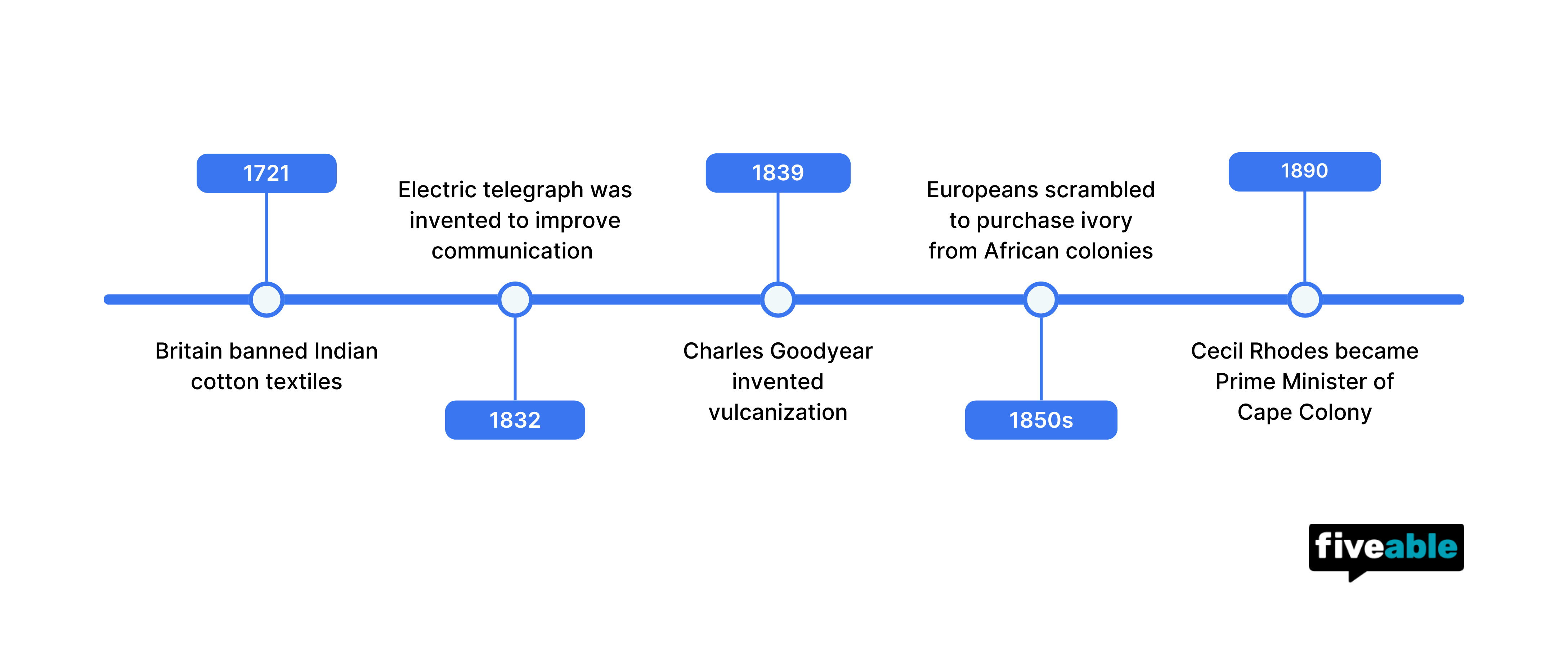
Key Takeaways
- Railroads moved colonial raw materials to ports more cheaply, refrigerated steamships carried perishables across oceans, and the telegraph sped up communication.
- Imperial powers pushed farmers toward cash crops, raising food prices, while indentured laborers dug guano for export.
- The American Civil War blockade cut off cotton supplies and prompted farmers elsewhere to grow cotton; by the end of the 19th century, cotton supplied 93 percent of Egypt's export revenue.
- Goodyear's vulcanization created the modern rubber industry, rubber barons forced indigenous workers into virtual slavery, and palm oil became a major West African cash crop.
- Cecil Rhodes's De Beers controlled 90 percent of world diamond production by 1891; he also pushed British expansion in Africa, and his racist policies paved the way for apartheid.
- Cash-crop monocultures depleted soil and helped pests and diseases spread, leaving many former colonies unable to rediversify their land and needing to import basic agricultural goods.
Technological Developments: Railroads, Steamships, and the Telegraph
New transportation and communication technology made it possible to move colonial resources to industrial centers fast and cheap. The Industrial Revolution wasn't just about factories.
Railroads
- Before railroads, colonies relied on water transport or poorly maintained roads that often washed out in rainy seasons.
- Railroads cut the cost of moving raw materials from colonial interiors to coastal ports, and opened interior markets to European manufactured goods.
- In India, Britain built a complex railway network running from the interior to the coasts. Europeans claimed railroads proved imperialism helped colonized peoples, but the networks primarily served the colonizers' extraction needs.
- Cecil Rhodes (1853-1902), founder of De Beers Diamonds, pushed a railroad project from Cape Town, South Africa to Cairo, Egypt to link Britain's African colonies. It was never completed because Britain never controlled all the land along the route.
- African railway workers were overwhelmingly natives paid far less than European workers. Railroads were a tool for extracting maximum resources at minimum labor cost.
Steamships
- Early steamships burned huge quantities of coal, so they could only travel limited distances, mostly on navigable rivers like the Ganges in South Asia and the Congo in Africa.
- More efficient steam engines after 1870 made long ocean voyages practical.
- Compression refrigeration, developed in the 1870s, let perishables like meat and dairy cross oceans for the first time.
Telegraph
- Invented in 1832, the electric telegraph made news travel instantly instead of taking weeks or months.
- India got telegraph service in 1850, only five years after Britain. Lines often followed railroad routes.
- Submarine cables connected continents: the first permanent transatlantic cable linked the U.S. and England in 1866, England-Australia service started in 1872, and Portugal-Brazil service in 1874 connected Europe and South America.
Agricultural Products: From Subsistence Farming to Cash Crops
Before imperial control, most farmers in Asia and Africa practiced subsistence farming, growing just enough food to live on with maybe a little to sell. Imperial powers pushed them to grow cash crops instead. These are crops grown for commercial value, not for the farmers to eat: tea, cotton, sugar, oil palms, rubber, and coffee.
The damage was real. As cash crops replaced food crops, food prices rose in colonized nations.
Two other agricultural exports to know:
- Meat. Europe's growing middle classes wanted meat. Cattle ranches in Argentina, Brazil, and Uruguay exported beef, while Australia and New Zealand exported lamb and mutton. Refrigerated steamships and canning made it all shippable.
- Guano. Bat and seabird excrement rich in nitrates and phosphates, making it an excellent natural fertilizer. The dry climates of Peru and Chile let huge deposits accumulate. Between 1840 and 1880, millions of tons were dug by hand, often by indentured Chinese or Polynesian laborers, and shipped abroad.
Raw Materials: Cotton, Rubber, Palm Oil, Ivory, Minerals, and Diamonds
Industrial demand turned colonies into export economies, places where commercial extraction of natural resources for foreign markets defined the whole economy. Imperial attention focused on tropical climates where these raw materials grew.
Cotton
- Parliament banned Indian cotton textiles in 1721 to protect Britain's wool industry. The pattern was set: colonies supply raw materials, England manufactures textiles.
- During the Industrial Revolution, 80 percent of the cotton in Britain's textile mills came from the United States.
- The American Civil War changed everything. Northern warships blockaded Confederate ports, cutting off the cotton supply, so farmers from Australia to the West Indies switched from food to cotton.
- Egypt benefited most. It had already developed a fine long-staple cotton variety and ramped up production. By the end of the 19th century, 93 percent of Egypt's export revenue came from cotton.
Rubber
- Natural rubber comes from latex sap, but it softens when warm and hardens when cold. Charles Goodyear's vulcanization process (1839) fixed those problems and created the modern rubber industry (tires, hoses, waterproof clothing, shoe soles).
- The two original sources were wild trees in the Amazon rainforest and vines in Central Africa, each supplying about half the world's rubber. In both regions, "rubber barons" forced indigenous people into virtual slavery, and some companies mutilated or killed workers who missed quotas.
- In 1876, the British India Office obtained rubber tree seeds from Brazil, propagated them in England, and sent seedlings to Ceylon (Sri Lanka) and Singapore. Thousands of acres of forest were cleared for rubber plantations in Malaya, Indochina, and the Dutch East Indies.
Palm Oil
- Europe's factory machinery needed constant lubrication, and palm oil was also used for candles.
- The oil palm originated in West Africa, where it had been a staple food for 5,000 years and was so valued it served as money in many cultures.
- It became a major West African cash crop, often worked by enslaved prisoners of tribal wars. Europeans later set up oil palm plantations in Malaya and the Dutch East Indies.
Ivory
- Elephant tusks supplied ivory, prized for piano keys, billiard balls, knife handles, and carvings. African elephants of both sexes have large tusks averaging six feet, so most of the trade was with Africa.
- The European scramble for ivory in the mid-19th century actually preceded the scramble for colonies. The Ivory Coast (Côte d'Ivoire) got its name from French trading posts set up to buy ivory and enslaved people.
Minerals
- Mexico: silver
- Chile: copper (used for telegraph cables and electrical lines)
- Northern Rhodesia (now Zambia) and the Belgian Congo: copper
- Bolivia, Nigeria, Malaya, and the Dutch East Indies: tin (for canned food)
- Australia, South Africa, parts of West Africa, and Alaska: gold
Diamonds and Cecil Rhodes
- Rhodes went to South Africa in 1870 for his health, joined the Kimberley diamond rush in 1871, and formed the De Beers Mining Company in 1880. By 1891, De Beers controlled 90 percent of the world's diamond production.
- He also held a large stake in the world's largest gold fields, discovered on South Africa's Witwatersrand in 1886.
- Rhodes was elected to the Cape Parliament at 29 and became prime minister of the Cape Colony in 1890. He pushed British expansion north into Bechuanaland (Botswana) and Rhodesia (now Zimbabwe and Zambia), dreaming of that Cape-to-Cairo railroad with British claims along the whole route.
- His racist policies as prime minister paved the way for apartheid, the system of racial segregation that plagued South Africa in the 20th century.
Global Consequences: Monocultures and Environmental Damage
Commercial extraction left lasting scars on colonized economies and environments. As industrialized nations grew wealthier, stock exchanges developed, more people invested capital, and the pressure to protect global markets and investments grew.
The environmental costs:
- Farmers were allowed to raise only cash crops like sugar, cocoa, or groundnuts. This created monocultures, a lack of agricultural diversity.
- Forests were cleared for farmland, damaging biodiversity and the climate.
- Cash crops like cotton rapidly depleted soil fertility, and crop diseases and pests spread easily through single-crop regions.
The long-term result: many former colonies still can't rediversify their land use because monocultures damaged croplands so badly. They often must import basic agricultural goods to feed their own people. That's the through-line to remember for essays: extraction economies built for the colonizer's benefit left lasting structural problems for the colonized.
Key Terms to Know
| Term | Why it matters |
|---|---|
| Export economies | Colonial economies built around extracting raw materials and food for foreign markets, the core concept of this topic. |
| Cash crops | Crops like cotton, tea, and coffee grown to sell, not eat; replacing food crops with them drove up food prices in colonies. |
| Subsistence farming | Growing just enough food to live on, the traditional system imperial powers disrupted. |
| Guano | Nitrate-rich bird and bat excrement from Peru and Chile, exported as fertilizer from 1840 to 1880 by indentured laborers. |
| Cotton | Britain's key industrial raw material; Egypt's economy became 93 percent dependent on cotton exports by 1900. |
| Rubber | Extracted brutally from the Amazon and Congo basin, then grown on Southeast Asian plantations after 1876. |
| Vulcanization | Charles Goodyear's 1839 process that made rubber stable and launched the modern rubber industry. |
| Palm oil | West African staple turned cash crop, used to lubricate European factory machinery and make candles. |
| Ivory | African elephant tusks used for piano keys and billiard balls; the ivory scramble preceded the colonial scramble. |
| Railroads | Lowered the cost of moving raw materials to ports while opening colonial markets, built mainly to serve colonizers. |
| Steamships | After more efficient engines in 1870 and refrigeration in the 1870s, they moved goods and perishables across oceans. |
| Telegraph | Invented in 1832; submarine cables (transatlantic in 1866) made global communication instant. |
| Cecil Rhodes | De Beers founder and Cape Colony prime minister (1890) who pushed the Cape-to-Cairo railroad and racist policies. |
| De Beers Mining Company | Rhodes's company, founded 1880, controlling 90 percent of world diamond production by 1891. |
| Monocultures | Single-crop agriculture forced by cash cropping; it depleted soils and still hurts former colonies' food security. |
| Apartheid | The racial segregation system in 20th-century South Africa, foreshadowed by Rhodes's policies. |
Practice and Next Steps
Pair these notes with the 6.4 Global Economic Development course topic study guide for the College Board framing, then keep moving through the chapter sequence: 6.3 Indigenous Responses to State Expansion comes before this topic, and 6.5 Economic Imperialism builds directly on it. The full set of chapters lives on the AP World AMSCO notes page.
To check yourself, run Unit 6 questions in guided practice and review definitions in the AP World key terms glossary. When you're ready to write, try a prompt from the FRQ practice tool using the export-economy examples from this chapter (Egyptian cotton, Amazon and Congo rubber, Peruvian guano) as evidence.
Frequently Asked Questions
What is an export economy in AP World Unit 6?
An export economy is a colonial economy organized around extracting natural resources and producing food or industrial crops for foreign markets, with profits used to buy back finished goods. Examples from Topic 6.4 include Egyptian cotton (93 percent of Egypt's export revenue by 1900), rubber from the Amazon and Congo basin, palm oil from West Africa, and guano from Peru and Chile. The 6.4 course study guide covers the same concept from the College Board angle.
Why was guano so important in the 1800s?
Guano (bat and seabird excrement) is rich in nitrates and phosphates, making it an excellent natural fertilizer for industrializing nations' farms. Peru and Chile's dry climates preserved massive deposits, and between 1840 and 1880 millions of tons were dug by hand, often by indentured Chinese or Polynesian laborers, and exported. It mattered so much that President Millard Fillmore told Congress in 1850 the U.S. should secure it at a reasonable price.
Did railroads actually help colonized peoples in Asia and Africa?
Mostly no, despite European claims. Railroads in colonies like British India ran from the interior to coastal ports specifically to ship raw materials out cheaply, while opening interior markets to European manufactured goods. African railway workers were overwhelmingly natives paid far less than Europeans, so the technology primarily served extraction, not local development. That's a classic AP World argument point about the gap between imperial rhetoric and reality.
Who was Cecil Rhodes and why does he matter for AP World?
Cecil Rhodes (1853-1902) founded the De Beers Mining Company in 1880, which controlled 90 percent of world diamond production by 1891, and became prime minister of the Cape Colony in 1890. He pushed an unfinished Cape Town-to-Cairo railroad to link British colonies and expanded British control into what became Rhodesia. His racist policies paved the way for apartheid in 20th-century South Africa, making him a go-to example of economic imperialism's political consequences.
How does Topic 6.4 show up on the AP World exam?
Topic 6.4 asks you to explain how environmental factors contributed to the global economy from 1750 to 1900, which shows up in multiple choice, SAQs, and as essay evidence. The strongest examples to have ready are cotton in Egypt, rubber in the Amazon and Congo basin, palm oil in West Africa, guano in Peru and Chile, meat from Argentina and Uruguay, and African diamonds. Practice applying them with AP World guided practice questions.
What are monocultures and why are they a consequence of imperialism?
Monocultures are areas with no agricultural diversity because farmers were forced to grow only cash crops like sugar, cocoa, or cotton. They depleted soil fertility, made crop diseases and pests spread faster, and required clearing forests, damaging biodiversity. Many former colonies still can't rediversify their damaged croplands today and must import basic food, which is why monocultures are a key long-term consequence in Unit 6.
See Fiveable more often in Google
Mark Fiveable as a preferred source and Google is more likely to show you our guides in Top Stories, with a "preferred" badge in AI Mode and AI Overviews.