AMSCO 5.9 Society and the Industrial Age Notes

🌍AP World History: Modern Review
AMSCO 5.9 Society and the Industrial Age Notes
🌍 AP World History: Modern
AMSCO 1.1 Developments in East Asia Notes
AMSCO 1.2 Developments in Dar al-Islam Notes
AMSCO 1.3 Developments in South and Southeast Asia Notes
AMSCO 1.4 Developments in the Americas Notes
AMSCO 1.5 Developments in Africa Notes
AMSCO 1.6 Developments in Europe Notes
AMSCO 1.7 Comparison in the Period from c.1200 to c.1450 Notes
AMSCO 2.1 The Silk Roads Notes
AMSCO 2.2 The Mongol Empire and the Modern World Notes
AMSCO 2.3 Exchange in the Indian Ocean Notes
AMSCO 2.4 Trans-Saharan Trade Routes Notes
AMSCO 2.5 Cultural Consequences of Connectivity Notes
AMSCO 2.6 Environmental Consequences of Connectivity Notes
AMSCO 2.7 Comparison of Economic Exchange Notes
AMSCO 3.1 European, East Asian, and Gunpowder Empires Expand Notes
AMSCO 3.2 Empires: Administrations Notes
AMSCO 3.3 Empires: Belief Systems Notes
AMSCO 3.4 Comparison in Land-Based Empires Notes
AMSCO 4.1 Technological Innovations Notes
AMSCO 4.2 Exploration: Causes and Events Notes
AMSCO 4.3 Columbian Exchange Notes
AMSCO 4.4 Maritime Empires Link Regions Notes
AMSCO 4.5 Maritime Empires Develop Notes
AMSCO 4.6 Internal and External Challenges to State Power Notes
AMSCO 4.7 Changing Social Hierarchies Notes
AMSCO 4.8 Continuity and Change from c.1450 to c.1750 Notes
AMSCO 5.1 The Enlightment Notes
AMSCO 5.2 Nationalism and Revolutions Notes
AMSCO 5.3 Industrial Revolution Begins Notes
AMSCO 5.4 Industrialization Spreads Notes
AMSCO 5.5 Technology in the Industrial Age Notes
AMSCO 5.6 Industrialization: Government's Role Notes
AMSCO 5.7 Economic Developments and Innovations Notes
AMSCO 5.8 Reactions to the Industrial Economy Notes
AMSCO 5.9 Society and the Industrial Age Notes
AMSCO 5.10 Continuity and Change in the Industrial Age Notes
AMSCO 6.1 Rationales for Imperialism Notes
AMSCO 6.2 State Expansion Notes
AMSCO 6.3 Indigenous Responses to State Expansion Notes
AMSCO 6.4 Global Economic Development Notes
AMSCO 6.5 Economic Imperialism Notes
AMSCO 6.6 Causes of Migration in an Interconnected World Notes
AMSCO 6.7 Effects of Migration Notes
AMSCO 6.8 Causation in the Imperial Age Notes
AMSCO 7.1 Shifting Power Notes
AMSCO 7.2 Causes of World War I Notes
AMSCO 7.3 Conducting World War I Notes
AMSCO 7.4 Economy in the Interwar Period Notes
AMSCO 7.5 Unresolved Tensions After World War I Notes
AMSCO 7.6 Causes of World War II Notes
AMSCO 7.7 Conducting World War II Notes
AMSCO 7.8 Mass Atrocities Notes
AMSCO 7.9 Causation in Global Conflict Notes
AMSCO 8.1 Setting the Stage for the Cold War and Decolonization Notes
AMSCO 8.2 The Cold War Notes
AMSCO 8.3 Effects of the Cold War Notes
AMSCO 8.4 Spread of Communism Notes
AMSCO 8.5 Decolonization after 1900 Notes
AMSCO 8.6 Newly Independent States Notes
AMSCO 8.7 Global Resistance to Established Power Structure Notes
AMSCO 8.8 End of the Cold War Notes
AMSCO 8.9 Causation in the Age of the Cold Ward and Decolonization Notes
AMSCO 9.1 Advances in Technology and Exchange Notes
AMSCO 9.2 Technological Advancements and Limitations Notes
AMSCO 9.3 Technology and the Environment Notes
AMSCO 9.4 Economics in the Global Age Notes
AMSCO 9.5 Calls for Reforms and Responses Notes
AMSCO 9.6 Globalized Culture Notes
AMSCO 9.7 Resistance to Globalization Notes
AMSCO 9.8 Institutions Developing in a Globalized World Notes
AMSCO 9.9 Continuity and Change in a Globalized World Notes
Overview
AMSCO Topic 5.9, Society and the Industrial Age (p. 343 - p. 350), covers how industrialization reshaped everyday life between 1750 and 1900: new social classes, crowded and polluted cities, child labor, changing roles for women, and environmental damage. This chapter connects the economic story of Unit 5 to its human costs and benefits. A new middle class enjoyed real prosperity while the urban working class crowded into tenements, worked 14-hour factory days, and battled disease, exactly the contrast Charles Dickens captured in the opening quote from Oliver Twist (1839).
The big takeaway for AP World: industrialization changed existing social hierarchies and standards of living, and rapid urbanization created challenges like pollution, poverty, crime, public health crises, and housing shortages.
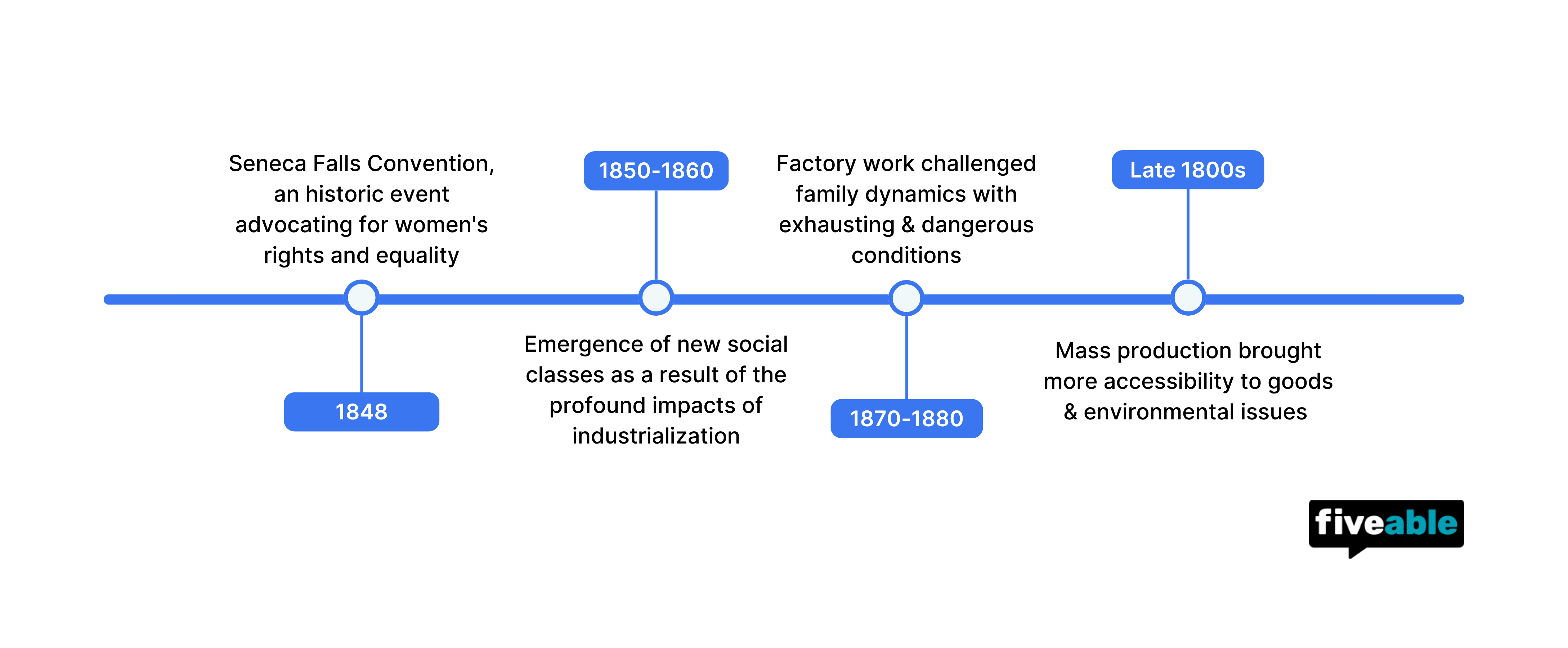
Timeline of events following Society and the Industrial Age. Image Courtesy of Riya
Key Takeaways
- Rapid city growth left many urban poor in crowded, unhealthy housing, and public health reforms later improved sanitation.
- Industrialists gained power over the landed aristocracy, the middle class gained new opportunities, and factory workers were treated as replaceable.
- Factory work pulled people away from home for long days, and low wages pushed families to send children to work.
- Working-class women faced low factory pay, while middle-class women faced pressure to stay home; the 1848 Seneca Falls meeting called for women's equality.
- Fossil fuels and industrial waste polluted air and water, contributing to respiratory problems and disease in industrial communities.
- Mass production made goods more accessible, while factory growth drove migration and industrializers' search for raw materials contributed to global inequality and colonization.
Effects on Urban Areas
Cities grew rapidly in the first half of the 19th century with almost no government planning, which created inhumane living conditions for the urban poor. People kept streaming in from farms and villages anyway, hoping for a better life. Many found one, especially as the middle class grew.
What working-class housing looked like:
- Families crowded into tenements, shoddily built apartment buildings often owned by the factory owners themselves
- Tenements sat in slums, areas of cities where low-income families were forced to live
- Industrial by-products were everywhere: polluted water supplies, open sewers
- Disease (especially the much-feared cholera) spread fast, along with fire, crime, and violence
How cities responded over time:
- Municipalities created police and fire departments
- Public health acts pushed sanitation reform: better drainage and sewage systems, cleaner water, rubbish removal, and building standards to reduce accidents and fires
Eventually, industrialization raised living standards for many. Life stayed hard for the poor, but the growing middle class gained access to goods, housing, culture, and education, plus leisure time spent in theaters, concert halls, and sports facilities.
Effects on Class Structure
Industrialization built a new three-tier social hierarchy in Britain, and the people at the top were no longer the old landed aristocracy.
Working class (bottom)
- Labored in factories and coal mines
- Interchangeable parts and the factory system's division of labor stripped away the artisan experience of crafting a complete product
- Workers needed fewer skills, so managers saw them as easily replaceable
- Competition for jobs kept wages low
Middle class (new)
- Factory and office managers, small business owners, and professionals
- White-collar workers (office jobs), mostly literate and educated
- Their wealth and opportunities drew even more migrants into cities
Industrialists (top)
- Owners of large corporations, the so-called "captains of industry"
- They overshadowed the landed aristocracy as the power brokers of modern society
That last point is the hierarchy shift the AP exam loves: money from industry, not inherited land, now determined who held power.
Farm Work Versus Factory Work
Industrialization split work from family life. Before factories, family members worked close together, whether women spinning fabric at home or landless workers farming a landlord's fields. Industrial machinery only ran in large factories, so people had to leave home and neighborhood for long workdays just to survive.
Factory work also meant a totally new sense of time:
- The factory whistle, not your own needs, dictated when you worked and when you took breaks (a real culture shock for former farmers)
- Workdays commonly ran 14 hours a day, six days a week
- Exhausted workers operated dangerous heavy machinery, so injuries and deaths were common
Effects on Children
Factory wages were so low that families had to send their children to work too. In the early decades of industrialization, children as young as five worked in textile mills. Owners valued their small size and nimble fingers, which let kids climb into machinery to make repairs or squeeze into tight spots in mines. Textile dust damaged their lungs just as badly as it damaged adults'.
Coal mines were even worse:
- Oppressive heat while carting heavy loads of coal
- Coal dust, even unhealthier to breathe than factory dust
- Constant threat of mine collapses and floods
Effects on Women's Lives
Industrialization changed women's lives in opposite ways depending on class. That class split is the key idea to remember.
Working-class women
- Worked in coal mines until Britain made hiring women for coal mining illegal in the 1840s
- Were the primary laborers in textile factories
- Factory owners preferred hiring women because they could pay them half of what they paid men
Middle-class women
- Spared factory work, but in many ways lived more limited lives
- A stay-at-home wife signaled that her husband could be the family's sole provider, so being a housewife became a status symbol
- By the late 1800s, advertising and consumer culture fed a "cult of domesticity" that idealized the female homemaker
- Pamphlets instructed middle-class women to care for the home, raise children, and be pious, submissive, pure, and domestic
For working-class women, the cult of domesticity was even more taxing. They were expected to manage the household and raise children while also working full time.
The rise of feminism
Industrialization also spurred feminism. When men left communities for jobs, women who stayed behind found new opportunities. In 1848 at Seneca Falls, New York, 300 people met to call for equality for women, an early political milestone of the movement.
Effects on the Environment
The Industrial Revolution ran on fossil fuels (coal, petroleum, and natural gas), and burning them poisoned air and water. Coal produced more energy than wood, but at a brutal cost.
- Air: coal-burning factories choked industrial towns in toxic pollution; smog (smoke plus fog) caused deadly respiratory problems
- Water: industries dumped waste straight into streams, rivers, and lakes, and cholera, typhoid, and other diseases ravaged neighborhoods
- Before London built public sanitation, the Thames River (the city's drinking water source) was filled with sewage and industrial pollution, spreading deadly disease through the city
The Industrial Revolution's Legacy
Mass production made goods cheaper, more abundant, and accessible to more people than ever before, but the revolution's costs were just as profound. This wrap-up sets up the change-and-continuity analysis in AMSCO 5.10 Continuity and Change in the Industrial Age.
The major legacies:
- Migration: factory growth pulled people from rural areas to cities and from agrarian countries to industrial ones, both low-skilled workers and high-skilled professionals
- Pollution: industrial by-products fouled air and water supplies
- Work and family: the workplace shifted from homes to factories, dramatically altering family life
- Inequality at home: a new and, many said, unequal relationship between workers and owners; more crowding and poverty brought more crime (workers' responses, like unions, are covered in AMSCO 5.8 Reactions to the Industrial Economy)
- Global inequality: early industrializers hunted the world for raw materials like cotton and rubber, undercut early industrialization in Egypt, China, and India, and ushered in a second wave of colonization (which sets up Unit 6)
Key Terms to Know
| Term | Why it matters |
|---|---|
| Mass production | Making goods cheaply and abundantly in factories, which put more products in more hands than ever before. |
| Tenement | A shoddily built, crowded apartment building (often owned by factory owners) that symbolized working-class living conditions. |
| Slums | Areas of cities where low-income families were forced to live, marked by pollution, open sewers, and disease. |
| Working class | The factory and mine laborers at the bottom of the new hierarchy, seen as replaceable and paid low wages. |
| Middle class | The new class of managers, small business owners, and professionals who enjoyed industrial prosperity. |
| White-collar | Office-based jobs held by the literate middle class, a new category of work created by industrialization. |
| Captains of industry | Industrialists and corporation owners who overshadowed the landed aristocracy as society's power brokers. |
| Division of labor | Splitting production into small, low-skill tasks, which made workers easily replaceable and kept wages low. |
| Cult of domesticity | A late-1800s ideal, pushed by advertising, that women should be pious, submissive, pure, and devoted to the home. |
| Seneca Falls Convention | An 1848 meeting in New York where 300 people called for equality for women, an early sign of feminism. |
| Cholera | A feared disease that spread quickly through polluted urban water supplies and drove sanitation reform. |
| Smog | Smoke mixed with fog from coal-burning factories that caused deadly respiratory problems in industrial towns. |
| Fossil fuels | Coal, petroleum, and natural gas, the energy sources that powered industry and polluted air and water. |
| Urbanization | The movement of people from rural areas to cities for factory jobs, a process that continues worldwide today. |
Practice and Next Steps
Pair these chapter notes with the Fiveable 5.9 Social Effects of Industrialization study guide, which covers the same course topic from the exam's angle. The full set of AP World AMSCO notes has every Unit 5 chapter if you're reviewing the whole industrialization story.
To check your understanding:
- Run through guided multiple-choice practice on Unit 5 to test how well you can identify causes and effects of industrialization
- Try FRQ practice with instant scoring. Social effects of industrialization show up often in continuity-and-change and causation prompts.
- Look up unfamiliar vocab in the AP World key terms glossary
Frequently Asked Questions
What is AMSCO Topic 5.9 about in AP World?
AMSCO Topic 5.9, Society and the Industrial Age (p. 343-350), covers the social effects of industrialization from 1750 to 1900: the rise of the middle class and industrial working class, crowded urban tenements and slums, child labor, changing roles for women, and air and water pollution. It pairs with the 5.9 Social Effects of Industrialization study guide.
What was the cult of domesticity?
The cult of domesticity was a late-1800s ideal, fueled by advertising and consumer culture, that pictured women as homemakers who should be pious, submissive, pure, and domestic. For middle-class women, staying home was a status symbol showing the husband could provide alone. For working-class women it was even more taxing, since they had to run the household, raise children, and work full time.
How did industrialization change social class structure?
It created a new hierarchy: a working class of factory and mine laborers at the bottom, a new middle class of white-collar managers, small business owners, and professionals in the middle, and industrialist 'captains of industry' at the top. Those industrialists overshadowed the old landed aristocracy as society's power brokers, which is the key hierarchy shift to know.
Did industrialization make life better or worse for workers?
Both, depending on class and timing. Early on, working-class families faced 14-hour days, child labor, low wages, tenement housing, and cholera outbreaks. Over time, sanitation reforms, public health acts, and mass production raised living standards for many, and the middle class gained access to goods, education, and leisure. AP essays reward showing this complexity instead of a one-sided answer.
How does Topic 5.9 show up on the AP World exam?
Social effects of industrialization appear in multiple-choice sets and in continuity-and-change or causation essay prompts about 1750-1900. Be ready to explain how new classes (middle class, working class) changed existing hierarchies and how rapid urbanization caused pollution, poverty, crime, and public health crises. Practice with FRQs and instant scoring to test your evidence.
See Fiveable more often in Google
Mark Fiveable as a preferred source and Google is more likely to show you our guides in Top Stories, with a "preferred" badge in AI Mode and AI Overviews.