AMSCO 5.7 Economic Developments and Innovations Notes

🌍AP World History: Modern Review
AMSCO 5.7 Economic Developments and Innovations Notes
🌍 AP World History: Modern
AMSCO 1.1 Developments in East Asia Notes
AMSCO 1.2 Developments in Dar al-Islam Notes
AMSCO 1.3 Developments in South and Southeast Asia Notes
AMSCO 1.4 Developments in the Americas Notes
AMSCO 1.5 Developments in Africa Notes
AMSCO 1.6 Developments in Europe Notes
AMSCO 1.7 Comparison in the Period from c.1200 to c.1450 Notes
AMSCO 2.1 The Silk Roads Notes
AMSCO 2.2 The Mongol Empire and the Modern World Notes
AMSCO 2.3 Exchange in the Indian Ocean Notes
AMSCO 2.4 Trans-Saharan Trade Routes Notes
AMSCO 2.5 Cultural Consequences of Connectivity Notes
AMSCO 2.6 Environmental Consequences of Connectivity Notes
AMSCO 2.7 Comparison of Economic Exchange Notes
AMSCO 3.1 European, East Asian, and Gunpowder Empires Expand Notes
AMSCO 3.2 Empires: Administrations Notes
AMSCO 3.3 Empires: Belief Systems Notes
AMSCO 3.4 Comparison in Land-Based Empires Notes
AMSCO 4.1 Technological Innovations Notes
AMSCO 4.2 Exploration: Causes and Events Notes
AMSCO 4.3 Columbian Exchange Notes
AMSCO 4.4 Maritime Empires Link Regions Notes
AMSCO 4.5 Maritime Empires Develop Notes
AMSCO 4.6 Internal and External Challenges to State Power Notes
AMSCO 4.7 Changing Social Hierarchies Notes
AMSCO 4.8 Continuity and Change from c.1450 to c.1750 Notes
AMSCO 5.1 The Enlightment Notes
AMSCO 5.2 Nationalism and Revolutions Notes
AMSCO 5.3 Industrial Revolution Begins Notes
AMSCO 5.4 Industrialization Spreads Notes
AMSCO 5.5 Technology in the Industrial Age Notes
AMSCO 5.6 Industrialization: Government's Role Notes
AMSCO 5.7 Economic Developments and Innovations Notes
AMSCO 5.8 Reactions to the Industrial Economy Notes
AMSCO 5.9 Society and the Industrial Age Notes
AMSCO 5.10 Continuity and Change in the Industrial Age Notes
AMSCO 6.1 Rationales for Imperialism Notes
AMSCO 6.2 State Expansion Notes
AMSCO 6.3 Indigenous Responses to State Expansion Notes
AMSCO 6.4 Global Economic Development Notes
AMSCO 6.5 Economic Imperialism Notes
AMSCO 6.6 Causes of Migration in an Interconnected World Notes
AMSCO 6.7 Effects of Migration Notes
AMSCO 6.8 Causation in the Imperial Age Notes
AMSCO 7.1 Shifting Power Notes
AMSCO 7.2 Causes of World War I Notes
AMSCO 7.3 Conducting World War I Notes
AMSCO 7.4 Economy in the Interwar Period Notes
AMSCO 7.5 Unresolved Tensions After World War I Notes
AMSCO 7.6 Causes of World War II Notes
AMSCO 7.7 Conducting World War II Notes
AMSCO 7.8 Mass Atrocities Notes
AMSCO 7.9 Causation in Global Conflict Notes
AMSCO 8.1 Setting the Stage for the Cold War and Decolonization Notes
AMSCO 8.2 The Cold War Notes
AMSCO 8.3 Effects of the Cold War Notes
AMSCO 8.4 Spread of Communism Notes
AMSCO 8.5 Decolonization after 1900 Notes
AMSCO 8.6 Newly Independent States Notes
AMSCO 8.7 Global Resistance to Established Power Structure Notes
AMSCO 8.8 End of the Cold War Notes
AMSCO 8.9 Causation in the Age of the Cold Ward and Decolonization Notes
AMSCO 9.1 Advances in Technology and Exchange Notes
AMSCO 9.2 Technological Advancements and Limitations Notes
AMSCO 9.3 Technology and the Environment Notes
AMSCO 9.4 Economics in the Global Age Notes
AMSCO 9.5 Calls for Reforms and Responses Notes
AMSCO 9.6 Globalized Culture Notes
AMSCO 9.7 Resistance to Globalization Notes
AMSCO 9.8 Institutions Developing in a Globalized World Notes
AMSCO 9.9 Continuity and Change in a Globalized World Notes
Overview
AMSCO Topic 5.7, Economic Developments and Innovations (p. 325 - p. 331), explains how industrialization between 1750 and 1900 created new economic ideas, new business structures, and a new consumer culture. The big shift is that mercantilism gave way to Adam Smith's laissez-faire capitalism, businesses organized into corporations and transnational companies like HSBC and Lever Brothers (later Unilever), and rising living standards fueled mass consumerism and leisure culture. The chapter's essential question asks how economic systems, ideologies, and institutions contributed to change in this period, and the answer runs through every section below.
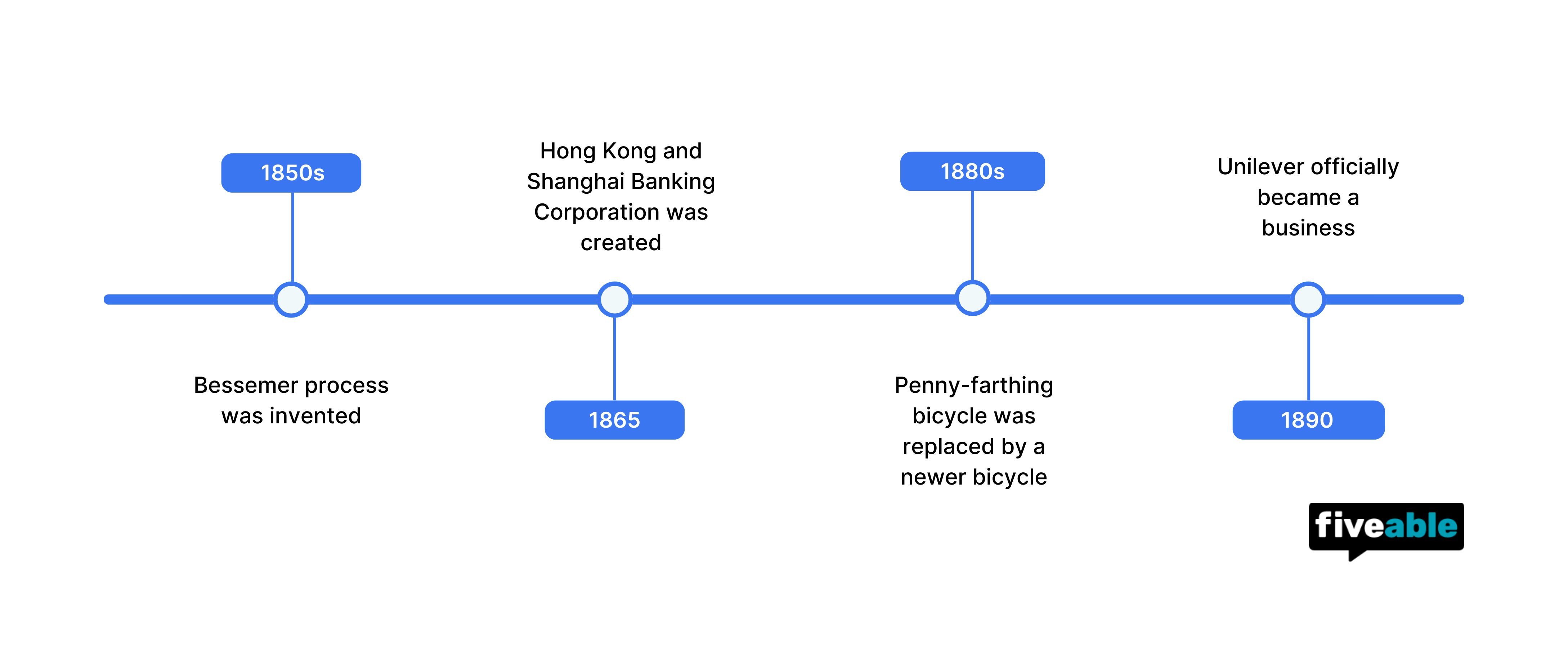
Timeline of events following economic developments and innovations from 1750-1900. Image courtesy of Siya.
Key Takeaways
- Western European countries moved away from mercantilism toward Adam Smith's laissez-faire ideas, reducing government involvement in trade and lowering tariffs.
- Corporations helped fund expensive industries by selling shares to stockholders, whose losses were limited to what they invested.
- Some corporations eliminated competition: Alfred Krupp built a monopoly in German steel, and John D. Rockefeller did the same in U.S. oil.
- Transnational companies like HSBC and Lever Brothers operated across borders, while European businesses drew on cheap colonial raw materials and labor.
- Insurance spread the risk of shipping losses, while growing banks gave entrepreneurs places to deposit money and borrow for new ventures.
- Rising living standards for some supported consumerism and leisure, including sports, music halls, and parks, though some sports remained divided by class.
From Mercantilism to Laissez-Faire Capitalism
The chapter opens with the ideological shift that made industrial capitalism possible. In The Wealth of Nations (1776), Adam Smith argued that humans are naturally transactional ("no dog exchanges bones with another"). His book became the foundational text for capitalism and private entrepreneurship, and it shaped economics and politics for centuries.
What changed in practice:
- Mercantilism, a system of economic protectionism where governments tightly managed trade, was abandoned by Western European countries.
- It was replaced by laissez-faire policy (French for "leave alone"), which called for minimal government involvement in commerce and encouraged countries to reduce tariffs on trade.
- These free-trade ideas were reflected in, and reinforced by, new transnational institutions like the Hong Kong and Shanghai Banking Corporation (a bank) and Lever Brothers (a manufacturer, later part of Unilever).
- As trade grew, consumer goods became more available, more affordable, and more varied.
This is the "economic ideology" piece of the topic. If a question asks why governments stepped back from controlling trade in this era, Adam Smith and laissez-faire capitalism are your answer. (For where governments still played a role, see the AMSCO 5.6 notes on industrialization and government.)
Effects on Business Organization
Industrialization created huge, expensive industries like steel and rail, and entrepreneurs needed a way to fund them without risking personal ruin. The solution was the corporation: a business chartered by a government as a legal entity owned by stockholders.
How corporations work
- Stockholders buy partial ownership directly from the company when it forms, or later through a stock market.
- When the corporation profits, stockholders may receive payments called dividends.
- If the corporation loses money or goes bankrupt, stockholders are not liable for the losses. The most they can lose is what they paid for the stock.
Compare this to the older forms: a sole proprietorship (one owner) and a partnership (a small group making all decisions). The corporation replaced the single entrepreneur taking on high-risk ventures with larger companies collectively taking on lower-risk efforts. Spreading risk made investing safer and more attractive, which pulled in capital.
AMSCO highlights four features of a corporation:
- Limited liability: investors can't lose more than they put in.
- Transferability of shares: ownership and voting rights move easily from one investor to another.
- Juridical personality: the corporation acts as a legal "person" that can sue, be sued, make contracts, and hold property.
- Indefinite duration: the corporation can outlive its founders.
Critics charged that corporations undermined individual responsibility, but they came to dominate banking, manufacturing, and services, and they gained serious economic and political power. A corporation's choice of where to build a factory could create thousands of jobs for a community.
Monopolies: markets with one seller
Some corporations grew powerful enough to form a monopoly, meaning control of a specific business and elimination of all competition. Two examples to know:
- Alfred Krupp of Essen, Germany used the Bessemer process (a more efficient way to produce steel) to build a monopoly in the German steel industry.
- John D. Rockefeller created a monopoly in the U.S. oil industry.
Transnational companies
Transnational companies operated across national boundaries, and they gained wealth and influence on a scale rarely seen before. The three examples AMSCO emphasizes:
- Cecil Rhodes, the British-born founder of De Beers Diamonds, invested enthusiastically in a Cape Town-to-Cairo railroad meant to connect Britain's African colonies for easier governance and wartime logistics. It was never completed because Britain never controlled all the land along the route. The railway workforce was overwhelmingly African laborers paid far less than European workers, so the railroad functioned as a tool for extracting maximum resources at minimal labor cost.
- The Hong Kong and Shanghai Banking Corporation (HSBC), a British-owned bank opened in the colony of Hong Kong in 1865, focused on finance, corporate investments, and global banking.
- Lever Brothers, a British company that later merged with a Dutch firm to form Unilever, made household goods, most famously soap. By 1890 it had soap factories in Australia, Switzerland, the United States, and beyond. It sourced palm oil first from British West Africa and later from huge plantations it operated in the Belgian Congo.
Notice the pattern: transnational business and imperialism fed each other. European companies got cheap raw materials and cheap colonial labor; colonies got extraction.
Banking, insurance, and finance
Risk reduction didn't stop with the corporate structure. Insurance, especially marine insurance, spread the risk of shipping losses. Lloyd's of London, which began in a coffee house where merchants and sailors gathered for reliable shipping news, helped establish the insurance industry. Banks multiplied as merchants and entrepreneurs looked for reliable places to deposit money and to borrow when they needed to build a factory or hire workers for a new venture.
Effects on Mass Culture
Industrial capitalism raised living standards for some, and a culture of consumerism and leisure developed among Britain's working and middle classes. Production was booming, so consumption had to keep up. Producers advertised heavily, especially to the middle class, whose members had disposable income (money to spend on nonessential goods).
Leisure and sports
- Biking and boating became popular leisure activities in the late 1800s. In the 1880s, the dangerous penny-farthing bicycle (one giant wheel, one tiny wheel) gave way to the safety bicycle, which used a chain connecting different-sized gears to reach the same speed with less risk of toppling over.
- Companies encouraged workers to play sports, believing athletics taught virtues like self-discipline and playing by the rules. Selling athletic equipment, from soccer balls to stadiums, also generated business.
- Material goods and entertainment became important escapes from bleak industrial work. Soccer (football) took off in Europe; baseball dominated in the United States.
- Sports developed along class lines. In England, tennis and golf belonged to the upper classes, while certain types of rugby were played only by the lower classes.
Public culture
The second half of the 19th century saw the construction of music halls and public parks built to accommodate a wide range of social classes. One stated aim of this class mingling was for lower classes to observe and emulate "more civilized, rational behavior" from their social superiors. Whether that actually worked is hard to measure, but these shared public spaces endured.
This consumer-and-leisure culture sets up the social changes covered in the AMSCO 5.9 notes on society in the Industrial Age, and the downsides of industrial capitalism trigger the protests covered in the AMSCO 5.8 notes on reactions to the industrial economy.
Key Terms to Know
| Term | Why it matters |
|---|---|
| Adam Smith | Author of The Wealth of Nations (1776), the foundational text of capitalism and laissez-faire economics. |
| Laissez-faire | "Leave alone" policy of minimal government involvement in commerce that replaced mercantilism and lowered tariffs. |
| Mercantilism | The older protectionist economic system that Western European countries abandoned in favor of free trade. |
| Corporation | A government-chartered legal entity owned by stockholders, built to spread risk and enable large-scale business. |
| Stockholders | Investors who buy partial ownership of a corporation, earn dividends in good times, and lose only their investment in bad ones. |
| Stock market | The marketplace where shares of corporations are bought and sold, making investment flexible and transferable. |
| Limited liability | The corporate feature guaranteeing investors can't lose more than they paid in, which made investing far less risky. |
| Monopoly | Control of an entire industry with all competition eliminated, like Krupp in German steel or Rockefeller in U.S. oil. |
| Bessemer process | An efficient steel-making method that Alfred Krupp used to build his German steel monopoly. |
| Cecil Rhodes | British founder of De Beers Diamonds who backed the never-completed Cape Town-to-Cairo railroad through British Africa. |
| Transnational | Operating across national boundaries, the defining trait of 19th-century giants like HSBC, Lever Brothers, and De Beers. |
| Hong Kong and Shanghai Banking Corporation (HSBC) | British-owned bank founded in colonial Hong Kong in 1865, a key example of transnational finance. |
| Lever Brothers (later Unilever) | British maker of household goods (especially soap) that sourced palm oil from British West Africa and the Belgian Congo. |
| Lloyd's of London | Insurance pioneer that grew out of a coffee house, showing how finance reduced business risk. |
| Consumerism | The culture of buying nonessential goods that grew as wages, advertising, and disposable income rose. |
| Disposable income | Money left over for nonessentials, which advertisers targeted in the growing middle class. |
Practice and Next Steps
Pair these notes with Fiveable's Topic 5.7 Economic Developments and Innovations study guide for the course-aligned version of this content, and browse the full set of AP World AMSCO notes to keep moving through Unit 5.
To check your understanding:
- Run timed multiple-choice sets on AP World guided practice.
- Try writing about industrial capitalism with FRQ practice and instant scoring.
- Look up any term from this chapter in the AP World key terms glossary.
Next up in the chapter sequence: AMSCO 5.8 Reactions to the Industrial Economy, where workers and reformers push back against everything you just read.
Frequently Asked Questions
What is AMSCO Topic 5.7 in AP World about?
AMSCO Topic 5.7, Economic Developments and Innovations (p. 325-331), covers how industrialization changed economic ideas and institutions from 1750 to 1900. It explains the shift from mercantilism to Adam Smith's laissez-faire capitalism, the rise of corporations, stock markets, and transnational companies like HSBC and Unilever, and the growth of consumerism and leisure culture.
What are the four features of a corporation in AP World?
AMSCO lists limited liability (investors can't lose more than they invested), transferability of shares (ownership moves easily between investors), juridical personality (the corporation acts as a legal 'person' that can sue, make contracts, and hold property), and indefinite duration (it can outlive its founders). Together these features spread risk and made large-scale investment safer and more attractive.
What is a transnational company in AP World, and what are examples?
A transnational company is one that operates across national boundaries. The key examples for Topic 5.7 are the Hong Kong and Shanghai Banking Corporation (HSBC), a British bank founded in colonial Hong Kong in 1865, and Unilever, a British-Dutch soap maker that sourced palm oil from British West Africa and the Belgian Congo. Cecil Rhodes's De Beers Diamonds is a third example tied to British imperialism in Africa.
Why did countries abandon mercantilism during the Industrial Revolution?
Western European countries dropped mercantilism largely because of the growing acceptance of Adam Smith's laissez-faire ideas in The Wealth of Nations (1776), which argued for free markets, private entrepreneurship, and minimal government involvement in commerce. Laissez-faire policy encouraged countries to reduce tariffs, which expanded trade and made consumer goods more available, affordable, and varied.
How does Topic 5.7 show up on the AP World exam?
Topic 5.7 supports questions about how economic systems, ideologies, and institutions caused change from 1750 to 1900, which can appear in multiple choice, SAQs, or as evidence in the LEQ and DBQ. Strong specific evidence includes Adam Smith and laissez-faire, limited-liability corporations and stock markets, monopolies like Krupp and Rockefeller, and transnational businesses like HSBC and Unilever. You can drill this content with Fiveable's AP World guided practice.
See Fiveable more often in Google
Mark Fiveable as a preferred source and Google is more likely to show you our guides in Top Stories, with a "preferred" badge in AI Mode and AI Overviews.