AMSCO 4.8 Continuity and Change from c.1450 to c.1750 Notes

🌍AP World History: Modern Review
AMSCO 4.8 Continuity and Change from c.1450 to c.1750 Notes
🌍 AP World History: Modern
AMSCO 1.1 Developments in East Asia Notes
AMSCO 1.2 Developments in Dar al-Islam Notes
AMSCO 1.3 Developments in South and Southeast Asia Notes
AMSCO 1.4 Developments in the Americas Notes
AMSCO 1.5 Developments in Africa Notes
AMSCO 1.6 Developments in Europe Notes
AMSCO 1.7 Comparison in the Period from c.1200 to c.1450 Notes
AMSCO 2.1 The Silk Roads Notes
AMSCO 2.2 The Mongol Empire and the Modern World Notes
AMSCO 2.3 Exchange in the Indian Ocean Notes
AMSCO 2.4 Trans-Saharan Trade Routes Notes
AMSCO 2.5 Cultural Consequences of Connectivity Notes
AMSCO 2.6 Environmental Consequences of Connectivity Notes
AMSCO 2.7 Comparison of Economic Exchange Notes
AMSCO 3.1 European, East Asian, and Gunpowder Empires Expand Notes
AMSCO 3.2 Empires: Administrations Notes
AMSCO 3.3 Empires: Belief Systems Notes
AMSCO 3.4 Comparison in Land-Based Empires Notes
AMSCO 4.1 Technological Innovations Notes
AMSCO 4.2 Exploration: Causes and Events Notes
AMSCO 4.3 Columbian Exchange Notes
AMSCO 4.4 Maritime Empires Link Regions Notes
AMSCO 4.5 Maritime Empires Develop Notes
AMSCO 4.6 Internal and External Challenges to State Power Notes
AMSCO 4.7 Changing Social Hierarchies Notes
AMSCO 4.8 Continuity and Change from c.1450 to c.1750 Notes
AMSCO 5.1 The Enlightment Notes
AMSCO 5.2 Nationalism and Revolutions Notes
AMSCO 5.3 Industrial Revolution Begins Notes
AMSCO 5.4 Industrialization Spreads Notes
AMSCO 5.5 Technology in the Industrial Age Notes
AMSCO 5.6 Industrialization: Government's Role Notes
AMSCO 5.7 Economic Developments and Innovations Notes
AMSCO 5.8 Reactions to the Industrial Economy Notes
AMSCO 5.9 Society and the Industrial Age Notes
AMSCO 5.10 Continuity and Change in the Industrial Age Notes
AMSCO 6.1 Rationales for Imperialism Notes
AMSCO 6.2 State Expansion Notes
AMSCO 6.3 Indigenous Responses to State Expansion Notes
AMSCO 6.4 Global Economic Development Notes
AMSCO 6.5 Economic Imperialism Notes
AMSCO 6.6 Causes of Migration in an Interconnected World Notes
AMSCO 6.7 Effects of Migration Notes
AMSCO 6.8 Causation in the Imperial Age Notes
AMSCO 7.1 Shifting Power Notes
AMSCO 7.2 Causes of World War I Notes
AMSCO 7.3 Conducting World War I Notes
AMSCO 7.4 Economy in the Interwar Period Notes
AMSCO 7.5 Unresolved Tensions After World War I Notes
AMSCO 7.6 Causes of World War II Notes
AMSCO 7.7 Conducting World War II Notes
AMSCO 7.8 Mass Atrocities Notes
AMSCO 7.9 Causation in Global Conflict Notes
AMSCO 8.1 Setting the Stage for the Cold War and Decolonization Notes
AMSCO 8.2 The Cold War Notes
AMSCO 8.3 Effects of the Cold War Notes
AMSCO 8.4 Spread of Communism Notes
AMSCO 8.5 Decolonization after 1900 Notes
AMSCO 8.6 Newly Independent States Notes
AMSCO 8.7 Global Resistance to Established Power Structure Notes
AMSCO 8.8 End of the Cold War Notes
AMSCO 8.9 Causation in the Age of the Cold Ward and Decolonization Notes
AMSCO 9.1 Advances in Technology and Exchange Notes
AMSCO 9.2 Technological Advancements and Limitations Notes
AMSCO 9.3 Technology and the Environment Notes
AMSCO 9.4 Economics in the Global Age Notes
AMSCO 9.5 Calls for Reforms and Responses Notes
AMSCO 9.6 Globalized Culture Notes
AMSCO 9.7 Resistance to Globalization Notes
AMSCO 9.8 Institutions Developing in a Globalized World Notes
AMSCO 9.9 Continuity and Change in a Globalized World Notes
Overview
AMSCO Topic 4.8, Continuity and Change from c. 1450 to c. 1750 (AMSCO pages 261-264), is the wrap-up chapter for Unit 4 of AP World History: Modern. It answers one big question: how did economic developments from 1450 to 1750 affect social structures over time? The short version: transoceanic voyaging connected the Eastern and Western Hemispheres for the first time, Western European maritime powers built trading empires in the Indian Ocean and the Americas, and new coerced labor systems and race-based social hierarchies developed to feed the new global economy.
Because this is a review chapter, it's gold for LEQ and DBQ prep. Almost every continuity-and-change prompt about 1450-1750 can be answered with material on this page.
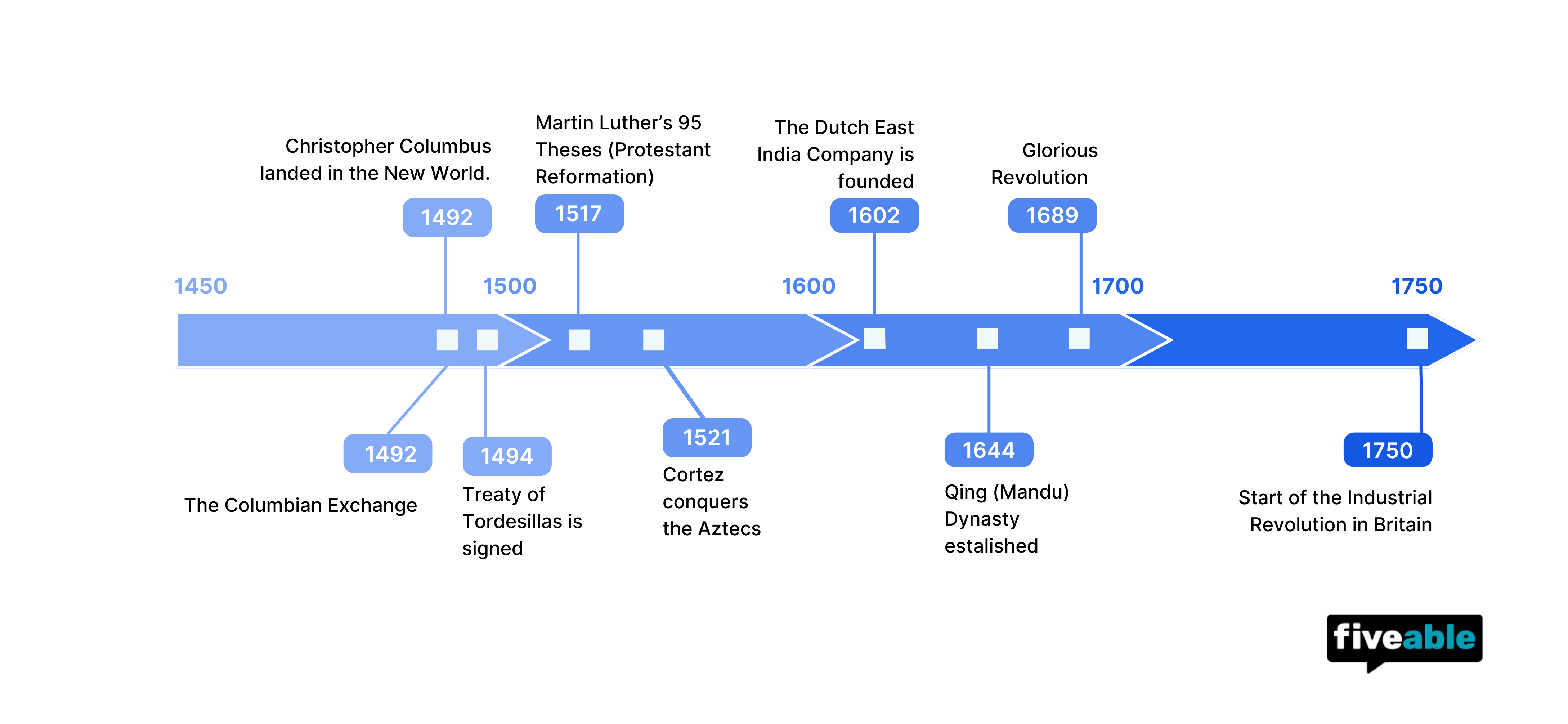
Timeline of key events in 1450-1750. Image Courtesy of Tien.
Key Takeaways
- Navigation tools and new ships helped Europeans cross oceans, bringing the Western Hemisphere into global trade and spreading crops, diseases, people, and beliefs through the Columbian Exchange and Atlantic System.
- Portuguese, Dutch, and English maritime empires challenged established merchants, while American silver shipped to Asia financed growing trade between Europe and Asia.
- Mercantilism gave way to capitalism and joint-stock companies; trade profits expanded Europe's middle class, but gold and silver flowing into Spain and China caused inflation.
- Traditional serfdom and peasant agriculture continued, while demand for labor expanded the Atlantic slave trade and coerced labor systems in the Americas.
- In the American colonies, racial and ethnic hierarchies put most wealth and political power in the hands of white Europeans and Americans of European descent.
- Bartolomé de Las Casas's account of Spanish cruelty sparked a long debate; recent historians have found brutality across European colonial empires but cannot easily determine whether Spain was worse.
Transoceanic Travel and Trade
The single most significant change in this period was the integration of the Western Hemisphere into the global trading network. Western European states wanted a sea route to Asia, and they got there by borrowing and improving technology from the Classical, Islamic, and Asian worlds:
- Astronomical charts and the astrolabe (navigation)
- The compass and magnetic compass (direction-finding)
- The lateen sail (sailing against the wind)
- New ship designs: the carrack, caravel, and fluyt
These tools made the voyages covered in Topic 4.1 on technological innovations and Topic 4.2 on exploration possible.
The Columbian Exchange and the Atlantic System
The result was the Columbian Exchange, the biological transfer of crops, animals, people, and diseases between hemispheres. It changed who grew what foods where, unleashed deadly diseases on populations with no immunity, and triggered massive migrations, many of them forced.
The Columbian Exchange also produced the Atlantic System, a transoceanic trading network linking Western Europe, Western Africa, and the Americas through the movement of goods and people. As people migrated (or were forced to migrate) within this system, cultures mixed. Religions spread and often produced syncretic belief systems and practices. For the full breakdown, see the AMSCO 4.3 Columbian Exchange notes.
Economic Changes: Maritime Empires, Silver, and Capitalism
European voyages transformed the global economy by shifting control of trade from existing merchant networks to European states. The Portuguese led the way in building maritime trading empires, followed by the Dutch and English. Europeans set up trading ports and cities along the coasts of Africa and the Indian Ocean, which brought them into contact, and often conflict, with established Arab, Indian, and Chinese merchants. Over time, Europeans came to dominate global trade at those merchants' expense, profiting from carrying goods between regions.
Colonies and the Silver Trade
Unlike the trading-post empires of the Indian Ocean, Spain built a territorial empire in the Americas, soon joined by Portugal, England, France, and the Netherlands. The discovery of huge silver deposits in Spain's colonies pulled Europe deeper into the global economy. Asian markets, especially China, wanted silver, so shipments of American silver to Asia became a regular feature of global trade and financed the growing Europe-Asia trade. Some experts estimate the amount of silver in the global economy tripled in the 16th century.
Mercantilism Gives Way to Capitalism
European monarchs saw how much wealth trade could generate, so they adopted mercantilist policies designed to funnel a steady stream of income to the ruler. Over time, mercantilism gave way to capitalism as the dominant economic system. Investors formed joint-stock companies (also called chartered companies) to share the risks and rewards of global trading ventures. The AMSCO 4.5 notes on maritime empires cover these economic systems in depth.
Effects of the New Global Economy
The global flow of goods and profits cut both ways. On the benefit side:
- Wealth flowing into Europe expanded the middle class and provided capital that would later fund the Industrial Revolution.
- Regional markets in Europe, Africa, and Asia continued to prosper.
- Merchants and governments used rising profits to sponsor artists and authors. Some rulers used art and architecture to legitimize their rule; other art celebrated global trade itself.
On the cost side, the massive amounts of gold and silver flowing into Spain and China increased the quantity of money in circulation and caused inflation. Economic disputes also fueled rivalries and conflict between states, the kind covered in Topic 4.6 on challenges to state power.
Demand for Labor and New Social Structures
Growing global demand for raw materials and finished products intensified the demand for labor, and that demand reshaped societies on three continents.
The Atlantic Slave Trade and Coerced Labor
The Columbian Exchange and Atlantic System caused a demographic shift in Africa as the Atlantic slave trade intensified. Slavers captured and sold millions of African men, who ended up on American plantations producing cash crops like sugar, cotton, and tobacco. Some African communities experienced a gender imbalance, and Africa's population declined, though it eventually recovered as people grew new American crops such as manioc.
Track the continuities and changes in labor systems side by side:
| Continuity | Change |
|---|---|
| Traditional forced labor systems like serfdom continued in parts of Afro-Eurasia. | Chattel slavery in the Atlantic slave trade created large-scale, transoceanic forced migration of millions of Africans to plantation economies. |
| Agriculture remained the center of the world's productive systems; traditional peasant agriculture continued (and increased). | New coerced labor systems developed in the Americas: indentured servitude, the encomienda and hacienda systems, and the Spanish adoption of the Inca mit'a system. |
Many European settlers arrived in the Americas as indentured servants, contracted to work for a set period before they were free to pursue other occupations.
Race-Based Hierarchies
As Europeans, Africans, and Native Americans coexisted in the American colonies, new social systems based on racial or ethnic identity appeared. The result was a rigid, hierarchical society in which white Europeans (or Americans of European descent) held most of the wealth and political power. A new subculture of people with mixed European and African heritage emerged. These societal conflicts eventually fed into revolutions. The AMSCO 4.7 notes on changing social hierarchies go deeper here.
The Black Legend: How Historians Debate Spanish Colonization
The chapter closes with a historiography case study you can use for sourcing and argumentation practice. In 1552, the Dominican friar Bartolomé de Las Casas described the greed and cruelty Spanish officials inflicted on native populations, and historians have debated his accuracy ever since.
- In 1914, Spanish historian Julián Juderías labeled the belief in the evils of Spanish rule the "Black Legend." He argued that jealous European rivals in the 16th and 17th centuries were primed to believe the worst about Spain, and that historians ignored Spanish colonialism's achievements.
- Religion shaped the debate too. The Black Legend fit Protestant suspicions of Catholic Spain, and in the 19th-century United States, where Protestants dominated history writing, acceptance of the Black Legend was common.
- Spanish historians defending colonization developed what critics called a "White Legend." American historian Lewis Hanke argued that Las Casas was one of many Spanish reformers and called the Spanish empire "one of the greatest attempts the world has seen to make Christian precepts prevail in the relations between peoples." Critics countered that Hanke exaggerated the reformers' influence and that what actually happened was extraordinarily harsh.
- Recent historians taking a global, comparative approach have found widespread brutality across all European colonial empires. Whether the Spanish were worse than other Europeans remains hard to determine.
The chapter pairs this debate with seven DBQ-style documents about European rivalries and conquest, including Cortes's 1520 letter to Charles V describing Tenochtitlan, Elizabeth I's 1588 declaration against the Spanish Armada, al-Fishtali's account of Morocco's dispute with Songhai over the salt tax, Schiller on the Thirty Years' War, a Spanish general's 1669 letter to privateer Henry Morgan, the 1731 Captain Jenkins ear incident, and a 1739 etching of the East India Company's 1612 victory over the Portuguese at Suvali. Notice the through line: economic disputes drove rivalries and conflicts between states.
Key Terms to Know
| Term | Why it matters |
|---|---|
| Columbian Exchange | The biological transfer of crops, animals, people, and diseases between hemispheres that reshaped diets, populations, and societies worldwide. |
| Atlantic System | The trade network linking Western Europe, Western Africa, and the Americas through the movement of goods and people. |
| Caravel | A new European ship design (alongside the carrack and fluyt) that made transoceanic voyaging possible. |
| Astrolabe | A navigation tool, borrowed from earlier Islamic and Classical learning, that helped sailors find their position at sea. |
| Maritime trading empires | Sea-based empires built by the Portuguese, then the Dutch and English, with trading ports along African and Indian Ocean coasts. |
| Silver trade | American silver flowing to Asia (especially China) financed Europe-Asia trade; global silver may have tripled in the 16th century. |
| Mercantilism | Economic policies designed to give European monarchs a steady stream of income from trade. |
| Capitalism | The economic system that eventually replaced mercantilism as the dominant system in the new global economy. |
| Joint-stock company | A chartered company letting investors share the risks and rewards of global trading ventures. |
| Inflation | The negative side effect of gold and silver flooding into Spain and China, increasing money in circulation. |
| Chattel slavery | The system of the Atlantic slave trade, treating millions of enslaved Africans as property on American plantations. |
| Indentured servitude | A labor contract binding many European migrants to work for a set period before gaining freedom. |
| Encomienda and hacienda | Coerced labor systems in Spain's American colonies. |
| Mit'a | An Inca labor system adopted by the Spanish to extract forced labor in the Americas. |
| Serfdom | A traditional forced labor system that continued in parts of Afro-Eurasia, a key continuity. |
| Syncretic belief systems | Blended religious practices that developed as religions spread through migration and trade. |
| Black Legend | The historical belief in the unique cruelty of Spanish colonial rule, named and challenged by Julián Juderías in 1914. |
| Bartolomé de Las Casas | The Dominican friar whose 1552 account of Spanish cruelty started the centuries-long debate over Spanish colonization. |
Practice and Next Steps
Try these AMSCO and released-exam prompts using this chapter's material:
- "Identify historical developments in the period from c. 1450-c. 1750. Rank them according to how significant they were in either 1) maintaining continuity or 2) bringing about change. Explain your rankings." (AMSCO)
- "Explain how economic developments from c. 1450 to c. 1750 affected social structures over time." (AMSCO)
- "Describe and explain a significant continuity and a significant change in labor migration in the period 1450-1750 C.E." (College Board, 2017 AP World Exam, LEQ #2)
- "In the period circa 1450-1750, European expansion affected the development of numerous East Asian and South Asian states. Develop an argument that evaluates the extent to which the economies of East and/or South Asian states in this time period changed in response to European expansion." (College Board, 2021 AP World Exam, LEQ #3)
For prompt #4, useful evidence includes European trading posts disrupting existing Asian merchant networks, Chinese demand for American silver reshaping trade, and the East India Company displacing the Portuguese monopoly in India after the 1612 Battle of Suvali.
Keep going with these resources:
- Review the matching 4.8 Continuity and Change course topic study guide
- Browse all AP World AMSCO notes for other Unit 4 chapters
- Drill Unit 4 multiple choice with guided practice questions
- Write a continuity-and-change LEQ and get instant feedback with FRQ practice
- Test the whole period with a full-length practice exam
Frequently Asked Questions
What is AMSCO Topic 4.8 in AP World about?
AMSCO Topic 4.8 (pages 261-264) is the Unit 4 review chapter covering continuity and change from c. 1450 to c. 1750. It explains how transoceanic trade, the Columbian Exchange, the silver trade, and new coerced labor systems reshaped global economies and social structures, and it includes a historiography section on the Black Legend.
How did economic developments from 1450 to 1750 affect social structures?
Growing demand for raw materials and cash crops intensified the demand for labor, fueling the Atlantic slave trade and new coerced labor systems like indentured servitude, encomienda, hacienda, and the mit'a. In the Americas, this produced rigid hierarchies based on racial and ethnic identity, with Europeans holding most wealth and political power, while Africa experienced population decline and gender imbalances.
What is a continuity and a change in labor from 1450 to 1750?
A major continuity is that traditional forced labor systems like serfdom persisted in Afro-Eurasia and agriculture stayed the center of the world's productive systems. A major change is the rise of chattel slavery in the Atlantic slave trade, which forcibly moved millions of Africans across the ocean to plantations, alongside new systems like indentured servitude and the encomienda. This pairing was the basis of an actual released LEQ on the 2017 AP World exam.
What is the Black Legend in AP World History?
The Black Legend is the belief that Spanish colonial rule was uniquely cruel, rooted in Bartolomé de Las Casas's 1552 account of Spanish abuses of native populations. Spanish historian Julián Juderías named and challenged it in 1914, arguing that jealous and anti-Catholic rivals exaggerated Spain's cruelty. Recent global historians have found widespread brutality across all European empires, so whether Spain was worse remains debated.
How should I use Topic 4.8 to study for the AP World exam?
Treat it as your Unit 4 LEQ toolkit, since continuity-and-change prompts about 1450-1750 show up often on the exam. Practice the chapter's prompts (including released LEQs from 2017 and 2021) and check your essays with Fiveable's FRQ practice with instant scoring. The chapter's seven documents on European rivalries are also great DBQ sourcing practice.
See Fiveable more often in Google
Mark Fiveable as a preferred source and Google is more likely to show you our guides in Top Stories, with a "preferred" badge in AI Mode and AI Overviews.