AMSCO 4.1 Technological Innovations Notes

🌍AP World History: Modern Review
AMSCO 4.1 Technological Innovations Notes
🌍 AP World History: Modern
AMSCO 1.1 Developments in East Asia Notes
AMSCO 1.2 Developments in Dar al-Islam Notes
AMSCO 1.3 Developments in South and Southeast Asia Notes
AMSCO 1.4 Developments in the Americas Notes
AMSCO 1.5 Developments in Africa Notes
AMSCO 1.6 Developments in Europe Notes
AMSCO 1.7 Comparison in the Period from c.1200 to c.1450 Notes
AMSCO 2.1 The Silk Roads Notes
AMSCO 2.2 The Mongol Empire and the Modern World Notes
AMSCO 2.3 Exchange in the Indian Ocean Notes
AMSCO 2.4 Trans-Saharan Trade Routes Notes
AMSCO 2.5 Cultural Consequences of Connectivity Notes
AMSCO 2.6 Environmental Consequences of Connectivity Notes
AMSCO 2.7 Comparison of Economic Exchange Notes
AMSCO 3.1 European, East Asian, and Gunpowder Empires Expand Notes
AMSCO 3.2 Empires: Administrations Notes
AMSCO 3.3 Empires: Belief Systems Notes
AMSCO 3.4 Comparison in Land-Based Empires Notes
AMSCO 4.1 Technological Innovations Notes
AMSCO 4.2 Exploration: Causes and Events Notes
AMSCO 4.3 Columbian Exchange Notes
AMSCO 4.4 Maritime Empires Link Regions Notes
AMSCO 4.5 Maritime Empires Develop Notes
AMSCO 4.6 Internal and External Challenges to State Power Notes
AMSCO 4.7 Changing Social Hierarchies Notes
AMSCO 4.8 Continuity and Change from c.1450 to c.1750 Notes
AMSCO 5.1 The Enlightment Notes
AMSCO 5.2 Nationalism and Revolutions Notes
AMSCO 5.3 Industrial Revolution Begins Notes
AMSCO 5.4 Industrialization Spreads Notes
AMSCO 5.5 Technology in the Industrial Age Notes
AMSCO 5.6 Industrialization: Government's Role Notes
AMSCO 5.7 Economic Developments and Innovations Notes
AMSCO 5.8 Reactions to the Industrial Economy Notes
AMSCO 5.9 Society and the Industrial Age Notes
AMSCO 5.10 Continuity and Change in the Industrial Age Notes
AMSCO 6.1 Rationales for Imperialism Notes
AMSCO 6.2 State Expansion Notes
AMSCO 6.3 Indigenous Responses to State Expansion Notes
AMSCO 6.4 Global Economic Development Notes
AMSCO 6.5 Economic Imperialism Notes
AMSCO 6.6 Causes of Migration in an Interconnected World Notes
AMSCO 6.7 Effects of Migration Notes
AMSCO 6.8 Causation in the Imperial Age Notes
AMSCO 7.1 Shifting Power Notes
AMSCO 7.2 Causes of World War I Notes
AMSCO 7.3 Conducting World War I Notes
AMSCO 7.4 Economy in the Interwar Period Notes
AMSCO 7.5 Unresolved Tensions After World War I Notes
AMSCO 7.6 Causes of World War II Notes
AMSCO 7.7 Conducting World War II Notes
AMSCO 7.8 Mass Atrocities Notes
AMSCO 7.9 Causation in Global Conflict Notes
AMSCO 8.1 Setting the Stage for the Cold War and Decolonization Notes
AMSCO 8.2 The Cold War Notes
AMSCO 8.3 Effects of the Cold War Notes
AMSCO 8.4 Spread of Communism Notes
AMSCO 8.5 Decolonization after 1900 Notes
AMSCO 8.6 Newly Independent States Notes
AMSCO 8.7 Global Resistance to Established Power Structure Notes
AMSCO 8.8 End of the Cold War Notes
AMSCO 8.9 Causation in the Age of the Cold Ward and Decolonization Notes
AMSCO 9.1 Advances in Technology and Exchange Notes
AMSCO 9.2 Technological Advancements and Limitations Notes
AMSCO 9.3 Technology and the Environment Notes
AMSCO 9.4 Economics in the Global Age Notes
AMSCO 9.5 Calls for Reforms and Responses Notes
AMSCO 9.6 Globalized Culture Notes
AMSCO 9.7 Resistance to Globalization Notes
AMSCO 9.8 Institutions Developing in a Globalized World Notes
AMSCO 9.9 Continuity and Change in a Globalized World Notes
Overview
AMSCO Topic 4.1, Technological Innovations (p.191-198), explains how Europeans gained the tools to cross oceans between 1450 and 1750, kicking off Unit 4's story of transoceanic interconnections. The big idea: Europeans didn't invent most of this technology. The magnetic compass came from China (originally for fortune telling), the astrolabe was improved by Muslim navigators in the 12th century, and the lateen sail came from Arab sailors in the Indian Ocean. Cross-cultural interaction through trade networks let Europeans combine classical, Islamic, and Asian knowledge with their own innovations, like the Portuguese caravel, to make transoceanic travel and trade possible.
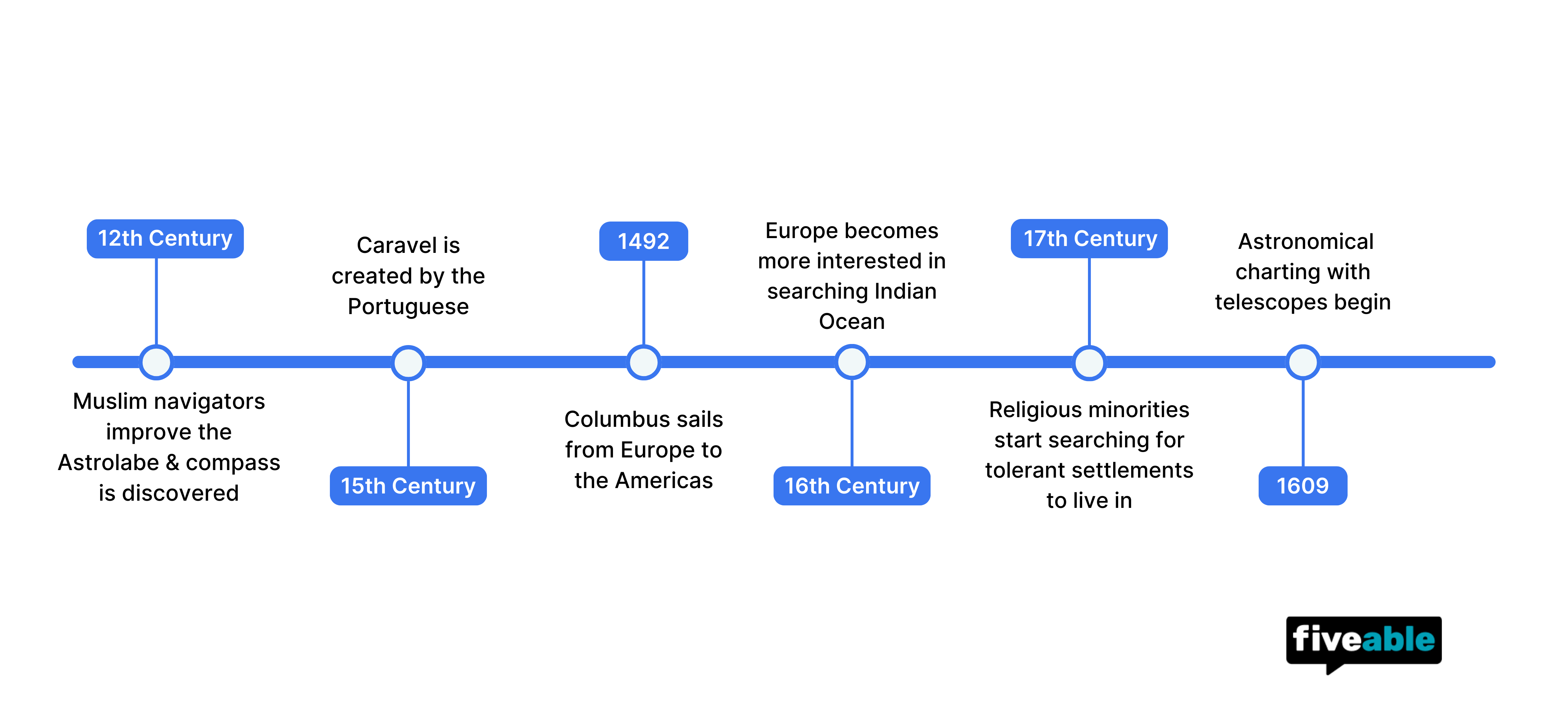
Timeline of key events in 1450-1750 (Image Courtesy of Tien)
Key Takeaways
- Population growth left some Europeans seeking work and food, while primogeniture pushed younger sons to look for land elsewhere and religious minorities sought tolerance.
- Europeans entered Indian Ocean trade seeking wealth and converts but faced resistance from Omani traders; Columbus's voyages also helped link Afro-Eurasia and the Americas through Atlantic trade.
- Transoceanic trade helped build maritime empires, while Europeans combined classical, Islamic, and Asian navigation knowledge; Prince Henry financed Portuguese expeditions along Africa's Atlantic coast.
- Better wind records helped sailors plan routes, the Chinese magnetic compass helped them steer, and the astrolabe improved by Muslim navigators helped them measure latitude.
- Arab lateen sails caught wind on either side, and pairing them with square sails expanded ocean routes; Portugal's maneuverable caravel handled storms better than earlier ships.
- Combined navigation techniques expanded exploration and global trade; Chinese gunpowder aided European conquests, and Peter the Great hired foreign technicians to strengthen Russia's military and navy.
Why Europeans Took to the Seas
Demographic pressure pushed Europeans toward exploration and trade. As Europe's population grew, not everyone could find work or even food, and the social system made things worse for some groups:
- Primogeniture laws gave the entire estate to the eldest son, so younger sons of wealthy families had no land and went looking for opportunity elsewhere.
- In the early 17th century, religious minorities searched for places that would tolerate their dissent.
- Others simply wanted adventure and glory.
People leaving home in search of work, food, land, tolerance, and adventure created a global shift in demographics. That's a pattern you'll see playing out across the rest of Unit 4.
The chapter opens with Alexander Neckham (1157-1217) describing sailors using a magnetized needle to find north when clouds or darkness hid the sun and stars. That quote is a snapshot of the whole topic: technology making the open ocean survivable.
Developments of Transoceanic Travel and Trade
Europe was never totally cut off from East and South Asia. Indian Ocean trade routes had long carried silk, spices, and tea to the Mediterranean via the Red Sea, and Islamic traders knew land routes from China to Baghdad, Constantinople, and on to Rome. What changed in the 16th century was that more Europeans entered the Indian Ocean directly, motivated by twin goals: wealth and new converts.
They didn't have it to themselves. Middle Eastern traders based in kingdoms such as Oman pushed back. The Portuguese set up forts in Oman but faced repeated attempts to remove them. This Omani-European rivalry showed how hard it was for Europeans to control Indian Ocean trade, which is why finding new sea routes to Asia mattered so much.
Columbus's voyages connected people across the Atlantic, and European traders became the go-betweens linking Afro-Eurasia and the Americas:
- From the Americas: sugar, tobacco, and rum
- From Africa: enslaved people
- From Asia: silk, spices, and rhubarb
This trade transformed Spain, Portugal, Great Britain, France, and Holland into maritime empires, empires based on sea travel rather than land. One detail worth remembering: in Southeast Asia, Europeans did most of their business with women, who traditionally handled markets and money-changing in those cultures.
Classical, Islamic, and Asian Technology
Portugal, Spain, and England built their naval technology on borrowed knowledge. They knew classical Greek traditions like navigating by the stars, then combined that with ideas from Islamic and Asian sailors and scholars, learned through trade-network contact. Al-Andalus, in what is now Spain, was a key place where Islamic ideas diffused into Europe.
The leading European figure here was Prince Henry the Navigator of Portugal. He never sailed far enough to lose sight of land himself, but he financed expeditions along Africa's Atlantic coast and around the Cape of Good Hope. His backing meant Portugal explored African coastal communities and kingdoms before any other European power.
Advances in Ideas
Better knowledge made ocean sailing safer:
- Newton's discovery of gravitation improved understanding of tides, so sailors could predict when falling water levels would expose dangerous rocks near shore.
- Increasingly accurate records of wind direction and intensity let sailors plan routes with confidence.
- Cartography (mapmaking) kept improving, along with knowledge of current and wind patterns.
An astronomical chart is any map of the stars and galaxies. Before the compass spread, mariners used these charts and the skies to figure out their location. Star charts go way back: Babylonian and Mesopotamian astronomers made them as early as the 2nd millennium B.C.E., Chinese charts date to the 5th century B.C.E., and classical Greek astronomers used them widely. Telescope-aided charting began in 1609 and was standard for mapping the stars by the end of the 17th century, with charts divided into grids to locate constellations.
Advances in Equipment
Several pieces of ship equipment made sailing safer and faster:
- A new type of rudder, imported from China, made ships more maneuverable.
- The astrolabe, improved by Muslim navigators in the 12th century, let sailors determine latitude, how far north or south of the equator they were.
- The magnetic compass, invented in China, let sailors steer in the right direction. It works because Earth acts as an enormous bar magnet whose field runs nearly parallel to the north-south axis, so a freely moving magnetized needle aligns with it. (Other compasses use a gyroscope or track the sun or a specific star.)
- The lateen sail, a triangular sail used by Arab sailors in the Indian Ocean, was pivotal. Old square sails only worked with the wind at your back. The lateen could catch wind on either side of the ship, allowing travel in different directions. Combining lateen and square sails let sailors enter open ocean successfully for the first time, expanding trade routes.
New Ship Designs
Builders adapted ships by adjusting length-to-width ratio, number of masts, and sail types. Know these three:
| Ship | Length | Sails/Masts | Purpose | Who Used It | When |
|---|---|---|---|---|---|
| Carrack | 150 feet | Square and lateen on 3-4 masts | Trade | Portugal | 14th to 17th centuries |
| Caravel | 75 feet | Lateen sails on 2 or 3 masts | Long voyages at great speed | Portuguese and Spanish | 15th to 17th centuries |
| Fluyt | 80 feet | Square on 2 or 3 masts | Trade | Dutch | 16th to 17th centuries |
The caravel, developed by the Portuguese in the 15th century, was small enough to maneuver well and could survive ocean storms better than earlier ship designs.
Long-Term Results
Combining European navigational techniques with those from the rest of the world produced a rapid expansion of exploration and global trade. About the only part of the world untouched was Polynesia, simply because it sat far from the trading routes.
A few more ripple effects from the chapter:
- Gunpowder, another Chinese invention, aided European conquests abroad. Pirates picked it up too, especially the Dutch pirates known as the Sea Beggars.
- In North Africa and the trading cities along Africa's east coast, Islam spread rapidly through the growth of the Baghdad-centered Abbasid Empire and the activities of Muslim merchants, and cross-cultural interaction brought extensive trade and new technology to the continent.
- Navigational techniques kept spreading through the 17th century. Russia's Tsar Peter the Great visited Western Europe in 1697 to observe military and naval technology, then hired technicians from Germany and elsewhere to build up Russia's military and naval power.
Notice the through-line: technology diffuses across cultures, and whoever adopts and combines it fastest gains an edge. That's the exact skill the AP exam wants you to argue with evidence.
Key Terms to Know
| Term | Why It Matters |
|---|---|
| Magnetic compass | Chinese invention (originally for fortune telling) that uses Earth's magnetic field to show direction, letting sailors steer accurately without sun or stars. |
| Astrolabe | Instrument improved by Muslim navigators in the 12th century that let sailors measure how far north or south of the equator they were. |
| Lateen sail | Triangular sail from Arab and Indian Ocean sailors that caught wind on either side of the ship, making true ocean travel possible when paired with square sails. |
| Caravel | Small (75-foot), fast Portuguese ship from the 15th century that handled ocean storms better than earlier designs. |
| Carrack | Larger (150-foot) Portuguese trade ship with square and lateen sails on 3-4 masts, used from the 14th to 17th centuries. |
| Fluyt | 80-foot Dutch trade ship with square sails, used in the 16th and 17th centuries. |
| Cartography | Mapmaking; improvements here, plus knowledge of winds and currents, made navigation far more reliable. |
| Astronomical chart | Any map of the stars and galaxies; mariners used these grids of the sky to find their location, especially before the compass. |
| Primogeniture laws | Laws giving an entire estate to the eldest son, leaving younger sons landless and motivated to seek fortune overseas. |
| Maritime empires | Sea-based empires (Spain, Portugal, Great Britain, France, Holland) built on transoceanic trade rather than land conquest. |
| Omani-European rivalry | Competition between Middle Eastern traders and Europeans (Portuguese forts in Oman were repeatedly challenged) that showed the limits of European control of Indian Ocean trade. |
| Prince Henry the Navigator | Portuguese ruler who financed expeditions along Africa's Atlantic coast, giving Portugal a head start in exploration. |
| Al-Andalus | Region in what is now Spain where Islamic ideas diffused into Europe. |
| Gunpowder | Chinese invention that aided European conquests abroad and armed pirates like the Dutch Sea Beggars. |
| Sea Beggars | Dutch pirates who turned gunpowder technology against the empires that spread it. |
| Peter the Great | Russian tsar who visited Western Europe in 1697 and hired foreign technicians to build Russia's military and naval power, showing technology was still diffusing in the 17th century. |
Practice and Next Steps
Topic 4.1 sets up everything else in Unit 4: the ships and instruments here are what make exploration, the Columbian Exchange, and maritime empires possible.
- Review the matching course-topic guide on Technological Innovations from 1450 to 1750 for the College Board framing of this material.
- Move on to AMSCO 4.2 Exploration: Causes and Events Notes to see how states put this technology to use, or browse the full set of AP World AMSCO notes.
- Test yourself with AP World guided practice questions, and look up any term you're shaky on in the AP World key terms glossary.
- When you're further into the unit, try FRQ practice with instant scoring to build your skills with continuity and change arguments about technology diffusion.
Frequently Asked Questions
What does AMSCO Topic 4.1 Technological Innovations cover?
AMSCO Topic 4.1 (p.191-198) covers the navigational technologies that made transoceanic travel possible from 1450 to 1750: the magnetic compass, astrolabe, lateen sail, and new ships like the caravel, carrack, and fluyt. It also explains why Europeans explored (primogeniture laws, religious minorities, demographic pressure) and how the resulting trade created maritime empires.
Did Europeans invent the compass, astrolabe, and lateen sail?
No, and that's the main point of Topic 4.1. The magnetic compass was invented in China (originally for fortune telling), the astrolabe was improved by Muslim navigators in the 12th century, and the lateen sail came from Arab sailors in the Indian Ocean. Europeans combined these borrowed technologies with classical Greek star navigation and their own innovations like the caravel.
What is the difference between a caravel, carrack, and fluyt?
The caravel (75 feet, lateen sails on 2-3 masts) was a fast Portuguese and Spanish ship built for long voyages. The carrack (150 feet, square and lateen sails on 3-4 masts) was a larger Portuguese trade ship used from the 14th to 17th centuries. The fluyt (80 feet, square sails) was a Dutch trade ship of the 16th and 17th centuries.
Why did Europeans start exploring the oceans in this period?
Demographic pressure was a big driver. Europe's growing population meant not everyone could find work or food, primogeniture laws left younger sons of wealthy families without land, and religious minorities in the early 17th century sought tolerant places to settle. Add the search for wealth, converts, and adventure, plus competition like the Omani-European rivalry that pushed Columbus to seek a new route to India.
How does Topic 4.1 show up on the AP World exam?
Topic 4.1 supports questions about how cross-cultural interactions diffused technology and changed trade and travel patterns from 1450 to 1750. Expect to use examples like the compass, astrolabe, lateen sail, and the caravel/carrack/fluyt as evidence in multiple-choice and essay questions. Practice applying them with Fiveable's AP World guided practice.
See Fiveable more often in Google
Mark Fiveable as a preferred source and Google is more likely to show you our guides in Top Stories, with a "preferred" badge in AI Mode and AI Overviews.