AMSCO 9.8 Institutions Developing in a Globalized World Notes

🌍AP World History: Modern Review
AMSCO 9.8 Institutions Developing in a Globalized World Notes
🌍 AP World History: Modern
AMSCO 1.1 Developments in East Asia Notes
AMSCO 1.2 Developments in Dar al-Islam Notes
AMSCO 1.3 Developments in South and Southeast Asia Notes
AMSCO 1.4 Developments in the Americas Notes
AMSCO 1.5 Developments in Africa Notes
AMSCO 1.6 Developments in Europe Notes
AMSCO 1.7 Comparison in the Period from c.1200 to c.1450 Notes
AMSCO 2.1 The Silk Roads Notes
AMSCO 2.2 The Mongol Empire and the Modern World Notes
AMSCO 2.3 Exchange in the Indian Ocean Notes
AMSCO 2.4 Trans-Saharan Trade Routes Notes
AMSCO 2.5 Cultural Consequences of Connectivity Notes
AMSCO 2.6 Environmental Consequences of Connectivity Notes
AMSCO 2.7 Comparison of Economic Exchange Notes
AMSCO 3.1 European, East Asian, and Gunpowder Empires Expand Notes
AMSCO 3.2 Empires: Administrations Notes
AMSCO 3.3 Empires: Belief Systems Notes
AMSCO 3.4 Comparison in Land-Based Empires Notes
AMSCO 4.1 Technological Innovations Notes
AMSCO 4.2 Exploration: Causes and Events Notes
AMSCO 4.3 Columbian Exchange Notes
AMSCO 4.4 Maritime Empires Link Regions Notes
AMSCO 4.5 Maritime Empires Develop Notes
AMSCO 4.6 Internal and External Challenges to State Power Notes
AMSCO 4.7 Changing Social Hierarchies Notes
AMSCO 4.8 Continuity and Change from c.1450 to c.1750 Notes
AMSCO 5.1 The Enlightment Notes
AMSCO 5.2 Nationalism and Revolutions Notes
AMSCO 5.3 Industrial Revolution Begins Notes
AMSCO 5.4 Industrialization Spreads Notes
AMSCO 5.5 Technology in the Industrial Age Notes
AMSCO 5.6 Industrialization: Government's Role Notes
AMSCO 5.7 Economic Developments and Innovations Notes
AMSCO 5.8 Reactions to the Industrial Economy Notes
AMSCO 5.9 Society and the Industrial Age Notes
AMSCO 5.10 Continuity and Change in the Industrial Age Notes
AMSCO 6.1 Rationales for Imperialism Notes
AMSCO 6.2 State Expansion Notes
AMSCO 6.3 Indigenous Responses to State Expansion Notes
AMSCO 6.4 Global Economic Development Notes
AMSCO 6.5 Economic Imperialism Notes
AMSCO 6.6 Causes of Migration in an Interconnected World Notes
AMSCO 6.7 Effects of Migration Notes
AMSCO 6.8 Causation in the Imperial Age Notes
AMSCO 7.1 Shifting Power Notes
AMSCO 7.2 Causes of World War I Notes
AMSCO 7.3 Conducting World War I Notes
AMSCO 7.4 Economy in the Interwar Period Notes
AMSCO 7.5 Unresolved Tensions After World War I Notes
AMSCO 7.6 Causes of World War II Notes
AMSCO 7.7 Conducting World War II Notes
AMSCO 7.8 Mass Atrocities Notes
AMSCO 7.9 Causation in Global Conflict Notes
AMSCO 8.1 Setting the Stage for the Cold War and Decolonization Notes
AMSCO 8.2 The Cold War Notes
AMSCO 8.3 Effects of the Cold War Notes
AMSCO 8.4 Spread of Communism Notes
AMSCO 8.5 Decolonization after 1900 Notes
AMSCO 8.6 Newly Independent States Notes
AMSCO 8.7 Global Resistance to Established Power Structure Notes
AMSCO 8.8 End of the Cold War Notes
AMSCO 8.9 Causation in the Age of the Cold Ward and Decolonization Notes
AMSCO 9.1 Advances in Technology and Exchange Notes
AMSCO 9.2 Technological Advancements and Limitations Notes
AMSCO 9.3 Technology and the Environment Notes
AMSCO 9.4 Economics in the Global Age Notes
AMSCO 9.5 Calls for Reforms and Responses Notes
AMSCO 9.6 Globalized Culture Notes
AMSCO 9.7 Resistance to Globalization Notes
AMSCO 9.8 Institutions Developing in a Globalized World Notes
AMSCO 9.9 Continuity and Change in a Globalized World Notes
Overview
AMSCO Topic 9.8, Institutions Developing in a Globalized World (AMSCO p.696-702), covers how globalization changed international interactions among states, focusing on the United Nations and the global organizations built around it after World War II. The chapter explains the UN's six main bodies, the Universal Declaration of Human Rights, peacekeeping missions, and financial institutions like the World Bank and IMF. This topic sits near the end of Unit 9 (1900 to present), connecting the postwar push for cooperation to the globalized world you studied in Topic 9.7 on resistance to globalization.
The big idea: after two world wars, nations built international institutions with the stated goal of maintaining world peace and making cooperation easier. Whether those institutions actually deliver is exactly the kind of evaluation question the AP exam loves.
Key Takeaways
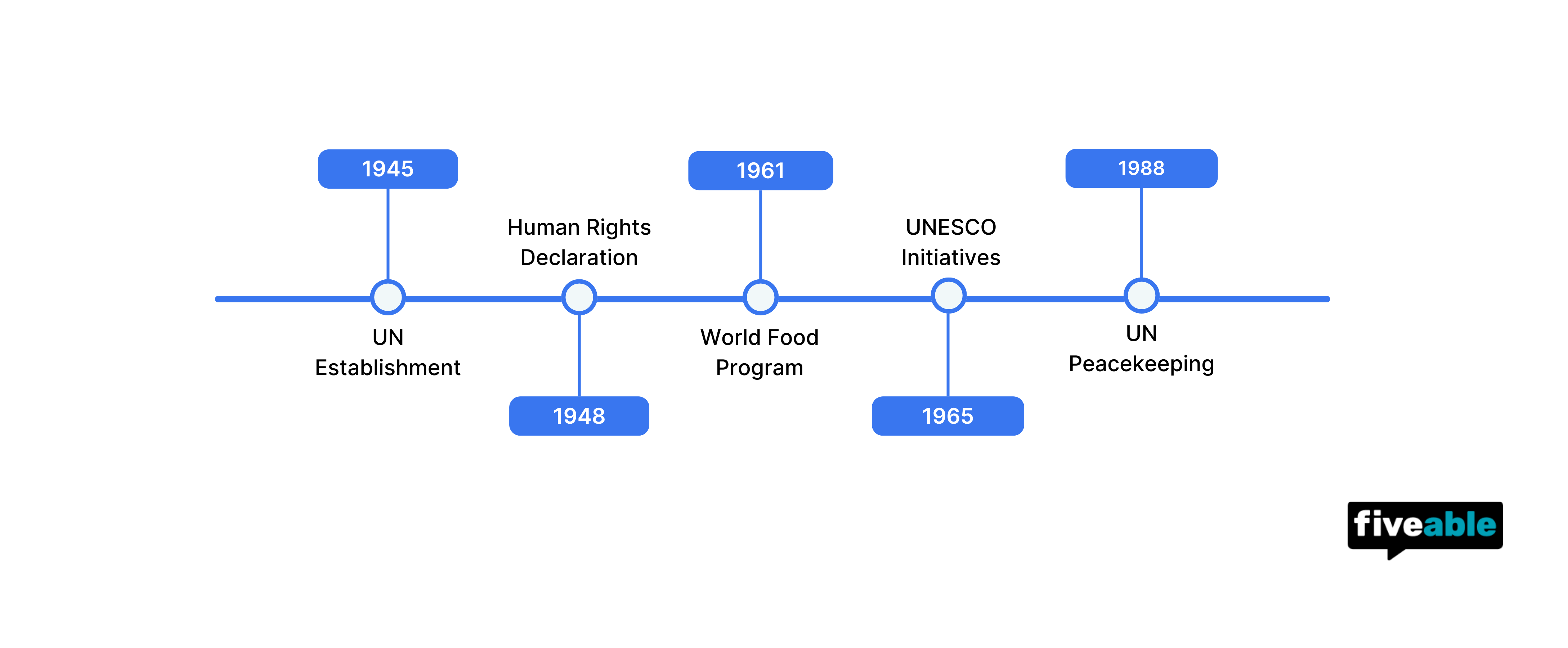
- Founded in 1945, the UN pursued the League of Nations' goal of preventing another world war; the League had failed without U.S. membership or real power.
- Each UN member has one General Assembly vote, while the Security Council has five permanent members whose vetoes can block UN action.
- The 1948 Universal Declaration of Human Rights set standards that include freedom of expression, and the UN has investigated abuses such as genocide.
- Peacekeepers helped end civil wars in Mozambique, El Salvador, and Cambodia, but could not prevent massacres in Rwanda; slow deployment can let conflicts grow too large to control.
- Beyond peacekeeping, the UN aids refugees, protects cultural and environmental sites through UNESCO, and set Global Goals addressing poverty and climate change.
- The World Bank lends to fight poverty, while the IMF offers short-term loans to stabilize currencies; critics say IMF loan conditions can ignore countries' needs.
The United Nations: A Structure for Peace
The United Nations was born on October 24, 1945, a date still honored as United Nations Day. Representatives of the United States, Great Britain, the Soviet Union, and China first discussed the idea in 1943, while World War II was still raging. Despite their ideological differences, the Allies shared one commitment: stop conflicts from escalating into another world war.
- At its founding, the UN had 51 member states. By 2019, membership had grown to 193.
- The UN Charter's preamble promised "to save succeeding generations from the scourge of war, which twice in our life-time has brought untold sorrow to mankind."
- Through agencies like the IMF and World Bank, the UN provides technical advice and loans to developing nations. Other organizations like the WTO and GATT promote free trade worldwide.
Why the UN succeeded where the League of Nations failed
The League of Nations, created in 1920 after World War I, had the same basic purpose: resolve international disputes and prevent another world war. It failed for two big reasons. First, the United States never joined, since some Americans feared membership would undercut U.S. authority. Second, it had no real power, and it disbanded after failing to prevent World War II. The UN's founders learned the lesson. This time, all the major powers agreed they needed to belong for the organization to have any chance of success.
The Six Main Bodies of the UN
Six main bodies carry out the UN's work. Know what each one does, because the structure explains both the UN's strengths and its limits.
- The General Assembly is the only UN body where all members have representation. Each member nation gets one vote, and decisions on peace and security, admitting new members, and the budget require a two-thirds majority of those present and voting.
- The Security Council acts on issues the General Assembly debates, and it can even authorize military force against a country accused of violating UN principles. It has five permanent members (the leading WWII Allies: the United States, France, Great Britain, Russia, and China) plus 10 rotating elected members. Each permanent member holds veto power. That veto was controversial from the start in 1945, and conflicts among the five often blocked UN action entirely.
- The Secretariat is the administrative arm, led by the secretary-general, who usually comes from a small, neutral nation so no great power dominates the organization. All five permanent Security Council members must approve the selection. Secretariat staffers swear loyalty to the UN and cannot take instructions from their home countries.
- The International Court of Justice settles disputes about international law that countries bring to it. It has no enforcement power, but the Security Council can act on its judgments, and most countries obey its decisions anyway.
- The Economic and Social Council is the largest and most complex part of the UN. It directs economic, social, humanitarian, and cultural activities, including promoting green energy and raising wages in poorer countries in the early 21st century.
- The Trusteeship Council supervised trust territories (including land that is now Israel, Papua New Guinea, and Nauru) on their path to self-government. When Palau, the last trust territory, became independent in 1994, the council suspended operations. Some have suggested it could become trustee of the seafloor or outer space.
Human Rights and the Universal Declaration
In 1948, the UN adopted the Universal Declaration of Human Rights, a milestone document setting standards for all governments and all people. Drafters came from different countries, cultures, and legal traditions, and the declaration has been translated into more than 500 languages.
Rights it includes:
- Freedom from slavery, torture, and degrading punishment
- Equality before the law and the right to a nationality
- The right to own property, individually or with others
- Freedom of thought, conscience, religion, opinion, and expression
- Equal pay for equal work, plus the right to rest and paid holidays
- Equal rights for children born within and outside of marriage
- The right to adequate food, clothing, shelter, health care, and education
Since 1948, the UN has investigated abuses such as genocide, war crimes, government oppression, and crimes against women.
UN Peacekeeping: Successes and Failures
Peacekeeping is what the UN is best known for since World War II. Prevention through diplomacy comes first, with special envoys sent to resolve problems peacefully. When that's not enough, the UN sends peacekeeping forces made up of civilians, police, and troops from member countries. The soldiers are usually lightly armed and instructed to return fire only if attacked.
- The first peacekeeping mission responded to the 1948 Arab-Israeli conflict in Palestine. Later missions went to the Congo, Lebanon, East Timor, and the Balkans.
- Peacekeeping exploded in the 1990s. In 1988 the UN had only 5 active operations; by 1993 it had 28, with soldiers from dozens of countries including Canada, Venezuela, Ukraine, Egypt, and Bangladesh.
1990s missions to know
- Successes: UN troops kept peace while Namibia transitioned from South African colony to independent state. Peacekeepers helped end civil wars in Mozambique, El Salvador, and Cambodia, and in Haiti they maintained order while a democratic government replaced a military dictatorship.
- Failures: In 1994, peacekeepers could not prevent the massacres in Rwanda. In 1995, UN forces withdrew from Somalia while civil war raged. Bosnia took years and produced mixed results. As one UN officer in Bosnia put it, "It's much easier to come in and keep peace when there's some peace around."
Why peacekeeping struggles
Two recurring problems. First, slow response: by the time member countries agree on a mission and send forces, the war may have grown too big to control. Second, mismatched expectations: people expect peacekeepers to stop the fighting, but their actual job is monitoring truces, running free elections, and supplying civilians. By 2019, the UN ran fewer but larger missions: down to 15 operations, but with more total troops.
Other UN Priorities: Refugees, Food, Culture, Health
The UN's mission goes well beyond peacekeeping.
- Refugees. Working with NGOs and the UNHCR (United Nations High Commissioner for Refugees), the UN provides food, medicine, and temporary shelter to people fleeing war, famine, and disasters. Among the earliest refugees it helped were Palestinians displaced after the 1948 UN partition of Palestine created Israel. In 2019, the UN aided refugees from Venezuela and Myanmar.
- World Food Program (WFP). Established in 1961, with first missions in Iran, Thailand, and Algeria in 1962. It has fed more than 1.4 billion people affected by natural disasters or political unrest.
- UNESCO. Created in 1945 to repair WWII damage to schools, libraries, and museums, then shifted to developing literacy, extending free education, and protecting cultural and environmental sites as World Heritage Sites. The UK, Singapore, Israel, and the U.S. all left UNESCO over politics and priorities; the UK and Singapore rejoined, but as of 2019 the U.S. had not.
- World Health Organization (WHO) controls epidemics and provides vaccines. UNICEF was created to help children after WWII, then expanded to aid children in the developing world and at disaster sites. Human Rights Watch (HRW) monitors abuses in 100 countries, using the Universal Declaration of Human Rights as its guide.
- The Global Goals. In 2015, the General Assembly set 17 goals to accomplish by 2030, including ending hunger and poverty, achieving gender equality, ensuring clean water and sanitation, and fighting climate change. The UN partnered with NGOs like the Bill and Melinda Gates Foundation.
Financial Institutions and Independent NGOs
Several financial NGOs work closely with the UN on economic issues. Each is independent, and each draws criticism. This is great evidence for any essay weighing globalization's costs and benefits, a theme that continues in Topic 9.9 on continuity and change in a globalized world.
- World Bank (created 1944) fights poverty with loans to countries. It first funded dams and roads, then expanded to social projects like education and disease prevention. Critics say it ignores how projects damage the environment and local culture: a dam might permanently flood farms, or a highway's profits might flow to overseas investors instead of locals.
- International Monetary Fund (IMF) (created 1945) promotes stable currency exchange rates through short-term loans and economic advice. Critics argue its loan conditions ignore each country's individual needs and that wealthy nations steer it for their own benefit while it claims to help developing nations.
- Together, the IMF and World Bank produced the 2018 report Pathways for Peace on preventing violent conflicts.
- International Peace Bureau, founded in 1891, operates entirely separate from the UN. It won the Nobel Peace Prize in 1910, began working for nuclear disarmament in the 1980s, and lobbies governments to cut military spending. By 2019, it had 300 member organizations in 70 countries.
Key Terms to Know
| Term | Why it matters |
|---|---|
| United Nations (UN) | International organization founded in 1945 to maintain world peace and facilitate cooperation; grew from 51 members to 193. |
| General Assembly | The only UN body where every member state has one equal vote; decides peace, membership, and budget questions by two-thirds majority. |
| Security Council | The UN's action arm, with five veto-holding permanent members (U.S., France, Great Britain, Russia, China) plus 10 rotating members. |
| Secretariat | The UN's administrative arm; its staffers serve the UN, not their home governments. |
| Secretary-general | Leader of the UN, usually from a small, neutral nation and approved by all five permanent Security Council members. |
| International Court of Justice | Settles international law disputes; no enforcement power, but most countries obey its rulings. |
| Economic and Social Council | The largest, most complex UN body, directing economic, social, humanitarian, and cultural work. |
| Trusteeship Council | Guided trust territories to independence; suspended after Palau became independent in 1994. |
| Universal Declaration of Human Rights | The 1948 milestone document setting human rights standards for all governments, translated into 500+ languages. |
| Peacekeeping action | UN missions of lightly armed troops, police, and civilians that monitor truces and support elections in conflict zones. |
| World Bank | Created in 1944 to fight poverty with loans; criticized for environmental and cultural damage from its projects. |
| International Monetary Fund (IMF) | Created in 1945 to stabilize currency exchange rates with short-term loans; criticized for one-size-fits-all loan conditions. |
| World Food Program (WFP) | UN food aid agency founded in 1961 that has fed more than 1.4 billion people. |
| UNESCO | UN agency for education, science, and culture; designates World Heritage Sites. |
| Human Rights Watch | Monitors human rights abuses in 100 countries using the Universal Declaration as its guide. |
| International Peace Bureau | An NGO independent of the UN, founded in 1891, that pushes nuclear disarmament and lower military spending. |
Practice and Next Steps
Once you have these notes down, check the Topic 9.8 course study guide for the College Board's framing of how globalization changed international interactions among states, and browse the full set of Unit 9 AMSCO notes to see how this topic connects to the rest of the unit.
To test yourself:
- Run through guided MCQ practice on Unit 9 to see how the UN and international institutions show up in multiple choice.
- Try FRQ practice with instant scoring using globalization-era prompts, since the costs and benefits of international institutions make strong evaluative essay material.
- Look up any term that's still fuzzy in the AP World key terms glossary.
Frequently Asked Questions
What is AMSCO Topic 9.8 about in AP World?
AMSCO Topic 9.8, Institutions Developing in a Globalized World (p.696-702), covers the international organizations created to maintain peace and ease cooperation after World War II. It focuses on the United Nations and its six main bodies, the Universal Declaration of Human Rights, peacekeeping missions, and financial institutions like the World Bank and IMF.
What are the six main bodies of the United Nations?
The six main UN bodies are the General Assembly (all members, one vote each), the Security Council (five permanent veto-holding members plus 10 rotating members), the Secretariat (administration, led by the secretary-general), the International Court of Justice, the Economic and Social Council, and the Trusteeship Council, which suspended operations after Palau became independent in 1994.
Why did the United Nations succeed where the League of Nations failed?
The League of Nations, created in 1920, failed largely because the United States never joined and it lacked real power, so it couldn't prevent World War II. When the UN formed in 1945, all the major powers agreed they had to belong for it to work, and the Security Council was given the authority to act, including using military force.
What is the difference between the World Bank and the IMF?
The World Bank, created in 1944, fights poverty with loans for projects like dams, roads, education, and disease prevention. The IMF, created in 1945, promotes stable currency exchange rates through short-term loans and economic advice. Both are criticized: the World Bank for environmental and cultural damage, the IMF for loan conditions that ignore individual countries' needs.
How does Topic 9.8 show up on the AP World exam?
Topic 9.8 supports the skill of explaining how and why globalization changed international interactions among states, so expect questions weighing whether institutions like the UN actually maintained peace. UN peacekeeping successes (Namibia, Cambodia) versus failures (Rwanda, Somalia) make strong essay evidence. You can practice applying this with FRQ practice and instant scoring.
See Fiveable more often in Google
Mark Fiveable as a preferred source and Google is more likely to show you our guides in Top Stories, with a "preferred" badge in AI Mode and AI Overviews.